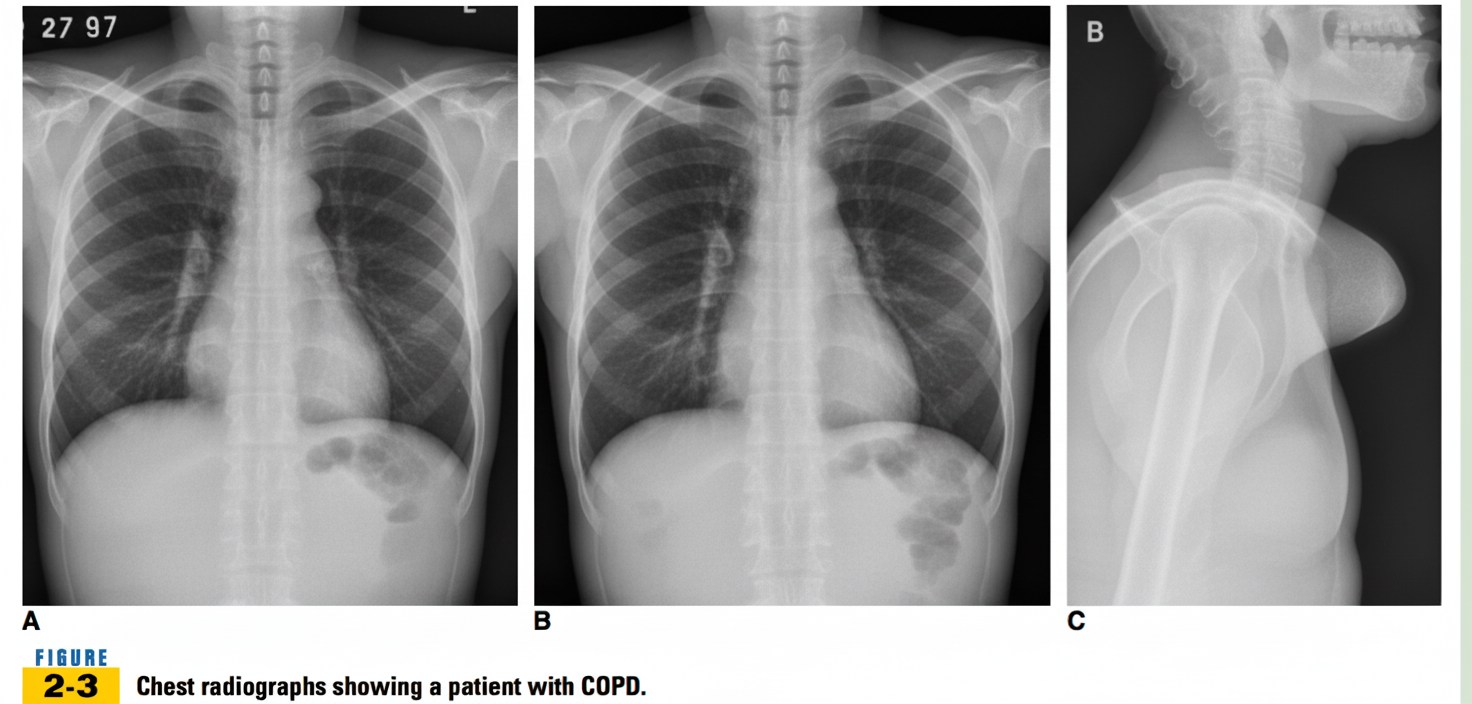
A young male presents with cough. The provided chest X-ray shows no known cardiac abnormality. Which of the following is most likely to be true about the patient?

Westermark sign is seen in which condition?
Which condition is characterized by the "air crescent" sign?
Mounier-Kuhn syndrome is characterized on imaging by which finding?
All of the following statements about Pneumococcal Pneumonia are true, except?
What is the earliest chest X-ray finding in cystic fibrosis?
Obliteration of the right cardiac silhouette on a chest X-ray suggests pathology involving which of the following structures?
A chest X-ray shows a homogenous opacity on the right side with a shift of the mediastinum to the opposite side. What is the most probable diagnosis?
What is the earliest feature of pulmonary venous hypertension?
On a chest X-ray in PA view, which of the following is NOT typically seen on the right side of the cardiac shadow?
Explanation: ***The patient is likely to be immunocompromised.*** - The chest X-ray likely shows **bilateral perihilar interstitial infiltrates** with a **normal cardiac silhouette**, which is classic for **PCP (Pneumocystis jirovecii pneumonia)**. - PCP is an **opportunistic infection** that predominantly affects **immunocompromised patients**, particularly those with **HIV/AIDS** or other causes of severe immunosuppression. *Raised ACE levels are likely.* - Elevated **ACE levels** are typically associated with **sarcoidosis**, which would show bilateral hilar lymphadenopathy rather than interstitial infiltrates. - The **normal cardiac silhouette** and clinical presentation do not support sarcoidosis as the primary diagnosis. *Cold agglutinins will be positive.* - **Cold agglutinins** are characteristic of **Mycoplasma pneumoniae** infection, which typically causes unilateral lower lobe pneumonia. - The bilateral perihilar pattern seen here is not consistent with **typical Mycoplasma pneumonia** presentation. *Occupational history will provide an important clue to the diagnosis.* - **Occupational lung diseases** like **pneumoconiosis** typically develop over years of exposure and show different radiological patterns. - The acute presentation with cough and bilateral perihilar infiltrates is more consistent with an **infectious process** rather than occupational lung disease.
Explanation: **Explanation:** **Westermark sign** is a classic, though infrequent, radiographic finding in **Pulmonary Embolism (PE)**. It refers to a focal area of increased lucency (hyperlucency) on a chest X-ray, caused by **oligemia** (reduced blood flow) distal to the occluded pulmonary artery. The lack of blood flow leads to a reduction in the caliber of peripheral vessels, making that segment of the lung appear darker than the surrounding tissue. **Analysis of Options:** * **Pulmonary Embolism (Correct):** In addition to Westermark sign, other X-ray signs include **Hampton’s Hump** (a wedge-shaped opacity representing pulmonary infarction) and **Palla’s sign** (enlarged right descending pulmonary artery). * **Pulmonary Sequestration:** This is a congenital anomaly where a segment of lung tissue lacks communication with the tracheobronchial tree and receives systemic arterial supply. It typically appears as a solid mass or cystic lesion, not focal oligemia. * **Pulmonary Alveolar Proteinosis:** Characterized by the accumulation of surfactant in alveoli. The classic radiographic finding is a **"Bat-wing" appearance** or "Crazy paving" pattern on CT. * **Pneumothorax:** While this also shows hyperlucency, it is characterized by the **absence of lung markings** and a visible visceral pleural line, rather than just reduced vessel caliber. **NEET-PG High-Yield Pearls:** * **Gold Standard Investigation for PE:** CT Pulmonary Angiography (CTPA). * **Most Common X-ray finding in PE:** A normal chest X-ray is the most common finding; however, **atelectasis** is the most common abnormality seen. * **ECG in PE:** Most common finding is **Sinus Tachycardia**; most specific is the **S1Q3T3 pattern**.
Explanation: The **Air Crescent Sign** is a classic radiological finding characterized by a crescent-shaped radiolucency (air) separating a central mass from the wall of a cavity. ### **Explanation of the Correct Answer** **B. Aspergillosis:** This sign is most characteristically associated with two stages of pulmonary aspergillosis: 1. **Angioinvasive Aspergillosis:** In immunocompromised patients, the sign appears during the recovery phase (as neutrophils return). It represents the infarction and necrosis of lung tissue, where air fills the space between the devitalized sequestrum and the surrounding parenchyma. Its appearance is a **good prognostic sign** indicating marrow recovery. 2. **Aspergilloma (Mycetoma):** In pre-existing cavities (e.g., old TB), a fungal ball forms. The air crescent represents the residual space between the fungus ball and the cavity wall. Unlike the invasive form, this mass is often **mobile** when the patient changes position. ### **Analysis of Incorrect Options** * **A. Hydatid Cyst:** While it can show similar signs, the specific findings are the **"Water-lily sign"** (endocyst rupture) or the **"Monod sign"** (air between the pericyst and exocyst). * **C. Tuberculosis Cavity:** While TB provides the cavity where an aspergilloma might grow, the simple TB cavity itself is usually just a thick-walled, air-filled lucency without a central mass. * **D. Amoebic Liver Abscess:** This typically presents on a chest X-ray as an elevated right hemidiaphragm or sympathetic pleural effusion, not an air crescent. ### **NEET-PG High-Yield Pearls** * **Monod Sign:** Often used interchangeably with the air crescent sign in the context of a mycetoma. * **Reverse Halo Sign:** Associated with Mucormycosis or Organizing Pneumonia. * **Finger-in-glove Sign:** Classic for Allergic Bronchopulmonary Aspergillosis (ABPA). * **Halo Sign:** An early sign of Angioinvasive Aspergillosis (ground-glass opacity surrounding a nodule representing hemorrhage).
Explanation: **Explanation:** **Mounier-Kuhn Syndrome**, also known as **Tracheobronchomegaly**, is a rare clinical entity characterized by marked dilation of the trachea and mainstem bronchi. The underlying pathophysiology involves the atrophy or absence of elastic fibers and smooth muscle within the tracheobronchial wall, leading to redundant, flaccid airways that collapse during expiration (tracheobronchomalacia). **Why Option B is correct:** On imaging (CT Chest), the diagnosis is confirmed when the transverse or anteroposterior diameter of the trachea exceeds **30 mm** (measured 2 cm above the aortic arch). The right and left mainstem bronchi are also dilated (>20 mm and >18 mm, respectively). A classic sign is the presence of **tracheal diverticulosis**, where the redundant mucosa herniates through the weakened muscular wall. **Why other options are incorrect:** * **A. Tracheal stenosis:** This refers to narrowing of the airway (e.g., post-intubation or Wegener’s), which is the opposite of the dilation seen in Mounier-Kuhn. * **C. Tracheal erosions:** These are typically seen in malignancy or chronic irritation (e.g., tracheostomy tubes) and are not a feature of this congenital connective tissue disorder. * **D. Sabre sheath trachea:** This refers to a trachea with a narrow transverse diameter and an increased AP diameter (ratio >2:1), characteristically associated with **COPD**, not Mounier-Kuhn. **High-Yield Clinical Pearls for NEET-PG:** * **Clinical Presentation:** Recurrent lower respiratory tract infections and bronchiectasis due to ineffective cough and impaired mucociliary clearance. * **Dynamic Imaging:** Expiratory CT is the gold standard to demonstrate dynamic airway collapse. * **Associations:** Often linked with Ehlers-Danlos syndrome or Marfan syndrome.
Explanation: **Explanation:** Pneumococcal pneumonia, caused by *Streptococcus pneumoniae*, is the classic prototype of **Lobar Pneumonia**. **1. Why Option A is the "Except" (Correct Answer):** The question asks for the false statement. Option A is technically **true** regarding the pathology, but in the context of this specific question's construction, it is often used to test the distinction between Lobar and Bronchopneumonia. *Streptococcus pneumoniae* typically causes **Non-segmental consolidation**. It starts peripherally and spreads across segmental boundaries via the **Pores of Kohn** and **Channels of Lambert** until it involves the entire lobe. Therefore, it does not respect segments (non-segmental), unlike bronchopneumonia which is segmental. *Note: If the option intended to say "Segmental Consolidation," it would be the false statement. In standard radiology, Pneumococcal pneumonia is defined by its non-segmental spread.* **2. Analysis of other options:** * **Option B (Air Bronchogram Absent):** This is the **False statement** (and thus the intended answer in many versions of this MCQ). In lobar consolidation, the alveoli are filled with exudate while the bronchi remain patent. This creates the classic **Air Bronchogram sign**. Therefore, saying it is "absent" is incorrect. * **Option C (Usually confined to one lobe):** True. It typically presents as a homogenous opacity involving a single lobe (Lobar Pneumonia). * **Option D (Cavitation is rare):** True. *S. pneumoniae* (Type 3) can occasionally cause necrosis, but cavitation is highly characteristic of *Staphylococcus aureus* or *Klebsiella*, not typical Pneumococcus. **Clinical Pearls for NEET-PG:** * **Classic Sign:** Air Bronchogram (patent airway amidst fluid-filled alveoli). * **Bulging Fissure Sign:** Classically associated with *Klebsiella pneumoniae* due to heavy inflammatory exudate. * **Rust-colored sputum:** Pathognomonic clinical finding for Pneumococcal pneumonia. * **Round Pneumonia:** A common presentation of Pneumococcal pneumonia in children.
Explanation: **Explanation:** Cystic Fibrosis (CF) is a multisystem disorder characterized by thick, viscous secretions. In the lungs, these secretions lead to small airway obstruction and air trapping long before structural damage occurs. **1. Why Hyperinflation is the correct answer:** The earliest radiological manifestation of CF is **hyperinflation**. This occurs due to the "ball-valve" effect, where thick mucus plugs allow air to enter during inspiration but prevent it from exiting during expiration. On a chest X-ray, this is visualized as flattened diaphragms, an increased retrosternal clear space, and horizontal ribs. **2. Analysis of Incorrect Options:** * **Ring shadows:** These represent thickened bronchial walls seen end-on or dilated bronchi (bronchiectasis). While classic for CF, they indicate established structural damage and appear later than hyperinflation. * **Marked increase in bronchovascular markings:** This is a non-specific finding often associated with chronic bronchitis or early inflammation, but it typically follows the initial phase of air trapping. * **Prominent right descending pulmonary artery:** This is a sign of **pulmonary hypertension**, which is a late-stage complication of CF resulting from chronic hypoxia and cor pulmonale. **3. NEET-PG High-Yield Pearls:** * **Earliest Sign:** Hyperinflation. * **Most Common Pattern:** Bronchiectasis, typically involving the **upper lobes** (unlike idiopathic bronchiectasis, which often affects the lower lobes). * **Finger-in-glove sign:** Represents mucoid impaction in dilated bronchi. * **Gold Standard Diagnosis:** Sweat Chloride Test (>60 mEq/L). * **Common Pathogens:** *Staphylococcus aureus* (early childhood) and *Pseudomonas aeruginosa* (most common in adults).
Explanation: This question tests the concept of the **Silhouette Sign**, a fundamental principle in chest radiology. ### **The Concept: Silhouette Sign** The silhouette sign occurs when two structures of similar radiographic density (e.g., soft tissue and fluid/consolidation) are in direct anatomical contact. This results in the loss of the distinct border or "silhouette" between them. 1. **Why Right Middle Lobe (RML) is correct:** Anatomically, the RML lies anteriorly and is in direct contact with the **right heart border (Right Atrium)**. Therefore, any pathology that increases the density of the RML (like pneumonia or collapse) will obliterate the right heart border. 2. **Why Right Lower Lobe (RLL) is incorrect:** The RLL is located posteriorly. It does not touch the heart border but sits on the diaphragm. Pathology in the RLL obliterates the **right hemidiaphragm** but leaves the heart border visible. 3. **Why Right Atrium/Ventricle are incorrect:** These are the structures that *form* the silhouette, not the lung segments causing the obliteration. The right heart border is formed by the right atrium, while the right ventricle is an anterior structure that does not form a border on a standard PA view. ### **High-Yield Clinical Pearls for NEET-PG** * **Right Heart Border:** Obliterated by **Right Middle Lobe** lesions. * **Right Hemidiaphragm:** Obliterated by **Right Lower Lobe** lesions. * **Left Heart Border:** Obliterated by **Lingula** (Left Upper Lobe) lesions. * **Left Hemidiaphragm:** Obliterated by **Left Lower Lobe** lesions. * **Aortic Knuckle:** Obliterated by **Left Upper Lobe (Posterior segment)** or mediastinal masses. * **Descending Aorta:** Obliterated by **Left Lower Lobe** lesions.
Explanation: ### Explanation The key to solving chest radiology questions in NEET-PG lies in identifying the **opacity** and the **position of the mediastinum**. **1. Why Pleural Effusion is Correct:** A large pleural effusion presents as a **homogenous opacity** (radiopacity) because fluid absorbs more X-rays than air-filled lung tissue. Since fluid occupies space in the pleural cavity, it exerts **positive pressure**, pushing the mobile mediastinal structures (like the trachea and heart) toward the **opposite (contralateral) side**. The classic radiological sign is the obliteration of costophrenic angles and a meniscus sign. **2. Analysis of Incorrect Options:** * **Collapse (A):** While it also shows a homogenous opacity, collapse involves a loss of lung volume. This creates negative pressure, **pulling** the mediastinum toward the **same (ipsilateral) side**. * **Pneumothorax (C):** This presents as an area of **hyperlucency** (increased blackness) due to air in the pleural space, not an opacity. While it can shift the mediastinum to the opposite side (Tension Pneumothorax), the density description does not match. * **Consolidation (D):** This appears as an ill-defined opacity (often with air bronchograms). Crucially, consolidation does not typically exert mass effect, so the **mediastinum remains central**. **3. NEET-PG High-Yield Pearls:** * **Shift to Same Side:** Collapse, Pneumonectomy, Agenesis. * **Shift to Opposite Side:** Large Pleural Effusion, Tension Pneumothorax, Large Diaphragmatic Hernia. * **No Shift:** Consolidation, Pulmonary Infarction, Small Effusion/Collapse. * **Meniscus Sign:** Characteristic of a moderate pleural effusion on an erect CXR.
Explanation: **Explanation:** Pulmonary venous hypertension (PVH) is most commonly caused by left-sided heart failure or mitral valve disease. The progression of PVH follows a predictable sequence on chest X-ray based on the Pulmonary Capillary Wedge Pressure (PCWP). **1. Why "Upper lobar diversion" is correct:** Also known as **Cephalization** or the **Antler sign**, this is the **earliest** radiological sign of PVH, occurring when PCWP rises to **10–15 mmHg**. In a normal upright individual, lower lobe vessels are more prominent due to gravity. In PVH, interstitial edema causes perivascular pressure to rise, leading to the constriction of lower lobe vessels and a compensatory shunting of blood to the upper lobes. **2. Analysis of Incorrect Options:** * **Kerley B lines:** These represent thickening of the interlobular septa due to fluid. They indicate **interstitial edema** and typically appear when PCWP reaches **15–20 mmHg**. This is a later stage than cephalization. * **Left atrial enlargement:** While often present in chronic conditions like mitral stenosis, it is a sign of the *underlying cause* rather than a feature of pulmonary venous hypertension itself. * **Pleural effusion:** This occurs during the **alveolar edema** stage when PCWP exceeds **25 mmHg**. It is a late finding. **High-Yield Clinical Pearls for NEET-PG:** * **Stages of PVH:** 1. **Stage 1 (Redistribution):** PCWP 10-15 mmHg → Cephalization. 2. **Stage 2 (Interstitial Edema):** PCWP 15-25 mmHg → Kerley lines, Peribronchial cuffing, Hazy hila. 3. **Stage 3 (Alveolar Edema):** PCWP >25 mmHg → Bat-wing appearance, Pleural effusion. * **Kerley B lines** are best seen at the **costophrenic angles** (perpendicular to the pleura).
Explanation: To master chest X-ray interpretation for NEET-PG, one must understand the anatomical structures forming the cardiac borders in a Posteroanterior (PA) view. ### **Explanation of the Correct Answer** The **Ascending Aorta** is typically a midline structure and does not form the right heart border in a normal chest X-ray. It is situated behind the sternum. The right border of the mediastinum above the heart is formed by the Superior Vena Cava (SVC). The ascending aorta only becomes visible on the right side in cases of **aneurysmal dilatation** or **aortic ectasia** (common in the elderly or hypertensive patients). ### **Analysis of Incorrect Options** * **Superior Vena Cava (A):** Forms the straight upper part of the right mediastinal border above the right atrium. * **Right Atrium (B):** Forms the primary convex lower part of the right cardiac border. * **Inferior Vena Cava (D):** May be seen as a small vertical shadow at the cardiophrenic angle (the junction of the right atrium and the diaphragm), especially during deep inspiration. ### **High-Yield Clinical Pearls for NEET-PG** * **Left Cardiac Border:** Formed by the Left Subclavian Artery, Aortic Arch (Aortic Knuckle), Pulmonary Trunk, Left Auricle, and Left Ventricle. * **Right Ventricle:** It is the most anterior chamber of the heart and **does not** form any border on a PA view; it is best visualized on a Lateral view (forming the anterior border). * **Left Atrium:** It is the most posterior chamber and does not form a border on a normal PA view. If enlarged, it may create a "Double Atrial Shadow" on the right side.
Normal Chest Radiographic Anatomy
Practice Questions
Radiographic Signs in Chest Imaging
Practice Questions
Pulmonary Infections
Practice Questions
Chronic Obstructive Pulmonary Disease
Practice Questions
Interstitial Lung Diseases
Practice Questions
Pulmonary Neoplasms
Practice Questions
Pleural Diseases
Practice Questions
Mediastinal Pathology
Practice Questions
Congenital and Developmental Chest Anomalies
Practice Questions
Pulmonary Vascular Diseases
Practice Questions
Chest Trauma Imaging
Practice Questions
Post-Surgical Chest Imaging
Practice Questions
Get full access to all questions, explanations, and performance tracking.
Start For Free