Which of the following can cause rib notching, except?
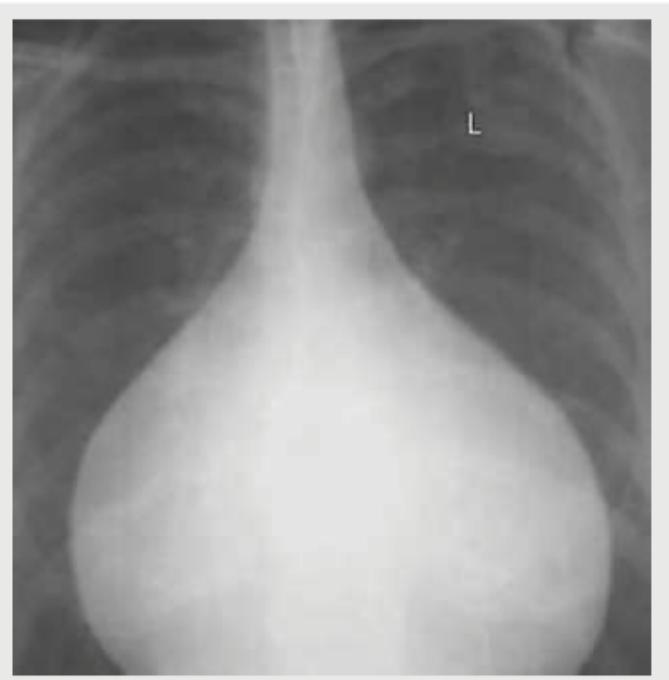
'Batwing' appearance on X-ray chest is seen in:
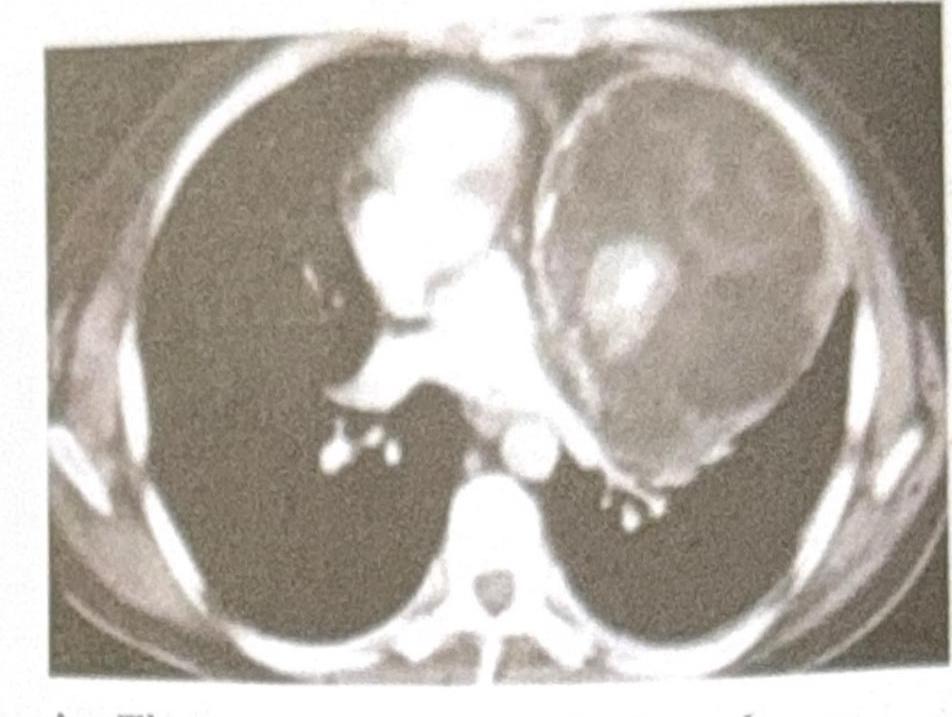
A 30-year-old male presents with a 3-week history of right-sided chest pain and cough. Examination reveals decreased breath sounds in the right lower lung. Chest X-ray shows blunting of the costophrenic angles. A contrast-enhanced CT scan of the chest is performed. What is the most probable diagnosis?
Garland sign on CXR in sarcoidosis involves all except?
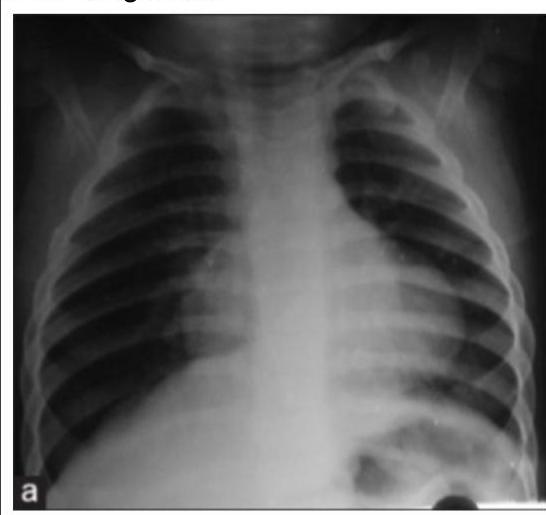
Which of the following features on X-ray chest can differentiate an Atrial Septal Defect (ASD) from a Ventricular Septal Defect (VSD)?
What is the investigation of choice for pleural effusion?
What is the common location of a thoracic pheochromocytoma?
Kerley B lines are seen in which of the following conditions?
What is the investigation of choice for evaluating pleural diseases?
What is the investigation of choice for the detection and characterization of interstitial lung disease?
Explanation: **Explanation:** Rib notching is primarily caused by the enlargement and tortuosity of intercostal arteries, which erode the inferior margins of the ribs. In the context of congenital heart disease and surgical shunts, the presence or absence of rib notching depends on whether the **subclavian artery** is utilized, as this disrupts the normal collateral flow. **1. Why Waterston-Cooley Shunt is the correct answer:** The **Waterston-Cooley shunt** involves a side-to-side anastomosis between the **ascending aorta and the right pulmonary artery**. Since this procedure does not involve the subclavian artery, it does not trigger the development of intercostal collaterals. Therefore, it **does not cause rib notching**. **2. Analysis of other options:** * **Blalock-Taussig (BT) Shunt:** The classic BT shunt involves sacrificing the subclavian artery to connect it to the pulmonary artery. This leads to decreased pressure in the distal arm, prompting the development of extensive collateral circulation via the intercostal arteries. This results in **unilateral rib notching** on the side of the shunt. * **Pulmonary Atresia with large VSD:** In conditions with severely reduced pulmonary blood flow (like Tetralogy of Fallot or Pulmonary Atresia), the body compensates via **Major Aortopulmonary Collateral Arteries (MAPCAs)**. These large collateral vessels often arise from intercostal arteries, leading to rib notching. **Clinical Pearls for NEET-PG:** * **Most common cause of bilateral rib notching:** Coarctation of the aorta (usually ribs 3-9; 1st and 2nd ribs are spared as they are supplied by the thyrocervical trunk). * **Superior rib notching:** Think of connective tissue disorders like **Neurofibromatosis type 1** or Hyperparathyroidism (subperiosteal resorption). * **Unilateral rib notching:** Seen in classic BT shunts or Blalock-Taussig-Thomas procedures. Note that the *Modified* BT shunt (using a GORE-TEX graft) rarely causes notching as the subclavian artery is preserved.
Explanation: **Explanation:** The **'Batwing' (or Butterfly) appearance** is a classic radiological sign characterized by bilateral, symmetric perihilar opacities that spare the peripheral lung zones (the outer 2–3 cm of the lung parenchyma). **Why Cardiogenic Pulmonary Edema is correct:** In acute heart failure, increased pulmonary venous pressure leads to the leakage of fluid into the alveolar spaces. This fluid accumulation occurs preferentially in the large-vessel-rich perihilar regions due to better lymphatic drainage at the periphery and the effects of gravity. This results in the dense central opacification resembling the wings of a bat or butterfly. **Analysis of Incorrect Options:** * **Bronchial Asthma:** Typically presents with a normal chest X-ray or signs of hyperinflation (flattened diaphragm, increased retrosternal space). It does not cause alveolar filling patterns. * **Mitral Stenosis:** While it can lead to pulmonary edema, its primary early findings include left atrial enlargement (straightening of the left heart border, double atrial shadow) and Cephalization (upper lobe diversion/Antler sign). * **Pulmonary Embolism:** Usually presents with a normal X-ray. Specific signs include **Hampton’s Hump** (wedge-shaped opacity) or **Westermark sign** (focal oligemia), not bilateral perihilar opacities. **High-Yield Clinical Pearls for NEET-PG:** * **Differential Diagnosis for Batwing Appearance:** Apart from cardiogenic edema, it can be seen in Alveolar proteinosis, Pneumocystis jirovecii pneumonia (PJP), and pulmonary hemorrhage. * **Stages of Heart Failure on CXR:** 1. **Stage 1 (Redistribution):** PCWP 13–18 mmHg; Cephalization (Antler sign). 2. **Stage 2 (Interstitial Edema):** PCWP 18–25 mmHg; **Kerley B lines**, peribronchial cuffing. 3. **Stage 3 (Alveolar Edema):** PCWP >25 mmHg; **Batwing appearance**, pleural effusion.
Explanation: **Explanation:** The diagnosis of **Empyema** (Option A) is supported by the clinical presentation of subacute chest pain and cough, combined with the classic radiological finding of the **"Split Pleura Sign"** on contrast-enhanced CT (CECT). This sign occurs when the visceral and parietal pleura separate and show intense enhancement due to inflammation, enclosing a fluid collection. This is the most specific CT sign for differentiating empyema from other thoracic collections. **Why other options are incorrect:** * **Loculated Pleural Effusion (Option B):** While an empyema is a type of loculated effusion, the term "empyema" specifically refers to infected/purulent fluid. In NEET-PG questions, the presence of pleural enhancement and thickening on CECT strongly points toward the inflammatory nature of an empyema rather than a simple transudative loculation. * **Pulmonary Abscess (Option C):** An abscess is located *within* the lung parenchyma. On CT, it typically has thick, irregular walls and forms an **acute angle** with the chest wall. In contrast, an empyema is in the pleural space and forms **obtuse angles** with the chest wall, displacing and compressing the adjacent lung (the "extrapleural sign"). * **Mesothelioma (Option D):** This is a malignancy typically associated with asbestos exposure and older age. It presents as nodular, irregular pleural thickening that often involves the mediastinal pleura, which is not suggested by this patient’s acute/subacute infectious profile. **High-Yield Clinical Pearls for NEET-PG:** * **Split Pleura Sign:** Pathognomonic for Empyema on CECT. * **Wall Characteristics:** Empyema has smooth inner/outer walls; Lung Abscess has ragged, irregular inner walls. * **Vessel Displacement:** In empyema, pulmonary vessels are displaced/pushed away; in a lung abscess, vessels are destroyed or end abruptly at the cavity. * **Lateral Decubitus View:** The most sensitive X-ray position to detect small amounts of pleural fluid (as little as 5-10 ml).
Explanation: **Explanation:** The **Garland sign**, also known as the **1-2-3 sign** or the **Pawnbroker’s sign**, is a classic radiological feature of Stage I Sarcoidosis on a Chest X-ray. It represents a specific pattern of symmetric lymphadenopathy. **1. Why Option D is correct:** The Garland sign specifically involves three distinct lymph node groups: the **Right Paratracheal**, **Right Hilar**, and **Left Hilar** nodes. **Left pretracheal lymph nodes** are not part of this classic triad. In sarcoidosis, while various mediastinal nodes can be involved, the "1-2-3" pattern specifically excludes the left paratracheal/pretracheal area because the presence of the aortic arch often obscures or prevents the visualization of discrete nodes in that specific location on a standard PA view. **2. Analysis of incorrect options:** * **Option A (Right paratracheal nodes):** Represents the "1" in the 1-2-3 sign. It appears as a vertical soft tissue density widening the right superior mediastinum. * **Option B & C (Right and Left hilar nodes):** Represent the "2" and "3" of the sign. Sarcoidosis characteristically causes **bilateral, symmetrical, and bulky** hilar lymphadenopathy, which helps differentiate it from tuberculosis or malignancy (which are often unilateral or asymmetric). **Clinical Pearls for NEET-PG:** * **Stages of Sarcoidosis (Scadding Scale):** * Stage 0: Normal CXR. * Stage 1: BHL (Bilateral Hilar Lymphadenopathy) only. * Stage 2: BHL + Parenchymal infiltrates. * Stage 3: Parenchymal infiltrates without BHL. * Stage 4: End-stage pulmonary fibrosis (honeycombing). * **Lofgren Syndrome:** A clinical triad of BHL, Erythema Nodosum, and Polyarthritis (highly suggestive of acute sarcoidosis). * **Eggshell Calcification:** While most common in Silicosis, it can also be seen in the lymph nodes of Sarcoidosis patients.
Explanation: **Explanation:** The key to differentiating **Atrial Septal Defect (ASD)** from **Ventricular Septal Defect (VSD)** on a chest X-ray lies in identifying which cardiac chambers are dilated. **Why "Enlarged Left Atrium" is the correct answer:** In **VSD**, the left-to-right shunt occurs at the ventricular level. The extra blood volume flows into the lungs and returns via the pulmonary veins directly into the **Left Atrium (LA)** and then the Left Ventricle, causing volume overload and enlargement of these chambers. In **ASD**, however, the shunt occurs at the atrial level. While the extra blood returns from the lungs to the LA, it immediately shunts across the defect into the Right Atrium. Therefore, the **Left Atrium does NOT enlarge in ASD** (it may even appear small). The presence of LA enlargement on an X-ray (e.g., double atrial shadow, splaying of the carina) strongly points toward VSD or PDA rather than ASD. **Analysis of Incorrect Options:** * **B. Pulmonary Plethora:** This refers to increased pulmonary vascular markings. Both ASD and VSD are left-to-right shunts that increase pulmonary blood flow, so both will show plethora. * **C. Enlarged Pulmonary Artery:** Both conditions lead to increased flow into the pulmonary trunk, causing a prominent pulmonary conus/artery. * **D. Enlarged Aorta:** In both ASD and VSD, the aorta is typically small or normal because blood is being shunted away from the systemic circulation into the pulmonary circulation. **High-Yield Clinical Pearls for NEET-PG:** * **ASD:** Characterized by Right Atrial and Right Ventricular enlargement. The LA remains normal-sized. * **VSD:** Characterized by Left Atrial and Left Ventricular enlargement. * **Holt-Oram Syndrome:** Often associated with ASD (Secundum type) and upper limb radial ray defects. * **Eisenmenger’s Syndrome:** Occurs when long-standing pulmonary hypertension reverses the shunt (Right-to-Left), leading to cyanosis and "pruning" of peripheral pulmonary vessels on X-ray.
Explanation: **Explanation:** The investigation of choice for pleural effusion is **Contrast-Enhanced Computed Tomography (CECT)** because it provides the most comprehensive evaluation of the pleural space, lung parenchyma, and mediastinum. While other modalities can detect fluid, CECT is superior in differentiating between transudates and exudates (based on pleural thickening/enhancement), identifying underlying causes (such as malignancy or pneumonia), and detecting loculated effusions or associated lung masses. **Analysis of Options:** * **A. Chest X-ray:** This is the **initial/screening investigation**. It requires approximately 175–200 ml of fluid to obliterate the costophrenic angle on a PA view (and ~50–75 ml on a lateral view). It cannot reliably distinguish between fluid, thickening, or underlying collapse. * **B. Ultrasound (USG):** This is the **most sensitive** modality for detecting small amounts of fluid (as little as 5–20 ml) and is the **investigation of choice for guiding thoracocentesis** (tapping). However, it lacks the anatomical detail of CECT for staging or diagnosing complex underlying pathologies. * **C. Magnetic Resonance Imaging (MRI):** MRI has a limited role in routine chest imaging due to motion artifacts and lung air interference. It is reserved for specific cases like chest wall invasion or when CT contrast is contraindicated. **High-Yield Clinical Pearls for NEET-PG:** * **Initial Investigation:** Chest X-ray (PA view). * **Most Sensitive for Detection:** Ultrasound. * **Investigation of Choice (Overall):** CECT. * **Gold Standard for Empyema/Complex Effusion:** CECT (shows the "Split Pleura Sign"). * **Minimum fluid for X-ray detection:** 175–200 ml (PA view); 50 ml (Lateral view); 5–10 ml (Lateral decubitus view).
Explanation: **Explanation:** **Thoracic pheochromocytomas** (also known as intrathoracic paragangliomas) are rare neuroendocrine tumors derived from the chromaffin cells of the sympathetic chain. The correct answer is the **posterior mediastinum** because this is the anatomical location of the paravertebral sympathetic chain and the aorticosympathetic ganglia. Approximately 1–2% of all pheochromocytomas occur within the thorax, and the vast majority are found in the posterior mediastinal compartment, specifically in the paravertebral sulcus. **Analysis of Incorrect Options:** * **Anterior Mediastinum:** This compartment is characterized by the "4 Ts" (Thymoma, Teratoma, Thyroid masses, and Terrible Lymphoma). Pheochromocytomas do not originate here as there is no primary sympathetic ganglionic tissue. * **Middle Mediastinum:** This area contains the heart, great vessels, and trachea. While rare "cardiac" paragangliomas can occur (near the left atrium or aortic root), they are significantly less common than those in the posterior sympathetic chain. * **Superior Mediastinum:** While the sympathetic chain extends into the upper thorax, most neurogenic tumors, including pheochromocytomas, are classically categorized under posterior mediastinal masses in radiologic differential diagnoses. **NEET-PG High-Yield Pearls:** * **Rule of 10s:** Pheochromocytomas are traditionally 10% extra-adrenal, 10% bilateral, and 10% malignant (though these percentages are evolving with genetic data). * **Imaging:** On MRI, these tumors often show a **"Light Bulb Sign"** (hyperintense on T2-weighted images). * **Nuclear Medicine:** **123I-MIBG scan** is the gold standard for localizing extra-adrenal sites. * **Clinical Triad:** Episodic headache, sweating, and tachycardia associated with hypertension.
Explanation: **Explanation:** **Kerley B lines** are short (1–2 cm), thin, horizontal peripheral lines seen at the lung bases, perpendicular to the pleural surface. They represent **thickened interlobular septa** caused by fluid accumulation (edema) or cellular infiltration. **Why Mitral Stenosis is Correct:** In Mitral Stenosis, there is an obstruction to left atrial outflow, leading to increased left atrial pressure. This pressure is transmitted backward into the pulmonary veins and capillaries (**Pulmonary Venous Hypertension**). When the capillary hydrostatic pressure exceeds the oncotic pressure, fluid transudates into the pulmonary interstitium and interlobular septa, manifesting as Kerley B lines on a chest X-ray. **Analysis of Incorrect Options:** * **Pleural Effusion:** While often co-existing with heart failure, pleural effusion refers to fluid in the pleural space, not the interlobular septa. It typically presents as blunting of the costophrenic angles. * **Pericardial Effusion:** This involves fluid within the pericardial sac. On X-ray, it presents as a "water-bottle" or "money-bag" heart silhouette, but it does not directly cause septal thickening in the lungs. **High-Yield Clinical Pearls for NEET-PG:** * **Kerley A lines:** Longer (2–6 cm) lines radiating from the hila toward the periphery; represent distended anastomotic channels between peripheral and central lymphatics. * **Differential Diagnosis for Kerley B lines:** 1. **Left Ventricular Failure/Pulmonary Edema** (Most common cause). 2. **Mitral Valve Disease.** 3. **Lymphangitic Carcinomatosis** (Look for unilateral or asymmetric lines). 4. **Pneumoconiosis** (e.g., Silicosis). * **Staging of Pulmonary Edema:** Kerley B lines appear during the **interstitial phase** (PCWP 18–25 mmHg), following cephalization (PCWP 13–18 mmHg) but before alveolar edema (PCWP >25 mmHg).
Explanation: **Explanation:** **CT scan (Contrast-Enhanced CT)** is the investigation of choice for evaluating pleural diseases because it provides superior anatomical detail and can distinguish between pleural thickening, fluid, and solid masses. It is highly sensitive for detecting pleural calcification, plaques, and nodules, and is the gold standard for differentiating a lung abscess from an empyema. Its ability to visualize the entire pleural space, including the mediastinal and diaphragmatic surfaces, makes it indispensable for staging pleural malignancies like mesothelioma. **Why other options are incorrect:** * **Chest X-ray:** Usually the initial screening tool. While it can detect pleural effusion (blunting of costophrenic angles), it lacks the sensitivity to characterize the nature of the disease or detect small lesions. * **Ultrasound (USG):** Excellent for detecting small effusions, identifying loculations, and guiding thoracocentesis. However, it cannot visualize the entire pleura (due to rib shadows) or evaluate the lung parenchyma as effectively as CT. * **MRI:** Reserved for specific cases, such as evaluating chest wall invasion or diaphragmatic involvement in mesothelioma when CT is inconclusive. It is not the primary choice due to cost and motion artifacts. **High-Yield Clinical Pearls for NEET-PG:** * **Split Pleura Sign:** Seen on CECT; it indicates an empyema (thickened visceral and parietal pleura separated by fluid). * **Pleural Calcification:** Often associated with old TB or Asbestosis (Holly leaf sign on CXR). * **Sensitivity for Effusion:** USG can detect as little as 5–10 ml of fluid, whereas a PA view CXR requires ~200 ml to show blunting of the costophrenic angle.
Explanation: **Explanation:** **High-Resolution Computed Tomography (HRCT)** is the gold standard and investigation of choice for Interstitial Lung Disease (ILD). The underlying medical concept relies on HRCT’s ability to provide ultra-thin sections (1–2 mm) using a high-spatial-frequency reconstruction algorithm. This allows for the visualization of the secondary pulmonary lobule—the smallest functional unit of the lung—enabling clinicians to identify specific patterns such as ground-glass opacities, honeycombing, reticular patterns, and traction bronchiectasis, which are essential for differentiating between types of ILD (e.g., IPF vs. NSIP). **Why other options are incorrect:** * **Chest X-ray:** While often the initial screening tool, it lacks sensitivity. Up to 10–15% of patients with biopsy-proven ILD may have a normal chest radiograph. It cannot characterize the specific pattern or extent of the disease. * **MRI:** Due to low proton density in the lungs and artifacts caused by respiratory motion and air-tissue interfaces, MRI has a limited role in parenchymal lung evaluation compared to CT. * **Ventilation-Perfusion (V/Q) Scan:** This is primarily used to diagnose Pulmonary Embolism (by detecting mismatch) or to evaluate lung function prior to surgery, not for parenchymal characterization. **Clinical Pearls for NEET-PG:** * **HRCT Technique:** Uses thin slices (1-2mm) and a "bone algorithm" for edge enhancement. * **Prone HRCT:** Used to differentiate early interstitial changes from dependent basal atelectasis. * **Expiratory HRCT:** The investigation of choice to detect **air trapping**, a hallmark of small airway diseases like Bronchiolitis Obliterans. * **Honeycombing:** The radiological hallmark of Usual Interstitial Pneumonia (UIP).
Normal Chest Radiographic Anatomy
Practice Questions
Radiographic Signs in Chest Imaging
Practice Questions
Pulmonary Infections
Practice Questions
Chronic Obstructive Pulmonary Disease
Practice Questions
Interstitial Lung Diseases
Practice Questions
Pulmonary Neoplasms
Practice Questions
Pleural Diseases
Practice Questions
Mediastinal Pathology
Practice Questions
Congenital and Developmental Chest Anomalies
Practice Questions
Pulmonary Vascular Diseases
Practice Questions
Chest Trauma Imaging
Practice Questions
Post-Surgical Chest Imaging
Practice Questions
Get full access to all questions, explanations, and performance tracking.
Start For Free