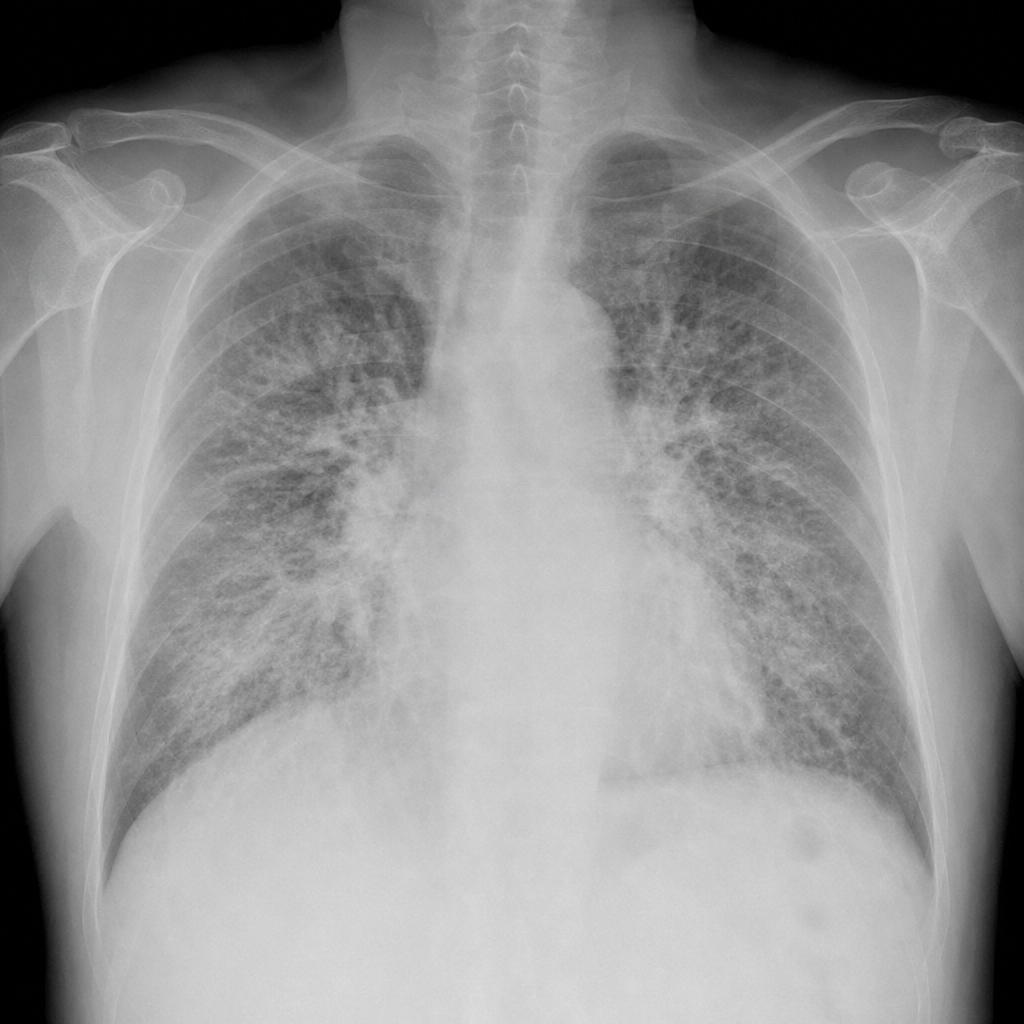
Which of the following conditions is characterized by opacity with nodular and irregular calcification?
Disseminated small nodules with calcification in a chest X-ray suggest which of the following conditions?
What is the best view for a chest X-ray?
A bedridden patient experiences acute chest pain which is worsened by breathing. Which imaging techniques could be helpful?
A "water can" appearance of the heart shadow in a Chest X-ray is seen in which of the following conditions?
What are the characteristic features of a benign lung tumor on an X-ray?
Miliary mottling in the lungs is seen in which of the following conditions?
What is the ideal method for screening for lung secondaries?
A chest radiograph is obtained from a male patient with hypertension. What is the probable diagnosis?

What is the best radiographic view to diagnose pneumothorax?
Explanation: ### Explanation The correct answer is **D. All of the above**. This question tests the recognition of **dystrophic calcification** in chronic interstitial lung diseases (ILDs). While many lung opacities are purely soft tissue density, certain chronic inflammatory and fibrotic processes lead to the deposition of calcium salts within damaged tissues, appearing as nodular or irregular radiopacities on a chest X-ray or CT scan. **Breakdown of Options:** * **Sarcoidosis:** This is a classic cause. Calcification occurs in approximately 5% of cases, typically within parenchymal granulomas or as "eggshell calcification" in hilar lymph nodes. The parenchymal nodules can become conglomerate and calcify as the disease progresses to Stage IV fibrosis. * **Scleroderma (Systemic Sclerosis):** In the lungs, scleroderma typically presents as Non-Specific Interstitial Pneumonia (NSIP). Over time, the chronic fibrotic areas can undergo dystrophic calcification. Additionally, patients may exhibit soft tissue calcification in the chest wall (calcinosis cutis), which overlaps the lung fields on imaging. * **Pulmonary Histiocytosis (Langerhans Cell Histiocytosis):** While characterized initially by nodules and thin-walled cysts, chronic lesions can undergo scarring and irregular calcification during the late fibrotic stages of the disease. **Clinical Pearls for NEET-PG:** * **Eggshell Calcification:** High-yield differential includes **Silicosis** (most common), Sarcoidosis, Coal Worker’s Pneumoconiosis, and treated Lymphoma. * **Popcorn Calcification:** Pathognomonic for **Pulmonary Hamartoma**. * **Fleischner Society Tip:** When you see diffuse "microlithiasis" (sand-like calcification), think of **Alveolar Microlithiasis** (SLC34A2 gene mutation). * **Dystrophic vs. Metastatic:** Dystrophic calcification (as seen in these ILDs) occurs in damaged tissue with normal serum calcium; metastatic calcification occurs in normal tissue due to high serum calcium (e.g., hyperparathyroidism).
Explanation: **Explanation:** The presence of disseminated small nodules with calcification on a chest X-ray is a classic radiologic presentation of **healed Histoplasmosis**. **1. Why Histoplasmosis is correct:** *Histoplasma capsulatum* is a dimorphic fungus often associated with bird or bat droppings. In the acute phase, it causes granulomatous inflammation. As these granulomas heal, they undergo **dystrophic calcification**, resulting in multiple, small (punctate), well-defined calcified nodules scattered throughout the lung parenchyma (often referred to as "buckshot calcification"). It is also frequently associated with calcified hilar or mediastinal lymph nodes. **2. Why the other options are incorrect:** * **Aspergillosis:** Typically presents as an "Aspergilloma" (fungus ball in a pre-existing cavity with a Monod sign/air crescent) or as Allergic Bronchopulmonary Aspergillosis (ABPA) with "finger-in-glove" opacities. It does not typically present as disseminated calcified nodules. * **Cryptococcosis:** Usually presents as solitary or multiple pulmonary nodules or masses (often non-calcified) or interstitial infiltrates, especially in immunocompromised patients. * **Coccidioidomycosis:** Often presents with thin-walled cavities, nodules, or pneumonia. While it can cause granulomas, disseminated miliary-style calcification is much more characteristic of Histoplasmosis. **Clinical Pearls for NEET-PG:** * **Differential Diagnosis for Miliary/Disseminated Calcified Nodules:** Healed Histoplasmosis, Healed Varicella Pneumonia (usually smaller/finer), Silicosis (look for "eggshell calcification" of nodes), and Mitral Stenosis (ossified nodules). * **Histoplasmosis Key Word:** "Buckshot calcification." * **Splenic Calcifications:** Histoplasmosis is also a common cause of multiple small "starry sky" calcifications in the spleen.
Explanation: The **Postero-Anterior (PA) view** is considered the "gold standard" and the best routine view for a chest X-ray due to several anatomical and physical advantages: ### 1. Why PA View is the Best (Correct Answer) * **Reduced Cardiac Magnification:** In the PA view, the heart is closer to the film/detector. According to the principles of divergent X-ray beams, the closer an object is to the detector, the less it is magnified. This allows for an accurate assessment of the **Cardio-Thoracic Ratio (CTR)**. * **Scapular Displacement:** Patients are instructed to rotate their shoulders forward, which moves the scapulae laterally out of the lung fields, providing a clearer view of the lung parenchyma. * **Inspiratory Effort:** PA views are typically taken in a standing position with a full deep breath, allowing for better visualization of the lung bases and the diaphragm (usually at the level of the 10th posterior rib). ### 2. Why Other Options are Incorrect * **A.P. View:** Used primarily for bedridden or critically ill patients (portable X-rays). Because the heart is further from the detector, it appears **falsely enlarged** (spurious cardiomegaly), and the scapulae often overlie the lung fields. * **Lateral View:** While excellent for visualizing the "hidden areas" (retrocardiac and retrosternal spaces), it is a supplementary view and cannot replace the PA view for primary screening. ### 3. High-Yield Clinical Pearls for NEET-PG * **Distance:** A standard PA view is taken at a distance of **6 feet (72 inches)** to further minimize magnification. * **Lordotic View:** Best for visualizing **apical lung tumors** (Pancoast tumors) or TB lesions obscured by the clavicles. * **Lateral Decubitus View:** The most sensitive conventional view for detecting **small pleural effusions** (as little as 5-10 ml). * **Expiratory Film:** Indicated for detecting a small **pneumothorax** or foreign body aspiration (air trapping).
Explanation: **Explanation:** The clinical presentation of a bedridden patient with acute pleuritic chest pain is highly suggestive of **Pulmonary Embolism (PE)**. Immobilization is a major risk factor for Deep Vein Thrombosis (DVT), which can lead to PE. **1. Why CT Scan is the Correct Answer:** **CT Pulmonary Angiography (CTPA)** is currently the **gold standard** and investigation of choice for diagnosing acute pulmonary embolism. It allows for direct visualization of the embolus as a filling defect within the pulmonary arteries. It is preferred due to its high sensitivity, specificity, and ability to provide alternative diagnoses (like pneumonia or aortic dissection) if PE is ruled out. **2. Why Other Options are Incorrect:** * **X-ray Chest:** Usually the first investigation performed, but it is often **normal** in PE (the "normal CXR in a hypoxic patient" sign). While it can show signs like *Westermark sign* or *Hampton’s hump*, these are rare and non-specific. Its primary role is to rule out other causes like pneumothorax. * **Ventilation-Perfusion (V/Q) Scan:** Previously the first-line test, it is now reserved for patients with **renal failure** (where contrast is contraindicated) or pregnancy. It is less definitive than CTPA. * **Ultrasound (USG):** While bedside lung USG can show peripheral infarcts and Lower Limb Doppler can identify DVT, it cannot definitively diagnose or map a pulmonary embolism in the central vasculature. **Clinical Pearls for NEET-PG:** * **Gold Standard/IOC for PE:** CT Pulmonary Angiography (CTPA). * **Most common ECG finding in PE:** Sinus Tachycardia (Specific but rare: S1Q3T3 pattern). * **Most common X-ray finding:** Normal (or non-specific atelectasis). * **Definitive Gold Standard (Invasive):** Conventional Pulmonary Angiography (rarely used now).
Explanation: **Explanation:** The **"Water Can" (or "Money Bag" / "Flask-shaped")** appearance is a classic radiological sign of **Pericardial Effusion**. This occurs when an abnormal amount of fluid accumulates in the pericardial sac. Due to gravity, the fluid collects in the dependent portions of the pericardium, causing a symmetric, globular enlargement of the cardiac silhouette with sharp margins. The heart loses its normal contours (like the left atrial appendage or pulmonary artery segment), resembling an old-fashioned leather water bottle. **Analysis of Incorrect Options:** * **Tetralogy of Fallot (TOF):** Characterized by a **"Boot-shaped" heart (Coeur en sabot)**. This is due to right ventricular hypertrophy (lifting the apex) and a small/concave pulmonary artery segment. * **Ebstein’s Anomaly:** Characterized by a **"Box-shaped" heart**. This massive cardiomegaly is caused by severe right atrial enlargement and a "functional" right ventricle being incorporated into the atrium (atrialization). * **Hypertrophic Cardiomyopathy (HCM):** Usually presents with a normal-sized heart or mild left ventricular enlargement. It does not typically produce a specific named "shape" on a chest X-ray like the others. **High-Yield Clinical Pearls for NEET-PG:** * **Minimum fluid for X-ray detection:** At least **200–250 ml** of fluid must accumulate before the cardiac silhouette enlarges on a PA view. * **Echocardiography:** The gold standard and most sensitive investigation for diagnosing pericardial effusion. * **Differential Diagnosis:** A very large pericardial effusion can mimic the "Box-shaped" heart of Ebstein’s, but the "Water Can" description is specifically pathognomonic for effusion in exams. * **Clinical Sign:** Look for **Beck’s Triad** (hypotension, JVD, muffled heart sounds) if the effusion leads to cardiac tamponade.
Explanation: **Explanation:** In chest radiology, distinguishing between benign and malignant pulmonary nodules is a critical skill for the NEET-PG exam. The presence and pattern of **calcification** are the most reliable indicators of a benign lesion. **1. Why Option D is Correct:** Benign tumors, such as hamartomas or healed granulomas (e.g., TB or Histoplasmosis), often exhibit specific "benign" calcification patterns. **Concentric (laminated) dense calcification**, along with central, diffuse, or "popcorn" calcification (classic for hamartomas), indicates a slow-growing or stable process. These patterns suggest the lesion has been present for a long time, significantly reducing the likelihood of malignancy. **2. Why the Other Options are Incorrect:** * **Size > 5 cm (Option A):** Larger lesions are statistically more likely to be malignant. A nodule >3 cm is often termed a "mass," and the risk of malignancy increases significantly with size. * **Cavitation (Option B):** While benign lesions (like lung abscesses) can cavitate, a thick-walled, irregular, or eccentric cavity is a classic hallmark of **Squamous Cell Carcinoma**. * **Peripheral location (Option C):** Location is not a definitive rule; however, many primary lung adenocarcinomas are found in the periphery. Benign nodules can be found anywhere, making this a non-specific feature. **High-Yield Clinical Pearls for NEET-PG:** * **Popcorn Calcification:** Pathognomonic for **Pulmonary Hamartoma**. * **Doubling Time:** A nodule that remains stable in size for **2 years** is considered benign. * **Margin Morphology:** Spiculated or "sunburst" margins (Corona Radiata) are highly suggestive of malignancy, whereas smooth, well-defined margins favor a benign etiology. * **Feeding Vessel Sign:** Often associated with septic emboli or AV malformations.
Explanation: **Explanation:** Miliary mottling refers to the presence of numerous, small (1–4 mm), discrete, round opacities scattered throughout both lungs, resembling millet seeds. While classically associated with **Miliary Tuberculosis** (hematogenous spread), it is a radiological pattern seen in a wide variety of conditions. **Analysis of Options:** * **Histiocytosis X (Langerhans Cell Histiocytosis):** In the early stages, this condition presents with a nodular pattern (miliary-sized) primarily in the upper and middle zones. These nodules later cavitate to form characteristic thin-walled cysts. * **Metastasis:** Certain malignancies spread hematogenously to produce "miliary metastases." Common primaries include **Thyroid carcinoma (Papillary)**, Renal Cell Carcinoma (RCC), Melanoma, and Trophoblastic tumors. * **Mitral Stenosis:** Chronic pulmonary venous hypertension leads to **Hemosiderosis** (deposition of iron-laden macrophages), which manifests as fine miliary mottling, typically in the lower zones. **Why "All of the above" is correct:** The miliary pattern is a morphological description, not a specific diagnosis. Since all three conditions—interstitial lung disease (Histiocytosis), neoplastic spread (Metastasis), and vascular congestion (Mitral Stenosis)—can manifest with these fine nodules, "All of the above" is the correct choice. **High-Yield Clinical Pearls for NEET-PG:** * **Mnemonic for Miliary Mottling (SHOMIT):** **S**arcoidosis/Silicosis, **H**istiocytosis/Hemosiderosis, **O**ther (Fungal/Viral), **M**etastasis/Miliary TB, **I**dle (Pneumoconiosis), **T**ropical Eosinophilia. * **Most common cause:** Miliary Tuberculosis. * **Snowstorm appearance:** Often used to describe larger, more confluent miliary nodules seen in Silicosis or Metastasis. * **HRCT:** The gold standard for evaluating the distribution (perilymphatic, centrilobular, or random) of these nodules to narrow the differential.
Explanation: **Explanation:** The detection of pulmonary metastases (lung secondaries) is critical for staging malignancies. **Computed Tomography (CT) scan** is the gold standard and ideal screening method because of its superior spatial resolution and ability to detect small nodules (as small as 1–2 mm) that are often obscured by bony structures or the heart on conventional imaging. * **Why CT Scan is Correct:** CT provides cross-sectional imaging without overlapping structures. It is highly sensitive for identifying "cannonball" or "miliary" patterns of spread and can detect nodules in the lung apices, costophrenic angles, and retrocardiac areas—regions where other modalities often fail. * **Why Chest X-ray is Incorrect:** While often the first-line investigation due to cost and availability, CXR has low sensitivity. It can miss up to 20–30% of small nodules, especially those under 1 cm or those located in "blind spots" like the hilar regions. * **Why MRI is Incorrect:** MRI has limited utility in lung parenchyma due to low proton density and artifacts caused by respiratory motion and air-tissue interfaces. It is generally reserved for evaluating chest wall invasion or apical (Pancoast) tumors. * **Why Enzyme Assay is Incorrect:** There is no specific enzyme assay that can reliably screen for the physical presence of lung secondaries; diagnosis requires anatomical imaging. **High-Yield Clinical Pearls for NEET-PG:** * **HRCT vs. Contrast CT:** For screening metastases, a standard **Contrast-Enhanced CT (CECT)** is preferred over HRCT to differentiate nodules from vascular structures. * **Feeding Vessel Sign:** A distinct vessel leading to a nodule on CT is highly suggestive of hematogenous pulmonary metastasis. * **Most Common Primary:** In males, the most common primary site leading to lung secondaries is the GI tract/Prostate; in females, it is Breast cancer.
Explanation: ***Coarctation of the Aorta*** - Classic chest X-ray findings include **rib notching** (ribs 3-8 bilaterally) due to intercostal artery dilatation and the **"3-sign"** at the aortic knuckle from pre- and post-stenotic dilatation. - **Hypertension in a young male** with these characteristic radiographic features strongly suggests coarctation of the aorta as the underlying cause. *Mitral Stenosis* - Chest X-ray typically shows **left atrial enlargement** with a prominent left heart border and **pulmonary edema** patterns. - Associated with **rheumatic heart disease** and presents with dyspnea rather than systemic hypertension as the primary feature. *Transposition of Great Arteries* - Chest X-ray shows a **"egg-on-string" appearance** with a narrow mediastinum and increased pulmonary vascular markings. - Presents in **neonates with cyanosis** and severe heart failure, not hypertension in older patients. *Aortic Stenosis* - Chest X-ray may show **left ventricular hypertrophy** and **post-stenotic aortic dilatation** but lacks rib notching. - Typically presents with **syncope, angina, and dyspnea** rather than isolated hypertension on imaging.
Explanation: **Explanation:** The diagnosis of a pneumothorax on a chest X-ray relies on identifying the **visceral pleural line** and the absence of distal lung markings. **Why PA view in full expiration is the best choice:** During **expiration**, the volume of the thoracic cavity decreases while the volume of the intrapleural air remains constant. This causes the lung to collapse further toward the hilum, making the pneumothorax appear relatively larger and more conspicuous. Additionally, the lung parenchyma becomes denser (more radiopaque) during expiration, which increases the contrast between the dark (radiolucent) pleural air and the gray lung tissue, making the thin visceral pleural line easier to detect. **Analysis of Incorrect Options:** * **PA view in full inspiration:** This is the standard chest X-ray. While large pneumothoraces are visible, small ones may be masked as the expanding lung pushes against the chest wall, minimizing the pleural space. * **AP view:** Generally reserved for bedridden patients. It is less ideal than PA because of cardiac magnification and the tendency of air to collect anteriorly in a supine patient, often manifesting only as a "deep sulcus sign" rather than a clear pleural line. * **Lateral oblique view:** This view is not standard for pleural pathologies and provides poor visualization of the lung periphery where air typically collects. **High-Yield Clinical Pearls for NEET-PG:** * **Gold Standard:** While expiratory PA films are excellent for screening, **Non-contrast CT (NCCT) Chest** is the most sensitive imaging modality for pneumothorax. * **Supine Patients:** In trauma or ICU settings (supine AP), look for the **Deep Sulcus Sign** (an abnormally deep and lucent costophrenic angle). * **Lateral Decubitus View:** If a patient cannot stand, a lateral decubitus film (with the **affected side up**) can help detect small amounts of air.
Normal Chest Radiographic Anatomy
Practice Questions
Radiographic Signs in Chest Imaging
Practice Questions
Pulmonary Infections
Practice Questions
Chronic Obstructive Pulmonary Disease
Practice Questions
Interstitial Lung Diseases
Practice Questions
Pulmonary Neoplasms
Practice Questions
Pleural Diseases
Practice Questions
Mediastinal Pathology
Practice Questions
Congenital and Developmental Chest Anomalies
Practice Questions
Pulmonary Vascular Diseases
Practice Questions
Chest Trauma Imaging
Practice Questions
Post-Surgical Chest Imaging
Practice Questions
Get full access to all questions, explanations, and performance tracking.
Start For Free