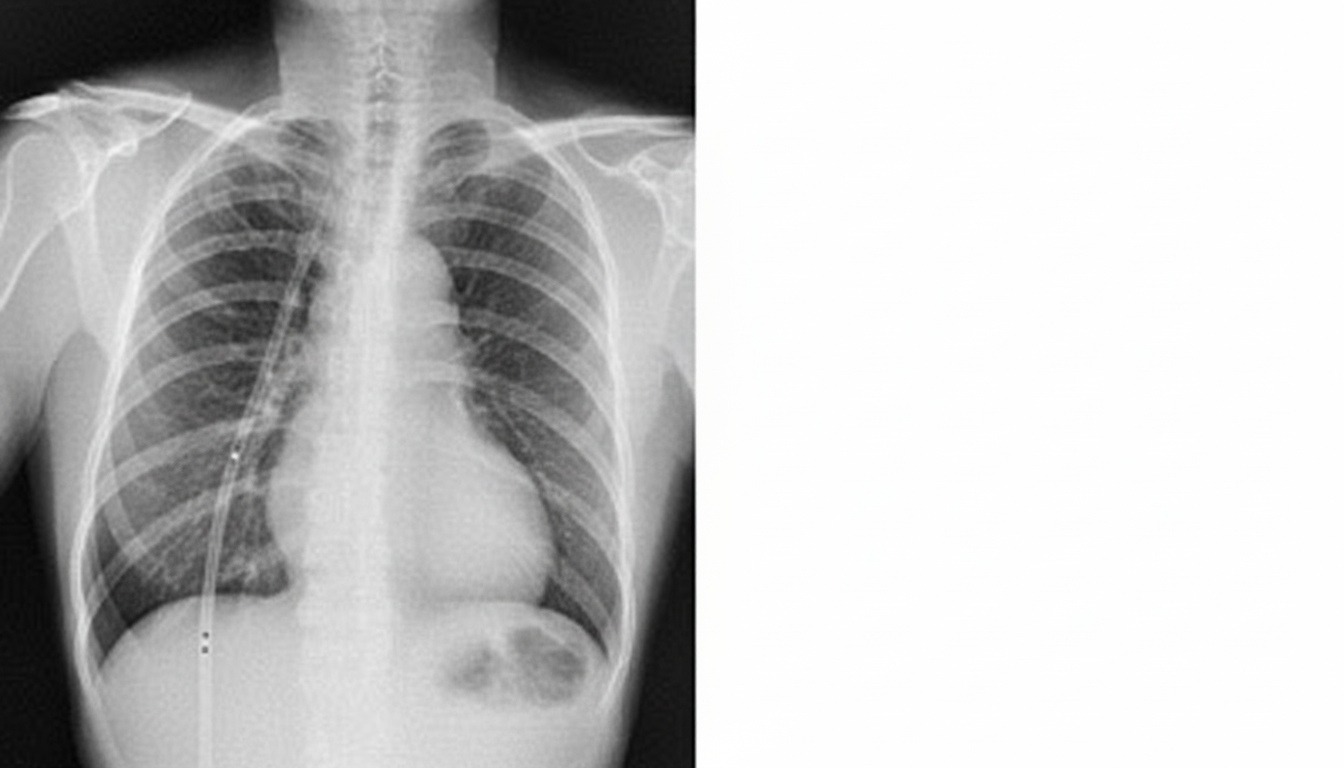
What is the best imaging modality to assess the position and integrity of an implantable cardioverter-defibrillator (ICD)?
Pneumatoceles are commonly seen in which type of pneumonia?
Obliteration of the costophrenic angle is seen in which condition?
A triangular opacity with clear borders, its base towards the midline and obliterating the right heart border on a chest radiograph suggests that the pathology is likely to be in which location?
Which of the following is not a sign of pulmonary hydatidosis?
The Spinnaker Sail sign is seen in which of the following conditions?
Hoffman-Rigler sign for enlargement of the left ventricle is seen on which radiographic view?
What is the best imaging modality for bronchogenic carcinoma?
All of the following are true about loculated pleural effusion except?
The "thumb sign" on imaging is characteristic of which condition?
Explanation: **Explanation:** The **Plain Radiograph (Chest X-ray)** is the gold standard and first-line imaging modality for assessing the position and integrity of an Implantable Cardioverter-Defibrillator (ICD). **Why it is correct:** Chest X-rays (PA and Lateral views) provide high spatial resolution for visualizing metallic components. They allow clinicians to: 1. **Verify Position:** Confirm the generator site and lead tip placement (e.g., right ventricle). 2. **Assess Integrity:** Detect lead fractures, insulation breaks, or dislodgement. 3. **Identify "Twiddler’s Syndrome":** Where the patient manipulates the generator, causing leads to coil and displace. 4. **Identify Device Models:** The radiopaque "X-ray ID" code on the generator can be read on a plain film. **Why other options are incorrect:** * **CT Scan:** While it provides 3D detail, the high-density metal of the ICD causes significant **"streak artifacts,"** which obscure the leads and surrounding anatomy, making it inferior for assessing lead integrity. * **MRI:** Most modern ICDs are "MRI-conditional," but MRI is never the *first* or *best* tool for checking lead integrity. Furthermore, the magnetic field can cause heating of the leads or device malfunction. * **PET Scan:** This is a functional imaging modality used for detecting metabolic activity (e.g., infection or malignancy) and has no role in assessing the mechanical integrity of hardware. **High-Yield Clinical Pearls for NEET-PG:** * **ICD vs. Pacemaker:** On X-ray, ICD leads are distinguished by the presence of one or two thick, radiopaque **shocking coils**. * **Golden Rule:** Always obtain two views (PA and Lateral) to ensure the lead is not displaced posteriorly or anteriorly. * **Complication:** Pneumothorax is the most common acute complication post-insertion, also best diagnosed via Chest X-ray.
Explanation: **Explanation:** **Pneumatoceles** are thin-walled, air-filled cavities within the lung parenchyma that develop due to a check-valve mechanism in the small airways, leading to focal air trapping and alveolar rupture. **Why Klebsiella pneumonia is correct:** *Klebsiella pneumoniae* is a Gram-negative organism known for causing severe, necrotizing pneumonia, particularly in patients with chronic alcoholism or diabetes. It characteristically causes extensive tissue destruction and inflammatory exudate, which leads to the formation of **pneumatoceles** and abscesses. A classic radiological sign associated with *Klebsiella* is the **"Bulging Fissure Sign,"** caused by the heavy, voluminous inflammatory exudate displacing the interlobar fissure. **Why other options are incorrect:** * **Pneumococcal pneumonia (*S. pneumoniae*):** Typically presents as classic lobar pneumonia with air bronchograms. While it is the most common cause of community-acquired pneumonia (CAP), it rarely causes cavitation or pneumatoceles. * **Mycoplasma pneumonia:** An "atypical" pneumonia that usually presents with interstitial infiltrates or reticulonodular patterns rather than cavitary lesions. * **Streptococcal pneumonia (*S. pyogenes*):** While it can cause empyema, it is not the primary association for pneumatoceles compared to *Klebsiella* or *Staphylococcus aureus*. **High-Yield Clinical Pearls for NEET-PG:** * **Most common cause of pneumatoceles in children:** *Staphylococcus aureus*. * **Most common cause of pneumatoceles in adults (among the options):** *Klebsiella pneumoniae*. * **Bulging Fissure Sign:** Highly suggestive of *Klebsiella*. * **Currant Jelly Sputum:** Clinical hallmark of *Klebsiella* infection. * **Pneumocystis jirovecii (PJP):** Another important cause of pneumatoceles, especially in HIV/AIDS patients, which can lead to spontaneous pneumothorax.
Explanation: **Explanation:** The **costophrenic angle** is the junction between the ribs and the diaphragm. In a healthy individual, this angle is sharp and clearly defined on a chest X-ray. **Why Pleural Effusion is correct:** Pleural effusion is the accumulation of fluid in the pleural space. Due to gravity, fluid first collects in the most dependent parts of the thoracic cavity. On an upright chest X-ray, this fluid fills the costophrenic sulcus, leading to the **"blunting" or obliteration** of the costophrenic angle. This is often accompanied by a concave upper border known as the **Ellis-Damoiseau line (Meniscus sign)**. **Analysis of Incorrect Options:** * **Pneumothorax:** This is the presence of air in the pleural space. Instead of blunting, it typically results in a **deep sulcus sign** (an abnormally deepened and lucent costophrenic angle) on a supine film, or a visible visceral pleural line with peripheral lucency. * **Tuberculosis:** While TB can cause an effusion, it is a broad disease. The primary radiological features are usually apical infiltrates, cavitation, or hilar lymphadenopathy. Obliteration specifically refers to the fluid effect, not the infection itself. * **Pneumonia:** This presents as **consolidation** (airspace opacification with air bronchograms). Unless complicated by a parapneumonic effusion, pneumonia does not typically obliterate the costophrenic angle. **High-Yield NEET-PG Pearls:** * **Sensitivity:** A minimum of **175–200 mL** of fluid is required to blunt the lateral costophrenic angle on a PA view. * **Lateral View:** The posterior costophrenic angle is the most dependent; blunting here can be seen with as little as **50–75 mL** of fluid. * **USG:** Ultrasound is more sensitive than X-ray and can detect as little as **5–10 mL** of pleural fluid.
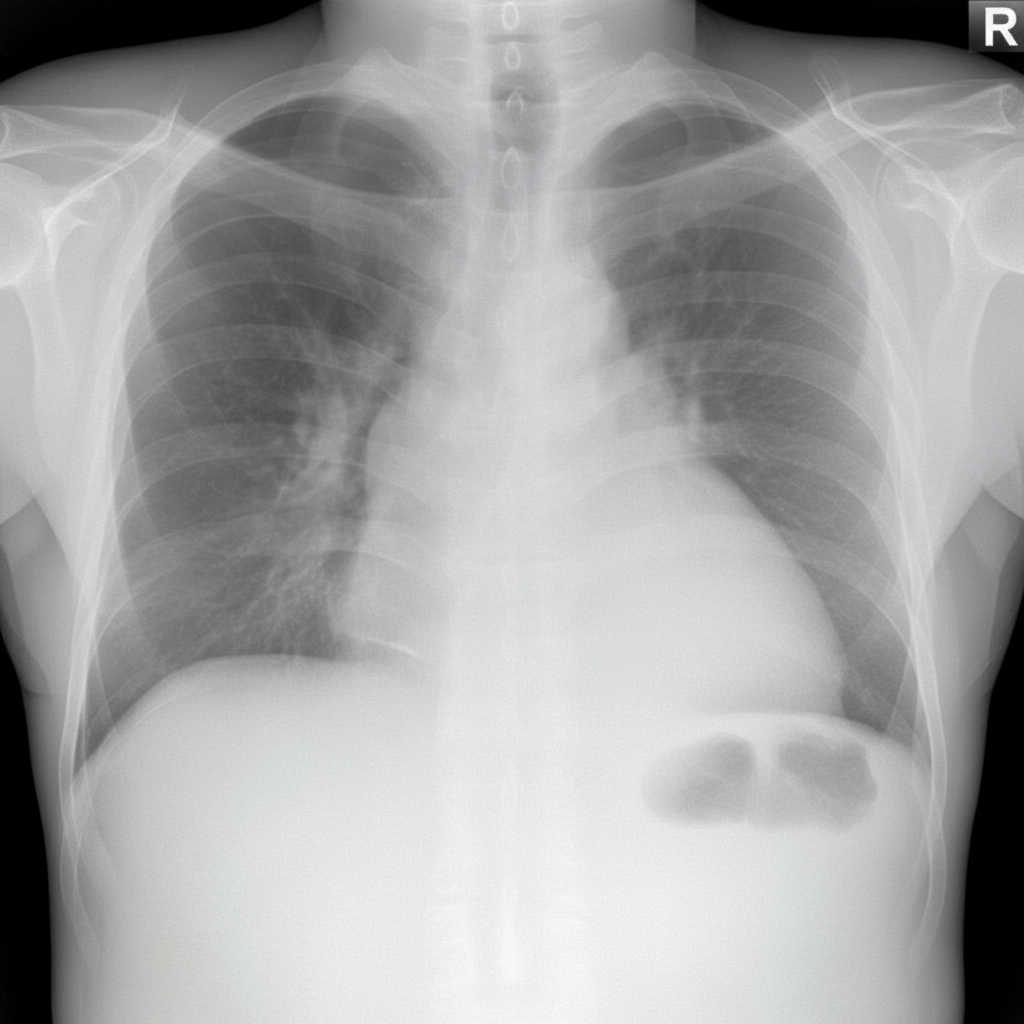
Explanation: ### Explanation The correct answer is **Right Middle Lobe (RML)**. This question tests the application of the **Silhouette Sign**, a fundamental principle in chest radiology. #### 1. Why Right Middle Lobe is Correct The Silhouette Sign occurs when two structures of similar radiographic density (e.g., fluid/consolidation and soft tissue) are in direct anatomical contact; the border between them is lost. * Anatomically, the **Right Middle Lobe** lies anteriorly and is in direct contact with the **right heart border** (right atrium). * Therefore, any pathology (like pneumonia or collapse) in the RML will obliterate (silhouette) the right heart border. On a lateral view, RML pathology typically appears as a triangular opacity. #### 2. Why Other Options are Incorrect * **Apical segment of the right lower lobe (Option A):** This segment is located posteriorly. It does not contact the heart border; therefore, the heart border remains visible (positive silhouette). * **Medial segment of the right lower lobe (Option B):** While the lower lobes are adjacent to the diaphragm, they are situated posteriorly. Pathology here would obliterate the **right hemidiaphragm** but leave the heart border clear. * **Any of the above (Option D):** Incorrect because the silhouette sign is site-specific based on anatomical adjacency. #### 3. High-Yield Clinical Pearls for NEET-PG * **Right Heart Border:** Silhouetted by Right Middle Lobe. * **Left Heart Border:** Silhouetted by the **Lingula** (Left Upper Lobe). * **Right Hemidiaphragm:** Silhouetted by the Right Lower Lobe. * **Left Hemidiaphragm:** Silhouetted by the Left Lower Lobe. * **Aortic Knuckle:** Silhouetted by the Left Upper Lobe (posterior segment). * **Golden S-Sign:** Seen in RML collapse due to a central mass; the upper border of the collapsed lobe is convex due to the mass and concave peripherally.
Explanation: **Explanation:** The **Drooping Lily sign** is the correct answer because it is a classic radiological sign of the **renal system**, not the lungs. It is seen on an Intravenous Urogram (IVU) in patients with a **duplicated collecting system**. The sign occurs when the upper pole moiety is obstructed (often due to an ectopic ureterocele), causing it to dilate and displace the functioning lower pole moiety downward and outward, resembling a wilted or "drooping lily." The other options are classic signs of **Pulmonary Hydatid Disease** (caused by *Echinococcus granulosus*): * **Water Lily Sign (Camoa Sign):** Occurs when the endocyst ruptures and the membranes float on the surface of the remaining fluid within the ectocyst. * **Rising Sun Sign:** Seen when the detached endocyst membranes collapse into the bottom of the cyst, appearing as a solid mass at the base of a cavity. * **Meniscus Sign (Air Crescent Sign):** Occurs when air enters the space between the pericyst (host tissue) and the ectocyst (parasite membrane), appearing as a thin crescent of air. **High-Yield Clinical Pearls for NEET-PG:** * **Most common organ involved:** Liver (50-70%), followed by Lungs (20-30%). * **Serology:** ELISA is the screening test of choice. * **Treatment:** Albendazole is the mainstay; surgery is preferred for large/complicated cysts. * **PAIR Procedure:** (Puncture, Aspiration, Injection, Re-aspiration) is generally contraindicated in the lungs due to the risk of anaphylaxis and pneumothorax; it is primarily used for hepatic cysts.
Explanation: **Explanation:** The **Spinnaker Sail sign** (also known as the Angel Wing sign) is a classic radiographic finding pathognomonic for **Pneumomediastinum** in neonates and infants. **1. Why Pneumomediastinum is correct:** When air escapes into the mediastinum, it dissects between the pericardium and the parietal pleura. In pediatric patients, this air lifts the lobes of the **thymus** superiorly and laterally away from the cardiac silhouette. On a frontal chest X-ray, the displaced thymic lobes resemble the sails of a boat (Spinnaker sails). This sign is rarely seen in adults because the thymus undergoes involution after puberty. **2. Why the other options are incorrect:** * **Pseudopneumomediastinum:** This refers to artifacts that mimic air in the mediastinum, such as the Mach band effect or skin folds. While it looks like pneumomediastinum, the anatomical displacement of the thymus (the "sail") is absent. * **Pleural effusion:** This presents as blunting of the costophrenic angles or a meniscus sign. It involves fluid in the pleural space, not air in the mediastinum. * **Pulmonary infarct:** This typically presents as **Hampton’s Hump** (a wedge-shaped opacity) on a chest X-ray, unrelated to thymic displacement. **Clinical Pearls for NEET-PG:** * **Continuous Diaphragm Sign:** Another sign of pneumomediastinum where air trapped behind the pericardium allows the central portion of the diaphragm to be seen. * **Naclerio’s V sign:** A V-shaped air lucency seen in the lower mediastinum, often associated with esophageal rupture (Boerhaave syndrome). * **Sail Sign vs. Spinnaker Sail Sign:** Do not confuse them. A normal **"Sail Sign"** is a healthy thymus appearing as a triangular opacity in a normal pediatric X-ray; the **"Spinnaker Sail Sign"** is the abnormal lifting of that thymus by air.
Explanation: **Explanation:** The **Hoffman-Rigler sign** is a classic radiographic sign used to identify **Left Ventricular Enlargement (LVE)**. It is specifically assessed on a **Lateral view of the chest**. **Why the Lateral View is Correct:** The left ventricle forms the posterior-inferior border of the cardiac silhouette. On a lateral radiograph, LVE is suggested if the posterior border of the left ventricle displaces posteriorly and overlaps the inferior vena cava (IVC). Specifically, the sign is positive if the left ventricular border extends **more than 1.8 cm posterior** to the posterior border of the IVC at a level 2 cm cephalad to the intersection of the IVC and the diaphragm. **Why Other Options are Incorrect:** * **PA/AP View:** While these views show an increased cardiothoracic ratio and a "down-and-out" apex in LVE, the specific Hoffman-Rigler measurement requires the depth perspective provided only by the lateral projection. * **Apicogram:** This is a specialized view (Lordotic view) used primarily to visualize lesions in the lung apices (e.g., TB or Pancoast tumors) by displacing the clavicles; it has no role in measuring chamber enlargement. **High-Yield Clinical Pearls for NEET-PG:** * **Left Atrial Enlargement (LAE):** Look for the "Double density sign," "Splaying of the carina" (widening of the subcarinal angle >90°), and "Walking cane sign" (posterior displacement of the left main bronchus) on PA/Lateral views. * **Right Ventricular Enlargement (RVE):** On the lateral view, RVE is characterized by the filling of the **retrosternal clear space**. * **Most sensitive view for small pleural effusion:** Lateral decubitus view. * **Most sensitive view for pneumoperitoneum:** Chest X-ray PA view (Erect), looking for air under the diaphragm.
Explanation: **Explanation:** **Computed Tomography (CT)** is the gold standard and best imaging modality for the evaluation of bronchogenic carcinoma. Its superiority lies in its high spatial resolution, which allows for the precise assessment of the primary tumor size, its relationship to adjacent structures (like the chest wall or mediastinum), and the detection of occult pulmonary nodules. Furthermore, **Contrast-Enhanced CT (CECT)** is essential for staging, as it accurately identifies hilar and mediastinal lymphadenopathy and detects common sites of metastasis, such as the liver and adrenal glands. **Why other options are incorrect:** * **MRI:** While excellent for evaluating superior sulcus (Pancoast) tumors to check for brachial plexus or vertebral involvement, MRI is generally inferior to CT for lung parenchyma due to motion artifacts from breathing and low proton density in the lungs. * **Bronchoscopy:** This is an **invasive diagnostic procedure**, not an imaging modality. While it is crucial for obtaining a tissue biopsy and assessing endobronchial spread, it cannot stage the outer extent of the tumor or distant metastases. * **Chest X-ray (Not listed but relevant):** Usually the initial screening tool, but it lacks the sensitivity to detect small lesions or provide detailed staging. **High-Yield Clinical Pearls for NEET-PG:** * **Staging:** CT is the modality of choice for **T (Tumor)** and **N (Node)** staging; **PET-CT** is the most sensitive for **M (Metastasis)** staging. * **Screening:** Low-Dose CT (LDCT) is the recommended screening tool for high-risk smokers. * **Calcification Patterns:** Eccentric or stippled calcification in a nodule suggests malignancy, whereas "popcorn" calcification is classic for Hamartoma.
Explanation: **Explanation:** The core concept in differentiating pleural (extrapulmonary) from parenchymal (intrapulmonary) lesions lies in identifying signs of lung tissue involvement versus displacement. **Why Option D is the Correct Answer (The "Except"):** **Air bronchograms** are a hallmark of **intrapulmonary pathology**, specifically alveolar consolidation (e.g., pneumonia). They represent air-filled bronchi outlined by fluid-filled alveoli. Since a loculated pleural effusion is located in the pleural space (outside the lung parenchyma), it does not contain bronchi; therefore, air bronchograms are **never** seen within a pleural effusion. **Analysis of Incorrect Options:** * **Option A (Obtuse angle):** Extrapulmonary masses (like loculated effusions) typically displace the pleura and lung, forming an **obtuse angle** with the chest wall. In contrast, intrapulmonary masses usually form acute angles. * **Option B (Diffuse margins):** When a loculated effusion is viewed "end-on" (tangential to the X-ray beam), its borders appear sharp. However, when viewed en face (perpendicular), the margins appear **diffuse or ill-defined** because of the tapering thickness of the fluid collection. * **Option C (Not confined to segments):** Unlike lobar pneumonia, which respects anatomical boundaries, pleural fluid is in the pleural space and is **not restricted** by bronchopulmonary segments. **High-Yield Pearls for NEET-PG:** 1. **Vanishing Tumor (Pseudotumor):** A loculated effusion in the minor fissure, often seen in congestive heart failure, which disappears with diuretic therapy. 2. **Split Pleura Sign:** On contrast-enhanced CT, the thickening and separation of visceral and parietal pleura by fluid is highly suggestive of an empyema (a type of loculated effusion). 3. **D-shaped Opacity:** A classic radiological appearance of a loculated effusion against the chest wall.
Explanation: **Explanation:** The **"Thumb Sign"** is a classic radiological finding seen on a **lateral soft tissue neck X-ray**. It represents a thickened, edematous epiglottis that appears rounded and blunt, resembling the distal tip of a human thumb. **1. Why Epiglottitis is Correct:** Acute epiglottitis is a life-threatening inflammation of the epiglottis and supraglottic structures, historically most common in children due to *Haemophilus influenzae* type b (Hib). On a lateral X-ray, the normal thin, leaf-like epiglottis becomes swollen (the Thumb Sign), the aryepiglottic folds thicken, and the vallecula is often obliterated. This indicates potential airway obstruction. **2. Why the Other Options are Incorrect:** * **Candida, Aspergillus, and Thermomyces:** These are fungal pathogens. While they can cause pulmonary infections (like the "Air Crescent Sign" or "Halo Sign" in Invasive Aspergillosis) or esophageal candidiasis, they do not typically present with the specific localized supraglottic swelling characterized as the "Thumb Sign" on neck imaging. **3. High-Yield Clinical Pearls for NEET-PG:** * **Clinical Triad:** Dysphagia, Drooling, and Distress (the 3 D’s). Patients often assume a **"Tripod position"** to maintain airway patency. * **Management Rule:** Never examine the throat with a tongue depressor if epiglottitis is suspected, as it can trigger fatal laryngospasm. * **Differential Diagnosis:** Contrast this with **Croup (Laryngotracheobronchitis)**, which shows the **"Steeple Sign"** (subglottic narrowing) on an Anteroposterior (AP) neck X-ray. * **Omega Sign:** A variant of the epiglottis shape seen in **Laryngomalacia**, not to be confused with the Thumb Sign.
Normal Chest Radiographic Anatomy
Practice Questions
Radiographic Signs in Chest Imaging
Practice Questions
Pulmonary Infections
Practice Questions
Chronic Obstructive Pulmonary Disease
Practice Questions
Interstitial Lung Diseases
Practice Questions
Pulmonary Neoplasms
Practice Questions
Pleural Diseases
Practice Questions
Mediastinal Pathology
Practice Questions
Congenital and Developmental Chest Anomalies
Practice Questions
Pulmonary Vascular Diseases
Practice Questions
Chest Trauma Imaging
Practice Questions
Post-Surgical Chest Imaging
Practice Questions
Get full access to all questions, explanations, and performance tracking.
Start For Free