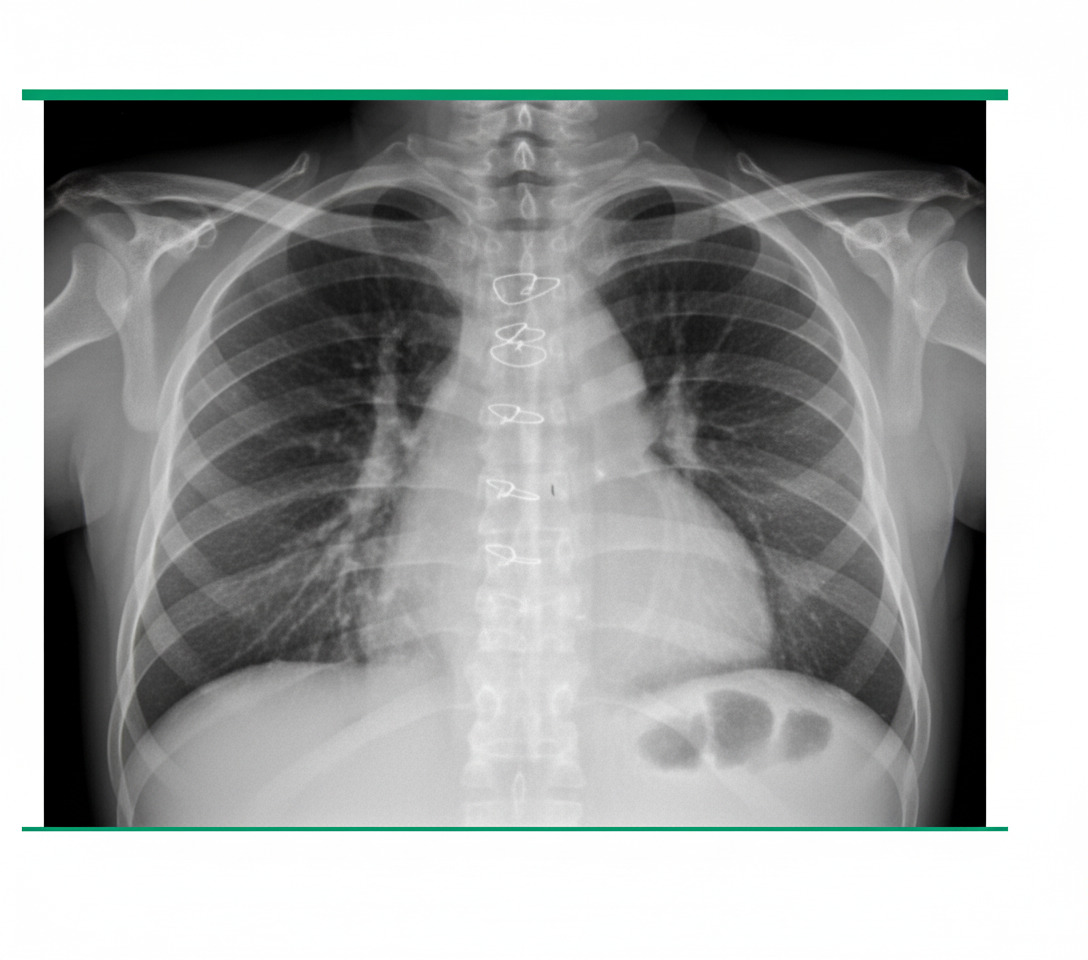
A 50-year-old chronic smoker presents with a chief complaint of hemoptysis and a mass in the wall of the right main bronchus causing tapered narrowing and irregular stenosis. Which of the following CT scans would you advise next?
Snowman shaped heart is typically seen in which of the following conditions?
Eggshell calcification is unlikely in which of the following conditions?
What is the characteristic radiological finding in sarcoidosis?
Increased radiolucency of one hemithorax may be caused by all of the following except?
A 40-year-old man has a routine chest X-ray which reveals a posterior mediastinal mass. Which of the following is the most likely diagnosis?
What is the characteristic radiographic sign of acute laryngotracheobronchitis?
Eggshell calcification is characteristic of which of the following conditions?
What is the characteristic X-ray finding in Atrial Septal Defect (ASD)?
Pneumothorax is best demonstrated by taking a radiograph, with the patient in which position?
Explanation: ### Explanation **Correct Option: A. CT Adrenals** The clinical presentation of a chronic smoker with hemoptysis and a mass causing irregular stenosis of the bronchus is highly suggestive of **Bronchogenic Carcinoma**. In the context of lung cancer staging, the **adrenal glands** are the most common site of extrathoracic distant metastasis. According to the TNM staging system, identifying distant metastasis (M1) is crucial for determining resectability and prognosis. Since the adrenals are frequently involved (often asymptomatic), a CT of the upper abdomen (specifically targeting the adrenals) is routinely performed alongside the chest CT during the initial staging workup of lung cancer. **Why other options are incorrect:** * **B & C (CT Pancreas/Kidneys):** While lung cancer can metastasize to these organs, they are significantly less common sites compared to the adrenals, liver, bone, and brain. They are not the primary focus of initial staging unless specific symptoms are present. * **D (Repeat CT Thorax):** Repeating the same scan is redundant. The diagnosis of a bronchial mass has already been established; the next logical step is to stage the disease to plan management (Surgery vs. Chemo-radiation). --- ### Clinical Pearls for NEET-PG * **Most common site of metastasis from Lung Cancer:** Adrenals (often bilateral). * **Most common site of metastasis TO the Lung:** Kidney (RCC - "Cannonball metastasis"). * **Pancoast Tumor:** A superior sulcus tumor often associated with Horner’s Syndrome and erosion of the 1st/2nd ribs. * **Squamous Cell Carcinoma:** Typically central, associated with smoking and cavitary lesions. * **Adenocarcinoma:** Most common type in non-smokers and females; typically peripheral.
Explanation: **Explanation:** The **Snowman appearance** (also known as the **Figure-of-8 heart**) is the classic radiological sign for **Supracardiac Total Anomalous Pulmonary Venous Connection (TAPVC)**. **Why it occurs:** In supracardiac TAPVC, the pulmonary veins drain into a common pulmonary vein, which then drains into a **vertical vein** (left side). This vertical vein connects to the **left innominate (brachiocephalic) vein**, which eventually drains into the **Right Superior Vena Cava (SVC)**. * **The "Head" of the snowman:** Formed by the dilated vertical vein (left), the enlarged innominate vein (top), and the dilated right SVC (right). * **The "Body" of the snowman:** Formed by the enlarged right atrium and right ventricle due to volume overload. **Analysis of Incorrect Options:** * **Tetralogy of Fallot (TOF):** Characterized by a **"Boot-shaped heart" (Coeur en Sabot)** due to right ventricular hypertrophy (lifting the apex) and a narrow pulmonary conus. * **Transposition of Great Vessels (TGA):** Characterized by an **"Egg-on-a-string"** appearance due to a narrow mediastinum (stress-induced thymic atrophy and hyperinflated lungs). * **Coarctation of Aorta:** Associated with the **"Figure-of-3" sign** on X-ray (pre-stenotic and post-stenotic dilatation) and **rib notching** (Roesler’s sign). **High-Yield Clinical Pearls for NEET-PG:** * **TAPVC Types:** Supracardiac (most common, Snowman sign), Cardiac (drains to coronary sinus), and Infracardiac (most severe, associated with pulmonary congestion). * **Box-shaped heart:** Seen in Ebstein’s Anomaly. * **Sitting Duck sign:** Seen in Persistent Truncus Arteriosus. * **Scimitar sign:** Seen in Partial Anomalous Pulmonary Venous Return (PAPVR).
Explanation: **Explanation:** **Eggshell calcification** refers to a characteristic radiological pattern where thin, peripheral calcification occurs in the rim of hilar or mediastinal lymph nodes. **Why Castleman Disease is the correct answer:** While Castleman disease (angiofollicular lymph node hyperplasia) is a lymphoproliferative disorder that causes significant lymphadenopathy, it typically presents with **central, coarse, or "popcorn-like" calcification** rather than peripheral eggshell calcification. It is also known for intense contrast enhancement on CT due to its hypervascular nature. **Analysis of Incorrect Options:** * **Silicosis:** This is the most classic and common cause of eggshell calcification (occurring in ~5% of cases). It results from the inhalation of silica particles, leading to fibrotic nodules. * **Coal Worker’s Pneumoconiosis (CWP):** Similar to silicosis, CWP can lead to progressive massive fibrosis and peripheral calcification of the lymph nodes. * **Scleroderma (Systemic Sclerosis):** Though less common than in pneumoconiosis, eggshell calcification can be seen in the mediastinal nodes of patients with scleroderma, even in the absence of silicosis. **NEET-PG High-Yield Pearls:** * **Mnemonic for Eggshell Calcification:** **"S-C-A-R-E"** * **S:** Silicosis (Most common), Sarcoidosis (5%) * **C:** Coal Worker's Pneumoconiosis * **A:** Amyloidosis * **R:** Radiation therapy (e.g., treated Hodgkin Lymphoma) * **E:** Ex-infectious (Histoplasmosis, Blastomycosis) or Rare causes like Scleroderma. * **Key Distinction:** If a question mentions "Eggshell calcification + Upper lobe nodules," think **Silicosis**. If it mentions "Eggshell calcification + Bilateral hilar lymphadenopathy + Non-caseating granulomas," think **Sarcoidosis**.
Explanation: **Explanation:** **Sarcoidosis** is a multisystem granulomatous disease of unknown etiology characterized by non-caseating granulomas. The most common and characteristic radiological presentation (seen in approximately 90% of patients) is **Bilateral Hilar Lymphadenopathy (BHL)**. 1. **Why BHL is correct:** In Sarcoidosis, the lymphadenopathy is typically symmetrical and involves both the hilar and paratracheal nodes (often forming the "1-2-3 sign" or Garland’s triad). On a PA chest X-ray, this appears as well-defined, lobulated masses at the hila. 2. **Why other options are incorrect:** * **Parenchymal disease:** While it occurs in later stages (Stage II-IV), it is not as "characteristic" or early a finding as BHL. * **Unilateral hilar lymphadenopathy:** This is rare in sarcoidosis and should prompt a search for alternative diagnoses like Tuberculosis, Lymphoma, or Malignancy. * **Miliary shadow:** This is the hallmark of Miliary Tuberculosis. While sarcoidosis can present with a micronodular pattern, it is usually distributed along the bronchovascular bundles (perilymphatic distribution), unlike the random distribution of miliary TB. **High-Yield Clinical Pearls for NEET-PG:** * **Scadding’s Staging of Sarcoidosis:** * Stage 0: Normal CXR. * Stage I: BHL alone (Best prognosis). * Stage II: BHL + Parenchymal infiltrates. * Stage III: Parenchymal infiltrates alone. * Stage IV: Pulmonary Fibrosis (Honeycombing). * **Panda Sign & Gallium-67 Scan:** Increased uptake in parotid, lacrimal glands, and hila. * **Eggshell Calcification:** Seen in hilar nodes (also seen in Silicosis). * **Kveim Test:** Historically used skin test (now largely replaced by biopsy).
Explanation: ### Explanation The radiolucency (blackness) of a lung on a chest X-ray is determined by the ratio of air to soft tissue/blood. An **increased radiolucency** means the hemithorax appears darker than normal. **Why "Expiratory Film" is the correct answer:** During expiration, the lungs contain less air and the thoracic volume decreases. This causes the lung parenchyma to become more compressed and the pulmonary vasculature to appear more crowded. Consequently, an expiratory film leads to **decreased radiolucency (increased opacity/whiteness)** of the lungs, not increased radiolucency. It is often used to detect small pneumothoraces or foreign body air trapping, but the overall effect on a normal lung is increased density. **Analysis of Incorrect Options:** * **Obstructive Emphysema:** A foreign body or tumor can create a "ball-valve" effect, allowing air in during inspiration but trapping it during expiration. This leads to hyperinflation and increased radiolucency of the affected side. * **Pneumothorax:** The presence of air in the pleural space (outside the lung) increases the total air volume in the hemithorax and lacks lung markings, resulting in a classic hyperlucent appearance. * **Patient Rotation:** If a patient is rotated, the distance between the X-ray source and the chest wall changes. The side rotated away from the film appears more lucent due to decreased soft tissue attenuation (Macleod’s sign can sometimes be mimicked by rotation). **High-Yield Clinical Pearls for NEET-PG:** * **Unilateral Hyperlucent Lung:** Always consider **Swyer-James-MacLeod Syndrome** (post-infectious obliterative bronchiolitis) in differentials. * **Mastectomy:** A common "trick" cause for unilateral hyperlucency due to the loss of overlying breast soft tissue. * **Poland Syndrome:** Congenital absence of the pectoralis major muscle, leading to a hyperlucent hemithorax on the affected side. * **Technical Tip:** A good inspiratory film should show **10 posterior ribs** or **6 anterior ribs** above the diaphragm.
Explanation: ### Explanation The mediastinum is traditionally divided into anterior, middle, and posterior compartments. The **posterior mediastinum** is defined as the space between the pericardium/trachea anteriorly and the vertebral column posteriorly (the paravertebral sulcus). **1. Why Neurogenic Tumor is Correct:** Neurogenic tumors are the **most common cause of a posterior mediastinal mass**, accounting for approximately 75% of masses in this compartment. They arise from peripheral nerves (Schwannoma, Neurofibroma), sympathetic ganglia (Ganglioneuroma, Neuroblastoma), or paraganglionic tissue. On imaging, they typically appear as well-circumscribed, rounded masses in the paravertebral area and may cause "scalloping" of the vertebral bodies or widening of the intervertebral foramina (the "dumbbell" sign). **2. Why Other Options are Incorrect:** * **Lipoma:** While lipomas can occur anywhere, they are rare in the mediastinum and more commonly found in the anterior compartment (cardiophrenic angles). * **Esophageal Cyst:** These are duplication cysts. While they are located in the posterior mediastinum, they are significantly less common than neurogenic tumors. * **Fibroma:** These are rare mesenchymal tumors and do not represent a primary diagnostic consideration for a posterior mediastinal mass. **3. High-Yield Clinical Pearls for NEET-PG:** * **Anterior Mediastinum (The 4 Ts):** Thymoma (most common), Thyroid (Retrosternal goiter), Teratoma (Germ cell tumors), and "Terrible" Lymphoma. * **Middle Mediastinum:** Most common causes are Lymphadenopathy (Sarcoid, TB, Malignancy) and Bronchogenic cysts. * **Posterior Mediastinum:** Neurogenic tumors are the hallmark. * **Imaging Sign:** The **Cervicothoracic Sign** helps differentiate masses; if the cephalad border of a mass is visible above the clavicles, it is located in the posterior mediastinum.
Explanation: **Explanation:** **Acute Laryngotracheobronchitis (Croup)** is a viral infection (most commonly caused by **Parainfluenza virus**) that leads to inflammation and subglottic edema. **Why "Steeple Sign" is correct:** In Croup, the inflammatory edema occurs in the subglottic region (just below the vocal cords). On an Anteroposterior (AP) neck X-ray, this narrowing of the subglottic airway creates a tapered, inverted "V" appearance, resembling a church steeple. This is the classic radiographic hallmark of the disease. **Analysis of Incorrect Options:** * **Thumb sign:** This is the characteristic finding of **Acute Epiglottitis**. On a lateral neck X-ray, the enlarged, edematous epiglottis appears rounded and thick, resembling a thumb. * **Vallecula sign:** This refers to the obliteration of the vallecular space on a lateral X-ray, also seen in **Acute Epiglottitis**. In a normal scan, the vallecula is a clear pocket of air; its disappearance indicates significant epiglottic swelling. **High-Yield Clinical Pearls for NEET-PG:** * **Clinical Triad:** Barking cough, inspiratory stridor, and hoarseness. * **Age Group:** Typically affects children aged 6 months to 3 years. * **Radiology Tip:** The Steeple sign is seen on the **AP view**, whereas the Thumb sign is seen on the **Lateral view**. * **Management:** Nebulized adrenaline (for immediate relief of edema) and Dexamethasone (to reduce inflammation) are the mainstays of treatment.
Explanation: ### **Explanation** **Silicosis** is the classic and most common cause of **eggshell calcification**. This radiological sign refers to the peripheral, rim-like calcification of the hilar and mediastinal lymph nodes. It occurs when inhaled silica particles are ingested by alveolar macrophages, which then migrate to the regional lymph nodes, causing a granulomatous reaction and subsequent peripheral calcification. #### **Analysis of Options:** * **B. Silicosis (Correct):** It typically presents with small, rounded opacities in the upper lobes. Eggshell calcification of hilar nodes is seen in approximately 5% of cases and is highly suggestive of the disease. * **A. Asbestosis:** Characterized by pleural plaques (most common) and subpleural linear opacities in the lower lobes. Calcification in asbestosis usually involves the **parietal pleura** (diaphragmatic calcification), not the lymph nodes in an "eggshell" pattern. * **C. Berylliosis:** While it presents with non-caseating granulomas similar to sarcoidosis, eggshell calcification is extremely rare compared to silicosis. * **D. Carcinoma:** Bronchogenic carcinoma typically presents as a mass lesion. While lymph nodes may be enlarged due to metastasis, they rarely exhibit peripheral rim calcification unless the patient had prior radiotherapy. #### **High-Yield Clinical Pearls for NEET-PG:** * **Differential Diagnosis for Eggshell Calcification:** 1. **Silicosis** (Most common) 2. **Coal Worker’s Pneumoconiosis (CWP)** 3. **Sarcoidosis** (Seen in ~5% of cases) 4. Post-irradiation (e.g., Hodgkin Lymphoma) 5. Blastomycosis (Rare) * **Silicosis & TB:** Patients with silicosis have a 30-fold increased risk of developing Tuberculosis (**Silicotuberculosis**) due to impaired macrophage function. * **PMF:** Progressive Massive Fibrosis is a late-stage complication of silicosis and CWP, characterized by large conglomerate masses (>1 cm) in the upper lobes.
Explanation: ### Explanation **Correct Answer: D. Pulmonary plethora** **Mechanism:** Atrial Septal Defect (ASD) is an acyanotic congenital heart disease characterized by a **left-to-right shunt** at the atrial level. Because the pressure in the left atrium is higher than in the right atrium, blood flows back into the right side of the heart. This leads to an increased volume of blood being pumped into the lungs via the right ventricle. On a chest X-ray, this increased pulmonary blood flow manifests as **pulmonary plethora** (increased vascular markings extending to the outer third of the lung fields and enlargement of the pulmonary arteries). **Analysis of Incorrect Options:** * **A & B (Enlarged Left Atrium/Ventricle):** In ASD, the shunt occurs *before* blood reaches the left ventricle. Therefore, the left-sided chambers are typically normal-sized or even small. Left-sided enlargement is characteristic of **Ventricular Septal Defects (VSD)** or **Patent Ductus Arteriosus (PDA)**. * **C (Pulmonary Arterial Hypertension):** While chronic ASD can eventually lead to PAH (Eisenmenger syndrome), it is a late complication rather than the primary characteristic finding. In early or uncomplicated ASD, plethora is the hallmark. **NEET-PG High-Yield Pearls:** * **Radiological Triad of ASD:** 1. Small aortic knuckle (due to decreased systemic output), 2. Enlarged right atrium and right ventricle, 3. Pulmonary plethora. * **Clinical Sign:** Fixed dilated splitting of the second heart sound (S2). * **Most Common Type:** Ostium secundum (located in the region of the fossa ovalis). * **ECG Finding:** Right Bundle Branch Block (RBBB) and right axis deviation are common.
Explanation: ### Explanation **Why End Expiration is the Correct Answer:** A pneumothorax is best demonstrated on an **end-expiratory** film. During expiration, the volume of the lungs decreases while the volume of the intrapleural air remains constant. This results in two key changes that make the pneumothorax more visible: 1. **Increased Density:** The lung parenchyma becomes denser (more radiopaque) as air is pushed out, providing a sharper contrast against the radiolucent (black) pleural air. 2. **Relative Volume Increase:** The pneumothorax occupies a larger percentage of the hemithorax relative to the deflated lung, making small apical slivers of air easier to detect. **Analysis of Incorrect Options:** * **Full/Mid Inspiration:** These are the standard positions for routine chest X-rays. During inspiration, the expanding lung pushes against the pleural air, potentially masking a small pneumothorax and making the lung parenchyma more lucent, which reduces contrast. * **Supine:** This is the least sensitive position. In a supine patient, air intrapleural air tracks anteromedially and basally rather than apically. This can lead to the **"Deep Sulcus Sign"** (an abnormally deepened, lucent costophrenic angle), which is often missed compared to the classic visceral pleural line seen on upright films. **NEET-PG High-Yield Pearls:** * **Gold Standard:** While expiratory X-rays are classic for exams, **Non-contrast CT (NCCT) Chest** is the most sensitive imaging modality for detecting a pneumothorax. * **Initial Investigation:** The first-line investigation remains an **Erect Posteroanterior (PA) Chest X-ray**. * **Tension Pneumothorax:** This is a **clinical diagnosis**. Imaging should never delay decompression (needle thoracostomy in the 5th intercostal space, mid-axillary line). * **Radiological Sign:** Look for the **visceral pleural line** with an absence of peripheral lung markings (vascular shadows).
Normal Chest Radiographic Anatomy
Practice Questions
Radiographic Signs in Chest Imaging
Practice Questions
Pulmonary Infections
Practice Questions
Chronic Obstructive Pulmonary Disease
Practice Questions
Interstitial Lung Diseases
Practice Questions
Pulmonary Neoplasms
Practice Questions
Pleural Diseases
Practice Questions
Mediastinal Pathology
Practice Questions
Congenital and Developmental Chest Anomalies
Practice Questions
Pulmonary Vascular Diseases
Practice Questions
Chest Trauma Imaging
Practice Questions
Post-Surgical Chest Imaging
Practice Questions
Get full access to all questions, explanations, and performance tracking.
Start For Free