What does an air bronchogram indicate?
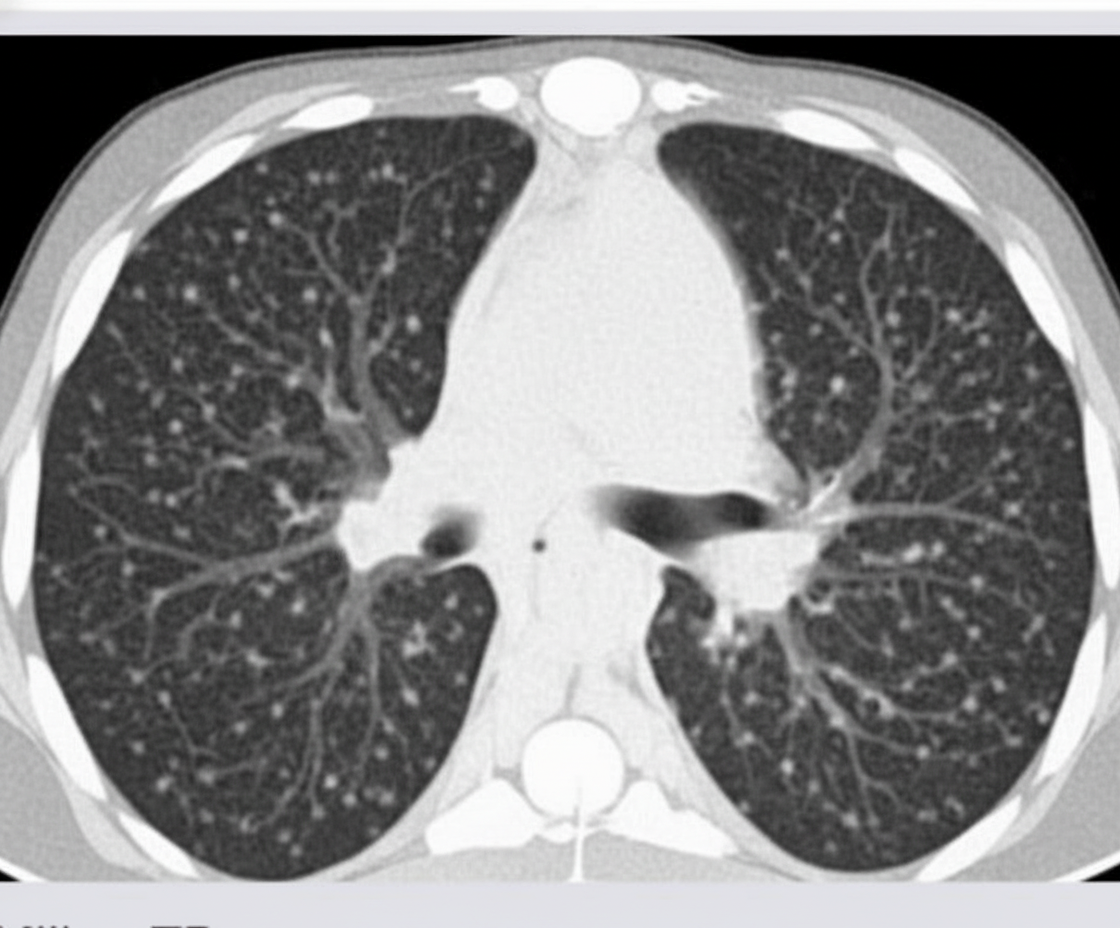
Miliary mottling on chest radiograph can be seen in which of the following conditions?
Superior rib notching is caused by which of the following?
Eggshell calcification is seen in all of the following conditions except?
Honey comb lung appearance is seen in which of the following conditions?
A patient with mitral stenosis has an X-ray. Which of the following findings is NOT typically seen?
What is the best position for a chest X-ray to detect a minimal right pleural effusion?
Air bronchogram in a chest X-ray is found in all of the following conditions except?
Which of the following causes rib notching on chest radiography?
On which view is the right lung best visualized?
Explanation: **Explanation:** An **air bronchogram** is a classic radiological sign where air-filled bronchi (dark/radiolucent) become visible against a background of opaque (white), fluid-filled, or collapsed lung parenchyma. **1. Why Option A is Correct:** The air bronchogram is a hallmark of **intrapulmonary pathology**, specifically involving the alveoli. Under normal conditions, bronchi are not visible because they are surrounded by air-filled alveoli (no contrast). When the surrounding alveoli are filled with fluid (pus, blood, edema) or are collapsed, the air-filled bronchi stand out. This confirms that the pathology is located within the lung tissue itself. Common causes include **lobar pneumonia**, pulmonary edema, and pulmonary hemorrhage. **2. Why Other Options are Incorrect:** * **Option B (Pleural pathology):** Pleural effusions or thickening occur in the space *outside* the lung. These processes displace or compress the lung but do not typically create the contrast between patent bronchi and consolidated alveoli required for an air bronchogram. * **Option C (Mediastinal pathology):** Mediastinal masses are extrinsic to the lung. While they may compress the lung, they do not involve the alveolar-bronchial interface necessary to produce this sign. **NEET-PG High-Yield Pearls:** * **Most common cause:** Lobar pneumonia (Streptococcus pneumoniae). * **Significance:** Its presence **rules out** a pleural or mediastinal origin of an opacity. * **Exception:** An air bronchogram is usually **absent** in obstructive atelectasis (resorption collapse) because the bronchus itself is blocked, preventing air from entering. * **Malignancy:** While usually associated with benign consolidation, it can be seen in **Bronchioloalveolar carcinoma** (now Adenocarcinoma in situ) and Lymphoma.
Explanation: **Explanation:** Miliary mottling refers to the presence of multiple, small (1–4 mm), discrete, rounded opacities scattered throughout both lung fields, resembling millet seeds. This pattern is a classic radiological finding that can arise from various infectious, occupational, and vascular etiologies. * **Tuberculosis (Option B):** This is the most common cause. It results from the hematogenous spread of *Mycobacterium tuberculosis*. The nodules are typically uniform in size and distributed throughout the lungs. * **Pneumoconiosis (Option A):** Occupational lung diseases, particularly **Silicosis** and **Coal Worker’s Pneumoconiosis**, present with diffuse micronodular opacities. In silicosis, these nodules are often more prominent in the upper lobes and may be associated with "eggshell calcification" of hilar lymph nodes. * **Mitral Stenosis (Option C):** Long-standing pulmonary venous hypertension in mitral stenosis can lead to **Pulmonary Hemosiderosis**. This results in the deposition of iron-containing pigment (hemosiderin) in the alveoli, appearing as miliary mottling on a chest X-ray. **High-Yield Clinical Pearls for NEET-PG:** * **Other Causes:** Sarcoidosis, Histoplasmosis, and Metastases (especially from Thyroid, Renal Cell Carcinoma, or Melanoma). * **Differential Diagnosis Tip:** If the nodules are larger and vary in size, consider **Malignant Deposits** (Cannon-ball metastases). * **HRCT:** High-Resolution CT is the gold standard for characterizing the distribution (centrilobular, perilymphatic, or random) of these nodules to narrow the diagnosis. For example, miliary TB shows a **random distribution**.
Explanation: **Explanation:** Rib notching is a classic radiological sign categorized into **inferior** and **superior** types based on the location of the erosion. **Why Marfan Syndrome is correct:** Superior rib notching occurs due to pressure erosion on the upper border of the ribs. In **Marfan Syndrome**, this is typically caused by the deficiency of connective tissue (fibrillin-1), leading to thin, spindly ribs that are susceptible to remodeling and pressure from surrounding structures. Other causes of superior rib notching include restrictive lung disease, collagen vascular diseases (like SLE), and neurofibromatosis. **Analysis of Incorrect Options:** * **Hyperparathyroidism:** This typically causes **subperiosteal bone resorption**, which can affect both borders of the rib but is classically associated with generalized osteopenia and "salt and pepper" skull. * **Poliomyelitis:** While paralytic conditions can cause rib thinning due to intercostal muscle atrophy, it is a less common cause of discrete superior notching compared to connective tissue disorders. * **Blalock-Taussig (BT) Shunt:** This is a classic cause of **unilateral inferior rib notching**. The procedure involves sacrificing the subclavian artery, leading to collateral flow through the intercostal arteries, which erodes the lower border of the ribs. **High-Yield Clinical Pearls for NEET-PG:** 1. **Inferior Rib Notching (Classic):** Most commonly caused by **Coarctation of the Aorta** (3rd to 9th ribs). It is bilateral and spares the 1st and 2nd ribs (supplied by the thyrocervical trunk). 2. **Unilateral Inferior Notching:** Seen in BT Shunts or Coarctation proximal to the left subclavian artery. 3. **Roesler’s Sign:** Another name for the rib notching seen in Coarctation of the Aorta. 4. **Mnemonic for Superior Notching:** "SHAM" (Scleroderma, Hyperparathyroidism, Atrophic/Paralytic states like Polio, Marfan/Melorheostosis).
Explanation: **Explanation:** **Eggshell calcification** refers to a characteristic radiological pattern where calcium deposits occur in the periphery (rim) of enlarged hilar or mediastinal lymph nodes. **Why Osteogenic Sarcoma is the correct answer:** Osteogenic sarcoma (Osteosarcoma) typically presents with **"Sunburst" periosteal reaction** or **Codman’s triangle** on X-ray. While it can metastasize to the lungs, these metastases usually present as "cannonball" nodules or may show dense, amorphous ossification rather than the specific peripheral rim calcification seen in lymph nodes. Therefore, it is the odd one out. **Analysis of other options:** * **Silicosis:** This is the **most common** cause of eggshell calcification. It occurs in about 5% of patients, typically involving the hilar and mediastinal nodes. * **Coal Worker’s Pneumoconiosis (CWP):** Similar to silicosis, CWP can lead to progressive massive fibrosis and peripheral calcification of lymph nodes. * **Sarcoidosis:** Approximately 5% of patients with sarcoidosis develop eggshell calcification, usually in the later stages of the disease. **High-Yield Clinical Pearls for NEET-PG:** * **Mnemonic for Eggshell Calcification:** **"S-S-C"** (Silicosis, Sarcoidosis, Coal worker's pneumoconiosis). * **Other rare causes:** Post-irradiation (Hodgkin lymphoma), Blastomycosis, and Amyloidosis. * **Silicosis Key Fact:** It increases the risk of **Tuberculosis (Silicotuberculosis)** because silica particles impair macrophage function. * **Radiological Sign:** In Silicosis, look for small, rounded opacities in the **upper lobes**.
Explanation: **Explanation:** **Honeycombing** is the radiological hallmark of **end-stage pulmonary fibrosis**. It is characterized by the presence of small, cystic airspaces (3–10 mm in diameter) with thick, well-defined walls, typically arranged in layers in the subpleural and basal regions of the lung. 1. **Why Scleroderma is correct:** Scleroderma (Systemic Sclerosis) is a connective tissue disorder frequently associated with **Interstitial Lung Disease (ILD)**, most commonly the NSIP (Non-Specific Interstitial Pneumonitis) or UIP (Usual Interstitial Pneumonitis) patterns. Chronic inflammation leads to irreversible architectural distortion and fibrosis, resulting in the classic "honeycomb" appearance on HRCT. 2. **Why other options are incorrect:** * **Consolidation:** Characterized by the replacement of alveolar air with fluid, pus, or cells. It presents as increased lung opacity with **air bronchograms**, not cystic fibrosis. * **Alveolar cell carcinoma (Adenocarcinoma in situ):** Typically presents as a "ground-glass" nodule or a lepidic growth pattern (pneumonic form), often showing the **"CT angiogram sign."** * **Pulmonary edema:** Features include Kerley B lines, pleural effusion, and peribronchial cuffing due to fluid overload, which is reversible and non-fibrotic. **High-Yield Clinical Pearls for NEET-PG:** * **HRCT** is the gold standard for diagnosing honeycombing. * **Differential Diagnosis for Honeycombing (Mnemonic: SHIT):** **S**arcoidosis (Stage IV), **H**istiocytosis X (LCH), **I**diopathic Pulmonary Fibrosis (IPD/UIP), **T**herapeutic drugs (Amiodarone/Bleomycin) or **T**he Connective tissue diseases (Scleroderma/RA). * **UIP Pattern:** Honeycombing is a mandatory requirement for a "Definite UIP" diagnosis on HRCT.
Explanation: In **Mitral Stenosis (MS)**, the primary hemodynamic consequence is the enlargement of the **Left Atrium (LA)** due to pressure and volume overload. ### Why Option C is the Correct Answer **Obliteration of the retrosternal space** on a lateral X-ray is a sign of **Right Ventricular (RV) enlargement**. In pure or early Mitral Stenosis, the left atrium enlarges posteriorly. While chronic MS can eventually lead to pulmonary hypertension and RV hypertrophy, the most characteristic lateral X-ray finding is the **obliteration of the retrocardiac space** (posteriorly), not the retrosternal space (anteriorly). ### Analysis of Incorrect Options (Findings seen in MS): * **A. Lifting up of left bronchus:** As the Left Atrium enlarges superiorly, it pushes the left main bronchus upward, widening the **carinal angle** (normal is <60-75°). * **B. Double atrial shadow:** This is seen on a PA view. The enlarged LA border projects behind the right atrial border, creating a "shadow within a shadow" or the **"Double Density Sign."** * **D. Posterior displacement of esophagus:** Because the LA is the most posterior chamber, its enlargement causes a smooth indentation and posterior displacement of the esophagus, clearly visible on a **Barium Swallow**. ### High-Yield Clinical Pearls for NEET-PG: * **Straightening of the Left Cardiac Border:** This is the earliest sign of MS on a PA view, caused by a prominent left atrial appendage and a dilated pulmonary artery. * **Mitralization of Heart:** The heart takes on a "pear-shaped" appearance. * **Kerley B Lines:** Horizontal lines at the lung bases indicating pulmonary venous hypertension (interstitial edema). * **Most sensitive view for LA enlargement:** Lateral X-ray with Barium Swallow.
Explanation: **Explanation:** The detection of pleural effusion on a chest X-ray depends on the volume of fluid and the patient's position relative to gravity. **Why Right Lateral Decubitus is Correct:** In the lateral decubitus position, the patient lies on their side. Gravity causes free-flowing pleural fluid to accumulate along the dependent chest wall. This creates a linear opacity between the inner rib cage and the lung parenchyma. The **Right Lateral Decubitus** is the most sensitive projection for a **right-sided** effusion because it allows even minimal amounts of fluid (as little as **5–10 mL**) to be visualized. **Analysis of Incorrect Options:** * **Erect (PA/AP):** This is the standard screening view. However, it requires at least **175–200 mL** of fluid to cause "blunting" of the costophrenic angle. It is not sensitive enough for "minimal" effusions. * **Supine:** In a supine patient, fluid layers posteriorly. This results in a vague, ground-glass opacification (veiling) of the entire hemithorax rather than a distinct fluid level, making it very difficult to quantify small amounts. * **Left Lateral Decubitus:** This position would be used to detect a minimal *left-sided* effusion. For a right-sided effusion, the fluid would move toward the mediastinum, making it harder to see. **NEET-PG High-Yield Pearls:** * **Sensitivity Hierarchy:** Lateral Decubitus (5-10 mL) > Lateral View (75 mL) > Erect PA View (175-200 mL). * **USG Chest:** The gold standard for bedside detection and localization; it can detect as little as **3–5 mL** of fluid. * **Loculated Effusion:** If fluid does not shift on a decubitus film, it suggests the effusion is loculated (common in empyema). * **Ellis S-shaped curve:** The characteristic upper border of a large pleural effusion seen on an erect X-ray.
Explanation: ### Explanation An **Air Bronchogram** occurs when air-filled bronchi (dark) become visible against a background of opacified, fluid-filled, or collapsed alveoli (white). For this sign to be present, the conducting airways must remain patent (open) while the surrounding lung parenchyma loses its aeration. **Why Pleural Effusion is the Correct Answer:** In **Pleural Effusion**, fluid accumulates in the pleural space, *outside* the lung. This fluid compresses the lung tissue (passive atelectasis), leading to the collapse of both the alveoli and the bronchi. Since the bronchi are no longer air-filled, they cannot provide the necessary contrast to create an air bronchogram. **Analysis of Incorrect Options:** * **Consolidation (e.g., Pneumonia):** This is the classic cause. Alveoli are filled with inflammatory exudate, but the bronchi remain patent, making them clearly visible. * **Pulmonary Edema:** In the alveolar stage of edema, fluid fills the air sacs while the bronchial tree remains open, often creating a "bat-wing" appearance with air bronchograms. * **Alveolar Cell Carcinoma (Adenocarcinoma in situ):** This tumor grows along the alveolar walls (lepidic growth) without destroying the underlying lung architecture or obstructing the bronchi, frequently presenting as a persistent consolidation with air bronchograms. **NEET-PG High-Yield Pearls:** * **The "Golden S Sign":** Seen in obstructive collapse (e.g., bronchogenic carcinoma) where a bronchus is blocked; air bronchograms are **absent** here. * **Non-obstructive Atelectasis:** Air bronchograms can be seen in compression or cicatrization atelectasis. * **Common Causes:** Pneumonia (most common), Hyaline Membrane Disease (RDS in neonates), and Pulmonary Infarction.
Explanation: **Explanation:** **1. Why Coarctation of the Aorta is correct:** Rib notching in Coarctation of the Aorta is a classic radiological sign (Roesler’s sign). It occurs due to the development of **extensive collateral circulation** to bypass the aortic obstruction. High-pressure blood flows through the internal mammary arteries into the intercostal arteries. These intercostal arteries become dilated, tortuous, and pulsatile, causing pressure erosion (notching) on the **inferior borders** of the 3rd to 8th ribs. *Note: The 1st and 2nd ribs are spared because their intercostal arteries arise from the costocervical trunk, which originates proximal to the coarctation.* **2. Why the other options are incorrect:** * **Modified Blalock-Taussig (BT) Shunt:** This involves a graft between the subclavian and pulmonary arteries. While a classic BT shunt (using the subclavian artery itself) could cause **unilateral** rib notching due to reduced flow, the modified version typically does not. * **Bidirectional Glenn Shunt:** This involves an anastomosis between the SVC and the right pulmonary artery. It does not involve the intercostal arterial system and thus does not cause rib notching. * **IVC Occlusion:** While venous obstruction (like SVC syndrome) can cause venous collateralization, it rarely causes the significant pressure erosion required for visible rib notching on X-ray. **3. High-Yield Clinical Pearls for NEET-PG:** * **Roesler’s Sign:** Inferior rib notching (3rd–8th ribs). * **Figure-of-3 Sign:** Seen on CXR (pre-stenotic dilation, the indentation at the coarctation, and post-stenotic dilation). * **Reverse 'E' Sign:** The corresponding indentation seen on a Barium swallow. * **Superior Rib Notching:** Rare; associated with connective tissue disorders (e.g., Neurofibromatosis, Marfan syndrome) or Osteogenesis Imperfecta. * **Unilateral Rib Notching:** Suggests the coarctation is proximal to the origin of the left subclavian artery (notching on the right only).
Explanation: **Explanation:** The **Lateral view** is the correct answer because it provides a comprehensive profile of the lung parenchyma, the retrosternal and retrocardiac spaces, and the posterior costophrenic sulci. While frontal views (PA/AP) involve significant overlap of the heart and mediastinum, the lateral view allows for the visualization of the entire vertical extent of the right lung, including the middle lobe and the posterior segments of the lower lobe, which are often obscured on other views. **Analysis of Options:** * **Right Posterior Oblique (RPO):** In this position, the right side of the back is against the film. This view is primarily used to elongate and study the **left** lung and the right axillary ribs. * **Right Anterior Oblique (RAO):** In this position, the right front of the chest is against the film. This view is traditionally used to visualize the **left** lung and the heart's left atrium. * **Left Anterior Oblique (LAO):** This view is excellent for visualizing the **right lung** and the aortic arch. However, the **Lateral view** remains the gold standard for a complete anatomical survey of a single lung's lobes and fissures. **High-Yield Clinical Pearls for NEET-PG:** * **The "Silhouette Sign":** Loss of the right heart border on a PA view indicates pathology in the **Right Middle Lobe**. * **Fissures:** On a lateral X-ray, the **Major (Oblique) fissure** separates the upper/middle lobes from the lower lobe, while the **Minor (Horizontal) fissure** (only on the right) separates the upper and middle lobes. * **Posterior Costophrenic Angle:** This is the deepest part of the pleura; it is best seen on a lateral view and can detect as little as **25-50 ml** of pleural fluid, whereas a PA view requires ~150-200 ml.
Normal Chest Radiographic Anatomy
Practice Questions
Radiographic Signs in Chest Imaging
Practice Questions
Pulmonary Infections
Practice Questions
Chronic Obstructive Pulmonary Disease
Practice Questions
Interstitial Lung Diseases
Practice Questions
Pulmonary Neoplasms
Practice Questions
Pleural Diseases
Practice Questions
Mediastinal Pathology
Practice Questions
Congenital and Developmental Chest Anomalies
Practice Questions
Pulmonary Vascular Diseases
Practice Questions
Chest Trauma Imaging
Practice Questions
Post-Surgical Chest Imaging
Practice Questions
Get full access to all questions, explanations, and performance tracking.
Start For Free