What is the investigation of choice for a solitary pulmonary nodule?
A chest X-ray of an industrial worker with 20 years of asbestos exposure shows a diffuse appearance of the lower lobe with a 'comet tail' infarct on a PA view. What is the most likely diagnosis?
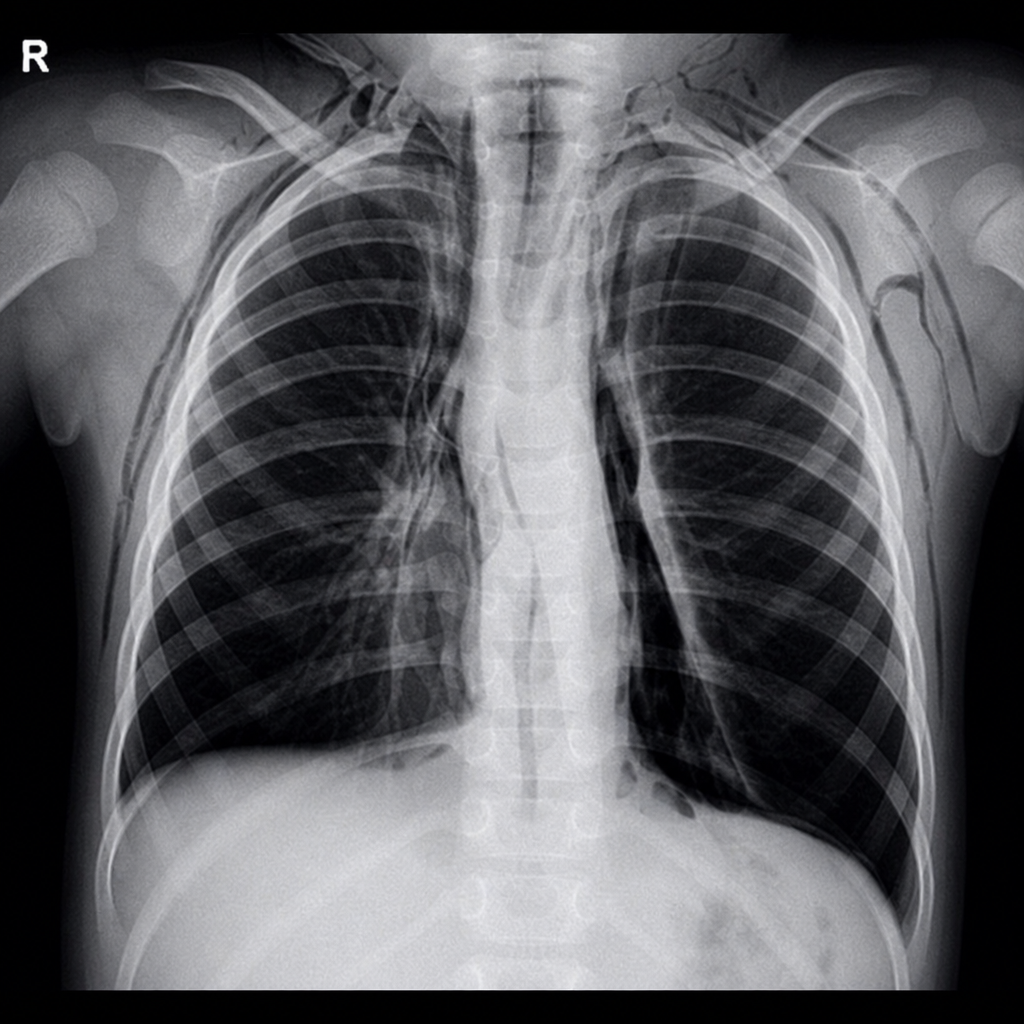
What findings are shown on the chest X-ray of the patient?

Obscuration of the left heart border is suggestive of which of the following conditions?
Millet seed like pattern is seen in which of the following conditions?
The "water lily sign" on a chest X-ray is characteristic of which condition?
Pulmonary embolism is best diagnosed by which imaging modality?
Which of the following statements regarding signs of pulmonary embolism are TRUE or FALSE?
Potato nodes are a characteristic feature of which of the following conditions?
Which of the following statements is false regarding the role of chest radiography in a patient presenting with acute abdomen?
Explanation: **Explanation:** A **Solitary Pulmonary Nodule (SPN)** is defined as a single, well-circumscribed opacity measuring $\leq$ 3 cm in diameter, surrounded by aerated lung, and without associated atelectasis or lymphadenopathy. **Why CT Scan is the Investigation of Choice:** Contrast-Enhanced Computed Tomography (CECT) of the chest is the gold standard for evaluating an SPN. It provides superior spatial resolution, allowing for the precise assessment of morphological features that help differentiate benign from malignant lesions. Key features evaluated on CT include: * **Margins:** Spiculated (malignant) vs. smooth (benign). * **Calcification patterns:** Eccentric/stippled (malignant) vs. central/popcorn/diffuse (benign). * **Density:** Measured in Hounsfield Units (HU); fat density suggests a hamartoma. * **Growth:** Comparing doubling time with previous scans. **Why other options are incorrect:** * **X-ray:** Usually the initial modality where a nodule is first detected, but it lacks the sensitivity to characterize the internal features or detect small nodules (< 5 mm). * **MRI:** Limited role in lung parenchyma due to low proton density and motion artifacts from respiration. It is generally reserved for evaluating chest wall invasion or Pancoast tumors. * **Ultrasound:** Ineffective for lung parenchyma because air reflects ultrasound waves. It is only useful for peripheral lesions abutting the pleura or for guiding biopsies. **High-Yield Clinical Pearls for NEET-PG:** * **Size Matters:** Lesions > 3 cm are termed "Lung Masses" and have a much higher risk of malignancy. * **Popcorn Calcification:** Pathognomonic for **Pulmonary Hamartoma**. * **Fleischner Society Guidelines:** These are used to determine the follow-up frequency of nodules based on size and patient risk factors. * **PET-CT:** The best non-invasive modality to assess the metabolic activity of a nodule (standardized uptake value, SUV > 2.5 suggests malignancy).
Explanation: **Explanation:** The correct answer is **Mesothelioma**, although the question describes a classic radiological sign typically associated with **Round Atelectasis**. In the context of NEET-PG and similar competitive exams, when a patient has long-term asbestos exposure (20+ years) and a "comet tail" sign is mentioned alongside a diffuse lower lobe appearance, examiners often point toward Mesothelioma if it is the intended "most likely" malignant outcome or if the "comet tail" is being used to describe pleural thickening/folding associated with the malignancy. *Note: In strict radiological terms, the "Comet Tail Sign" is pathognomonic for Round Atelectasis. However, if the clinical vignette emphasizes heavy industrial exposure and diffuse involvement, the examiner may be testing the most serious asbestos-related pleural complication.* **Analysis of Options:** * **Mesothelioma (A):** The most serious pleural malignancy associated with asbestos. While it typically presents as nodular pleural thickening or effusion, it can coexist with areas of rounded atelectasis. * **Round Atelectasis (D):** Classically presents with the "Comet Tail Sign" (vessels and bronchi curving toward a pleural-based mass). It is a benign condition caused by pleural folding. If this were a "best fit" for the sign alone, D would be the answer; however, in many standardized keys, asbestos + lower lobe mass = Mesothelioma. * **Lobular Collapse (B):** Usually presents with displacement of fissures and increased opacity of a lobe, not a focal "comet tail" appearance. * **Bronchogenic Carcinoma (C):** The most common cancer in asbestos workers (especially smokers), but it usually presents as a hila/parenchymal mass rather than the specific pleural-based "comet tail" morphology. **High-Yield Clinical Pearls for NEET-PG:** * **Comet Tail Sign:** Formed by the distortion of bronchovascular bundles converging toward an area of round atelectasis. * **Asbestos Exposure:** Most common malignancy is **Bronchogenic Carcinoma**; most specific malignancy is **Mesothelioma**. * **Pleural Plaques:** The most common radiological manifestation of asbestos exposure (usually involves the parietal pleura of the 6th–9th ribs and diaphragm). * **Latency:** Mesothelioma typically has a long latency period of 30–40 years.
Explanation: ***Reticular shadows*** - **Reticular pattern** appears as a fine, net-like or lace-like pattern of linear opacities on chest X-ray, typically indicating **interstitial lung disease**. - This pattern is commonly associated with **pulmonary fibrosis** and represents thickened interstitial septa and alveolar walls. *Emphysema* - Characterized by **hyperinflation** and **flattened diaphragms** with increased lung volumes, not reticular patterns. - Shows **decreased vascular markings** and **hyperlucent lung fields** due to destruction of alveolar walls. *Batwing edema* - Presents as bilateral **perihilar opacities** in a butterfly or bat-wing configuration, typically seen in **acute pulmonary edema**. - Associated with **cardiogenic pulmonary edema** and shows **air-space consolidation**, not reticular patterns. *Kerley B lines* - Appear as thin, horizontal **septal lines** at the lung periphery, typically in the **lower zones**. - Represent thickened interlobular septa due to **pulmonary edema** or **lymphatic congestion**, distinct from reticular shadows.
Explanation: ### Explanation The correct answer is **Lingular pathology**. #### 1. The Underlying Concept: The Silhouette Sign The "Silhouette Sign" is a fundamental principle in chest radiology. It occurs when two objects of the same radiodensity (e.g., water/soft tissue) are in direct anatomical contact; the border between them disappears. * The **left heart border** is an anterior structure. * The **lingula** (a segment of the left upper lobe) is also an anterior structure that lies in direct contact with the left heart border. * Therefore, any pathology that replaces air in the lingula (like pneumonia, collapse, or a mass) with soft tissue density will obscure the left heart border. #### 2. Analysis of Incorrect Options * **A. Pneumothorax:** This involves air in the pleural space. Air is radiolucent (black) and provides *increased* contrast against the heart border, making the border sharper, not obscured. * **B. Pleural effusion:** While a large effusion can obscure the heart, it typically starts by obliterating the costophrenic angles. A localized obscuration of the left heart border specifically points to the adjacent lung parenchyma (lingula). * **C. Right upper lobe collapse:** This would affect the right side of the mediastinum/superior vena cava. It has no anatomical relationship with the left heart border. #### 3. High-Yield Clinical Pearls for NEET-PG To master the Silhouette Sign, remember these specific pairings: * **Right Heart Border:** Obscured by **Right Middle Lobe** pathology. * **Left Heart Border:** Obscured by **Lingular** pathology. * **Right Diaphragm:** Obscured by **Right Lower Lobe** pathology. * **Left Diaphragm:** Obscured by **Left Lower Lobe** pathology. * **Descending Aorta:** Obscured by **Left Lower Lobe** pathology.
Explanation: **Explanation:** The term **"millet seed-like pattern"** refers to a **miliary pattern** on a chest X-ray, characterized by numerous fine, discrete, rounded opacities (usually 1–3 mm in diameter) distributed uniformly throughout both lung fields. **1. Why "All of the Above" is Correct:** While **Miliary Tuberculosis** is the most classic and common cause (resulting from hematogenous spread of *M. tuberculosis*), several other conditions can mimic this radiological appearance: * **Miliary TB (Option A):** The prototype for this pattern. It represents hematogenous dissemination. * **Pulmonary Hemosiderosis (Option B):** Recurrent alveolar hemorrhage leads to iron deposition (hemosiderin) in the interstitium, which presents as diffuse, fine nodular opacities. * **Healed Varicella Pneumonia (Option C):** After the acute phase of chickenpox pneumonia, the lesions often heal by forming multiple, tiny, punctate calcifications that persist for years, mimicking a miliary pattern. **2. Other Differentials for Miliary Pattern:** * **Fungal infections:** Histoplasmosis, Coccidioidomycosis. * **Malignancy:** Miliary metastases (e.g., Thyroid papillary CA, Renal cell CA, Melanoma, Trophoblastic tumors). * **Occupational:** Silicosis (early stages), Coal worker's pneumoconiosis. * **Sarcoidosis:** Stage II/III can present with diffuse micronodules. **High-Yield Clinical Pearls for NEET-PG:** * **Snowstorm appearance:** Often used interchangeably with miliary patterns in the context of **Metastatic Thyroid Carcinoma** or **Trophoblastic tumors**. * **Calcified miliary nodules:** Most commonly seen in **Healed Varicella**, **Healed Histoplasmosis**, and **Mitral Stenosis** (ossific nodules). * **HRCT:** The gold standard for evaluating miliary patterns; it helps differentiate between random (hematogenous), centrilobular, or perilymphatic distributions.
Explanation: The **Water Lily Sign** (also known as the Camelote sign) is a classic radiological finding pathognomonic for a **ruptured pulmonary hydatid cyst**, caused by the parasite *Echinococcus granulosus*. ### **Why Hydatid Cyst is Correct** A hydatid cyst consists of three layers: the pericyst (host tissue), the ectocyst (outer membrane), and the endocyst (inner germinal layer). When the cyst ruptures into the bronchial tree, air enters between the pericyst and the endocyst. As the fluid drains, the endocyst collapses and floats on the residual fluid within the cavity. On a chest X-ray or CT, these **undulating, collapsed membranes floating on fluid** resemble the leaves of a water lily. ### **Analysis of Incorrect Options** * **Tuberculosis (A):** Typically presents with upper lobe infiltrates, cavitation, or Ghon complexes. While it causes cavities, it does not produce floating membranes. * **Cryptococcosis (C):** Usually presents as solitary or multiple pulmonary nodules or masses, often in immunocompromised patients, but lacks the specific membrane collapse of hydatid disease. * **Aspergillosis (D):** Associated with the **"Monod sign"** or **"Air Crescent sign,"** where a fungus ball (aspergilloma) sits within a pre-existing cavity. Unlike the water lily sign, the mass in aspergillosis is solid and mobile, not a floating membrane. ### **High-Yield Clinical Pearls for NEET-PG** * **Causative Agent:** *Echinococcus granulosus* (Dog is the definitive host; Human is the accidental intermediate host). * **Other Signs of Hydatid Cyst:** * **Crescent Sign/Air Hammer Sign:** Air between the pericyst and exocyst. * **Whirl Sign:** Appearance of detached membranes on CT. * **Treatment:** Surgical excision is preferred; **PAIR** (Puncture, Aspiration, Injection, Re-aspiration) is generally avoided in the lungs due to the risk of anaphylaxis and pneumothorax.
Explanation: **Explanation:** **CT Pulmonary Angiography (CTPA)** is currently the **gold standard and investigation of choice** for diagnosing Pulmonary Embolism (PE). It allows for direct visualization of the embolus as a filling defect within the pulmonary arteries. Its high sensitivity and specificity, combined with its ability to provide alternative diagnoses (like pneumonia or aortic dissection), make it the preferred first-line imaging modality in clinical practice. **Analysis of Incorrect Options:** * **Ultrasound:** While Lower Limb Doppler is used to detect Deep Vein Thrombosis (DVT), it cannot directly visualize a pulmonary embolus. It is an adjunct, not the primary diagnostic tool for PE. * **Chest X-ray:** Usually the first investigation performed, but it is often **normal** in PE. While it may show signs like *Hampton’s Hump* (wedge-shaped opacity) or *Westermark sign* (focal oligemia), these are rare and non-specific. Its main role is to rule out other causes of chest pain. * **Ventilation-Perfusion (V/Q) Scan:** Previously the investigation of choice, it is now reserved for patients with **contraindications to CTPA**, such as severe renal failure (due to contrast risk) or pregnancy. **High-Yield Clinical Pearls for NEET-PG:** * **Gold Standard:** CT Pulmonary Angiography. * **Most Definitive (Invasive):** Conventional Pulmonary Angiography (rarely used now). * **ECG Finding:** Most common is Sinus Tachycardia; most specific is the **S1Q3T3 pattern**. * **Initial Screening Test:** D-Dimer (high negative predictive value). * **Investigation of choice in Pregnancy:** V/Q scan is often preferred to minimize maternal breast radiation, though protocols vary.
Explanation: This question tests your ability to differentiate between radiological and echocardiographic signs of Pulmonary Embolism (PE), a high-yield topic for NEET-PG. ### **Analysis of the Signs** 1. **McConnell Sign (FALSE in the option):** This is an **Echocardiographic** sign, not a CT sign. It refers to akinesia of the mid-free wall of the right ventricle with sparing of the apex. 2. **Westermark Sign (TRUE):** A classic **X-ray** finding representing regional oligemia (decreased vascularity) distal to an occluded pulmonary artery. 3. **Polo Mint Sign (FALSE in the option):** This is a **CT Pulmonary Angiography (CTPA)** sign, not an echo sign. It represents a central filling defect (thrombus) surrounded by a thin rim of contrast in a vessel viewed in cross-section. 4. **IOC in Pregnancy (TRUE):** While CTPA is often used, the **V/Q scan** is traditionally considered the Investigation of Choice (IOC) to minimize breast radiation, though protocols vary by institution. 5. **Chang Sign (TRUE):** A **Chest X-ray** sign showing dilatation and abrupt tapering of the right descending pulmonary artery. ### **Why the Option is Correct/Incorrect** The provided "Correct Answer" actually contains a mix of True and False statements. In NEET-PG, you must identify the specific modality for each sign: * **CTPA Signs:** Polo Mint sign, Railway Track sign. * **X-ray Signs:** Westermark sign, Hampton’s Hump (wedge-shaped opacity), Chang sign, Knuckle sign (Palla sign). * **Echo Signs:** McConnell sign, 60/60 sign. ### **High-Yield Clinical Pearls** * **Gold Standard Investigation:** Conventional Pulmonary Angiography (rarely done now). * **Investigation of Choice (General):** CT Pulmonary Angiography (CTPA). * **Most Common ECG Finding:** Sinus Tachycardia (S1Q3T3 is specific but less common). * **Hampton’s Hump:** Indicates pulmonary infarction (pleural-based opacity).
Explanation: **Explanation:** **1. Why Sarcoidosis is Correct:** "Potato nodes" is a classic radiological term used to describe the appearance of **bilateral, symmetrical, and massive hilar lymphadenopathy** typically seen in **Sarcoidosis**. These nodes are well-circumscribed, non-matted, and discrete, resembling the shape of potatoes on a chest X-ray or CT scan. In Sarcoidosis, the lymphadenopathy most commonly involves the right paratracheal, right hilar, and left hilar regions (known as the **1-2-3 sign** or Garland’s triad). **2. Why the Other Options are Incorrect:** * **Lymphoma:** While lymphoma causes significant mediastinal lymphadenopathy, the nodes are usually **asymmetrical** and often form a large, matted anterior mediastinal mass rather than discrete "potato-like" hilar nodes. * **Carcinoid:** Bronchial carcinoid typically presents as a well-defined endobronchial nodule or a peripheral pulmonary mass. It does not characteristically present with isolated, massive bilateral hilar lymphadenopathy. * **Tuberculosis:** TB usually presents with **unilateral** hilar lymphadenopathy (especially in primary TB). When nodes are involved, they often show **central necrosis** (rim enhancement on CT), unlike the solid, discrete nodes of Sarcoidosis. **3. NEET-PG High-Yield Pearls:** * **Garland’s Triad:** Right paratracheal + Bilateral hilar lymphadenopathy (Pathognomonic for Sarcoidosis). * **Eggshell Calcification:** Though also seen in Silicosis, it can occur in the lymph nodes of Sarcoidosis patients (late stage). * **Panda Sign:** Symmetrical uptake in lacrimal and parotid glands on Gallium-67 scan. * **Lofgren Syndrome:** A triad of Erythema nodosum, bilateral hilar lymphadenopathy, and polyarthritis (good prognosis).
Explanation: **Explanation:** **1. Why Option A is the correct (false) statement:** A **supine** chest radiograph is highly insensitive for detecting pneumoperitoneum. In the supine position, free air collects anteriorly and spreads out, making it difficult to visualize. The **gold standard** for detecting small amounts of free intraperitoneal air (as little as 1–2 ml) is an **erect (upright) chest X-ray**. In this position, air rises and collects under the diaphragm, appearing as a clear radiolucent crescent. If the patient cannot stand, a **left lateral decubitus** view is the preferred alternative. **2. Analysis of incorrect options:** * **Option B:** True. Conditions like lower lobe pneumonia, pleurisy, or myocardial infarction can present with referred pain to the upper abdomen, mimicking an acute abdomen. * **Option C:** True. Abdominal pathologies can lead to chest complications; for example, acute pancreatitis can cause pleural effusion (typically left-sided), and intestinal obstruction can lead to basal atelectasis or aspiration pneumonia. * **Option D:** True. A baseline chest X-ray is vital for pre-operative assessment and for monitoring potential post-operative pulmonary complications. **Clinical Pearls for NEET-PG:** * **Rigler’s Sign:** Visualization of both sides of the bowel wall on a supine abdominal X-ray, indicating a large pneumoperitoneum. * **Cupola Sign:** Air trapped under the central tendon of the diaphragm on a supine film. * **Football Sign:** A large oval radiolucency representing massive pneumoperitoneum on a supine film. * **Best Initial Investigation for Perforation:** Erect Chest X-ray. * **Most Sensitive Investigation for Perforation:** Non-contrast CT (NCCT) of the abdomen.
Normal Chest Radiographic Anatomy
Practice Questions
Radiographic Signs in Chest Imaging
Practice Questions
Pulmonary Infections
Practice Questions
Chronic Obstructive Pulmonary Disease
Practice Questions
Interstitial Lung Diseases
Practice Questions
Pulmonary Neoplasms
Practice Questions
Pleural Diseases
Practice Questions
Mediastinal Pathology
Practice Questions
Congenital and Developmental Chest Anomalies
Practice Questions
Pulmonary Vascular Diseases
Practice Questions
Chest Trauma Imaging
Practice Questions
Post-Surgical Chest Imaging
Practice Questions
Get full access to all questions, explanations, and performance tracking.
Start For Free