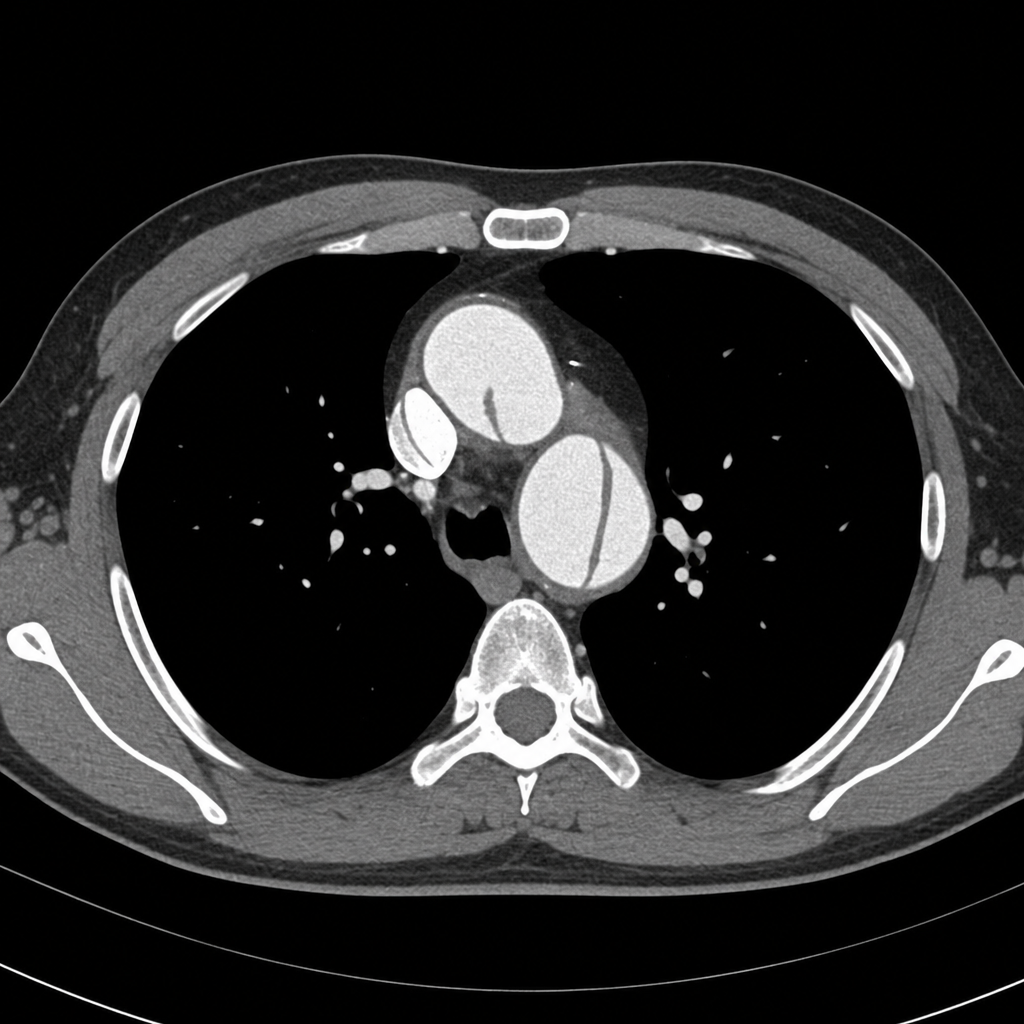
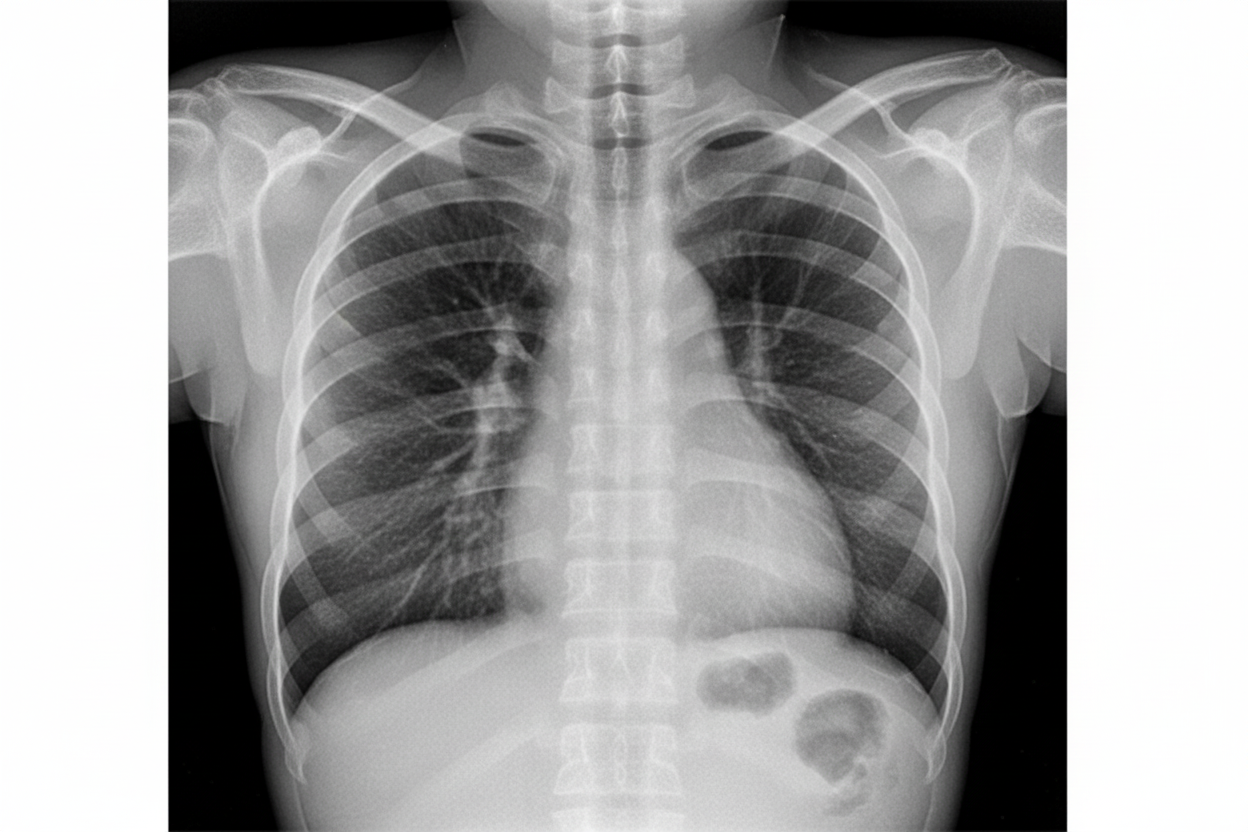
Which of the following chemicals or isotopes is used in cardiac ventriculography?
A 63-year-old patient with a history of tachyarrhythmias is on an implantable cardioverter-defibrillator (ICD). The patient suddenly develops shock. Which of the following is the best investigation to assess the position and integrity of the ICD?
A 24-year-old woman presents with mildly painful swelling of her right leg and acute shortness of breath. She is 32 weeks pregnant with her second child and has no other medical history. Which of the following statements is NOT true regarding this condition?
In which of the following conditions is an increased cardiac silhouette NOT seen, except?
Rib notching is a feature of which congenital heart anomaly?
What is the characteristic radiographic appearance of aoitis?
Which of the following statements is FALSE regarding Coarctation of the Aorta?
What is the investigation of choice to confirm hemochromatosis as the cause of cardiomyopathy?
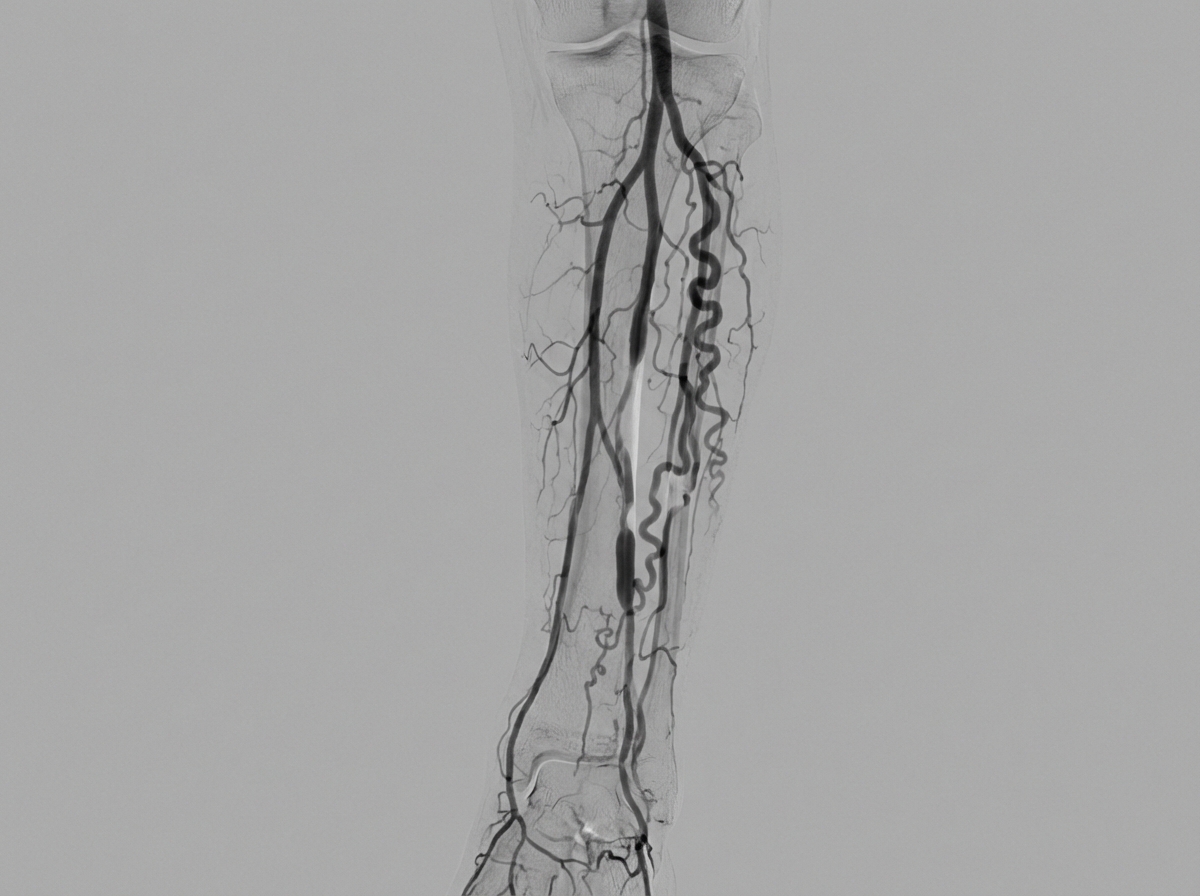
A digital subtraction angiography of a 35-year-old smoker is shown. What is the possible diagnosis?
What is the best initial investigation for a suspected case of Dysphagia lusoria?
Explanation: **Explanation:** **Cardiac Ventriculography** (specifically Radionuclide Ventriculography or MUGA scan) is a nuclear medicine study used to evaluate ventricular function, wall motion, and Ejection Fraction (EF). 1. **Why Technetium is correct:** The procedure utilizes **Technetium-99m ($^{99m}Tc$)**, usually tagged to Red Blood Cells (RBCs) or human serum albumin. Because the radioactive tracer remains within the intravascular compartment, a gamma camera can visualize the blood pool within the cardiac chambers. By synchronizing the image acquisition with an ECG (Gated study), clinicians can calculate the Left Ventricular Ejection Fraction (LVEF), which is the gold standard for monitoring cardiotoxicity (e.g., in patients on Doxorubicin). 2. **Why other options are incorrect:** * **Gallium (Ga-67):** Used primarily for imaging chronic inflammation, infections (like sarcoidosis), or certain tumors (lymphoma). It is not used for functional ventricular imaging. * **Lipodate:** An oral iodinated contrast medium formerly used for cholecystography (gallbladder imaging). It has no role in cardiac imaging. * **Diatrizoate:** A high-osmolar ionic contrast medium used in conventional X-ray angiography. While used in *invasive* catheter-based ventriculography, the term "ventriculography" in the context of isotopes specifically refers to nuclear medicine studies where Technetium is the agent of choice. **High-Yield Pearls for NEET-PG:** * **MUGA Scan:** Stands for Multi-Gated Acquisition scan. * **Best Parameter:** MUGA is considered more accurate and reproducible than Echocardiography for measuring LVEF. * **Radiopharmaceutical:** $^{99m}Tc$-pertechnetate is the most common isotope used in various scans due to its short half-life (6 hours) and optimal energy (140 keV).
Explanation: **Explanation:** The correct answer is **Plain radiograph (Chest X-ray)**. **Why Plain Radiograph is the Best Investigation:** In a patient with an ICD presenting with sudden shock or device malfunction, the immediate priority is to assess for mechanical complications such as **lead fracture, lead displacement (dislodgement), or "Twiddler’s Syndrome"** (where the patient manipulates the device, coiling the leads). * **Visualization:** A plain chest X-ray (PA and Lateral views) is the gold standard for evaluating the **integrity and position** of the radio-opaque leads and the generator. * **Speed and Accessibility:** It is rapid, inexpensive, and can be performed at the bedside in an unstable patient. * **Comparison:** It allows for easy comparison with post-implantation baseline films to detect subtle migrations. **Why Other Options are Incorrect:** * **MRI:** Most older ICDs are **MRI-contraindicated** due to the risk of lead heating, device movement, or reprogramming. Even with "MRI-conditional" devices, MRI is not used to check lead integrity and is time-consuming in an emergency. * **USG:** Ultrasound cannot penetrate the bony thorax or visualize the intracardiac leads effectively. It is useful for detecting a pocket hematoma but not for assessing lead integrity. * **Contrast CT:** While CT can show lead position, it is not the first-line investigation due to high radiation, cost, and **metallic streak artifacts** (blooming) from the leads, which often obscure the very fractures one is looking for. **Clinical Pearls for NEET-PG:** * **Lead Fracture:** Most commonly occurs at the site of venous entry (subclavian crush syndrome) or near the generator. * **ICD vs. Pacemaker on X-ray:** ICD leads are distinguished by the presence of **thickened, radio-opaque shock coils** (usually one or two) on the distal part of the lead. * **Twiddler’s Syndrome:** Characterized by lead displacement and coiling around the generator, visible on a plain X-ray.
Explanation: This clinical scenario describes a classic presentation of **Pulmonary Embolism (PE)** secondary to **Deep Vein Thrombosis (DVT)** in a pregnant patient. ### **Explanation of the Correct Answer (Option C)** In the context of pregnancy, the **D-Dimer assay is NOT a reliable diagnostic tool**. D-dimer levels naturally and progressively increase during pregnancy due to physiological changes in the coagulation system. Therefore, a high D-dimer in a pregnant patient lacks specificity and cannot be used to rule in or rule out PE. In non-pregnant patients, its primary value is its high negative predictive value; however, in pregnancy, this utility is significantly diminished. ### **Analysis of Incorrect Options** * **Option A:** Pregnancy is a hypercoagulable state (Virchow’s Triad). The combination of hormonal changes and mechanical compression of the IVC/iliac veins by the **gravid uterus** (especially on the left, though it can occur on the right) significantly increases the risk of DVT and subsequent PE. * **Option B:** Compression **Ultrasonography (CUS)** of the leg veins is the first-line investigation. If DVT is confirmed in a symptomatic patient, it justifies anticoagulation, potentially sparing the patient from further radiation exposure (CTPA/VQ scan). * **Option D:** A **V/Q (Ventilation/Perfusion) scan** is a valid diagnostic modality in pregnancy. It often carries a lower fetal radiation dose compared to CT Pulmonary Angiography (CTPA), although CTPA is generally preferred if the chest X-ray is abnormal. ### **High-Yield Clinical Pearls for NEET-PG** * **First-line investigation for suspected PE in pregnancy:** Lower limb Doppler (CUS). * **Gold standard for PE diagnosis:** CT Pulmonary Angiography (CTPA). * **Radiation Safety:** Fetal radiation dose in both V/Q scans and CTPA is well below the threshold (50 mGy) for teratogenicity. * **Left vs. Right:** DVT in pregnancy occurs more frequently in the **left leg** (80%) due to the compression of the left common iliac vein by the right common iliac artery (May-Thurner physiology).
Explanation: This question uses a double negative ("NOT seen, except"), which essentially asks: **"In which of the following conditions is an increased cardiac silhouette NOT seen?"** ### **Explanation** In **Tetralogy of Fallot (TOF)**, the heart size is typically **normal** on a chest X-ray. Although there is right ventricular hypertrophy (RVH), the heart does not enlarge overall because the pulmonary artery segment is concave (due to infundibular stenosis) and the left ventricle is often smaller than normal. The classic "Cœur en sabot" (boot-shaped heart) appearance is due to the upward tilting of the apex by RVH, not a generalized increase in the cardiac silhouette. ### **Analysis of Other Options** * **Pericardial Effusion:** Characterized by a significantly enlarged, globular, or "water-bottle" shaped heart once more than 250ml of fluid accumulates. * **Aortic Regurgitation:** Leads to left ventricular volume overload, resulting in significant cardiomegaly and a "down and out" apex. * **Ebstein Anomaly:** This condition produces some of the largest cardiac silhouettes seen in pediatric radiology ("box-shaped" heart) due to massive right atrial enlargement. ### **NEET-PG High-Yield Pearls** * **Normal Heart Size in Cyanotic Heart Disease:** Think **TOF** or **Tricuspid Atresia** (early stages). * **Classic X-ray Signs:** * **TOF:** Boot-shaped heart (Cœur en sabot). * **Ebstein Anomaly:** Box-shaped heart. * **TGA (Transposition of Great Arteries):** Egg-on-side appearance. * **TAPVC (Total Anomalous Pulmonary Venous Connection):** Snowman or Figure-of-8 appearance. * **Cardiothoracic (CT) Ratio:** A ratio >0.5 in adults or >0.6 in neonates indicates cardiomegaly.
Explanation: **Explanation:** **Coarctation of the Aorta** is the correct answer because rib notching is a classic radiological sign of this condition. In post-ductal coarctation, there is a narrowing of the aorta distal to the origin of the left subclavian artery. To bypass this obstruction, the body develops **collateral circulation**. Blood flows through the internal mammary arteries to the intercostal arteries to reach the descending aorta. The resulting high-pressure, turbulent flow causes the **intercostal arteries to become dilated and tortuous**, which leads to pressure erosion (notching) on the **inferior margins** of the 3rd to 8th ribs. **Why other options are incorrect:** * **Atrial Septal Defect (ASD):** This is an acyanotic heart disease characterized by a left-to-right shunt at the atrial level. Radiologically, it presents with cardiomegaly (RA/RV enlargement) and increased pulmonary vascular markings, but no collateral circulation involving intercostal arteries. * **Patent Ductus Arteriosus (PDA):** This involves a shunt between the aorta and the pulmonary artery. While it increases pulmonary blood flow, it does not necessitate the development of systemic collateral pathways that cause rib notching. **High-Yield Clinical Pearls for NEET-PG:** * **Roesler’s Sign:** The formal name for rib notching in Coarctation. * **Ribs Involved:** Usually the **3rd to 8th ribs**. The 1st and 2nd ribs are spared because their intercostal arteries arise from the costocervical trunk, not the aorta distal to the coarctation. * **Figure-of-3 Sign:** Seen on Chest X-ray, representing pre-stenotic dilation, the indentation (coarctation), and post-stenotic dilation. * **Reverse E Sign:** The corresponding indentation seen on a Barium swallow study. * **Clinical Finding:** Radio-femoral delay and upper limb hypertension.
Explanation: **Explanation:** The characteristic radiographic finding in **syphilitic aortitis** is **calcification of the ascending aorta**. This occurs because *Treponema pallidum* involves the *vasa vasorum*, leading to endarteritis obliterans. This results in ischemia and subsequent destruction of the elastic tissue in the tunica media, which later undergoes dystrophic calcification. * **Why Option A is correct:** While atherosclerotic calcification typically involves the aortic arch and descending aorta, **linear calcification isolated to the ascending aorta** is highly specific for syphilitic aortitis. * **Why Option B is incorrect:** Calcification of the descending aorta is a common feature of **atherosclerosis**, especially in elderly, hypertensive, or diabetic patients. It is not specific to aortitis. * **Why Option C is incorrect:** While aortitis can lead to aneurysmal dilation of the ascending aorta, "dilation of the aortic arch" is a non-specific finding seen in chronic hypertension and aging (aortic unfolding). * **Why Option D is incorrect:** Left atrial enlargement is a hallmark of **Mitral Stenosis** or chronic mitral regurgitation, not primary aortic pathology. **High-Yield Clinical Pearls for NEET-PG:** * **"Eggshell calcification"** of the ascending aorta on a chest X-ray should immediately trigger suspicion of tertiary syphilis. * **Complications of Aortitis:** Aortic regurgitation (due to root dilation), coronary ostial stenosis, and saccular aneurysms. * **Atherosclerosis vs. Syphilis:** Atherosclerosis = Descending aorta; Syphilis = Ascending aorta.
Explanation: **Explanation:** In Coarctation of the Aorta (CoA), the narrowing typically occurs distal to the origin of the left subclavian artery. To bypass this obstruction, the body develops extensive collateral circulation via the intercostal arteries. **1. Why Option C is False (The Correct Answer):** Rib notching (Roesler’s sign) occurs due to the pressure erosion of the inferior surface of the ribs by dilated, tortuous intercostal arteries. It typically involves the **3rd to 8th ribs**. * **1st and 2nd ribs** are spared because their intercostal arteries arise from the costocervical trunk, which originates proximal to the coarctation. * **Lower ribs (9th-12th)** are spared because they do not participate in the collateral pathway to the descending aorta. **2. Analysis of Other Options:** * **Option A & B (Double Bulge / Double Aortic Knuckle):** These refer to the **"Figure of 3" sign** seen on a PA chest X-ray. The upper bulge is the dilated pre-stenotic segment (arch and left subclavian), and the lower bulge is the post-stenotic dilatation. On a Barium swallow, this corresponds to the **"Reverse 3" or "E" sign**. * **Option D:** Rib notching is rarely seen in infants. It develops over time as collaterals enlarge; thus, the prevalence and prominence of notching **increase with age**, usually becoming visible after 6–8 years of life. **Clinical Pearls for NEET-PG:** * **Turner Syndrome:** Most common chromosomal association. * **Bicuspid Aortic Valve:** Most common associated cardiac anomaly (up to 85%). * **Physical Exam:** Radio-femoral delay and upper limb hypertension. * **Imaging Gold Standard:** Cardiac MRI or CT Angiography.
Explanation: **Explanation:** The investigation of choice for confirming and quantifying iron overload in the heart is **MRI**. Hemochromatosis leads to the deposition of paramagnetic iron (hemosiderin) in the myocardium, which causes a restrictive cardiomyopathy. **Why MRI is the Correct Answer:** MRI is uniquely sensitive to the magnetic properties of iron. Specifically, **T2* (T2-star) weighted imaging** is the gold standard. Iron deposits shorten the T2* relaxation time; the lower the T2* value (measured in milliseconds), the higher the concentration of iron in the tissue. This allows for non-invasive quantification of myocardial iron, which correlates directly with the risk of heart failure and guides chelation therapy. **Why Other Options are Incorrect:** * **ECG:** While it may show low voltage complexes or arrhythmias, these findings are non-specific and cannot confirm iron deposition. * **Echocardiogram:** Useful for assessing functional changes (diastolic dysfunction or reduced ejection fraction), but it cannot distinguish between different causes of restrictive cardiomyopathy (e.g., amyloidosis vs. hemochromatosis). * **CT Scan:** CT may occasionally show increased attenuation of the liver, but it lacks the sensitivity and specificity of MRI for myocardial iron quantification and involves ionizing radiation. **High-Yield Clinical Pearls for NEET-PG:** * **T2* MRI Value:** A value **<20 ms** indicates myocardial iron overload; **<10 ms** indicates a high risk of developing heart failure. * **Liver vs. Heart:** Myocardial iron deposition often lags behind hepatic deposition, making cardiac MRI essential even if liver enzymes are stable. * **Reversibility:** Unlike many other cardiomyopathies, iron-induced heart failure is often **reversible** with aggressive chelation therapy (e.g., Deferoxamine).
Explanation: ***Buerger's disease*** - **Thromboangiitis obliterans** affecting young male smokers shows characteristic **segmental occlusions** of distal vessels with **corkscrew collaterals** on DSA. - Strong association with **heavy smoking** in patients under 45 years, causing **inflammatory thrombosis** of small and medium-sized arteries. *Atherosclerosis* - Typically affects **older patients** (>50 years) with **proximal vessel involvement** and **calcified plaques** visible on angiography. - Shows **smooth tapering** rather than the **abrupt segmental occlusions** characteristic of Buerger's disease. *Takayasu's arteritis* - Primarily affects **young women** with involvement of **large vessels** including the **aorta and its major branches**. - DSA shows **smooth stenoses** and **wall thickening** of proximal vessels, not distal segmental disease. *Kawasaki disease* - Occurs predominantly in **children under 5 years** with **coronary artery involvement** causing aneurysms. - Associated with **acute febrile illness** and **mucocutaneous manifestations**, not peripheral vascular disease in adults.
Explanation: **Explanation:** **Dysphagia lusoria** is a clinical condition characterized by difficulty in swallowing due to extrinsic compression of the esophagus by an **aberrant right subclavian artery (ARSA)**. This is the most common congenital anomaly of the aortic arch, where the right subclavian artery arises as the last branch of the arch and crosses behind the esophagus (retro-esophageal) to reach the right arm. **Why MRA is the correct answer:** Magnetic Resonance Angiography (MRA) is considered the best initial investigation because it provides excellent soft-tissue contrast and detailed 3D visualization of the vascular anatomy and its relationship with the esophagus without the need for ionizing radiation or iodinated contrast. It is non-invasive and highly accurate in identifying the vascular ring or aberrant vessel causing the symptoms. **Analysis of Incorrect Options:** * **HRCT (A):** High-resolution CT is primarily used for evaluating lung parenchyma (interstitial lung diseases) and is not the modality of choice for vascular anomalies. * **Spiral CT (B):** While CT Angiography (CTA) is a valid alternative, MRA is often preferred in elective settings to avoid radiation. However, in many clinical scenarios, CTA and MRA are both highly sensitive; but for NEET-PG purposes, MRA is the classic "best" answer for non-invasive vascular mapping. * **DSA (D):** Digital Subtraction Angiography is the "gold standard" for vascular anatomy but is an invasive procedure. It is reserved for therapeutic interventions rather than initial diagnosis. **Clinical Pearls for NEET-PG:** * **Embryology:** ARSA results from the persistence of the right dorsal aorta and involution of the right 4th vascular arch. * **Barium Swallow:** Often the *first* screening test performed, showing a characteristic **oblique posterior indentation** on the esophagus. * **Kommerell’s Diverticulum:** A dilated origin of the aberrant right subclavian artery, which can further exacerbate the compression. * **Treatment:** Surgical management is indicated only if symptoms are severe or if an aneurysm is present.
Cardiovascular Anatomy
Practice Questions
Cardiac CT Techniques
Practice Questions
Cardiac MRI Techniques
Practice Questions
Ischemic Heart Disease Imaging
Practice Questions
Valvular Heart Disease
Practice Questions
Cardiomyopathies
Practice Questions
Pericardial Diseases
Practice Questions
Congenital Heart Disease
Practice Questions
Aortic and Great Vessel Imaging
Practice Questions
Peripheral Vascular Imaging
Practice Questions
Cardiovascular Interventional Procedures
Practice Questions
Post-Surgical Cardiovascular Imaging
Practice Questions
Get full access to all questions, explanations, and performance tracking.
Start For Free