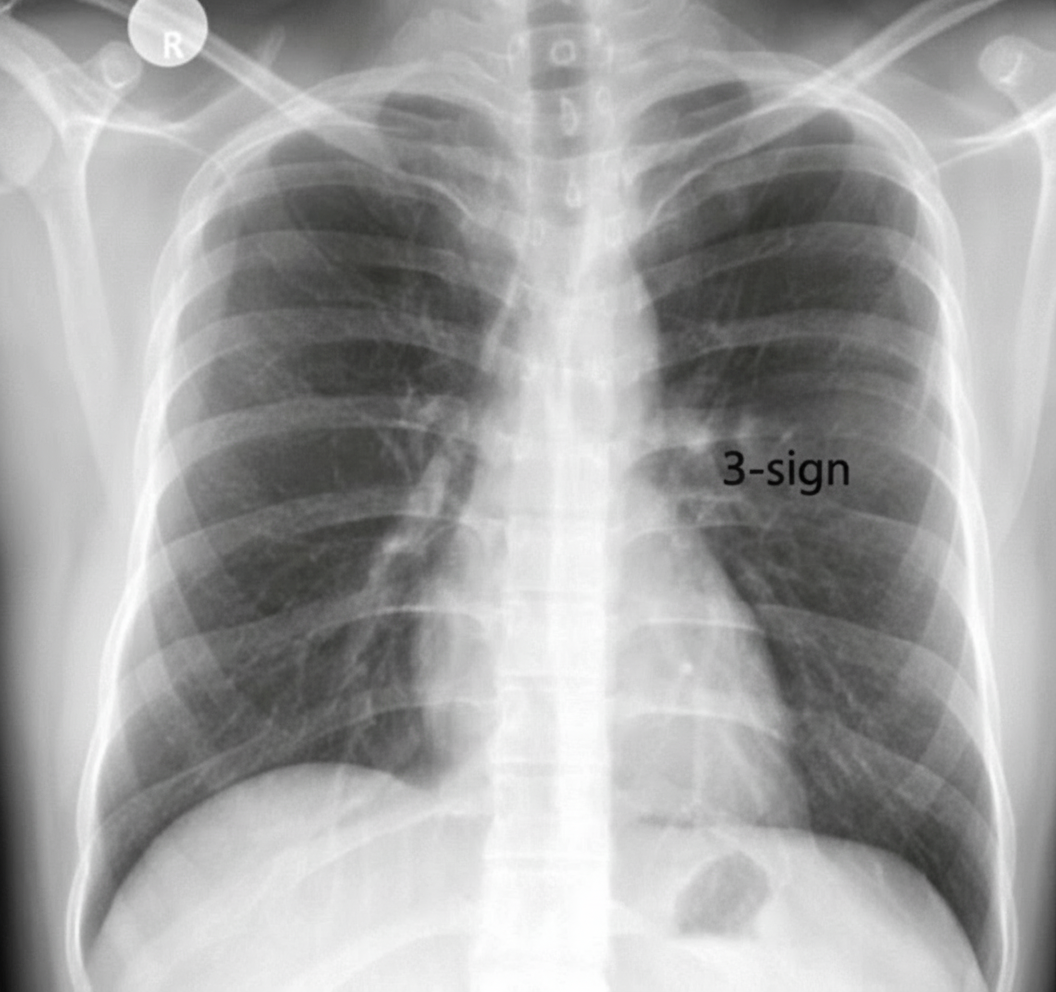
Snowman appearance is seen in which congenital heart disease?
Agatson scoring is done for which condition?
An abnormality on angiography is seen in which condition?
In mitral stenosis, a double atrial shadow is due to enlargement of which chamber?
Which of the following is NOT seen in left atrial enlargement?
Which of the following does NOT form the right heart border on a chest X-ray?
Which of the following radiological signs is NOT typically seen in a patient with mitral stenosis?
An X-ray of an asymptomatic 64-year-old male executive, who had an anterior Q wave myocardial infarction 4 years ago, shows a persistent bulge in the left ventricular contour. What is your diagnosis?
In atrial septal defect, what is the typical state of the aorta?
The characteristic "Coeur en Sabot" (heart on a wooden shoe) appearance is typically seen in which congenital heart defect?
Explanation: The **Snowman appearance** (also known as the **Figure-of-8 heart**) is a classic radiologic sign of **Supracardiac Total Anomalous Pulmonary Venous Connection (TAPVC)**. ### Why it occurs: In supracardiac TAPVC, the pulmonary veins do not drain into the left atrium. Instead, they form a common pulmonary vein that drains into a **vertical vein** (left side), which then drains into the **left innominate vein** and finally into the **Right Superior Vena Cava (SVC)**. * **The "Head" of the Snowman:** Formed by the dilated left vertical vein (left side), the left innominate vein (top), and the dilated right SVC (right side). * **The "Body" of the Snowman:** Formed by the enlarged right atrium and right ventricle due to volume overload. ### Why other options are incorrect: * **Ebstein Anomaly:** Characterized by a **Box-shaped heart** due to massive right atrial enlargement and a small "atrialized" right ventricle. * **Tetralogy of Fallot (TOF):** Classically shows a **Boot-shaped heart (Coeur en Sabot)** due to an upturned apex (right ventricular hypertrophy) and a concave pulmonary segment. * **Ventricular Septal Defect (VSD):** Typically presents with non-specific cardiomegaly and increased pulmonary vascular markings (plethora), but no distinct "snowman" shape. ### High-Yield Clinical Pearls for NEET-PG: * **TAPVC Types:** Snowman sign is specific to **Type I (Supracardiac)**. Type II (Cardiac) drains into the coronary sinus, and Type III (Infracardiac) often presents with a normal-sized heart but severe pulmonary edema. * **Egg-on-a-string appearance:** Seen in Transposition of the Great Arteries (TGA). * **Sitting Duck appearance:** Seen in Persistent Truncus Arteriosus. * **Scimitar Sign:** Seen in PAPVC (Partial Anomalous Pulmonary Venous Connection).
Explanation: **Explanation:** **Agatston scoring** is a standardized tool used in radiology to quantify the amount of calcium in the coronary arteries. It is performed using **Non-contrast High-Resolution Computed Tomography (HRCT)** of the heart. 1. **Why Option A is Correct:** The Agatston score measures **Coronary Artery Calcium (CAC)**. Since the presence of calcium in the vessel wall is a direct marker of atherosclerosis, the score serves as a powerful predictor of the risk for future major adverse cardiovascular events (MACE) and is used to risk-stratify patients with suspected **Coronary Artery Disease (CAD)**. The score is calculated based on the area of calcium deposits and their peak X-ray attenuation (measured in Hounsfield Units). 2. **Why Other Options are Incorrect:** * **Option B & C:** While hypertension and SLE can lead to vascular damage, the Agatston score is specific to coronary calcification rather than generalized end-organ damage (like retinopathy or nephropathy). * **Option D:** CHF with preserved ejection fraction (HFpEF) is a clinical diagnosis primarily evaluated via Echocardiography and BNP levels, not calcium scoring. **High-Yield Clinical Pearls for NEET-PG:** * **Imaging Modality:** ECG-gated non-contrast CT. * **Threshold:** A density of **>130 Hounsfield Units (HU)** is required to define a calcified plaque. * **Scoring Interpretation:** * **0:** No disease. * **1–100:** Mild disease. * **101–400:** Moderate disease. * **>400:** Severe disease (High risk of myocardial infarction). * **Clinical Utility:** It is most useful for asymptomatic individuals with intermediate risk to decide on the initiation of statin therapy.
Explanation: **Explanation:** **Takayasu Arteritis (Correct Answer):** Takayasu arteritis is a chronic, large-vessel vasculitis that primarily affects the **aorta and its main branches**. Angiography is considered the "gold standard" for diagnosis as it reveals characteristic features such as smooth, long-segment stenosis, occlusions, and aneurysmal dilatations. Because it involves large vessels, the luminal changes are easily visualized on conventional or CT/MR angiography. **Why other options are incorrect:** * **Giant Cell Arteritis (GCA):** While GCA also affects large vessels (temporal artery), the diagnosis is primarily clinical and confirmed via **temporal artery biopsy**. Angiography is rarely the definitive diagnostic modality compared to Takayasu. * **Polyarteritis Nodosa (PAN):** PAN is a medium-vessel vasculitis. While angiography can show "rosary sign" microaneurysms (especially in renal/mesenteric vessels), the question asks for the condition most classically associated with definitive angiographic abnormalities in a general cardiovascular context. * **Wegener’s Granulomatosis (GPA):** This is a small-vessel vasculitis. Small vessels are below the resolution of conventional angiography; diagnosis relies on **c-ANCA** markers and biopsy showing granulomatous inflammation. **High-Yield Clinical Pearls for NEET-PG:** * **Takayasu Arteritis:** Also known as **"Pulseless Disease."** It most commonly affects young females (<40 years). * **Most common vessel involved:** Subclavian artery (leads to limb claudication and blood pressure discrepancy). * **Classification:** Based on the Numano classification (Type I: Aortic arch; Type V: Entire aorta and branches). * **Radiological Sign:** "Reverse Coarctation" (narrowing of the aorta proximal to the usual site).
Explanation: In Mitral Stenosis (MS), the narrowing of the mitral valve orifice leads to increased pressure and volume overload in the **Left Atrium (LA)**. As the LA enlarges, it expands towards the right side, eventually overlapping the right heart border. **Explanation of the Correct Answer:** * **Left Atrium (B):** On a Chest X-ray (PA view), the enlarged LA creates a dense, curvilinear silhouette that is visible through the shadow of the Right Atrium (RA). This creates a "shadow within a shadow" appearance, known as the **Double Atrial Shadow** or **Double Density Sign**. The outer border is typically the RA, while the inner, denser border is the enlarged LA. **Explanation of Incorrect Options:** * **Right Atrium (A):** While the RA forms the right heart border, its enlargement alone does not create a double shadow; it simply shifts the border further to the right. * **Both Atria (C):** Although long-standing MS can lead to secondary pulmonary hypertension and RA enlargement, the specific "double shadow" sign is pathognomonic for LA enlargement specifically. * **Left Auricle (D):** Enlargement of the left atrial appendage (auricle) causes straightening or bulging of the left heart border (the "third mogul" sign), not the double shadow on the right. **High-Yield Clinical Pearls for NEET-PG:** * **Walking stick sign / Splaying of Carina:** Enlarged LA pushes the left main bronchus upward, increasing the subcarinal angle (>90°). * **Mitralization of Heart:** Straightening of the left cardiac border due to a prominent pulmonary artery and left atrial appendage. * **Cephalization (Antler Sign):** Redistribution of blood flow to the upper lobes (early sign of pulmonary venous hypertension). * **Kerley B Lines:** Horizontal lines at the lung bases indicating interstitial edema.
Explanation: ### Explanation **Correct Option: D. Retrosternal lucency on a lateral film** The **left atrium (LA)** is the most posterior chamber of the heart. When it enlarges, it expands posteriorly and superiorly. **Retrosternal lucency** is the space located behind the sternum and in front of the heart; this space is obliterated by **Right Ventricular Enlargement (RVE)**, not left atrial enlargement. Therefore, retrosternal lucency remains preserved in isolated LA enlargement. **Analysis of Incorrect Options:** * **A. Posterior displacement of the esophagus:** Because the LA lies directly anterior to the esophagus, its enlargement pushes the esophagus backward. This is classically visualized as a posterior indentation on a **Barium Swallow** (lateral view). * **B. Straightening of the left main bronchus:** The LA sits below the carina. Enlargement causes superior displacement and "lifting" of the left main bronchus, increasing the **carinal angle** (normal < 90°) and leading to a more horizontal or "straightened" appearance. * **C. Double shadow of the right atrium:** As the LA expands toward the right, its right border overlaps the right atrium, creating a "double density" or **"double atrial shadow"** on a PA chest X-ray. **High-Yield Clinical Pearls for NEET-PG:** * **Walking Man Sign:** On a lateral X-ray, the posterior displacement of the left main bronchus relative to the right looks like a pair of open legs. * **Splaying of the Carina:** An angle > 90° is a highly specific sign of LA enlargement. * **Mitral Stenosis:** The most common cause of isolated LA enlargement. * **Left Auricle Enlargement:** Causes "straightening of the left cardiac border" (filling of the pulmonary bay).
Explanation: ### Explanation In a standard Posteroanterior (PA) view of a chest X-ray, the heart borders are formed by specific anatomical structures that are in contact with the pleura, creating a silhouette. **1. Why the Right Ventricle is the Correct Answer:** The **Right Ventricle (RV)** is the most anterior chamber of the heart. It lies directly behind the sternum and does not reach the lateral edges of the cardiac silhouette in a normal PA view. Therefore, it **does not form any part of the heart border** on a PA chest X-ray. It is best visualized on a **Lateral view**, where it forms the anterior border of the heart. **2. Analysis of Incorrect Options (Structures that DO form the Right Border):** * **Superior Vena Cava (SVC):** Forms the upper part of the right cardiac border above the right atrium. * **Right Atrium:** Forms the main, convex lower part of the right cardiac border. * **Inferior Vena Cava (IVC):** May be seen as a small vertical shadow at the cardiophrenic angle (the junction of the right atrium and the diaphragm), especially during deep inspiration. **3. High-Yield Clinical Pearls for NEET-PG:** * **Left Heart Border:** Formed by the Aortic arch (knuckle), Pulmonary artery (trunk), Left auricle/atrium, and the **Left Ventricle** (forming the apex). * **Right Ventricular Enlargement (RVE):** Since the RV is anterior, its enlargement causes the **elevation of the cardiac apex** (boot-shaped heart/Coeur en Sabot) and obliterates the retrosternal clear space on a lateral film. * **Left Atrial Enlargement:** Does not form a border normally but, when enlarged, can create a **"Double Atrial Shadow"** on the right side and splaying of the carina.
Explanation: In **Mitral Stenosis (MS)**, the primary hemodynamic change is the obstruction of blood flow from the left atrium (LA) to the left ventricle, leading to **Left Atrial Enlargement (LAE)** and subsequent pulmonary venous hypertension. ### Why "Elevation of the right main bronchus" is correct: The correct radiological finding in LAE is the **elevation of the Left Main Bronchus**, not the right. As the left atrium enlarges posteriorly and superiorly, it pushes against the left main bronchus, splaying the carina (widening of the carinal angle >90°). The right main bronchus remains unaffected by LAE. ### Analysis of Incorrect Options: * **Straightening of the left heart border:** This occurs due to the enlargement of the **Left Atrial Appendage (LAA)**, which fills the normal concavity between the aortic arch and the left ventricle. * **Double density sign:** As the enlarged left atrium expands toward the right, its shadow overlaps the right atrium, creating a "double contour" or "shadow-within-a-shadow" on a PA chest X-ray. * **Kerley B lines:** These are short, horizontal lines at the lung bases representing thickened interlobular septa due to **pulmonary venous hypertension** and edema, a hallmark of significant MS. ### High-Yield Clinical Pearls for NEET-PG: * **Walking Man Sign:** Seen on lateral X-ray; the enlarged LA pushes the left main bronchus posteriorly, making it look like a person walking. * **Antler Sign:** Cephalization of pulmonary vessels (upper lobe diversion) due to pulmonary venous hypertension. * **Mitral Heart:** Characterized by a small/normal LV, enlarged LA, and prominent pulmonary artery segment. * **Most sensitive X-ray view for LAE:** Lateral view with barium swallow (shows posterior indentation of the esophagus).
Explanation: ### Explanation **Correct Answer: B. Left Ventricular Aneurysm** The diagnosis is based on the classic triad of clinical history and radiological findings: 1. **History of Myocardial Infarction (MI):** A left ventricular (LV) aneurysm is a late complication of a transmural MI (usually anterior Q-wave MI involving the LAD artery). 2. **Radiological Finding:** On a chest X-ray, it typically presents as a **localized bulge or "squared-off" appearance** of the left heart border, often with associated rim calcification. 3. **Persistence:** Unlike an acute infarct, an aneurysm represents a thinned, scarred segment of the myocardium that bulges paradoxically during systole. **Why Incorrect Options are Wrong:** * **A. Calcific Pericarditis:** This typically shows a "shell-like" calcification surrounding the heart (especially in the AV grooves) and results in a small or normal-sized heart rather than a localized ventricular bulge. * **C. Hydatid Cyst:** While it can occur in the myocardium, it is rare and usually presents as a well-defined, spherical water-density mass, often with "curvilinear" calcification, but lacks the specific association with a prior Q-wave MI. * **D. Pleuropericarditis:** This is an inflammatory condition presenting with effusion or pleural thickening; it does not cause a persistent, localized structural bulge of the ventricular contour. **High-Yield Clinical Pearls for NEET-PG:** * **ECG Hallmark:** Persistent ST-segment elevation in the same leads as the previous MI (months after the event) is highly suggestive of an LV aneurysm. * **Most Common Site:** The **apex** and anterior wall (due to LAD occlusion). * **True vs. False Aneurysm:** A **True Aneurysm** (as seen here) has a wide neck and involves all three layers of the heart wall. A **False Aneurysm (Pseudoaneurysm)** is a contained rupture with a narrow neck and carries a much higher risk of spontaneous rupture. * **Complications:** Heart failure, ventricular arrhythmias, and mural thrombus leading to systemic embolism.
Explanation: In **Atrial Septal Defect (ASD)**, the typical radiological and clinical finding regarding the aorta is that it appears **small or hypoplastic**. ### Why the Aorta is Small (Option A) The underlying pathophysiology of ASD involves a **left-to-right shunt** at the atrial level. This leads to: 1. **Volume Overload of the Right Heart:** Increased blood flow into the right atrium, right ventricle, and pulmonary circulation (Pulmonary Plethora). 2. **Decreased Left Ventricular Output:** Because a significant portion of blood shunts from the left atrium to the right atrium, the volume of blood entering the left ventricle (LV) is reduced. 3. **Reduced Stroke Volume:** Since the LV output is decreased, the ascending aorta receives less blood volume over time, leading to a "small" or "narrow" appearance on a chest X-ray (the **small aortic knob**). ### Why Other Options are Incorrect * **Normal (Option B):** In hemodynamically significant ASDs, the chronic reduction in systemic output almost always results in a noticeably smaller aortic silhouette compared to the enlarged pulmonary trunk. * **Enlarged/Aneurysmal (Options C & D):** These are characteristic of conditions with increased systemic flow or high pressure, such as **Aortic Regurgitation, Hypertension, or Aneurysms**. In ASD, the enlargement occurs in the **Pulmonary Artery**, not the aorta. ### High-Yield Clinical Pearls for NEET-PG * **Chest X-ray Triad in ASD:** 1. **Cardiomegaly** (Right atrial and ventricular enlargement). 2. **Prominent Pulmonary Artery** (due to increased flow). 3. **Small Aortic Knob** (due to decreased systemic flow). * **Hilar Dance:** On fluoroscopy, the hyperdynamic pulmonary arteries in ASD show vigorous pulsations known as "hilar dance." * **ECG Finding:** RSR' pattern in V1 (Incomplete RBBB) is a classic association.
Explanation: ### Explanation **Correct Answer: A. Tetralogy of Fallot** The **"Coeur en Sabot"** (boot-shaped heart) appearance is the classic radiologic hallmark of **Tetralogy of Fallot (TOF)**. This specific shape occurs due to two primary anatomical changes: 1. **Right Ventricular Hypertrophy (RVH):** The pressure overload causes the right ventricle to enlarge, which lifts the cardiac apex upward and outward. 2. **Pulmonary Hypoplasia:** The narrow pulmonary infundibulum and small pulmonary artery create a "concave" pulmonary bay (the segment between the aortic arch and the left ventricle), accentuating the boot-like silhouette. --- ### Analysis of Incorrect Options: * **B. Atrial Septal Defect (ASD):** Typically presents with cardiomegaly and an **enlarged pulmonary artery segment** (due to increased pulmonary blood flow), rather than a concave one. * **C. Transposition of Great Arteries (TGA):** Characterized by the **"Egg-on-a-string"** appearance. The narrow superior mediastinum (due to stress-induced thymic atrophy and the parallel orientation of great vessels) makes the heart look like an egg hanging by a string. * **D. TAPVC (Supracardiac type):** Characterized by the **"Snowman"** or **"Figure-of-8"** appearance. This is caused by a dilated persistent left vertical vein, the left innominate vein, and the right superior vena cava forming the "head" of the snowman. --- ### High-Yield Clinical Pearls for NEET-PG: * **TOF Components:** Ventricular Septal Defect (VSD), Overriding of Aorta, Right Ventricular Outflow Tract Obstruction (RVOTO), and RVH. * **Lung Fields in TOF:** On X-ray, the lung fields appear **oligemic** (darker/blacker) due to reduced pulmonary blood flow. * **Box-shaped heart:** Seen in **Ebstein’s Anomaly** (massive right atrial enlargement). * **Sitting Duck sign:** Seen in **Persistent Truncus Arteriosus**.
Cardiovascular Anatomy
Practice Questions
Cardiac CT Techniques
Practice Questions
Cardiac MRI Techniques
Practice Questions
Ischemic Heart Disease Imaging
Practice Questions
Valvular Heart Disease
Practice Questions
Cardiomyopathies
Practice Questions
Pericardial Diseases
Practice Questions
Congenital Heart Disease
Practice Questions
Aortic and Great Vessel Imaging
Practice Questions
Peripheral Vascular Imaging
Practice Questions
Cardiovascular Interventional Procedures
Practice Questions
Post-Surgical Cardiovascular Imaging
Practice Questions
Get full access to all questions, explanations, and performance tracking.
Start For Free