The investigation of choice in aortic dissection is:
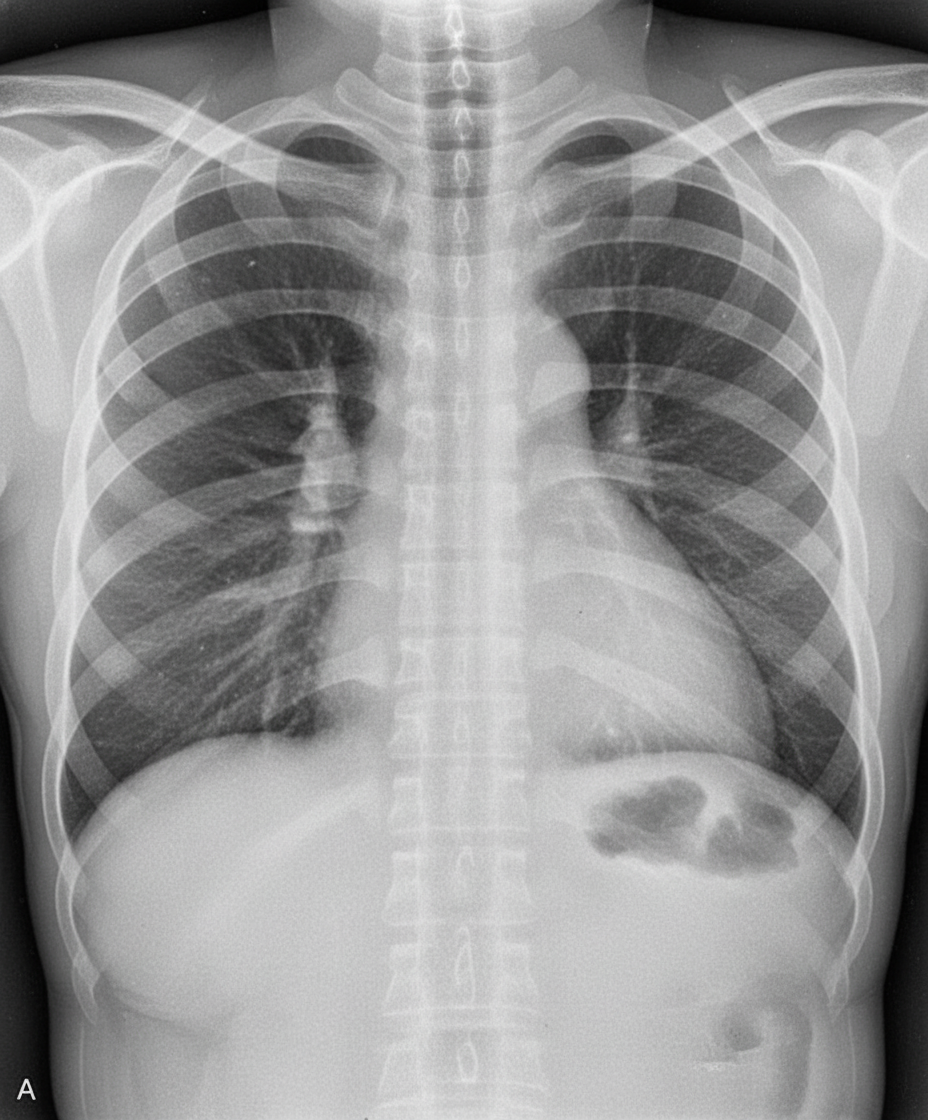
Comment on the diagnosis of the patient?

Which of the following conditions places the aorta at the greatest risk of inflammation (aortitis)?
During cardiac imaging, which phase of the cardiac cycle exhibits the minimum motion of the heart?
What is the investigation of choice for aortic dissection?
In which of the following conditions is the left atrium not enlarged?
Which drug is used to perform stress echocardiography?
Which artery is most commonly occluded in an inferior wall myocardial infarction?
Rapid high-frequency fluttering of anterior mitral valve leaflets during systole on 2D echocardiography is characteristically seen with which condition?
Hilar dance on fluoroscopy is seen in which condition?
Explanation: **Explanation:** **Aortic dissection** is a life-threatening emergency characterized by a tear in the tunica intima, leading to the creation of a "false lumen" within the aortic wall. **Why CT is the Investigation of Choice:** **Contrast-Enhanced Computed Tomography (CECT)**, specifically **CT Angiography (CTA)**, is the gold standard and investigation of choice because of its high sensitivity and specificity (>95%). It is rapid, widely available, and non-invasive. It accurately identifies the **intimal flap** (separating the true and false lumens), the extent of the dissection, and involvement of major branch vessels, which is critical for surgical planning. **Analysis of Other Options:** * **USG (Transthoracic Echocardiography):** While useful for screening or detecting proximal (Type A) dissections and pericardial effusion, it has poor visualization of the descending aorta. *Transesophageal Echocardiography (TEE)* is highly accurate but invasive and often unavailable in emergency settings. * **MRI (MRA):** This is the most accurate imaging modality; however, it is **not** the investigation of choice in an acute setting because it is time-consuming, difficult to monitor unstable patients within the magnet, and less available. * **Digital Subtraction Angiography (DSA):** Once the gold standard, it is now rarely used for diagnosis as it is invasive and cannot visualize the aortic wall or thrombus, only the lumen. **Clinical Pearls for NEET-PG:** * **Classic Sign on CT:** The "Intimal Flap" (visualized as a linear lucency) and the "Bird’s Beak Sign" (seen in the false lumen). * **Chest X-ray:** May show a **widened mediastinum** (most common finding) or the "Calcium Sign" (displacement of intimal calcification >1cm). * **Stanford Classification:** Type A involves the ascending aorta (Surgical emergency); Type B involves only the descending aorta (Medical management).
Explanation: ***Pulmonary artery hypertension*** - **Enlarged central pulmonary arteries** with **right heart enlargement** and **peripheral vascular pruning** are classic chest X-ray findings in pulmonary arterial hypertension. - The combination of prominent **main pulmonary artery segment** and **dilated right ventricle** creates the characteristic appearance on CXR. *Aortic dissection* - Typically presents with a **widened mediastinum** and abnormal **aortic contour** on chest X-ray, not enlarged pulmonary arteries. - Associated with **acute chest pain** radiating to the back, not the chronic progressive dyspnea seen in PAH. *Coarctation of aorta* - Chest X-ray shows **rib notching** from collateral circulation and **post-stenotic dilatation** of the descending aorta. - The **"3 sign"** or **"reverse E sign"** may be visible on the left heart border, not pulmonary artery enlargement. *Boot shaped heart* - Characteristic of **Tetralogy of Fallot** with **upturned cardiac apex** and **concave pulmonary artery segment**. - Associated with **decreased pulmonary vascular markings** (oligemic lung fields), opposite to the findings in PAH.
Explanation: **Explanation:** The correct answer is **Ascending aortic aneurysm**. **1. Why Ascending Aortic Aneurysm is correct:** The ascending aorta is the most common site for **Aortitis** (inflammation of the aortic wall), particularly when associated with systemic inflammatory conditions. Historically, **Syphilitic (Luetic) aortitis** characteristically involves the ascending aorta, leading to "eggshell calcification" and aneurysm formation. In modern practice, **Takayasu arteritis** and **Giant Cell Arteritis** are major causes of inflammatory aneurysms in this segment. Inflammation weakens the tunica media (vasa vasorum involvement), leading to dilation and subsequent aneurysm formation. **2. Analysis of Incorrect Options:** * **Abdominal Aortic Aneurysm (AAA):** These are most commonly **atherosclerotic** in origin rather than inflammatory. They typically occur infra-renally. While "Inflammatory AAA" exists as a clinical subtype, it is far less common than the inflammatory involvement seen in the ascending segment. * **Thoracic Aortic Aneurysm:** This is a broad anatomical term. While it includes the ascending aorta, the specific risk of primary aortitis is highest in the **ascending portion** compared to the descending thoracic aorta. * **Narrow Superior Mediastinum:** This is a radiological finding typically associated with **Transposition of the Great Arteries (TGA)** due to the anteroposterior alignment of the great vessels ("Egg-on-a-string" appearance). It is not a risk factor for aortitis. **Clinical Pearls for NEET-PG:** * **Syphilitic Aortitis:** Classically involves the ascending aorta; look for **linear calcification** of the ascending aortic wall on X-ray. * **Takayasu Arteritis:** Known as "Pulseless disease"; involves the aortic arch and its branches. * **Stanford Classification:** Type A involves the ascending aorta (surgical emergency); Type B involves the descending aorta (medical management).
Explanation: **Explanation:** The goal of cardiac imaging (especially Coronary CT Angiography) is to capture images when the heart is most stationary to avoid motion artifacts. **Why Mid-diastole is correct:** The cardiac cycle consists of systole (contraction) and diastole (relaxation). Diastole is further divided into early rapid filling, **diastasis (mid-diastole)**, and atrial contraction (late diastole). Diastasis is the period where ventricular filling slows down significantly, and the heart remains relatively quiescent. This "period of least motion" provides the optimal window for imaging, particularly at lower heart rates (typically <70 bpm). **Analysis of Incorrect Options:** * **Late Systole (A) & Mid Systole (B):** During systole, the ventricles are actively contracting and the heart undergoes significant translational and rotational movement. This results in maximum blurring and is unsuitable for high-resolution imaging. * **Late Diastole (C):** Also known as the "Atrial Kick," this phase involves active atrial contraction to top off the ventricles. This movement can cause motion artifacts, especially in the coronary arteries located near the atrioventricular groove. **High-Yield Clinical Pearls for NEET-PG:** * **The Imaging Window:** For CT Coronary Angiography, the **R-R interval** (70–80%) corresponding to mid-diastole is the preferred trigger point. * **Heart Rate Impact:** In patients with **tachycardia** (>75-80 bpm), the diastolic period shortens significantly. In such cases, **end-systole** may actually become a more stable window for imaging than diastole. * **Beta-blockers:** These are often administered before a cardiac CT to slow the heart rate and prolong the mid-diastolic quiescent phase.
Explanation: **Explanation:** **1. Why MRI is the correct answer:** MRI (specifically MR Angiography) is considered the **Gold Standard** and the investigation of choice for aortic dissection due to its near 100% sensitivity and specificity. It provides superior anatomical detail, accurately identifies the entry/exit tears, determines the involvement of branch vessels, and can detect associated aortic regurgitation without the need for iodinated contrast or ionizing radiation. **2. Analysis of Incorrect Options:** * **Aortography:** Formerly the gold standard, it is now rarely used as it is invasive, requires large doses of contrast, and may miss the diagnosis if the false lumen is thrombosed. * **CT Scan (Contrast-Enhanced CT/CTPA):** In clinical practice, CECT is the **investigation of choice in emergency/hemodynamically unstable patients** because it is rapid and widely available. However, in a theoretical "best test" scenario without clinical context, MRI is superior. * **X-ray Chest:** This is the initial screening tool. While it may show a "widened mediastinum" or "calcium sign," it is neither sensitive nor specific enough to confirm a diagnosis. **3. NEET-PG High-Yield Pearls:** * **Investigation of choice (Overall/Gold Standard):** MRI. * **Investigation of choice (Emergency/Unstable patient):** CT Scan (CECT). * **Bedside investigation of choice:** Transesophageal Echocardiography (TEE) — highly useful for unstable patients or those with renal failure. * **Stanford Classification:** Type A (involves ascending aorta; surgical emergency) vs. Type B (descending aorta only; medical management). * **Classic Sign on CT:** "Intimal flap" separating the true and false lumens.
Explanation: **Explanation:** The key to understanding chamber enlargement in congenital heart disease lies in the **direction of the shunt** and the **volume of blood** returning to specific chambers. **1. Why Atrial Septal Defect (ASD) is the correct answer:** In a typical secundum ASD, blood shunts from the Left Atrium (LA) to the Right Atrium (RA) due to higher compliance of the right ventricle. While the RA and RV become volume-overloaded and enlarged, the **LA does not enlarge** because it constantly decompresses itself into the RA. In fact, the LA may even be small or normal in size. **2. Why the other options are incorrect:** * **Ventricular Septal Defect (VSD):** Blood shunts from the LV to the RV, goes to the lungs, and returns via the pulmonary veins to the **LA**. This increased venous return causes LA and LV enlargement (Left-sided volume overload). * **Patent Ductus Arteriosus (PDA) & Aortopulmonary (AP) Window:** These are "Great Vessel" shunts. Blood shunts from the Aorta to the Pulmonary Artery, travels through the lungs, and returns to the **LA and LV**. Both conditions lead to LA enlargement. **Clinical Pearls for NEET-PG:** * **Rule of Thumb:** Any shunt that increases pulmonary blood flow will enlarge the **Left Atrium**, *except* for ASD and Total Anomalous Pulmonary Venous Connection (TAPVC). * **Radiological Sign:** On a lateral chest X-ray, LA enlargement is best seen as posterior displacement of the esophagus (if barium swallow is used) or the "double atrial shadow" on a PA view. * **ASD Triad:** Enlarged RA, Enlarged RV, and prominent pulmonary arteries with a **normal-sized LA**.
Explanation: **Explanation:** **Stress Echocardiography** is a functional imaging modality used to detect inducible myocardial ischemia. It relies on the principle that under stress, areas of the heart supplied by stenosed coronary arteries will demonstrate new or worsening **wall motion abnormalities (RWMA)** before the patient develops ECG changes or symptoms. **Why Dobutamine is the correct answer:** Dobutamine is a synthetic catecholamine and a potent **$\beta_1$-receptor agonist**. It acts as a positive inotrope and chronotrope, increasing myocardial oxygen demand by raising heart rate and contractility. This "mimics" the effect of physical exercise. In patients with significant coronary artery disease, this increased demand cannot be met, leading to detectable wall motion abnormalities on ultrasound. **Analysis of Incorrect Options:** * **Thallium (A):** This is a radioactive isotope used in **Nuclear Medicine (SPECT)** for myocardial perfusion imaging, not as a pharmacological stress agent for echocardiography. * **Adrenaline (C):** While it has $\beta_1$ effects, it also has significant $\alpha_1$ (vasoconstrictive) effects, making it hemodynamically unstable and unsuitable for controlled diagnostic stress testing. * **Adenosine (D):** This is a potent vasodilator used primarily in **Cardiac MRI or Nuclear Scintigraphy**. While it can be used in echo, it does not significantly increase heart rate/contractility; it works by causing "coronary steal," which is better visualized via perfusion defects rather than wall motion. **High-Yield Clinical Pearls for NEET-PG:** * **Antidote:** If a patient develops severe arrhythmia or ischemia during a Dobutamine stress test, **Esmolol** (a short-acting beta-blocker) is the drug of choice to reverse the effects. * **Atropine:** Often added to Dobutamine if the target heart rate (85% of age-predicted maximum) is not achieved. * **Contraindication:** Dobutamine stress echo should be avoided in patients with severe systemic hypertension, unstable angina, or significant outflow tract obstruction (e.g., HOCM).
Explanation: **Explanation:** The **inferior wall** of the heart is primarily supplied by the **Posterior Interventricular Artery (PIVA)**. In approximately 85% of individuals (Right Dominance), the PIVA arises from the Right Coronary Artery (RCA). Therefore, an occlusion of the RCA typically leads to an inferior wall myocardial infarction (MI), characterized by ST-segment elevation in leads II, III, and aVF. **Analysis of Options:** * **A. Posterior interventricular artery (Correct):** This is the anatomical name for the vessel that runs in the posterior interventricular groove. Its occlusion is the direct cause of inferior wall ischemia. * **B. Posterior descending artery:** While "Posterior Descending Artery" (PDA) is the common clinical synonym for the PIVA, standard anatomical nomenclature used in competitive exams like NEET-PG prefers **Posterior Interventricular Artery**. In many structured keys, if both are present, the formal anatomical term is prioritized. * **C. Atrial branch:** These branches supply the muscular walls of the atria and are not responsible for the ventricular inferior wall. * **D. Nodal branch:** The SA nodal and AV nodal arteries supply the conduction system. While their occlusion (often co-occurring with RCA infarcts) causes arrhythmias or heart block, they do not supply the inferior myocardial wall itself. **High-Yield Clinical Pearls for NEET-PG:** 1. **Coronary Dominance:** Defined by which artery gives rise to the PIVA. Right dominance (85%) = RCA; Left dominance (8%) = Left Circumflex (LCX); Codominance (7%) = Both. 2. **ECG Findings:** Inferior MI presents in leads **II, III, and aVF**. Lead III often shows higher ST elevation than Lead II if the RCA is the culprit. 3. **Associated Complication:** Inferior wall MIs are frequently associated with **Right Ventricular Infarction** and **Bradyarrhythmias** (due to AV node supply). Avoid nitrates in these patients to prevent severe hypotension.
Explanation: ### Explanation **Correct Answer: D. Aortic regurgitation** The characteristic finding of **diastolic fluttering** of the anterior mitral valve leaflet (AMVL) is a classic echocardiographic sign of **Aortic Regurgitation (AR)**. **Pathophysiology:** In aortic regurgitation, blood leaks backward from the aorta into the left ventricle during diastole. This regurgitant jet is directed toward the ventricular cavity and often strikes the **anterior leaflet of the mitral valve**. The high-velocity impact of this jet against the leaflet causes it to vibrate or "flutter." Because the mitral valve is open during diastole to allow filling from the left atrium, the AR jet interferes with its position, leading to this rapid high-frequency motion. **Analysis of Incorrect Options:** * **A. Mitral regurgitation:** This involves blood flowing backward from the LV to the LA during systole. It does not cause fluttering of the leaflets during diastole; rather, it may show structural abnormalities like prolapse or flail leaflets. * **B & C. Tricuspid and Pulmonary regurgitation:** These involve the right side of the heart. Their jets do not interact with the mitral valve, which is located on the left side. **High-Yield Clinical Pearls for NEET-PG:** * **Austin Flint Murmur:** The AR jet can also partially close the mitral valve prematurely, creating functional mitral stenosis. This produces a mid-diastolic, low-pitched rumbling murmur known as the Austin Flint murmur. * **M-Mode Finding:** On M-mode echocardiography, this fluttering appears as fine oscillations of the AMVL. * **Reverse Doming:** In severe AR, the jet may cause "downward" or "reverse" doming of the AMVL. * **Key Association:** Always look for **wide pulse pressure** and **water-hammer pulse** in clinical vignettes describing these echo findings.
Explanation: **Explanation:** **Hilar Dance** refers to the rhythmic, vigorous pulsations of the enlarged pulmonary arteries observed during fluoroscopy. This phenomenon occurs due to a combination of increased stroke volume into the pulmonary circulation and increased pulmonary pulse pressure. **1. Why Atrial Septal Defect (ASD) is correct:** In ASD, there is a significant left-to-right shunt at the atrial level, leading to chronic volume overload of the right ventricle and the pulmonary arterial tree. The massive increase in pulmonary blood flow (increased pulmonary-to-systemic flow ratio or Qp/Qs) causes the pulmonary arteries to dilate. During systole, the large volume of blood ejected into these distended, compliant vessels creates the visible "dancing" pulsations on fluoroscopy. **2. Why the other options are incorrect:** * **Ventricular Septal Defect (VSD):** While VSD also involves a left-to-right shunt, the pulsations are generally less pronounced than in ASD because the shunt occurs during systole directly into the pulmonary artery, often with higher pressure but less dramatic volume-induced "dance" compared to the large-volume low-pressure shunt of ASD. * **Pulmonary Stenosis (PS):** This condition results in post-stenotic dilation of the pulmonary artery, but blood flow is restricted, leading to reduced or normal pulsations rather than hyperdynamic ones. * **Tricuspid Regurgitation (TR):** TR causes systolic backflow into the right atrium and systemic veins (seen as systolic pulsations of the liver or neck veins), not the pulmonary arteries. **High-Yield Clinical Pearls for NEET-PG:** * **Classic Triad of ASD on X-ray:** Small aortic arch, enlarged right atrium/ventricle, and prominent pulmonary conus with peripheral pruning (if Eisenmenger develops). * **Auscultation:** ASD is characterized by a **fixed wide splitting of the S2** and a mid-systolic flow murmur at the pulmonary area. * **Other conditions with Hilar Dance:** Patent Ductus Arteriosus (PDA) and Persistent Truncus Arteriosus (though ASD is the most classic association).
Cardiovascular Anatomy
Practice Questions
Cardiac CT Techniques
Practice Questions
Cardiac MRI Techniques
Practice Questions
Ischemic Heart Disease Imaging
Practice Questions
Valvular Heart Disease
Practice Questions
Cardiomyopathies
Practice Questions
Pericardial Diseases
Practice Questions
Congenital Heart Disease
Practice Questions
Aortic and Great Vessel Imaging
Practice Questions
Peripheral Vascular Imaging
Practice Questions
Cardiovascular Interventional Procedures
Practice Questions
Post-Surgical Cardiovascular Imaging
Practice Questions
Get full access to all questions, explanations, and performance tracking.
Start For Free