Inferior rib notching is seen in all of the following conditions except:
What is the test of choice to detect perivalvular abscesses?
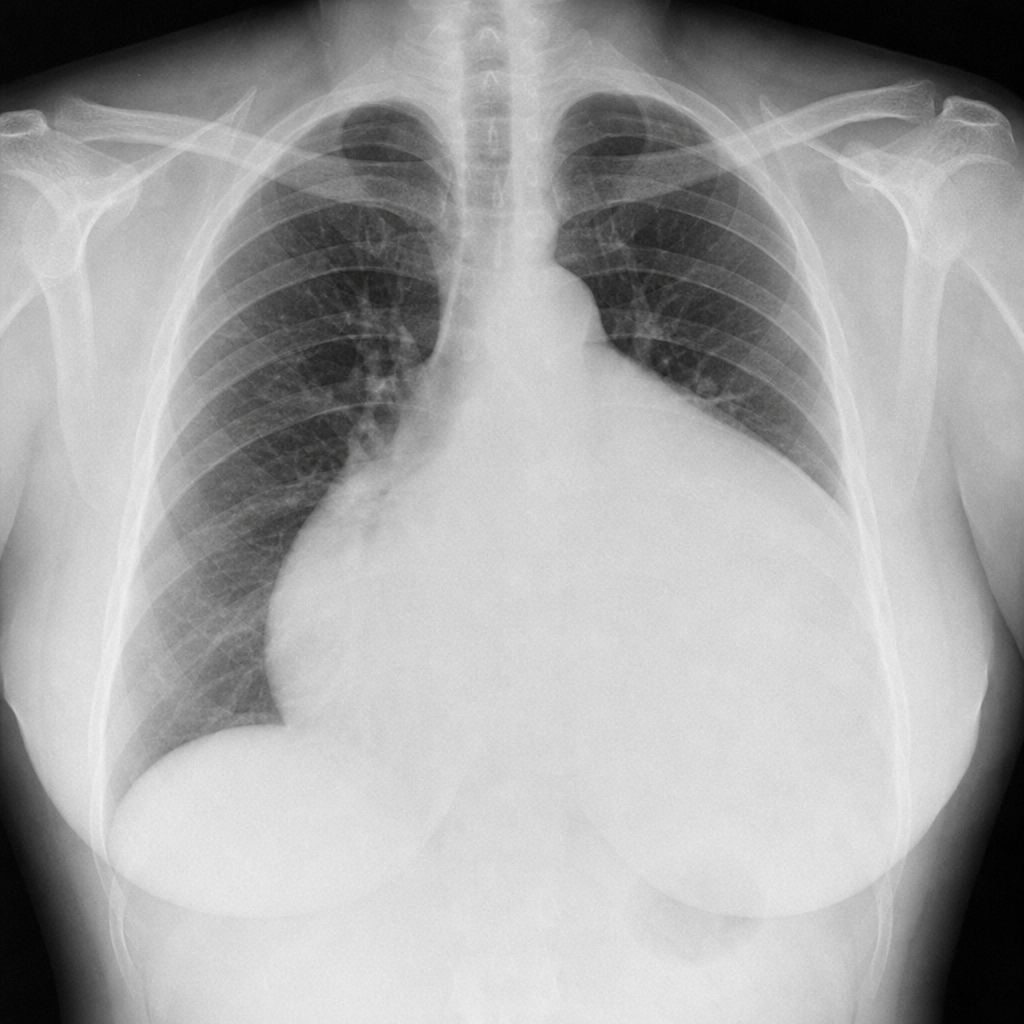
The 'Oreo cookie sign' is a radiological finding suggestive of which of the following conditions?
All are features of Kerley A lines except?
Judkins technique is used for which procedure?
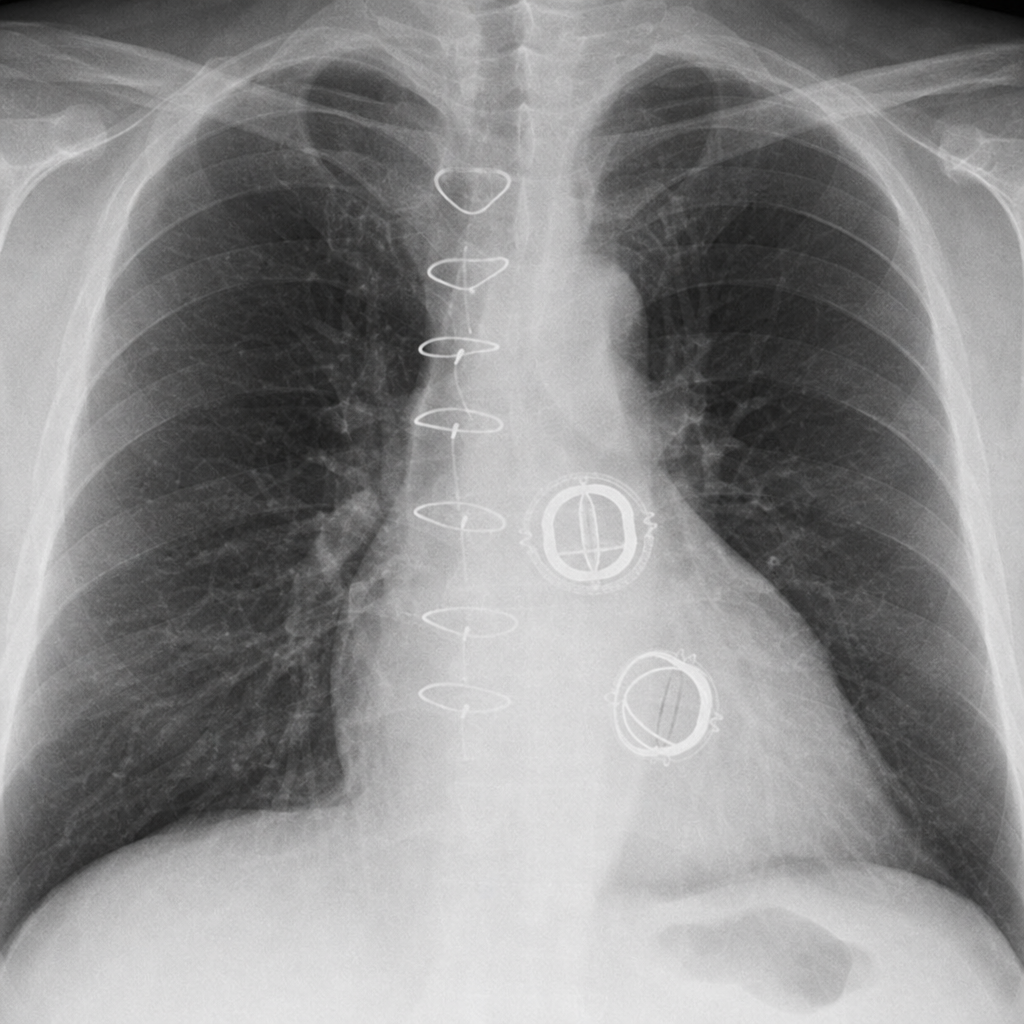
Left atrial hypertrophy is seen radiologically as:
What is the best investigation for diagnosing an abdominal aortic aneurysm?
What is the radiological sign of coarctation of aorta?
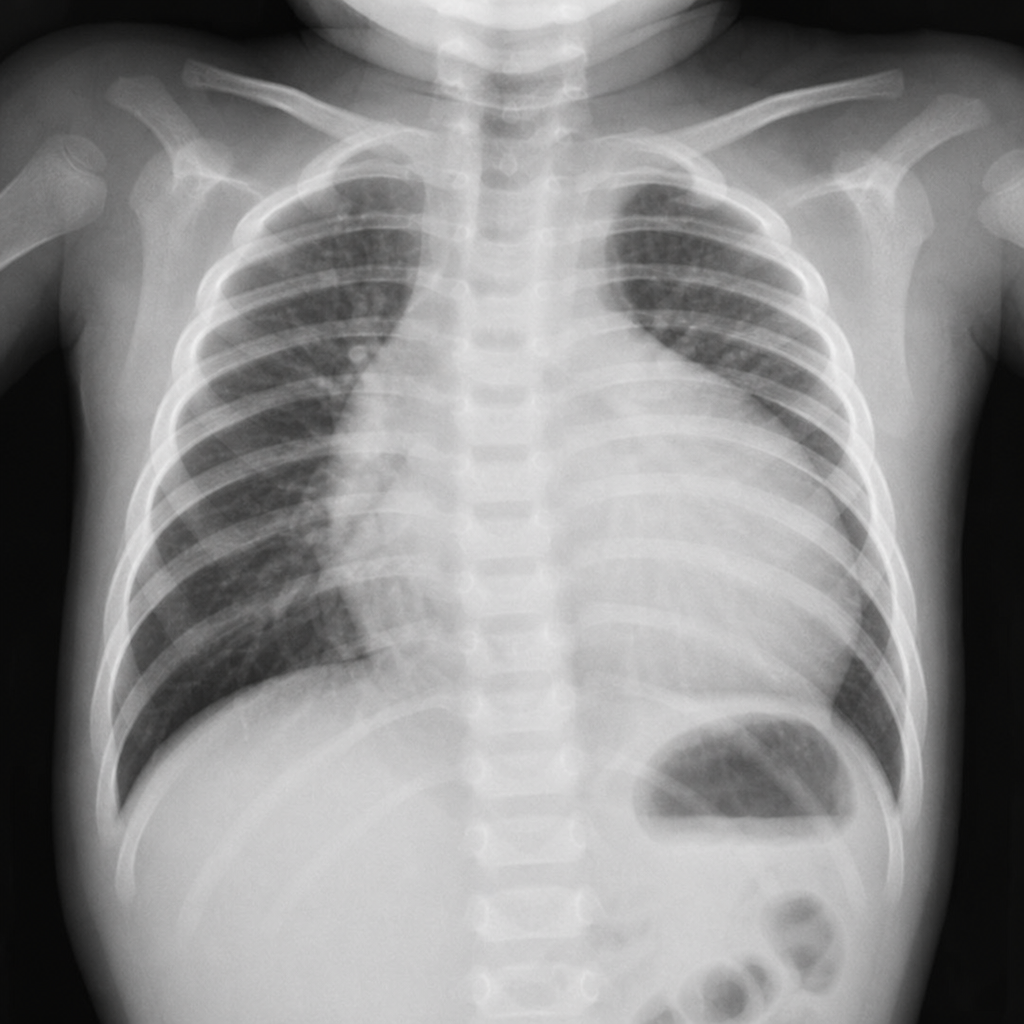
X-ray features of Atrial Septal Defect (ASD) are all except:
What is the best investigation for cardiac tamponade?
Explanation: **Explanation:** **Inferior rib notching** is a radiological sign caused by the pressure erosion of the lower borders of the ribs, typically due to the enlargement and tortuosity of the intercostal arteries. **Why Option C is correct:** In **Pulmonary Stenosis with VSD** (e.g., Tetralogy of Fallot), there is decreased pulmonary blood flow. This condition does not necessitate the development of systemic collateral circulation through the intercostal arteries. Therefore, inferior rib notching is not seen. Instead, these patients may show a "boot-shaped heart" (Coeur en sabot) on X-ray. **Why the other options are incorrect:** * **Coarctation of the Aorta (Option B):** This is the most common cause. To bypass the obstruction, collateral circulation develops via the internal mammary and intercostal arteries. The increased flow causes these arteries to dilate and erode the ribs (typically ribs 3–9). * **Blalock-Taussig (BT) Shunt (Option A):** A classic BT shunt involves anastomosing the subclavian artery to the pulmonary artery. This reduces blood flow to the ipsilateral intercostal arteries, leading to **unilateral** rib notching on the side of the surgery. * **Interrupted Aortic Arch (Option D):** Similar to severe coarctation, this condition forces the body to develop extensive collateral pathways through the intercostal system to maintain distal perfusion, leading to rib notching. **NEET-PG High-Yield Pearls:** 1. **Roesler’s Sign:** Another name for inferior rib notching in Coarctation of the Aorta. 2. **Ribs 1 & 2 are spared:** They are supplied by the costocervical trunk, which arises proximal to the typical site of coarctation. 3. **Superior Rib Notching:** A rarer finding associated with connective tissue disorders (e.g., Marfan syndrome, SLE), Neurofibromatosis, or Hyperparathyroidism. 4. **Unilateral Notching:** Seen in BT shunts or if the coarctation is proximal to the origin of the left subclavian artery.
Explanation: ### Explanation **1. Why Transesophageal Echocardiography (TEE) is the Correct Answer:** In the context of Infective Endocarditis (IE), a perivalvular abscess is a serious complication indicating the spread of infection beyond the valve leaflets. **TEE is the gold standard** for detecting these abscesses because the esophagus lies directly behind the heart, providing a high-resolution window without interference from the lungs or chest wall. The addition of **Color Doppler** is crucial as it helps identify "fistulous tracts" or turbulent flow within the abscess cavity, significantly increasing sensitivity (up to 90% compared to <30% for TTE). **2. Why Other Options are Incorrect:** * **2D-Echocardiography (Transthoracic/TTE):** While TTE is the initial screening tool for IE, it has poor sensitivity for perivalvular extensions, especially in patients with prosthetic valves or obesity, due to acoustic shadowing. * **CT Scan:** Cardiac CT is excellent for visualizing coronary anatomy and can detect abscesses, but it lacks the real-time hemodynamic assessment (blood flow velocity) provided by Doppler. It is usually a secondary choice when TEE is contraindicated. * **MRI:** Although MRI provides detailed anatomical images, it is rarely used in acute settings due to long acquisition times, difficulty in monitoring unstable patients, and artifacts caused by metallic prosthetic valves. **3. High-Yield Clinical Pearls for NEET-PG:** * **Duke’s Criteria:** Remember that "Echocardiogram positive for IE" (including abscess or new valvular regurgitation) is a **Major Criterion**. * **Prosthetic Valves:** TEE is mandatory if a prosthetic valve infection is suspected, as TTE is almost always non-diagnostic due to shadowing. * **Most Common Site:** Perivalvular abscesses are most frequently associated with the **Aortic valve** (often presenting as a new conduction block/prolonged PR interval on ECG).
Explanation: The **'Oreo cookie sign'** is a classic radiological finding seen on a **lateral chest X-ray** that indicates a significant **pericardial effusion**. ### 1. Why Pericardial Effusion is Correct Under normal circumstances, the retrosternal space contains two thin layers of fat: the **epicardial fat** (covering the heart) and the **paracardial/pericardial fat** (outside the parietal pericardium). On a lateral X-ray, these appear as two thin radiolucent (dark) lines. When fluid accumulates in the pericardial space, it creates a water-density (white) band that separates these two dark fat layers. This "dark-white-dark" appearance resembles an Oreo cookie, where the fat layers are the chocolate wafers and the effusion is the cream filling. ### 2. Why Other Options are Incorrect * **Aberrant subclavian artery:** This typically presents with an indentation on the posterior aspect of the esophagus (seen on barium swallow) or a retro-esophageal soft tissue mass, not a fat-pad sign. * **Left atrium enlargement:** This is characterized by the "double density sign," "walking man sign" (widening of the carina), or "straightening of the left heart border" on a PA view. * **Endomyocardial fibrosis:** This leads to restrictive cardiomyopathy and may show endocardial calcification or chamber obliteration, but it does not typically produce the specific three-layered fat-pad sign. ### 3. Clinical Pearls for NEET-PG * **Sensitivity:** The Oreo cookie sign is highly specific for pericardial effusion, usually indicating more than 30–50 mL of fluid. * **PA View Finding:** On the PA view, pericardial effusion presents as a **"Water bottle"** or **"Money bag"** heart. * **Gold Standard:** While X-ray shows these signs, **Echocardiography** remains the gold standard for diagnosis. * **Differential:** Do not confuse this with the "Oreo cookie sign" in spine imaging, which refers to certain types of vertebral fractures or discitis (though less commonly tested in PG exams).
Explanation: **Explanation:** The question asks for the feature that is **NOT** characteristic of Kerley A lines. Kerley lines represent thickened interlobular septa, typically due to pulmonary venous hypertension (e.g., Congestive Heart Failure). **Why Option C is the correct answer (The "Except"):** Kerley A lines are characteristically found in the **upper and mid-zones** of the lungs, radiating from the hila. They are longer (2–6 cm) and thinner than Kerley B lines. It is **Kerley B lines** that are located at the **lung bases** (periphery/costophrenic angles). **Analysis of Incorrect Options:** * **Option A & B:** These describe the pathophysiology. Kerley lines occur when the **interlobular septa** become prominent due to **lymphatic engorgement** and interstitial **edema**. This happens when pulmonary capillary wedge pressure (PCWP) exceeds 15–20 mmHg. * **Option D:** **Congestive Heart Failure (CHF)** is the most common cause of Kerley lines. As fluid backs up into the pulmonary circulation, it leaks into the interstitium, making these septa visible on a chest X-ray. **NEET-PG High-Yield Pearls:** * **Kerley A:** Long (up to 6cm), radiate from hila to the mid/upper zones. Represent distended anastomotic lymphatics. * **Kerley B:** Short (1–2cm), horizontal, located at the **bases** and periphery. These are the most common type seen clinically. * **Kerley C:** Reticular/spider-web appearance at the bases (represents Kerley B lines seen end-on). * **PCWP Correlation:** * 12–18 mmHg: Cephalization (Upper lobe diversion). * 18–25 mmHg: Kerley lines (Interstitial edema). * >25 mmHg: Bat-wing appearance (Alveolar edema).
Explanation: **Explanation:** The **Judkins technique** is the most widely used method for **coronary arteriography** (diagnostic cardiac catheterization). It involves a percutaneous approach, typically through the femoral artery (Seldinger technique), using pre-shaped, specialized catheters designed to selectively engage the ostia of the right and left coronary arteries. * **Why Option B is correct:** The Judkins technique utilizes specific catheters—the **Judkins Left (JL)** and **Judkins Right (JR)**—which have secondary curves tailored to the anatomy of the aortic arch and the location of the coronary ostia, allowing for rapid and safe opacification of the coronary arteries. * **Why Options A & D are incorrect:** Central venous line placement and chest tube insertion are bedside procedures that do not require specialized arterial catheters or fluoroscopic guidance for coronary engagement. * **Why Option C is incorrect:** While renal angiography also uses a percutaneous arterial approach, it typically employs different catheter shapes (e.g., Cobra or RDC catheters) specifically designed for the renal artery anatomy. **High-Yield Pearls for NEET-PG:** * **Sones Technique:** An older alternative to Judkins that uses a single catheter via a brachial artery cut-down. * **Radial Approach:** Currently gaining preference over the femoral (Judkins) approach due to lower bleeding complications, often using **Tiger or Jacky catheters** which can cannulate both coronaries with one catheter. * **Gold Standard:** Coronary angiography remains the gold standard for diagnosing Coronary Artery Disease (CAD). * **Contrast Media:** Non-ionic, low-osmolar contrast media (LOCM) are preferred to reduce the risk of nephropathy and arrhythmias.
Explanation: **Explanation:** Left Atrial Enlargement (LAE) – often referred to as hypertrophy in clinical scenarios – manifests through specific radiological signs due to the left atrium's posterior and midline position in the mediastinum. * **Double Cardiac Silhouette (Double Density Sign):** As the left atrium enlarges, its right border extends toward the right, overlapping the normal right atrial shadow. This creates a "double contour" or "double density" visible on a PA chest X-ray. * **Left Bronchial Elevation:** The left atrium lies directly beneath the bifurcation of the trachea (carina). When it enlarges superiorly, it pushes the left main bronchus upward, widening the subcarinal angle (normally $<75^\circ$) and creating the "walking man" sign on lateral views. * **Barium Swallow (RAO View):** Because the left atrium is the most posterior chamber, its enlargement causes posterior displacement and indentation of the esophagus. This is best visualized during a barium swallow in the Right Anterior Oblique (RAO) or lateral position. **Why "All of the above" is correct:** Each option describes a classic radiological sign resulting from the anatomical expansion of the left atrium in different planes (Rightward, Superior, and Posterior). **High-Yield Clinical Pearls for NEET-PG:** * **Most common cause:** Mitral Stenosis (MS). * **Straightening of the left cardiac border:** The earliest sign of LAE, caused by the prominence of the left atrial appendage. * **Carinal Angle:** An angle $>90^\circ$ is highly suggestive of LAE. * **Hoffman-Rigler Sign:** Used to identify Left Ventricular Enlargement (not LAE) on a lateral film. * **Giant Left Atrium:** Defined when the left atrium touches the right lateral chest wall.
Explanation: **Explanation:** **CT Angiography (CTA)** is the gold standard for diagnosing and pre-operative planning of an Abdominal Aortic Aneurysm (AAA). While ultrasound is excellent for screening, CTA provides precise anatomical detail, including the exact diameter, longitudinal extent, involvement of visceral branches (renal, mesenteric), and the presence of mural thrombus or calcification. This information is critical for determining whether a patient is a candidate for EVAR (Endovascular Aneurysm Repair) or open surgery. **Analysis of Options:** * **Ultrasound (USG):** This is the **investigation of choice for screening** and longitudinal monitoring of small aneurysms due to its non-invasive nature and lack of radiation. However, it is operator-dependent and limited by bowel gas or obesity, making it less definitive than CTA for surgical planning. * **Classical Radiography:** X-rays may incidentally show a "eggshell calcification" of the aortic wall, but they lack the sensitivity and specificity required for diagnosis or measurement. * **Non-contrast CT scan:** While it can detect the presence of an aneurysm and mural calcification, it cannot accurately assess the lumen, flow, or the relationship with arterial branches, which are essential for management. **Clinical Pearls for NEET-PG:** * **Screening tool of choice:** Ultrasound. * **Best/Gold Standard investigation:** CT Angiography. * **Definition of AAA:** Permanent dilation of the abdominal aorta >3 cm or >1.5 times its normal diameter. * **Most common site:** Infra-renal (90%). * **Surgical indication:** Diameter >5.5 cm in men or >5.0 cm in women, or rapid expansion (>0.5 cm in 6 months).
Explanation: **Explanation:** Coarctation of the aorta is a congenital narrowing of the aortic lumen, typically occurring near the ductus arteriosus. The radiological signs are a result of the anatomical narrowing and the subsequent development of collateral circulation. * **Option A: Dock’s Sign:** This refers to **rib notching**, typically seen on the inferior margins of the 3rd to 8th ribs. It is caused by the pressure erosion of the ribs by dilated, tortuous intercostal arteries acting as collateral pathways to bypass the obstruction. * **Option B & C: E sign and Inverted 3 sign:** These are two sides of the same coin. On a **Barium Swallow**, the dilated pre-stenotic aorta, the site of coarctation, and the post-stenotic dilatation indent the esophagus, forming an **"E sign."** On a **Plain Chest X-ray**, these same contours form the **"Figure of 3" sign** along the left mediastinal border. When viewed on an esophagogram, this "3" appears mirrored, hence the term **"Inverted 3 sign."** **High-Yield Clinical Pearls for NEET-PG:** * **Rib Notching:** Usually involves the 3rd to 8th ribs. It **spares the 1st and 2nd ribs** because their intercostal arteries arise from the costocervical trunk (proximal to the coarctation). * **Association:** Strongly associated with **Turner Syndrome** (15-20% of cases) and **Bicuspid Aortic Valve** (most common cardiac association, ~50-80%). * **Clinical Finding:** Classic "radio-femoral delay" and upper limb hypertension with lower limb hypotension.
Explanation: In **Atrial Septal Defect (ASD)**, the underlying pathophysiology is a left-to-right shunt at the atrial level. This leads to volume overload of the right-sided chambers and the pulmonary circulation. ### Why "Left Atrial Enlargement" is the Correct Answer: In ASD, the left atrium (LA) does not enlarge because it decompresses itself into the right atrium through the defect. Even though there is increased pulmonary venous return to the LA, the blood immediately shunts across the ASD. Therefore, **LA enlargement is characteristically absent** in ASD. If LA enlargement is seen on an X-ray in a patient with a left-to-right shunt, it points toward a Ventricular Septal Defect (VSD) or Patent Ductus Arteriosus (PDA). ### Explanation of Other Options: * **Right Atrial Enlargement:** The right atrium receives both the systemic venous return and the shunted blood from the LA, leading to dilation. * **Pulmonary Artery Hypertension (PAH):** Increased pulmonary blood flow (plethora) eventually leads to increased pulmonary vascular resistance. On X-ray, this manifests as a prominent pulmonary conus and "hilar dance" on fluoroscopy. * **Small Aortic Knuckle:** Due to the left-to-right shunt, the stroke volume entering the left ventricle and the aorta is relatively reduced compared to the massive pulmonary flow, making the aortic knob appear small or inconspicuous. ### High-Yield Clinical Pearls for NEET-PG: * **X-ray Triad of ASD:** Enlarged RA, Enlarged RV, and Pulmonary Plethora with a small Aortic Knuckle. * **Auscultation:** Wide, fixed split S2 (pathognomonic). * **ECG:** RSR' pattern in V1 (Partial RBBB) and Right Axis Deviation (in Ostium Secundum, the most common type). * **Lutembacher Syndrome:** ASD associated with Mitral Stenosis.
Explanation: **Explanation:** Cardiac tamponade is a life-threatening clinical emergency caused by the accumulation of fluid in the pericardial space, leading to increased intrapericardial pressure and subsequent compression of the cardiac chambers. **Why 2-D Echocardiography is the Correct Choice:** 2-D Echocardiography is the **gold standard and investigation of choice** for diagnosing cardiac tamponade. It allows for the direct visualization of pericardial effusion and provides critical functional information. The hallmark diagnostic findings on 2-D Echo include: * **Early diastolic collapse of the Right Ventricle (RV):** Highly specific for tamponade. * **Late diastolic collapse of the Right Atrium (RA):** The earliest sign. * **Swinging Heart:** The heart oscillates within the large fluid collection. * **IVC Plethora:** A dilated Inferior Vena Cava with <50% inspiratory collapse (indicates high central venous pressure). **Analysis of Incorrect Options:** * **B. M-Mode Echocardiography:** While M-mode can show the "layered" appearance of fluid and RV wall motion, it provides only a one-dimensional view. It is used as an adjunct to 2-D Echo but is not the primary diagnostic tool. * **C. Real-time Echocardiography:** This is a broad term. While 2-D Echo is performed in real-time, "2-D Echocardiography" is the standard clinical nomenclature used in exams to describe the diagnostic modality. * **D. Ultrasonography (USG):** While echocardiography is a form of USG, general abdominal or thoracic USG lacks the specialized probes and software required to assess intracardiac hemodynamics and chamber collapse accurately. **High-Yield Clinical Pearls for NEET-PG:** * **Beck’s Triad:** Hypotension, JVP distension, and muffled heart sounds. * **Pulsus Paradoxus:** A drop in systolic BP >10 mmHg during inspiration. * **Chest X-ray:** Shows a "Water-bottle" or "Money-bag" shaped heart (only if >250ml fluid). * **ECG:** Shows **Electrical Alternans** (varying amplitude of QRS complexes) and low voltage. * **Treatment:** Immediate **Pericardiocentesis** (often ultrasound-guided).
Cardiovascular Anatomy
Practice Questions
Cardiac CT Techniques
Practice Questions
Cardiac MRI Techniques
Practice Questions
Ischemic Heart Disease Imaging
Practice Questions
Valvular Heart Disease
Practice Questions
Cardiomyopathies
Practice Questions
Pericardial Diseases
Practice Questions
Congenital Heart Disease
Practice Questions
Aortic and Great Vessel Imaging
Practice Questions
Peripheral Vascular Imaging
Practice Questions
Cardiovascular Interventional Procedures
Practice Questions
Post-Surgical Cardiovascular Imaging
Practice Questions
Get full access to all questions, explanations, and performance tracking.
Start For Free