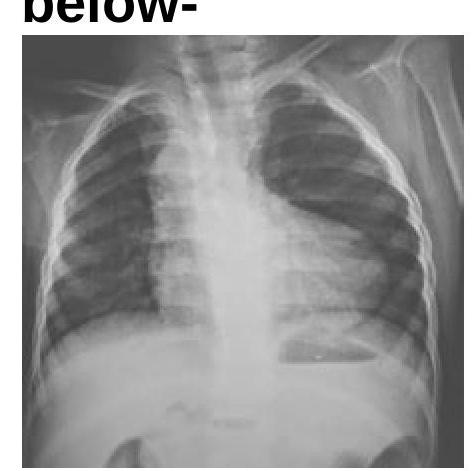
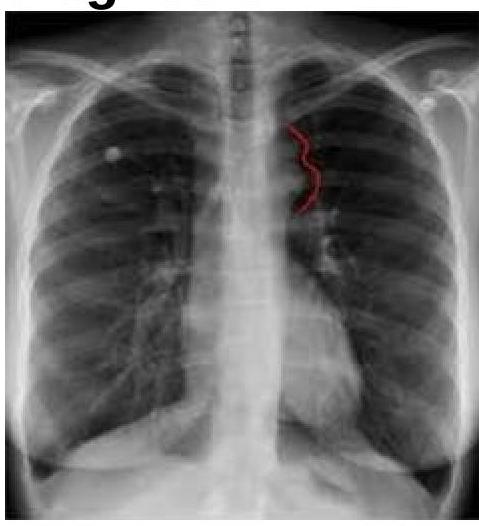
What is the MOST common radiographic manifestation of acute papillary muscle rupture?
Which X-ray finding is more characteristic of ASD compared to VSD?
In which of the following a 'Coeur en Sabot' shape of the heart is seen:
In coarctation of aorta the rib changes are seen from:
Flask shaped heart is seen in –
Snowman sign is seen in:
Egg on side appearance is seen in:
Carotid atheromas may appear radiographically as:
Lyre sign is seen in
The CT thorax image shows:

Explanation: ***Pulmonary edema*** - Acute **papillary muscle rupture** leads to severe **mitral regurgitation**, causing a sudden increase in left atrial pressure. - This rapid rise in pressure is directly transmitted to the **pulmonary veins and capillaries**, resulting in the extravasation of fluid into the lungs, manifesting as **pulmonary edema** on chest X-ray. - This is the **most common radiographic finding** because the acute nature of the rupture causes immediate hemodynamic consequences affecting the pulmonary circulation. *Left atrial enlargement* - **Left atrial enlargement** typically develops over time in chronic mitral regurgitation due to sustained volume overload. - In acute papillary muscle rupture, the onset of mitral regurgitation is sudden, and there isn't sufficient time for the left atrium to undergo **significant remodeling and enlargement**. *Left ventricular enlargement* - **Left ventricular enlargement** is also a feature of chronic volume overload (e.g., chronic mitral regurgitation or aortic regurgitation). - Acute papillary muscle rupture causes sudden pressure overload on the left atrium and pulmonary circulation, and the **left ventricle has not yet had time to dilate** in response to the acute insult. *Pericardial effusion* - **Pericardial effusion** is an accumulation of fluid in the pericardial sac and is not a direct consequence of papillary muscle rupture. - While other cardiac pathologies like **myocardial infarction** (which can cause papillary muscle rupture) can sometimes be complicated by a small pericardial effusion, it is not the most common or direct radiographic manifestation of the rupture itself.
Explanation: ***Normal LA*** - In an uncomplicated **atrial septal defect (ASD)**, blood shunts from the left atrium to the right atrium, decompressing the left atrium. - This decompression results in a **normal-sized left atrium** on chest X-ray, distinguishing it from conditions with **left ventricular overload**. *Enlarged LA* - An **enlarged left atrium (LA)** is more characteristic of conditions causing **left-sided volume or pressure overload**, such as **ventricular septal defect (VSD)** with significant left-to-right shunt. - In VSD, blood shunts from the left ventricle to the right ventricle, increasing **pulmonary blood flow** and pressure, ultimately leading to LA enlargement. *Aortic shadow* - The **aortic shadow** on X-ray reflects the size and position of the aorta, and while some cardiac conditions can affect it, changes in its size are not a primary distinguishing feature between ASD and VSD. - A subtle **aortic knuckle** may be seen, but it does not differentiate the two defects. *Pulmonary Congestion* - While both ASD and VSD can cause increased **pulmonary blood flow**, **pulmonary congestion** (interstitial or alveolar edema) is more likely to be prominent in a **large VSD** due to the higher pressure shunt. - ASD typically leads to **pulmonary arterial hypertension** over time, but less frank congestion unless there's associated left-sided heart failure.
Explanation: ***Tetralogy of Fallot*** - The "Coeur en Sabot" or **boot-shaped heart** on a chest X-ray is characteristic of Tetralogy of Fallot, due to **right ventricular hypertrophy** and an upturned apex with a prominent aorta. - This shape is caused by hypoplasia of the pulmonary artery and **right ventricular outflow tract obstruction**, leading to concentric right ventricular hypertrophy. *Transposition of great arteries* - Often presents with an **egg-on-a-string** appearance on chest X-ray due to a narrow vascular pedicle and cardiomegaly. - This condition involves the aorta originating from the right ventricle and the pulmonary artery from the left, leading to two parallel circulations. *Ventricular septal defect* - Chest X-rays typically show **cardiomegaly** and **increased pulmonary vascular markings** due to left-to-right shunting, but not a boot shape. - The defect allows blood to flow from the left ventricle to the right ventricle, increasing pulmonary blood flow. *Tricuspid atresia* - Chest X-ray may show a **mildly enlarged heart** with **decreased pulmonary vascularity** if the ventricular septal defect is small. - It involves the absence of the tricuspid valve, requiring an atrial septal defect or patent foramen ovale for survival.
Explanation: ***3-8th*** - In **coarctation of the aorta**, increased blood flow through dilated intercostal arteries causes **rib notching**, typically observed on chest X-rays. - This notching is most commonly seen on the inferior margins of the **3rd to 8th ribs** due to pressure erosion from enlarged collateral vessels. - The **first and second ribs are spared** because they are perfused by the costocervical trunk, which originates proximal to the coarctation site. - This is a **classic radiological sign** seen in longstanding coarctation with well-developed collateral circulation. *4-9th* - While notching can occasionally extend to the 9th rib, the range **4-9th** is not the standard teaching and misses the 3rd rib which is commonly affected. - Starting from the 4th rib would exclude the 3rd rib, which typically shows notching in established cases. *1-12th* - Notching is **not observed on all ribs** from 1st to 12th. - The **first two ribs are consistently spared** due to their blood supply from the costocervical trunk proximal to the coarctation. - The **lower ribs (10-12)** are also typically spared as they lack true posterior intercostal arteries. *8-12th* - This range is **too low** and misses the primary site of rib notching. - The notching pattern begins much higher (at the 3rd rib) and typically does not extend significantly beyond the 8th or 9th rib. - The lower floating ribs are not affected by the intercostal collateral circulation pattern.
Explanation: ***Pericardial effusion*** - A **"flask-shaped"** or **"water bottle-shaped" heart** on chest X-ray is a classic finding in significant pericardial effusion. - This appearance results from the accumulation of a large amount of fluid in the **pericardial sac**, which causes the cardiac silhouette to enlarge symmetrically and assume a globular shape. *TOF (Tetralogy of Fallot)* - TOF typically presents with a **"boot-shaped" heart** (coeur en sabot) on chest X-ray due to right ventricular hypertrophy and a concave pulmonary artery segment. - This morphology is distinctly different from the flask-shaped appearance of pericardial effusion. *Ebstein anomaly* - Ebstein anomaly is characterized by apical displacement of the tricuspid valve, leading to **massive right atrial enlargement**. - On chest X-ray, this often results in a **markedly enlarged oval-shaped heart**, which can be quite massive but does not typically have the distinct flask/water bottle shape. *TAPVC (Total Anomalous Pulmonary Venous Connection)* - TAPVC can present with different X-ray findings depending on the type, but a classic finding for the supracardiac type is a **"snowman" or "figure-of-8" heart** in children. - This appearance is due to the dilated superior vena cava and anomalous veins draining to it, not a flask shape.
Explanation: ***TAPVC*** - The **snowman sign**, or "figure-of-8" or "cottage loaf" heart, is characteristic of **supracardiac total anomalous pulmonary venous connection (TAPVC)**. - It results from the **dilatation of the superior vena cava** and the abnormally draining pulmonary veins entering the innominate vein, forming the "head" of the snowman, combined with the normal cardiac silhouette forming the "body." *VSD* - **Ventricular septal defects (VSDs)** primarily cause left-to-right shunting and may lead to **cardiomegaly** and **pulmonary vascular congestion** but do not typically present with a snowman sign. - The characteristic echocardiographic finding for a VSD is a **defect in the interventricular septum** with turbulent flow. *ASD* - **Atrial septal defects (ASDs)** involve a shunt between the atria and typically manifest with **right ventricular enlargement** and **dilated pulmonary arteries**, but not the characteristic appearance of a snowman. - The chest X-ray in ASD may show **increased pulmonary vascular markings** and cardiomegaly, but not the specific suprasternal widening seen in TAPVC. *TGA* - **Transposition of the great arteries (TGA)** often presents with a **"egg-on-a-string" appearance** on chest X-ray due to a narrow vascular pedicle and cardiomegaly. - This is primarily due to the **aorta arising from the right ventricle** and the **pulmonary artery from the left ventricle**, leading to separate circulations and distinct radiographic findings from TAPVC.
Explanation: ***TGA*** - Transposition of the Great Arteries (TGA) characteristically presents with a **narrow mediastinum** on chest X-ray, leading to the "egg on a string" or "egg on side" appearance. - This is due to the **aorta** and **pulmonary artery** being transposed, changing the typical vascular shadow. *TAPVC* - Total Anomalous Pulmonary Venous Connection (TAPVC) usually shows a **"snowman" or "figure-of-8" heart** on chest X-ray, particularly in the supracardiac type. - This results from the enlarged superior vena cava and anomalous pulmonary venous collector. *Ebstein anomaly* - Ebstein's anomaly involves downward displacement of the tricuspid valve, leading to a **massive cardiomegaly** and a typically **box-shaped heart** on chest X-ray. - This is caused by the atrialization of the right ventricle and subsequent right atrial enlargement. *TOF* - Tetralogy of Fallot (TOF) classically presents with a **"boot-shaped heart" (coeur en sabot)** on chest X-ray. - This appearance is due to **right ventricular hypertrophy** and an upturned cardiac apex, along with a concave main pulmonary artery segment.
Explanation: ***Both nodular radio-opaque mass and double vertical radio-opaque lines*** - Carotid atheromas, which are calcified plaques, can appear as **nodular radio-opaque masses** on imaging due to their irregular shape and calcification. - They can also present as **double vertical radio-opaque lines** within the neck, representing the calcified walls of the carotid artery. *Double vertical radio-opaque lines within the neck* - This appearance suggests calcification along the walls of a tubular structure, consistent with **atherosclerosis** in the carotid artery. - While it correctly describes one possible appearance, it is not exhaustive of all radiographic presentations of carotid atheromas. *Nodular radio-opaque mass* - This description is accurate for a localized, often irregular calcified plaque within the carotid artery. - However, carotid atheromas can also extend along the vessel wall, leading to a more linear calcification pattern. *None of the options* - This option is incorrect because carotid atheromas are indeed visible radiographically and can manifest in the ways described in the other options. - **Calcified plaques** are a common finding in carotid arteries and are detectable using various imaging modalities.
Explanation: ***Carotid body tumor*** - The **lyre sign** describes the splaying of the carotid artery bifurcation by a mass, which is characteristic of a **paraganglioma** originating from the **carotid body**. - This is best visualized on **angiography** or cross-sectional imaging, where the external and internal carotid arteries are pushed apart, resembling the shape of a lyre. *Carcinoma maxilla* - This refers to a **malignancy of the maxillary sinus** or bone, which typically presents with facial pain, swelling, epistaxis, or nasal obstruction. - It does not involve the carotid arteries and therefore would not exhibit a lyre sign. *Abdominal aortic aneurysm* - An **abdominal aortic aneurysm** is a localized dilation of the abdominal aorta, usually presenting as a pulsatile mass or back/abdominal pain. - This condition affects a different anatomical region and vascular system and has no association with the lyre sign. *Thyroglossal fistula* - A **thyroglossal fistula** is a congenital anomaly where a persistent tract connects the thyroid gland to the base of the tongue, often presenting as a midline neck mass or drainage. - This condition is located in the anterior neck and does not involve the carotid arteries or their bifurcation.
Explanation: ***Ascending aortic dissection*** - The CT image shows a **classic intimal flap** separating the true and false lumens in the ascending aorta, which is the hallmark feature of an aortic dissection. - This represents a **Stanford Type A dissection** involving the ascending aorta, which is a life-threatening emergency requiring **immediate surgical intervention** due to high risk of complications including rupture, cardiac tamponade, and acute aortic regurgitation. - The presence of the intimal flap creating two distinct channels (true and false lumens) is pathognomonic for dissection. *Descending aortic dissection* - While the intimal flap is characteristic of dissection, the image specifically shows involvement of the **ascending aorta** (proximal to the left subclavian artery), not the descending thoracic aorta. - Descending aortic dissections (Stanford Type B) are typically managed **medically** with blood pressure control, unlike ascending dissections which require surgery. *Aortic aneurysm* - An **aortic aneurysm** represents focal dilatation of the aortic wall (>50% increase in diameter) without separation of the intimal layers. - While aneurysms can be a risk factor for dissection, the key finding here is the **intimal flap dividing the lumen**, which defines dissection rather than simple aneurysmal dilatation. - The image does not show the uniform circumferential enlargement typical of aneurysms. *Aortic coarctation* - **Aortic coarctation** is a congenital narrowing of the aorta, typically located at the aortic isthmus (near the ligamentum arteriosum), distal to the left subclavian artery. - CT would show focal narrowing with pre-stenotic dilatation and collateral vessel formation, not an intimal flap. - This is a completely different pathology without the characteristic dissection flap seen in this image.
Cardiovascular Anatomy
Practice Questions
Cardiac CT Techniques
Practice Questions
Cardiac MRI Techniques
Practice Questions
Ischemic Heart Disease Imaging
Practice Questions
Valvular Heart Disease
Practice Questions
Cardiomyopathies
Practice Questions
Pericardial Diseases
Practice Questions
Congenital Heart Disease
Practice Questions
Aortic and Great Vessel Imaging
Practice Questions
Peripheral Vascular Imaging
Practice Questions
Cardiovascular Interventional Procedures
Practice Questions
Post-Surgical Cardiovascular Imaging
Practice Questions
Get full access to all questions, explanations, and performance tracking.
Start For Free