Identify the ECG given in the figure below.

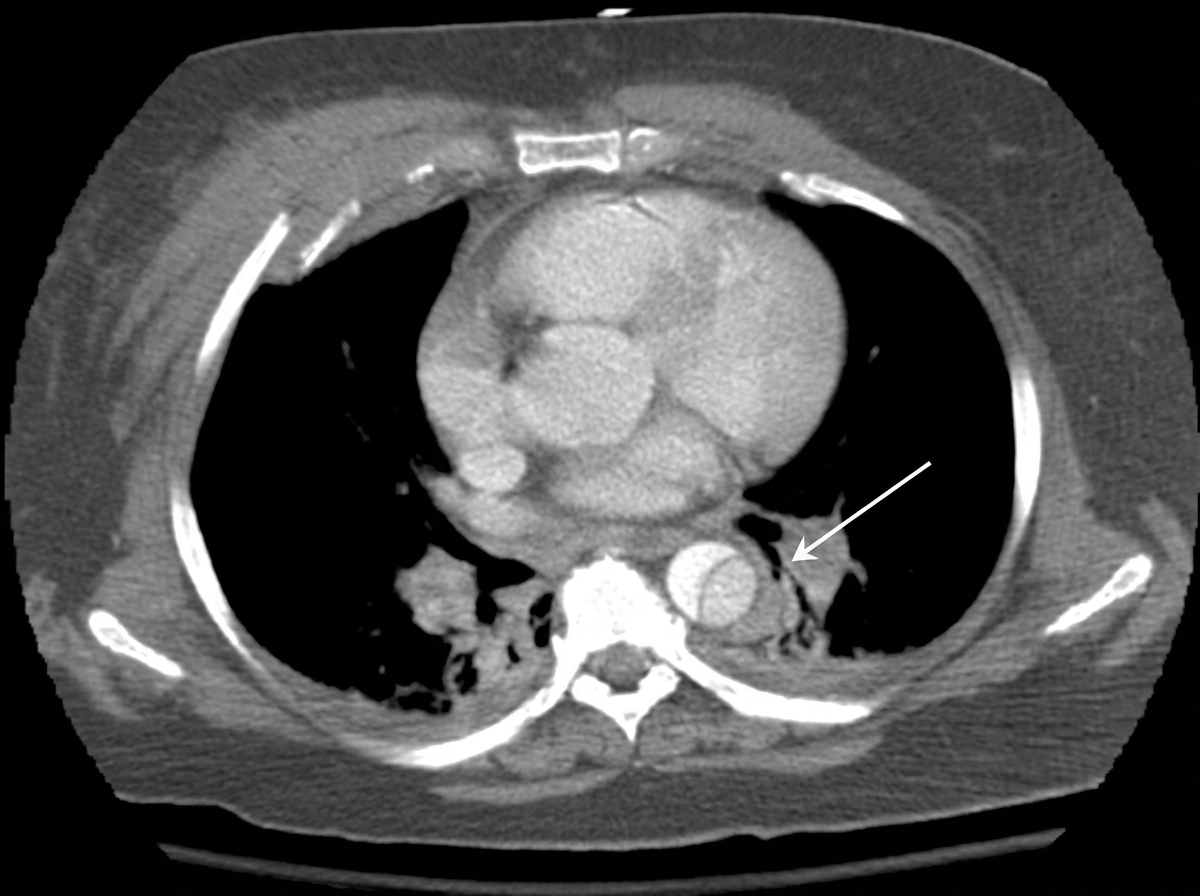
A 38-year-old patient presents with chest pain and hoarseness of voice for the past month. Based on the radiographic image below, what is the most likely diagnosis?

An MRI heart shows 'zebra' pattern in left ventricle. Which additional finding would best support Fabry disease?
An MRA shows 'string of pearls' appearance in renal arteries. Which additional finding would best support fibromuscular dysplasia?
What is the Investigation of Choice (IOC) for Acute Aortic Dissection?
An asymptomatic old patient presents with bruit in the carotid artery. Which of the following is the investigation of choice?
"Square root sign" is a hemodynamic finding seen in
MRI is superior in all of the following conditions except
IOC for Acute Aortic Dissection in a Clinically Unstable patient is?
In aortic dissection, the most accurate investigation is:
Explanation: ***Normal sinus rhythm*** - The ECG shows regular **P waves** followed by **QRS complexes**, with a consistent PR interval and a heart rate between 60-100 beats per minute, which are all characteristics of a normal sinus rhythm. - The QRS complexes are narrow, indicating normal ventricular depolarization, and the T waves are appropriately configured. *Paroxysmal supraventricular tachycardia* - This rhythm would typically show a **very rapid heart rate** (150-250 bpm) with narrow QRS complexes and often obscured or absent P waves. - The rate in this ECG is clearly within the normal range, and P waves are distinctly visible before each QRS. *Atrial fibrillation* - Atrial fibrillation is characterized by an **irregularly irregular rhythm**, absence of distinct P waves, and an erratic baseline due to chaotic atrial activity. - This ECG clearly shows a regular rhythm with discernible P waves. *Ventricular fibrillation* - Ventricular fibrillation is a life-threatening arrhythmia characterized by completely **chaotic and irregular electrical activity** in the ventricles, resulting in no identifiable P waves, QRS complexes, or T waves. - The ECG in the image shows clearly defined, organized waveforms, making ventricular fibrillation incorrect.
Explanation: ***Aortic dissection of the arch*** - The image suggests a dissection flap within the **aortic arch**, creating a true and false lumen, which is characteristic of an aortic dissection. - Chest pain and **hoarseness of voice** (due to recurrent laryngeal nerve compression by the expanding aorta) are classic symptoms of aortic dissection affecting the aortic arch. - Aortic dissection involves an **intimal tear** with blood entering the media, creating separate lumens, which differentiates it from a simple aneurysm. *Saccular aneurysm of distal arch* - A **saccular aneurysm** would appear as a focal, out-pouching dilatation of the aorta, without evidence of an intimal flap or separate lumens seen in the image. - While an aneurysm can cause symptoms like chest pain or hoarseness, the imaging features specifically point to dissection rather than a simple saccular aneurysm. *Coarctation of the aorta* - **Coarctation of the aorta** is a congenital narrowing of the aorta, typically distal to the left subclavian artery, which would appear as a localized constriction, not a dissection. - While it can manifest with chest pain, hoarseness is not a typical symptom, and classic imaging would show a "shelf-like" indentation or rib notching on X-ray. *Stenosis of the aorta* - **Aortic stenosis** usually refers to narrowing of the aortic valve or a focal narrowing of the aorta. The image displays a complex abnormality of the aortic wall and lumen, not simple stenosis. - While severe aortic stenosis can cause chest pain (angina), hoarseness is not a common associated symptom.
Explanation: ***Delayed enhancement*** - The **zebra stripe pattern** in Fabry disease refers to the characteristic histopathological appearance on electron microscopy showing lamellar inclusions in lysosomes. - On cardiac MRI, Fabry cardiomyopathy characteristically shows **late gadolinium enhancement (LGE)** in a **mid-wall inferolateral distribution** of the left ventricle. - This LGE pattern, combined with the clinical context of glycosphingolipid accumulation, is highly specific for Fabry disease and represents **myocardial fibrosis** secondary to sphingolipid storage. - LGE is one of the major diagnostic criteria for cardiac involvement in Fabry disease. *T1 shortening* - **T1 shortening** is not characteristic of Fabry disease. - In fact, Fabry cardiomyopathy typically shows **increased native T1 values** (T1 prolongation) in the inferolateral wall due to sphingolipid accumulation and interstitial expansion. - Native T1 mapping shows elevated T1 values before contrast administration, making T1 shortening an incorrect finding. *Pericardial effusion* - **Pericardial effusion** is not a characteristic or common finding in Fabry disease. - It is more typically associated with inflammatory pericarditis, heart failure, uremia, hypothyroidism, or malignancy. - Fabry disease primarily affects the myocardium through intracellular glycosphingolipid deposition, not the pericardium. *Wall motion abnormality* - **Wall motion abnormalities** can occur in advanced Fabry cardiomyopathy but are **non-specific** and seen in many cardiac conditions. - These represent a late manifestation of disease when significant myocardial damage has occurred. - They do not specifically support the diagnosis of Fabry disease compared to the characteristic LGE pattern.
Explanation: ***Beaded appearance of carotids*** - **Fibromuscular dysplasia (FMD)** is a systemic arteriopathy that commonly affects the renal and carotid arteries, often presenting with the characteristic "string of pearls" or **beaded appearance** due to alternating stenoses and aneurysms. - The presence of this finding in the carotid arteries, in addition to the renal arteries, strongly suggests widespread FMD rather than a localized process. *Atherosclerotic plaques* - **Atherosclerotic plaques** are focal deposits of lipids and fibrous tissue within the arterial wall, which can cause stenosis and are a common cause of **renal artery stenosis**. - However, atherosclerosis does not typically produce the diffuse **"string of pearls"** appearance seen in FMD and is a distinct vascular disease. *Arterial dissection* - While **arterial dissection** can occur in FMD, it is a complication rather than the primary characteristic finding of the disease itself. - A dissection involves a tear in the arterial wall, leading to a false lumen, and does not typically manifest as a "string of pearls" morphology on imaging. *Vessel wall thickening* - **Vessel wall thickening** can be a non-specific finding in various vascular conditions, including inflammation or chronic hypertension, and does not specifically point to FMD. - While FMD involves structural changes to the vessel wall, the key diagnostic feature is the specific **"string of pearls"** pattern, which is more detailed than mere thickening.
Explanation: ***CT-angio*** - **Computed tomography angiography (CTA)** is considered the **gold standard** imaging modality for diagnosing acute aortic dissection due to its rapid acquisition, wide availability, and excellent visualization of the aorta and its branches. - It precisely demonstrates the **intimal flap**, true and false lumens, and assesses the extent of the dissection and involvement of major branch vessels. *Usg* - **Ultrasound (USG)**, specifically **transesophageal echocardiography (TEE)**, is highly sensitive and specific for proximal aortic dissections. - However, its utility is operator-dependent and it has limitations in visualizing the entire aorta, especially the distal descending aorta. *Doppler* - **Doppler ultrasound** is used to assess blood flow velocity and patterns within vessels. - While it can detect flow disturbances, it is not the primary imaging modality for diagnosing the anatomical extent and characteristics of an aortic dissection flap. *Mr-Angio* - **Magnetic resonance angiography (MRA)** provides excellent soft tissue contrast, no radiation exposure, and detailed anatomical information for aortic dissection. - However, it is often less accessible, time-consuming, and contraindicated in patients with certain metallic implants or claustrophobia, making it less ideal for an acute emergency setting compared to CTA.
Explanation: ***Doppler ultrasonography*** - **Doppler ultrasonography** is a non-invasive, quick, and accurate method for assessing the degree of stenosis in the carotid arteries. - It provides information on **blood flow velocity** and plaque morphology, which is crucial for determining the need for intervention in **asymptomatic carotid bruits**. *Internal carotid angiography* - **Internal carotid angiography** is an invasive procedure with a risk of complications such as stroke. - It is typically reserved for cases where non-invasive imaging is inconclusive or as a preliminary step to endovascular intervention, not as a primary diagnostic tool for an **asymptomatic patient**. *Aortic arch angiography* - **Aortic arch angiography** is also an invasive procedure primarily used to visualize the great vessels originating from the aortic arch. - While it can show the proximal carotid arteries, it is not the initial investigation of choice for focusing specifically on **carotid stenosis**. *Spiral CT angiography* - **Spiral CT angiography** involves radiation exposure and intravenous contrast material, making it less suitable as a first-line screening tool. - While it provides detailed anatomical information, **Doppler ultrasonography** is preferred as the initial investigation due to its safety, lack of radiation, and effectiveness for **asymptomatic carotid disease**.
Explanation: ***Constrictive pericarditis*** - The "square root sign" refers to the characteristic **ventricular pressure tracing** seen on cardiac catheterization in constrictive pericarditis, resembling a rapid early diastolic filling followed by a plateau (shaped like the mathematical square root symbol √). - This hemodynamic pattern is due to the **abrupt cessation of ventricular filling** when the stiff, fibrotic pericardium limits further expansion. - This is a **catheterization/hemodynamic finding**, not a radiological imaging finding. *ASD* - An **atrial septal defect** (ASD) is a congenital heart defect involving a hole in the septum separating the atria. - It does not present with a "square root sign" on pressure tracings; rather, it's associated with a **fixed, wide splitting of S2** and right heart enlargement on imaging. *Pleuro-pericardial cyst* - A **pleuro-pericardial cyst** is a benign, fluid-filled sac located near the heart or lungs. - While it may be identified on imaging, it typically causes no hemodynamic changes and thus no "square root sign" on cardiac pressure measurements. *HOCM* - **Hypertrophic obstructive cardiomyopathy** (HOCM) is characterized by thickening of the ventricular walls, leading to dynamic outflow tract obstruction. - Its pressure tracings show a **spike-and-dome pattern** with dynamic LVOT gradient, distinct from the "square root sign."
Explanation: ***Serial evaluation of liver functions in a 54-year-old female with metastatic carcinoma breast with doxorubicin chemotherapy*** - While MRI can assess **liver morphology** and some functional parameters, **liver function** is primarily evaluated through **blood tests** (e.g., liver enzymes, bilirubin, albumin). - Regular biochemical tests are more direct and efficient for monitoring liver function during chemotherapy. *Diagnosis of iron overload cardiomyopathy in a pediatric patient with β-thalassemia major and congestive heart failure.* - **Cardiac MRI with T2* mapping** is the gold standard for quantifying myocardial iron deposition, which leads to iron overload cardiomyopathy. - This is crucial for guiding chelation therapy and preventing irreversible heart damage in **thalassemia patients**. *Diagnosis of aortic coarctation in a 17-year-old female with hypertension and radiofemoral delay on physical examination.* - **MRI angiography** provides excellent detailed anatomical imaging of the aorta, including the site, extent, and severity of coarctation, as well as collateral circulation. - This offers a comprehensive assessment that is superior to echocardiography in older children and adults. *Diagnosis of arrhythmogenic right ventricular cardiomyopathy in a 24-year-old man who survived recent cardiac arrest.* - **Cardiac MRI** is highly effective in diagnosing **ARVC** by detecting characteristic findings such as **fibrofatty replacement** in the right ventricular myocardium, wall motion abnormalities, and regional aneurysms. - These features are often difficult to visualize with other imaging modalities.
Explanation: ***TEE (Transesophageal Echocardiography)*** - **TEE is the investigation of choice** for acute aortic dissection in **hemodynamically unstable patients** due to its **portability and rapidity**. - Can be performed at the **bedside** without transporting the critically ill patient, minimizing risk. - Provides rapid diagnosis (5-10 minutes) with **>95% sensitivity and specificity** for detecting intimal flap and false lumen. - Simultaneously assesses **complications** such as aortic regurgitation, pericardial effusion/tamponade, and ventricular function. - Particularly excellent for visualizing the **ascending aorta** and aortic root. *CT-Angio* - **CT angiography** is the **investigation of choice** for acute aortic dissection in **hemodynamically STABLE patients**. - Provides excellent anatomical detail of the entire aorta, clearly showing the intimal flap, true and false lumens, and branch vessel involvement. - Requires **patient transport** to the radiology department, which is **unsafe in unstable patients**. - Best for comprehensive surgical planning in stable patients. *MRI* - **MRI** offers the highest anatomical detail and is considered the gold standard for **chronic dissection follow-up**. - Its lengthy acquisition time (30-60 minutes) and incompatibility with monitoring equipment make it **unsuitable for acutely unstable patients**. *NCCT* - **Non-contrast CT** may show indirect signs like the **hyperdense crescent sign** in the aortic wall. - Cannot reliably differentiate true and false lumens or assess the full extent of dissection. - Insufficient for definitive diagnosis or management planning.
Explanation: ***CT scan*** - **CT angiography** of the chest is the **gold standard** and most accurate readily available imaging modality for diagnosing acute aortic dissection, with sensitivity and specificity both >95%. - It offers **rapid acquisition** (3-5 minutes), high spatial resolution, and is widely available in emergency settings. - It clearly visualizes the **true and false lumens**, intimal flap, entry/re-entry tears, extent of the dissection (Stanford/DeBakey classification), involvement of branch vessels, and any associated complications like pericardial effusion or mediastinal hematoma. *MRI scan* - **MRI/MRA** offers comparable diagnostic accuracy (sensitivity ~98%, specificity ~95%) without radiation exposure and is excellent for chronic dissections or surveillance. - However, its use in acute settings is limited by **longer acquisition times** (20-30 minutes), limited availability in emergency departments, and contraindications (pacemakers, metallic implants, claustrophobia). - It is **not feasible** in hemodynamically unstable patients requiring rapid diagnosis and intervention. *ECG* - An **ECG** is routinely performed to evaluate chest pain and rule out acute coronary syndrome, but it does **not visualize** the aorta or diagnose dissection. - It may show non-specific ST-T changes or signs of **myocardial ischemia** if coronary ostia are involved in the dissection, but these findings are neither sensitive nor specific for aortic dissection. *Aortography* - **Conventional aortography** (invasive catheter-based angiography) was historically the gold standard but has been **replaced by CT and MRI** as first-line imaging. - It has lower sensitivity (~85-90%) than modern cross-sectional imaging and carries procedural risks including **arterial access complications**, contrast-induced nephropathy, and stroke. - Currently reserved for cases where intervention is planned or when non-invasive imaging is inconclusive.
Cardiovascular Anatomy
Practice Questions
Cardiac CT Techniques
Practice Questions
Cardiac MRI Techniques
Practice Questions
Ischemic Heart Disease Imaging
Practice Questions
Valvular Heart Disease
Practice Questions
Cardiomyopathies
Practice Questions
Pericardial Diseases
Practice Questions
Congenital Heart Disease
Practice Questions
Aortic and Great Vessel Imaging
Practice Questions
Peripheral Vascular Imaging
Practice Questions
Cardiovascular Interventional Procedures
Practice Questions
Post-Surgical Cardiovascular Imaging
Practice Questions
Get full access to all questions, explanations, and performance tracking.
Start For Free