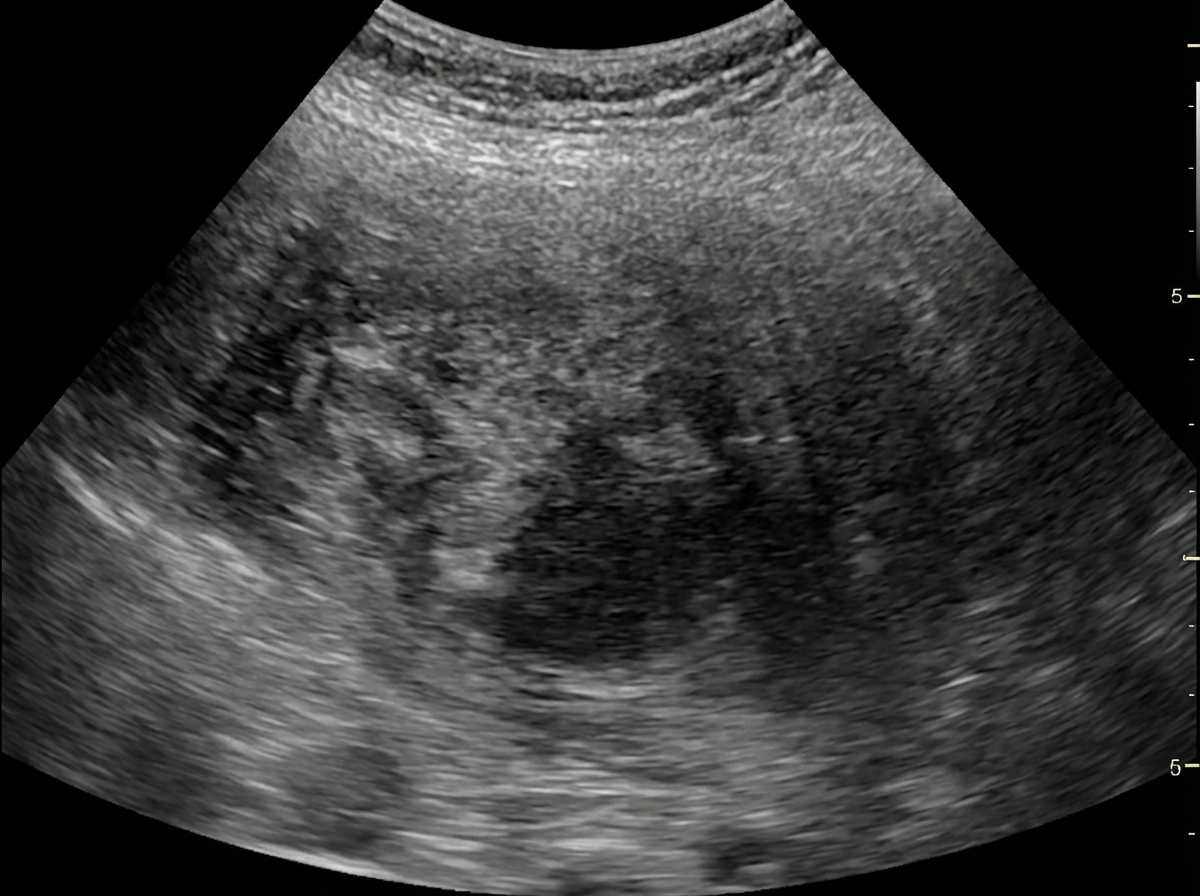
Most sensitive investigation for abdominal trauma in a hemodynamically stable patient is-
Clinical examination of a symptomatic patient shows a Sister Mary Joseph nodule. It is most commonly associated with which of the following?
A child is being assessed for possible intussusception; which of the following would be LEAST likely to provide valuable information?
What are the potential symptoms of malignant transformation in a retroperitoneal lipoma?
Organ which is commonly involved in retroperitoneal fibrosis is
Gas absent from intestine (gasless abdomen) on x-ray is seen in which condition?
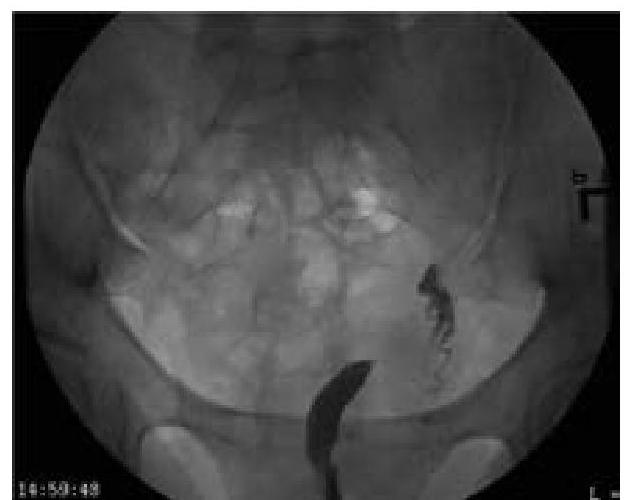
What type of uterine anomaly is shown in this X-ray HSG image?
In a patient with a tender and rigid abdomen, what is the expected finding on X-ray?
Blumberg's sign is
A patient presents with abdominal pain. On physical examination there was abdominal guarding and tenderness. A plain erect chest X-ray reveals air under diaphragm. Probable diagnosis is

Explanation: ***CT Scan (Computed Tomography)*** - **CT scans** offer superior anatomical detail and can accurately detect organ damage, hemorrhage, and other injuries in **hemodynamically stable** patients with abdominal trauma. - It is considered the **most sensitive** and specific imaging modality for evaluating blunt and penetrating abdominal trauma when the patient can tolerate the study. *Ultrasonography (FAST)* - While effective for detecting **free fluid** (blood) in specific abdominal areas, **Focused Assessment with Sonography for Trauma (FAST)** has lower sensitivity for solid organ injuries or bowel perforations. - Its primary role is rapid assessment for **hemoperitoneum** to guide immediate management in unstable patients, not detailed injury characterization. *Diagnostic peritoneal lavage (DPL)* - **DPL** is an invasive procedure with high sensitivity for detecting **intraperitoneal bleeding**, but it does not identify specific organ injuries or retroperitoneal hemorrhage. - It is rarely used in hemodynamically stable patients due to its invasiveness and the availability of more detailed imaging techniques. *MRI (Magnetic Resonance Imaging)* - **MRI** provides excellent soft tissue contrast but is typically too **time-consuming** and less accessible in urgent trauma settings compared to CT. - It's generally not the first-line investigation for acute abdominal trauma due to motion artifacts and limited utility in detecting air or bone injuries.
Explanation: ***Stomach cancer*** - A **Sister Mary Joseph nodule** is a **periumbilical metastatic nodule**, most commonly associated with **gastric adenocarcinoma** due to its propensity for peritoneal spread. - While it can originate from other abdominal malignancies, stomach cancer is statistically the most frequent primary source of this metastatic sign. *Ovarian cancer* - Ovarian cancer can metasatasize to the peritoneum and sometimes cause Sister Mary Joseph nodules, but it is not the most common primary source [1]. - Instead, ovarian cancer more frequently presents with symptoms like **abdominal distension**, **pelvic pain**, or **ascites** [1]. *Colon cancer* - **Colorectal cancer** can also metastasize to the peritoneum, potentially leading to a Sister Mary Joseph nodule, though less commonly than gastric cancer [2]. - It often manifests with changes in **bowel habits**, **rectal bleeding**, or **unexplained weight loss** [2]. *Pancreatic cancer* - Pancreatic cancer can produce a Sister Mary Joseph nodule, particularly in advanced stages with **peritoneal dissemination**. - However, it is primarily known for other metastatic patterns and often presents with **jaundice** (if the head of the pancreas is affected) or **epigastric pain**.
Explanation: ***Family history*** - Intussusception is typically an **acute pediatric condition** with no strong genetic predisposition. - While certain genetic syndromes can increase risk, general family history of other conditions is **not directly relevant** to confirming or ruling out intussusception. *Pain pattern* - The classic **intermittent, colicky abdominal pain** that recurs every 15-20 minutes is a hallmark symptom of intussusception. - This pattern provides crucial diagnostic information about the **bowel telescoping and transient obstruction**. *Abdominal palpation* - Palpation can reveal a **sausage-shaped abdominal mass**, especially in the right upper quadrant, which is a classic physical finding. - Tenderness, distension, and signs of peritonitis can also be detected, indicating **bowel obstruction or perforation**. *Stool inspection* - The presence of "**currant jelly stool**" (blood and mucus) is a highly characteristic sign of intussusception, resulting from venous congestion and sloughing of the intestinal mucosa. - This finding provides clear evidence of **intestinal ischemia and bleeding**.
Explanation: ***All of the options*** - Malignant transformation of a lipoma, particularly into a **liposarcoma**, can cause a variety of symptoms due to its growth and potential invasion of surrounding structures. - This includes generalized symptoms like **weight loss**, and localized effects such as **abdominal pain** and **organ compression** (e.g., renal failure). *Abdominal pain* - As a retroperitoneal tumor grows, it can cause **mass effect** and pressure on nearby organs and nerves, leading to abdominal pain. - Pain relief is often sought by patients presenting with these growths, highlighting their clinical significance. *Weight loss* - **Unexplained weight loss** is a common constitutional symptom associated with malignancy, including liposarcoma. - This systemic symptom can indicate a more advanced or aggressive tumor. *Renal failure due to compression* - A growing liposarcoma in the retroperitoneum can **compress structures** such as the ureters, leading to hydronephrosis and ultimately **renal failure**. - Direct invasion or extrinsic compression of the kidney itself can also impair renal function.
Explanation: ***Ureter*** - Retroperitoneal fibrosis is characterized by the proliferation of **fibrous tissue in the retroperitoneum**, which commonly encases the ureters. - This encasement can lead to **ureteral obstruction**, causing hydronephrosis and potential renal impairment. *Colon* - While the colon is located in the retroperitoneum for some segments (ascending, descending), it is **less commonly entrapped** and obstructed by retroperitoneal fibrosis compared to the ureters. - **Bowel obstruction** is not a primary or common clinical manifestation of retroperitoneal fibrosis. *Duodenum* - The duodenum is primarily located in the **upper retroperitoneum** but is generally less affected by the fibrotic process characteristic of retroperitoneal fibrosis. - **Obstructive symptoms related to the duodenum** are rare in this condition. *Kidneys* - The kidneys are retroperitoneal organs, but the fibrosis typically involves the **perirenal fat and surrounding structures**, not the kidney parenchyma itself. - Renal dysfunction in retroperitoneal fibrosis is usually a **secondary complication of ureteral obstruction**, not direct renal involvement.
Explanation: ***Acute pancreatitis*** - In **severe acute pancreatitis**, a **gasless or relatively gasless abdomen** may be seen due to profound **ileus** with fluid accumulation displacing intestinal gas. - The marked inflammatory process can lead to complete loss of intestinal motility and fluid sequestration (third-spacing), resulting in minimal visible bowel gas on X-ray. - **Note**: Classic signs include **sentinel loop sign** (dilated jejunal loop) or **colon cut-off sign**, but in severe cases with massive ascites or fluid collections, a gasless pattern may occur. *Ulcerative colitis* - Typically presents with **dilated loops of large bowel** with visible gas and **toxic megacolon** in severe cases. - Inflammatory changes cause bowel wall thickening, but gas is usually **present and often increased**. *Intussusception* - May show a **target sign** or **meniscus sign** on imaging, with bowel loops dilated proximal to the obstruction. - Gas is typically **present** within the bowel or proximal to the invagination, not absent from the entire abdomen. *Necrotizing enterocolitis* - Characterized by **pneumatosis intestinalis** (gas in the bowel wall) and **portal venous gas**, features directly contradicting a gasless abdomen. - Shows dilated loops with gas and evidence of bowel wall necrosis - **gas is prominently present**.
Explanation: ***Unicornuate uterus*** - The image shows a single, elongated uterine horn with a single fallopian tube arising from it, consistent with a **unicornuate uterus**. - This congenital anomaly results from the **failure of one Müllerian duct to develop**, leading to an abnormally shaped uterus. *Septate uterus* - A **septate uterus** would show a normal uterine fundus with an internal septum dividing the uterine cavity. - This image clearly depicts only **one rudimentary horn** and no visible septum. *Uterus didelphys* - **Uterus didelphys** involves two completely separate uteri, each with its own cervix and vagina. - The image does not show evidence of a **second, separate uterine structure**. *Bicornuate uterus* - A **bicornuate uterus** is characterized by two distinct uterine horns, which fuse at the cervix or lower uterine segment, creating a heart-shaped appearance of the fundus. - The image shows a **single, long horn** rather than two distinct horns.
Explanation: ***Air under the diaphragm*** - The presence of **free air** (pneumoperitoneum) beneath the diaphragm on an upright abdominal X-ray is a classic sign of **visceral perforation**. - A **tender and rigid abdomen** (peritoneal signs) indicates irritation of the peritoneum, most commonly due to a ruptured hollow viscus. *Blood under the diaphragm* - While blood can accumulate under the diaphragm (e.g., from **trauma** or a ruptured ectopic pregnancy), it typically manifests as a **hemoperitoneum** on imaging. - Blood is **fluid** and would appear as a fluid collection, not free air, on X-ray. *Hazy lung fields* - **Hazy lung fields** suggest conditions like **pulmonary edema**, pneumonia, or acute respiratory distress syndrome (ARDS). - These findings are primarily associated with pulmonary pathology and are not directly indicative of an acute abdominal emergency like perforation. *Prominent vascular markings* - **Prominent vascular markings** often indicate increased blood flow to the lungs or **pulmonary hypertension**. - This finding is unrelated to acute abdominal pain or peritoneal irritation.
Explanation: ***Rebound tenderness during abdominal palpation*** - Blumberg's sign refers specifically to **rebound tenderness**, which is pain experienced upon the rapid release of pressure applied to the abdomen. - It is a classic sign indicating **peritoneal irritation** or inflammation, often seen in conditions like appendicitis. *Board-like rigidity of abdomen* - **Board-like rigidity** describes a state of involuntary abdominal muscle contraction, making the abdomen feel hard and inflexible. - This is a sign of **generalized peritonitis**, a more severe and widespread inflammation of the peritoneum than what typically elicits Blumberg's sign alone. *Pressure over left iliac fossa causing pain in right iliac fossa* - This describes **Rovsing's sign**, where palpation of the left lower quadrant causes pain in the right lower quadrant. - Rovsing's sign is another indicator of **peritoneal irritation** in the right lower quadrant and is commonly associated with appendicitis. *Pressure over right iliac fossa causing pain in left iliac fossa* - Applying pressure to the right iliac fossa usually causes pain in that same area if **appendicitis** is present (e.g., McBurney's point tenderness). - This specific pain pattern (pain in the left iliac fossa from right iliac fossa pressure) is not a recognized named sign for **abdominal pathology**.
Explanation: ***Perforated abdominal viscus*** - The presence of **abdominal guarding** and **tenderness** indicates peritoneal irritation, while **air under the diaphragm** on an erect chest X-ray (**pneumoperitoneum**) is a classic sign of a perforated hollow abdominal organ. - This combination strongly suggests a **perforated abdominal viscus**, such as a **perforated peptic ulcer** or perforated diverticulitis, leading to the leakage of air and intestinal contents into the peritoneal cavity. *Acute myocardial infarction* - Acute myocardial infarction primarily presents with **chest pain**, radiation to the arm/jaw, and shortness of breath, not typically severe abdominal pain with guarding. - While it can cause some epigastric discomfort, it would not explain the **pneumoperitoneum** seen on the chest X-ray. *Aortic dissection* - Aortic dissection typically causes **sudden, severe tearing chest or back pain**, often radiating to the back. - There is no direct link between aortic dissection and **air under the diaphragm** unless there's a co-existing, unrelated issue, which is not suggested by the primary symptoms. *None of the options* - Given the clear clinical and radiological findings of **pneumoperitoneum** and **peritoneal signs**, a perforated abdominal viscus is the most fitting diagnosis among the choices provided. - This option is incorrect as there is a highly probable diagnosis among the given choices.
Get full access to all questions, explanations, and performance tracking.
Start For Free