All are true about management of PDPH except-
A 32-year-old patient with Restless leg syndrome comes to the OPD. What is the most appropriate first line treatment?
A 42-year-old female executive is referred to the sleep clinic with jaw pain. She complains that after she arrives home at night around 10 pm she frequently drinks 3-4 gin and tonics to help quiet her mind.’ She wakes up the next morning around 3am to read the international stock market news, at which point she states her teeth ache an unbearable amount. A study is performed on the patient and it is noted that she grinds her teeth and mutters during roughly half of her sleep. Which of the following would you expect to see on her EEG and at which stage of sleep would you expect her jaw pain to be caused?
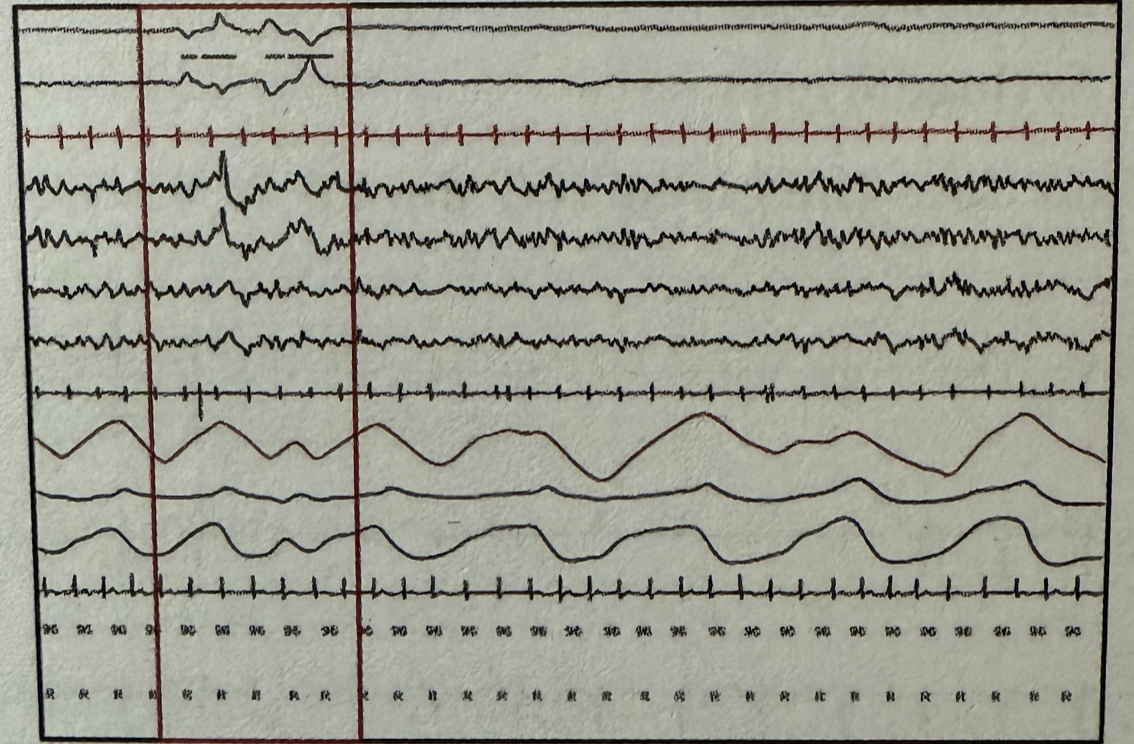
During polysomnography, which stage of sleep is represented by the marked areas when observing the following wave patterns? EOG (Electrooculography) EEG (Electroencephalography) EMG (Electromyography)
In narcolepsy, the polysomnographic recording typically shows which of the following patterns?
Somnambulism is mostly seen in which age group?
An otherwise healthy 43-year-old woman comes to the physician because of several episodes of involuntary movements of her head over the past few months. They are sometimes associated with neck pain and last minutes to hours. Neurologic examination shows no abnormalities. During examination of the neck, the patient's head turns horizontally to the left. She states this movement is involuntary, and that she is unable to unturn her head. After 5 minutes, her head re-straightens. Which of the following best describes this patient's disorder?
Chorea is NOT seen in
A patient was recently started on Fluphenazine. A few weeks later, he developed tremors, rigidity, bradykinesia, and excessive salivation. The first line of management for this patient is
The term 'cocaine bugs' refers to:
Explanation: ***Early ambulation*** - **Early ambulation** was historically thought to worsen PDPH but is now understood to have no significant impact on its incidence or severity. - While not directly a treatment, it is not contraindicated and does not preclude other management strategies; therefore, stating it is "true about management" is the exception as it's often a misconception. *Hydration* - **Hydration**, especially intravenous fluids, is a supportive measure for PDPH, as it can help maintain cerebral fluid volume. - This can potentially increase CSF pressure and alleviate symptoms. *Cerebral vasoconstriction - caffeine* - **Caffeine** induces **cerebral vasoconstriction**, which helps reduce cerebral blood volume and consequently decreases the intracranial pressure gradient, alleviating PDPH. - It also has mild analgesic properties. *Analgesic* - **Analgesics**, such as NSAIDs or acetaminophen, are used for symptomatic relief of the headache pain associated with PDPH. - They address the pain but do not target the underlying cause of CSF leakage.
Explanation: ***Gabapentin*** - **Gabapentin** and other alpha-2-delta ligands (e.g., pregabalin) are considered **first-line agents** for moderate to severe Restless Legs Syndrome (RLS), particularly when symptoms are bothersome and daily. - They work by modulating **calcium channels** and are effective in reducing RLS symptoms with a generally favorable side effect profile. *Iron Supplementation* - **Iron supplementation** is appropriate as first-line treatment only if **serum ferritin levels** are below 75 mcg/L, indicating iron deficiency. - While RLS is associated with **iron deficiency**, it's not the universal first-line treatment without biochemical confirmation [1]. *Pramipexole* - **Dopamine agonists** like pramipexole are effective for RLS but are generally **second-line treatments** due to concerns about augmentation (worsening of RLS symptoms) and impulse control disorders. - Augmentation is a significant side effect where symptoms worsen paradoxically with continued use, particularly with higher doses. *Vitamin B12* - **Vitamin B12 deficiency** can cause neurological symptoms, but it is **not a primary cause or treatment** for Restless Legs Syndrome. - Supplementation with **Vitamin B12** would only be considered if a confirmed deficiency exists, which is not stated as a contributing factor in this patient.
Explanation: ***Sleep spindles, N2*** - The patient's presentation of teeth grinding (**bruxism**) and muttering during sleep, along with jaw pain, is characteristic of **parasomnias**, which often occur during **stage N2 sleep**. - **Sleep spindles** and **K-complexes** are defining EEG features of **N2 sleep**, indicating that the sleep study would likely show these patterns. *Alpha waves, N2* - **Alpha waves** are characteristic of a **relaxed, awake state** or the early stages of falling asleep (N1), not N2 sleep. - While the patient has jaw pain, its cause is linked to sleep behaviors occurring in more advanced sleep stages than N1. *Beta waves, N3* - **Beta waves** are typically seen during **active wakefulness** and **REM sleep**, not deep N3 sleep. - **N3 sleep** (slow-wave sleep) is characterized by **delta waves**, not beta waves. *Delta waves, N3* - Although **delta waves** are indeed characteristic of **N3 sleep** (deep sleep), the patient's symptoms of teeth grinding and muttering are more commonly associated with **N2 sleep** or arousal disorders, not typically the deepest stage of sleep. - Bruxism and muttering are generally not prominent features of undisturbed N3 sleep.
Explanation: ***NREM I sleep*** - This stage is characterized by a transition from wakefulness to sleep, identifiable by the appearance of **slow eye movements** in the EOG and a reduction in EEG frequency with the presence of **theta waves**. - The EMG shows a decrease in muscle tone but without the complete atonia seen in REM sleep. *REM sleep* - **Rapid eye movements** are characteristic in the EOG, and the EEG shows **low-amplitude, mixed-frequency waves** similar to wakefulness. - The EMG would display profound muscle atonia, which is not evident in the provided tracing. *NREM II sleep* - This stage is marked by the presence of **sleep spindles** and **K-complexes** in the EEG, which are absent in the marked area. - Eye movements are generally absent, and muscle activity continues to be low. *NREM III sleep* - This is the deepest stage of sleep, characterized by **high-amplitude, slow-delta waves** (20-50% of the epoch) in the EEG. - Eye movements are typically absent, and muscle tone is very low but not completely absent.
Explanation: ***REM intrusion during inappropriate periods*** - In narcolepsy, the hallmark polysomnographic finding is **sleep-onset REM periods (SOREMPs)** - the occurrence of REM sleep within 15 minutes of sleep onset. - The **Multiple Sleep Latency Test (MSLT)** in narcolepsy typically shows **≥2 SOREMPs** along with a mean sleep latency of ≤8 minutes. - Clinically, this **REM sleep intrusion** manifests as **sudden, irresistible sleep attacks** during the day, **cataplexy** (sudden muscle weakness triggered by strong emotions), **sleep paralysis**, and **hypnagogic/hypnopompic hallucinations**. - These represent features of REM sleep (muscle atonia, dreams) occurring at inappropriate times. *An absence of REM sleep in midcycle* - This statement is incorrect as narcolepsy is characterized by an **abnormal presence and early onset of REM sleep**, not its absence. - Individuals with narcolepsy enter REM sleep much faster than normal (often within minutes rather than the typical 90 minutes). *Extreme muscular relaxation* - While **cataplexy** (present in Type 1 narcolepsy) involves sudden loss of muscle tone due to REM-related atonia during wakefulness, this is a clinical symptom rather than a continuous polysomnographic finding. - Polysomnography focuses on **sleep architecture** and the timing of **REM sleep onset**, not general muscle relaxation patterns. *Spike-and-wave EEG recording* - **Spike-and-wave patterns** on EEG are characteristic of **absence seizures** (a form of epilepsy), not narcolepsy. - Narcolepsy is a primary **sleep disorder** with distinct polysomnographic features related to **REM sleep dysregulation**, not epileptiform activity.
Explanation: ***Correct Option: Children*** - Somnambulism (sleepwalking) is **most commonly seen in children**, with peak incidence between **4-12 years of age** - Approximately **15-40% of children** experience at least one episode of sleepwalking - Occurs during **slow-wave sleep (NREM stage 3)**, which is more prominent in childhood - Episodes typically **decrease and resolve by adolescence** as sleep architecture matures *Incorrect Option: Adolescents* - While sleepwalking can persist into adolescence, the **prevalence significantly decreases** during teenage years - Most children who sleepwalk stop by the time they reach adolescence *Incorrect Option: All age groups* - Though somnambulism can technically occur at any age, it is **NOT equally distributed** across age groups - The frequency is **significantly higher in children** compared to other age groups *Incorrect Option: Adults* - Adult-onset sleepwalking is **relatively rare (1-4% prevalence)** - When it occurs in adults, it may be associated with underlying conditions (medications, sleep deprivation, psychiatric disorders, or neurological conditions) - Childhood somnambulism has much higher prevalence rates
Explanation: ***Dystonia*** - This patient presents with **sustained, involuntary muscle contractions** causing repetitive, twisting movements and abnormal postures [1], which are characteristic features of **dystonia**, specifically **cervical dystonia (torticollis)**. - The description of the head turning involuntarily to the left and inability to unturn it, lasting minutes to hours, fits the pattern of intermittent or spasmodic dystonia. *Athetosis* - **Athetosis** involves slow, sinuous, **writhing involuntary movements**, particularly affecting distal limbs [1]. - These movements are often continuous and slow, unlike the more sudden, sustained contractions seen in the patient. *Akathisia* - **Akathisia** is characterized by an internal feeling of **restlessness** and a strong urge to move, often described as an inability to sit still. - It results in fidgeting and pacing, rather than sustained, involuntary posturing of a specific body part. *Hemiballismus* - **Hemiballismus** involves **large-amplitude, involuntary, flinging movements** of one side of the body [1]. - This symptom typically arises from lesions in the **subthalamic nucleus** and is distinct from the sustained, twisting movements described [1]. *Chorea* - **Chorea** presents as **brief, irregular, rapid, and unpredictable involuntary movements** that flow randomly from one body part to another [1]. - Unlike the sustained, fixed posturing seen in dystonia, choreiform movements are often described as "dance-like" and are not maintained.
Explanation: ***Tourette syndrome*** - **Tourette syndrome** is primarily characterized by **motor and vocal tics**, which are sudden, repetitive, nonrhythmic movements or vocalizations. - While it involves involuntary movements, these are distinct from the continuous, flowing, dance-like movements of **chorea**. *Rheumatic fever* - **Sydenham's chorea** (St. Vitus' dance) is a major manifestation of **acute rheumatic fever**, particularly in children. - It is characterized by **involuntary, purposeless, jerky movements** affecting the face, trunk, and extremities. *Creutzfeldt-Jakob disease* - This rapidly progressive, fatal neurodegenerative disease often presents with various neurological symptoms including **chorea**, **myoclonus**, and ataxia. - The abnormal movements are due to widespread neuronal loss, particularly in the **basal ganglia**. *Huntington's disease* - **Huntington's disease** is a classic cause of **chorea**, characterized by progressive degeneration of neurons in the **caudate and putamen** [1]. - The chorea is typically generalized and worsens over time, accompanied by cognitive decline and psychiatric symptoms.
Explanation: ***Trihexyphenidyl*** - The patient is exhibiting symptoms of **drug-induced parkinsonism** (tremors, rigidity, bradykinesia, excessive salivation) due to **fluphenazine**, an antipsychotic. - **Anticholinergic medications** like trihexyphenidyl are the **first-line treatment** for drug-induced parkinsonism as they help restore the balance between dopamine and acetylcholine. *Pramipexole* - This is a **dopamine agonist** primarily used in the management of idiopathic **Parkinson's disease** and restless legs syndrome. - While it addresses dopamine deficiency, it is not the first-line treatment for **drug-induced parkinsonism**, where the issue is often dopamine receptor blockade rather than primary dopamine depletion. *Selegiline* - **Selegiline** is a selective **MAO-B inhibitor** used to treat idiopathic Parkinson's disease by preventing the breakdown of dopamine in the brain. - It is not the most appropriate first-line choice for **drug-induced parkinsonism** as it does not directly counteract the dopamine receptor blockade caused by antipsychotics. *Amantadine* - **Amantadine** is an antiviral drug with mild **dopaminergic properties** that can be used to treat **Parkinson's disease** and drug-induced extrapyramidal symptoms, particularly dyskinesia. - While sometimes used, it is generally considered **second-line** to anticholinergics for the acute management of **drug-induced parkinsonism**.
Explanation: ***Ekbom's syndrome*** - The term **"cocaine bugs"** refers to **formication** - tactile hallucinations of insects crawling on or under the skin, commonly experienced during cocaine intoxication or withdrawal. - While formication itself is a **hallucination** (false sensory perception), chronic cocaine users may develop **Ekbom's syndrome (delusional parasitosis)** - a fixed false belief of being infested by parasites. - Among the given options, Ekbom's syndrome is the most closely associated with the phenomenon of "cocaine bugs," though technically the term specifically describes the tactile hallucinations rather than the delusional disorder itself. *Othello syndrome* - This is a form of **delusional jealousy**, where an individual falsely believes their partner is unfaithful without any real evidence. - It is not associated with tactile hallucinations or the sensation of insects crawling on the skin. *Cotard's syndrome* - This is a rare mental disorder in which a person holds the **nihilistic delusion** that they are dead, do not exist, are putrefying, or have lost their blood or internal organs. - It is distinct from the tactile hallucinations or parasitosis delusions described as "cocaine bugs." *De Clérambault syndrome* - Also known as **erotomania**, this is a delusion in which an individual believes that another person, usually of higher social status, is in love with them. - This condition does not involve tactile hallucinations or the sensation of parasitic infestation.
Get full access to all questions, explanations, and performance tracking.
Start For Free