What is the major difference between typical and atypical antipsychotics?
A patient undergoing treatment for a psychiatric disorder takes an overdose of a drug and develops bradycardia, hypotension, decreased sweating, and salivation. What is the likely drug?
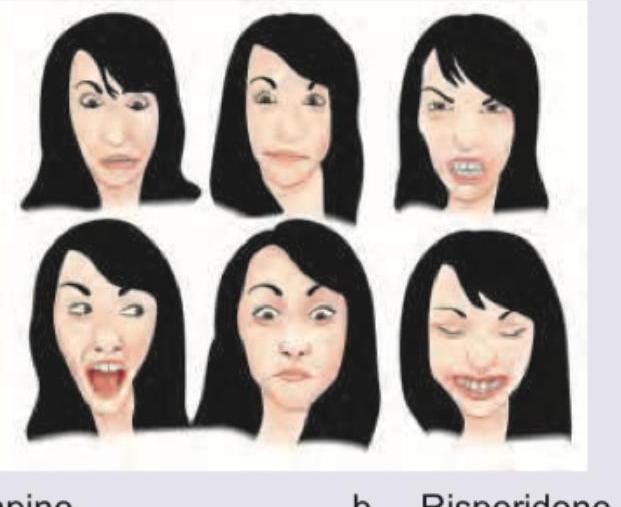
An elderly woman suffering from schizophrenia is on antipsychotic medication. She developed purposeless involuntary facial and limb movements, constant chewing and puffing of cheeks. Which of the following drugs is least likely to be involved in this side effect?
What is the drug of choice for a schizophrenic patient with poor oral absorption?
Which is a common side effect of lithium?
Estimation of serum levels is important for which of the following drugs?
Which of the following antismoking drugs can lead to suicidal ideation?
A 28-year-old woman diagnosed with schizophrenia had been compliant with her prescribed olanzapine for several months. However, she discontinued the treatment. Which of the following is the most likely reason for her discontinuation?
Which among the following psychoactive substances has antidepressant properties?
Which of the following drugs are used in the management of acute mania?
Explanation: ### Explanation The fundamental difference between typical (First Generation) and atypical (Second Generation) antipsychotics lies in their receptor binding profiles and side effect patterns. **Why Option B is Correct:** Typical antipsychotics (e.g., Haloperidol, Chlorpromazine) are potent **D2 receptor antagonists** in the nigrostriatal pathway. Chronic blockade of these receptors leads to "upregulation" and supersensitivity, resulting in **Tardive Dyskinesia (TD)**—a late-onset extrapyramidal symptom (EPS) characterized by involuntary choreoathetoid movements. While atypical antipsychotics carry a significantly lower risk of TD due to their rapid dissociation from D2 receptors and 5-HT2A antagonism, TD remains a hallmark long-term complication primarily associated with typical agents. **Why Other Options are Incorrect:** * **Option A:** While many atypicals have a lower risk of hyperprolactinemia, **Risperidone** and **Paliperidone** (atypical agents) cause significant increases in prolactin, often comparable to typical antipsychotics. * **Option C:** Both classes are available as parenteral preparations. For example, Haloperidol (Typical) and Olanzapine or Ziprasidone (Atypical) are available as short-acting injectables for acute agitation. * **Option D:** Sedation is not exclusive to atypicals. While Clozapine and Quetiapine are highly sedating, typical antipsychotics like **Chlorpromazine** (low potency) are also profoundly sedating. **High-Yield NEET-PG Pearls:** * **Mechanism:** Typical = D2 blockade; Atypical = D2 + 5-HT2A blockade (Serotonin-Dopamine Antagonists). * **Side Effect Profile:** Typical = High EPS/Neurological; Atypical = High Metabolic (Weight gain, Dyslipidemia, Diabetes). * **Clozapine:** The only antipsychotic proven effective for treatment-resistant schizophrenia; carries a risk of **agranulocytosis** (requires regular ANC monitoring). * **Aripiprazole:** A "Dopamine system stabilizer" (Partial D2 agonist).
Explanation: ### Explanation The clinical presentation of **bradycardia, hypotension, decreased sweating, and salivation** in the context of an overdose points toward **Tricyclic Antidepressant (TCA)** toxicity, specifically **Amitriptyline**. **1. Why Amitriptyline is Correct:** Amitriptyline is a tertiary amine TCA. While TCAs are known for their anticholinergic effects (dry mouth, tachycardia) at therapeutic doses, a **massive overdose** leads to life-threatening cardiovascular and neurological toxicity: * **Cardiovascular Effects:** TCAs inhibit fast sodium channels in the myocardium (Quinidine-like effect). This leads to QRS prolongation, **hypotension**, and potentially **bradycardia** (due to conduction blocks), despite the initial reflex tachycardia. * **Autonomic Effects:** While "decreased sweating" (anhidrosis) is a classic anticholinergic sign, the presence of "salivation" in this specific question stem is a known paradoxical or terminal finding in severe TCA poisoning, though typically, TCAs cause dryness. *Note: In NEET-PG contexts, the combination of hypotension and ECG changes is the hallmark of TCA overdose.* **2. Why Incorrect Options are Wrong:** * **Lithium:** Toxicity typically presents with gastrointestinal symptoms (nausea, vomiting) and neurological signs (coarse tremors, ataxia, seizures). It does not typically cause the "dryness" associated with anticholinergic profiles. * **Selegiline:** An MAO-B inhibitor. Overdose usually leads to a hyperadrenergic state (hypertension, tachycardia, hyperthermia), not bradycardia and hypotension. * **Amphetamine:** A potent sympathomimetic. Overdose causes **tachycardia, hypertension, mydriasis, and diaphoresis (increased sweating)**—the exact opposite of this patient's presentation. **3. High-Yield Clinical Pearls for NEET-PG:** * **TCA Toxicity Triad (The 3 C’s):** **C**oma, **C**onvulsions, and **C**ardiotoxicity. * **ECG Marker:** QRS duration >100 ms is a predictor of seizures; >160 ms is a predictor of ventricular arrhythmias. * **Antidote:** **Sodium Bicarbonate** ($NaHCO_3$) is the drug of choice to manage QRS widening and hypotension. * **Amitriptyline** is also used for chronic pain, migraine prophylaxis, and enuresis.
Explanation: **Explanation:** The clinical presentation described—purposeless involuntary facial movements, constant chewing, and puffing of cheeks—is characteristic of **Tardive Dyskinesia (TD)**. This is a late-onset extrapyramidal side effect (EPS) caused by long-term blockade of dopamine (D2) receptors, leading to receptor supersensitivity. **Why Clozapine is the correct answer:** Clozapine is an atypical (second-generation) antipsychotic with a unique pharmacological profile. It has a **low affinity for D2 receptors** and a high affinity for D4 and serotonin (5-HT2A) receptors. Because it dissociates rapidly from D2 receptors, it carries the **lowest risk** of causing EPS and Tardive Dyskinesia among all antipsychotics. In fact, Clozapine is often the drug of choice for patients who have already developed TD. **Analysis of Incorrect Options:** * **Haloperidol & Fluphenazine:** These are high-potency, first-generation (typical) antipsychotics. They have a very high affinity for D2 receptors in the nigrostriatal pathway, making them the most common culprits for TD. * **Loxapine:** This is a mid-potency typical antipsychotic. While it has some serotonin-blocking properties, it behaves primarily like a first-generation drug and carries a significant risk of TD, especially in elderly patients. **Clinical Pearls for NEET-PG:** * **Risk Factors for TD:** Old age (highest risk), female gender, and long-term use of typical antipsychotics. * **Pathophysiology:** Dopamine receptor supersensitivity in the nigrostriatal pathway. * **Management:** The first step is to reduce the dose or switch to **Clozapine** or **Quetiapine**. * **Newer Treatments:** VMAT-2 inhibitors like **Valbenazine** or **Deutetrabenazine** are now FDA-approved for TD. * **Warning:** Anticholinergics (like Trihexyphenidyl) often **worsen** the symptoms of Tardive Dyskinesia, unlike acute dystonia.
Explanation: **Explanation:** The correct answer is **Clozapine**. **Why Clozapine is the Correct Choice:** The question addresses a specific pharmacokinetic challenge: **poor oral absorption**. While most antipsychotics are available in oral forms, Clozapine is unique in its pharmacological profile. In clinical scenarios where a patient fails to respond to standard antipsychotics (often due to poor absorption, high first-pass metabolism, or treatment resistance), Clozapine remains the **Gold Standard**. From a NEET-PG perspective, Clozapine is the only antipsychotic proven to be effective in **Treatment-Resistant Schizophrenia (TRS)**. If a patient has poor oral absorption leading to subtherapeutic plasma levels despite standard dosing, Clozapine is indicated because of its superior efficacy and the requirement for mandatory therapeutic drug monitoring (TDM) to ensure therapeutic levels are reached. **Analysis of Incorrect Options:** * **Haloperidol & Fluphenazine:** These are typical (first-generation) antipsychotics. While they are available as long-acting injectables (depots) to bypass the GI tract for *compliance* issues, they are not the "drug of choice" for absorption-related treatment failure. * **Olanzapine:** An atypical antipsychotic similar to Clozapine but with lower efficacy in resistant cases. It does not offer a specific advantage over Clozapine in the context of malabsorption-induced treatment failure. **High-Yield Clinical Pearls for NEET-PG:** * **Clozapine Side Effects:** Agranulocytosis (requires weekly CBC monitoring for the first 6 months), seizures (dose-dependent), myocarditis, and hypersalivation (sialorrhea). * **Indication:** Treatment-resistant schizophrenia (failure of 2 different antipsychotics for 6 weeks each) and reducing suicidal behavior in schizophrenia. * **Note:** Clozapine is the only antipsychotic that **does not** cause Tardive Dyskinesia and has minimal Extrapyramidal Side Effects (EPS).
Explanation: **Explanation:** Lithium is the gold-standard mood stabilizer for Bipolar Affective Disorder (BPAD). Understanding its side effect profile is crucial for NEET-PG, as it has a narrow therapeutic index (0.6–1.2 mEq/L). **Why Fine Tremors is the Correct Answer:** Fine hand tremors are the **most common** neurological side effect of lithium, occurring in up to 25–50% of patients even at therapeutic serum levels. They are typically postural (evident when arms are outstretched) and are caused by lithium's effect on the peripheral nervous system and muscles. While they are "common," the development of **coarse tremors** is a critical warning sign of lithium toxicity. **Analysis of Incorrect Options:** * **Polyuria & Polydipsia (Options A & C):** These are frequent side effects occurring due to lithium-induced **Nephrogenic Diabetes Insipidus (NDI)**. Lithium inhibits ADH action on the collecting ducts. While very common, fine tremors are statistically reported more frequently as an early/persistent side effect in clinical studies. * **Weight Gain (Option D):** This is a common metabolic side effect (often due to insulin-like effects or secondary to polydipsia if patients consume high-calorie drinks), but it is less immediate and less characteristic than tremors. **High-Yield Clinical Pearls for NEET-PG:** * **Management of Fine Tremors:** Propropanol (Beta-blocker) is the drug of choice. * **L-I-T-H-I-U-M Mnemonic for Side Effects:** **L**eukocytosis, **I**nsipidus (NDI), **T**remors/Teratogenicity (Ebstein’s Anomaly), **H**ypothyroidism, **I**nsulin-like effect (Weight gain), **U**rine excess, **M**others (avoid in pregnancy). * **Monitoring:** Check Thyroid Function Tests (TFTs) and Renal Function Tests (RFTs) before and during treatment. * **Toxicity:** Levels >1.5 mEq/L. Features include coarse tremors, ataxia, vomiting, and seizures. Hemodialysis is the treatment of choice for severe toxicity.
Explanation: **Explanation:** **Lithium** is the correct answer because it has a **narrow therapeutic index**, meaning the difference between a therapeutic dose and a toxic dose is very small. Regular Therapeutic Drug Monitoring (TDM) is mandatory to ensure efficacy and prevent life-threatening toxicity. * **Why Lithium?** Lithium is not metabolized; it is excreted unchanged by the kidneys. Its serum levels are highly sensitive to hydration status, sodium intake, and drug interactions (e.g., NSAIDs, Diuretics, ACE inhibitors). The standard therapeutic range is **0.6–1.2 mEq/L**. Levels above 1.5 mEq/L are generally considered toxic. * **Why other options are incorrect:** * **Haloperidol & Chlorpromazine (Antipsychotics):** While plasma levels can be measured, they do not correlate strongly with clinical response or side effects. Dosing is primarily guided by clinical symptoms and the emergence of extrapyramidal side effects (EPS). * **Benzodiazepines:** These have a wide therapeutic window. Monitoring is based on clinical sedation and respiratory status rather than serum concentrations. **High-Yield Clinical Pearls for NEET-PG:** * **Sampling Time:** Serum Lithium levels should be measured **12 hours after the last dose** (Trough level). * **Monitoring Frequency:** Initially every 5–7 days until stable; then every 3–6 months. * **Target Levels:** * Acute Mania: 0.8–1.2 mEq/L * Maintenance: 0.6–0.8 mEq/L * Toxicity: >1.5 mEq/L (Severe toxicity >2.0 mEq/L may require hemodialysis). * **Other drugs requiring TDM in Psychiatry:** Valproate, Carbamazepine, and Clozapine (in specific refractory cases).
Explanation: **Varenicline** is a high-yield topic in NEET-PG psychopharmacology. It is a **selective nicotinic acetylcholine receptor (nAChR) partial agonist** (specifically at the $\alpha_4\beta_2$ subtype). By partially stimulating these receptors, it reduces withdrawal symptoms, while its antagonistic property blocks the "reward" effect of nicotine if a patient relapses. ### Explanation of Options: * **Varenicline (Correct):** In 2009, the FDA issued a **Black Box Warning** (later updated but still clinically significant) regarding serious neuropsychiatric events, including **suicidal ideation**, depression, agitation, and hostility. Patients must be monitored closely for mood changes during treatment. * **Baclofen:** A $GABA_B$ agonist primarily used as a muscle relaxant. While sometimes used off-label for alcohol or cocaine dependence, it is not a primary antismoking drug and is not classically associated with suicidal ideation. * **Rimonabant:** A CB1 cannabinoid receptor antagonist. While it was used for weight loss and smoking cessation, it was withdrawn globally because it caused severe depression and anxiety, but it is not the *standard* answer for antismoking-induced suicidality in the context of current psychiatric exams compared to Varenicline. * **Naltrexone:** An opioid antagonist used primarily in alcohol and opioid dependence. It does not have a primary role in smoking cessation. ### High-Yield Clinical Pearls for NEET-PG: 1. **Mechanism of Action:** $\alpha_4\beta_2$ Nicotinic receptor partial agonist. 2. **Most Common Side Effect:** **Nausea** (often dose-dependent; taking it with food helps). 3. **Vivid Dreams:** Patients frequently report abnormal or vivid dreams. 4. **Bupropion:** Another antismoking drug (NDRI) that also carries a risk of neuropsychiatric side effects and is contraindicated in patients with a **seizure disorder** or eating disorders.
Explanation: ***Weight gain*** - **Olanzapine** is associated with one of the highest propensities among all antipsychotics for causing significant **weight gain** and metabolic syndrome (dyslipidemia, hyperglycemia). - For young women, this effect is often highly stigmatizing and is the leading cause for non-adherence and treatment discontinuation after several months of successful compliance. *Acute dystonia* - This is an acute **Extrapyramidal Symptom (EPS)** characterized by sudden, sustained muscle contractions, typically appearing within the first few days or weeks of starting treatment. - Olanzapine has a low rate of acute dystonia, and it would likely have caused discontinuation much earlier than several months into therapy. *Akathisia* - **Akathisia** is characterized by distressing subjective restlessness and motor agitation; although possible, it usually manifests early in the treatment course or after dose increases. - While bothersome, weight gain accumulated over several months is a statistically more frequent reason for patient-led drug discontinuation in this population than chronic akathisia. *Tardive dyskinesia* - **Tardive dyskinesia (TD)** is an involuntary movement disorder that is a late-onset side effect, typically developing after years of cumulative antipsychotic exposure. - Given that she was compliant for only several months, the development of severe TD causing discontinuation is highly improbable compared to chronic, rapidly accumulating metabolic side effects like weight gain.
Explanation: ***Correct: Ketamine*** - Ketamine, traditionally an anesthetic, exhibits rapid and potent **antidepressant properties**, particularly effective in treatment-resistant depression (TRD). - It primarily acts as an **NMDA receptor antagonist**, increasing **glutamate** release, which subsequently causes a surge in neurotrophic factors (like BDNF) crucial for synaptic plasticity. - Esketamine (S-ketamine) nasal spray is FDA-approved for treatment-resistant depression. *Incorrect: Bupropion* - Bupropion is an antidepressant that acts as a **norepinephrine-dopamine reuptake inhibitor (NDRI)**, but it is **not classified as a psychoactive substance of abuse** in the same context as the other options. - It is a prescription medication clinically used for depression and **smoking cessation**, often preferred due to minimal sexual side effects. - While it has antidepressant properties, it is not a "psychoactive substance" in the classical sense used in this question. *Incorrect: Cannabidiol* - Cannabidiol (CBD) is a non-psychoactive component of cannabis used for various conditions, showing promise for **anxiety** and certain seizure disorders (FDA-approved Epidiolex for specific epilepsies). - While some studies hint at potential antidepressant effects, evidence is limited and inconsistent. - It is primarily researched for its anxiolytic and anticonvulsant properties, not as a primary or fast-acting antidepressant like ketamine. *Incorrect: Mephedrone* - Mephedrone is a synthetic substituted cathinone, often illegally used as a recreational drug with potent **stimulant** and **euphoric** effects. - It primarily acts as a **dopamine** and **serotonin** releasing agent, posing high risks of addiction, neurotoxicity, and cardiovascular complications. - It has no recognized clinical antidepressant use and carries significant abuse potential.
Explanation: ***Correct: 1, 2 & 3 (Lithium, Valproate & Haloperidol)*** **Drugs used in acute mania management:** **Lithium** - First-line mood stabilizer with proven efficacy in acute mania. It reduces manic symptoms and prevents recurrence. Therapeutic level: 0.8-1.2 mEq/L for acute phase. **Valproate (Sodium valproate/Divalproex)** - First-line mood stabilizer, particularly effective for mixed episodes and rapid cycling. Often preferred when rapid control is needed due to faster onset than lithium. **Haloperidol** - Typical antipsychotic effective for acute manic episodes, especially when rapid tranquilization is required for agitation and psychotic symptoms. Second-generation antipsychotics (olanzapine, risperidone, quetiapine) are also commonly used. *Incorrect: Amitriptyline* Amitriptyline is a **tricyclic antidepressant (TCA)** that is **contraindicated in acute mania**. Antidepressants can precipitate or worsen manic episodes, induce rapid cycling, and destabilize mood in bipolar disorder. They should only be used (if at all) in the depressive phase of bipolar disorder, and always with a mood stabilizer. **Clinical Pearl:** The acute management of mania typically involves mood stabilizers (lithium, valproate, carbamazepine) and/or antipsychotics. Antidepressants are avoided as they can trigger manic switching.
Principles of Psychopharmacology
Practice Questions
Antipsychotic Medications
Practice Questions
Antidepressant Medications
Practice Questions
Mood Stabilizers
Practice Questions
Anxiolytics and Hypnotics
Practice Questions
Stimulants and Cognitive Enhancers
Practice Questions
Pharmacokinetics and Pharmacodynamics
Practice Questions
Drug Interactions
Practice Questions
Adverse Effects and Management
Practice Questions
Pharmacogenomics in Psychiatry
Practice Questions
Special Populations Considerations
Practice Questions
Treatment Algorithms and Guidelines
Practice Questions
Get full access to all questions, explanations, and performance tracking.
Start For Free