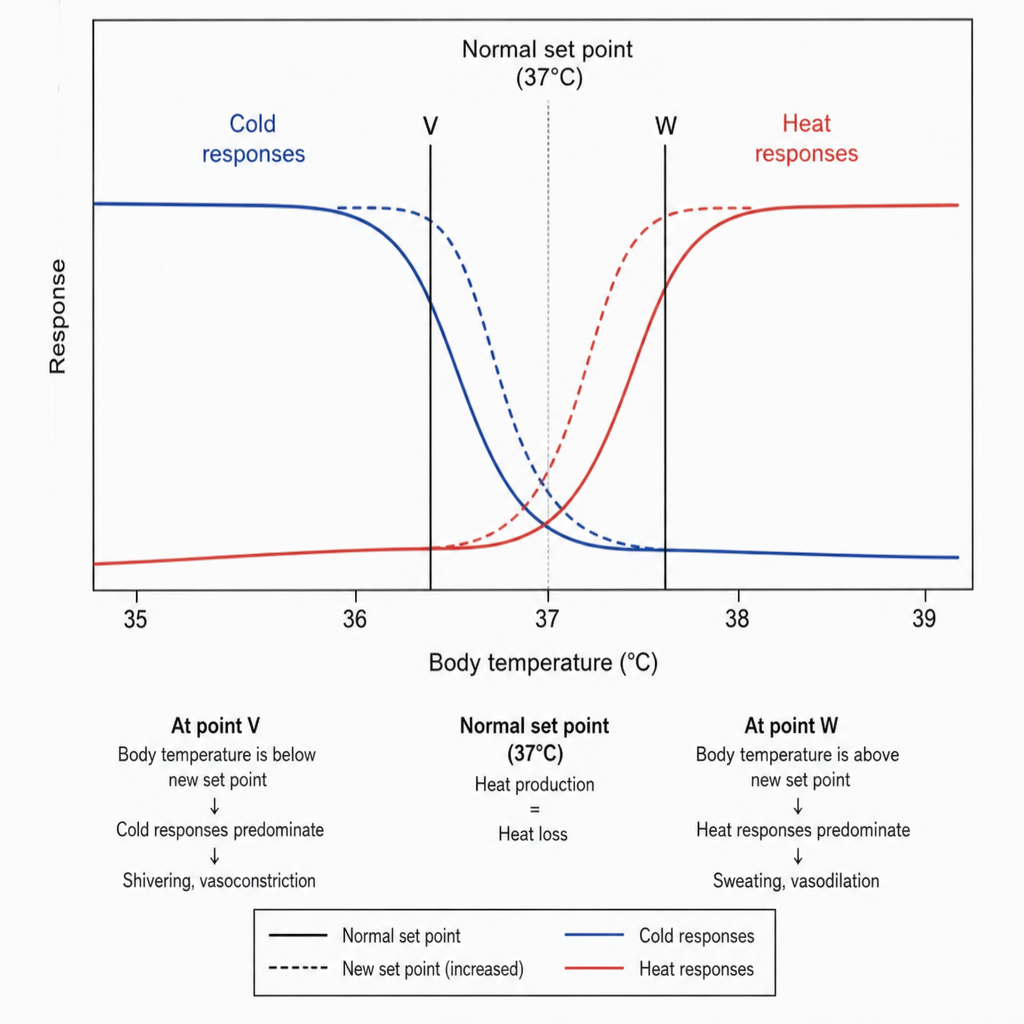
Which of the following is endogenous pyrogen?
Which of the following is the principal mode of heat exchange in an infant incubator?
Which receptor is primarily stimulated in response to moderate cold temperatures?
What is the average daily water loss in sweat during normal physical activities in temperate conditions?
Fever increases water loss by how much for each degree Celsius increase in body temperature?
What is the primary mechanism underlying hyperthermia?
Shivering is controlled by?
During acclimatization to hot environments, increased sweating efficiency is primarily due to enhanced sensitivity of which receptors?
Lesion of preoptic nucleus of hypothalamus is associated with which of the following conditions?
Nonshivering thermogenesis in adults is due to:
Explanation: ***PG E2*** - **Prostaglandin E2 (PGE2)** is considered the **endogenous mediator of fever** in the context of this question (NEET-PG 2018). - **Mechanism:** PGE2 acts on the **preoptic area of the hypothalamus** to raise the body's temperature set point, leading to fever. - **Production pathway:** Endogenous pyrogens like **IL-1, IL-6, and TNF-α** stimulate **cyclooxygenase-2 (COX-2)** in hypothalamic endothelial cells → **PGE2 synthesis** → binds to EP3 receptors → raises set point. - **Clinical relevance:** This is why **antipyretics** (aspirin, paracetamol, NSAIDs) work by inhibiting COX enzymes, thereby reducing PGE2 production. - **Terminology note:** Strictly speaking, cytokines (IL-1, IL-6, TNF-α) are the true "endogenous pyrogens," while PGE2 is the "final common mediator" - but for exam purposes, PGE2 is accepted as the endogenous pyrogenic mediator. *PG D2* - **Prostaglandin D2 (PGD2)** is primarily involved in **allergic reactions**, **sleep regulation**, and modulating immune responses. - Main roles include **bronchoconstriction** in asthma, **vasodilation**, and mast cell activation. - It does **not** act as a fever mediator in the hypothalamus. *PGF2 alpha* - **Prostaglandin F2 alpha (PGF2α)** functions primarily in **reproductive physiology**. - Causes **uterine contractions** (labor induction), **luteolysis** (corpus luteum regression), and **bronchoconstriction**. - It has **no direct role** in fever generation or thermoregulation. *PG I2* - **Prostacyclin (PGI2)** is a potent **vasodilator** and **inhibitor of platelet aggregation**. - Produced by vascular endothelium, it has **anti-thrombotic** and **anti-inflammatory** properties. - It does **not** function as a pyrogenic mediator and may actually have **antipyretic effects** in some contexts.
Explanation: ***Convection*** - In an infant incubator, **convection** is the primary method of heat transfer where a fan circulates warm air around the infant. - This controlled circulation of warm air helps maintain a stable thermal environment for the neonate. *Radiation* - **Radiation** involves heat transfer through electromagnetic waves, and while it occurs, it's not the primary mode in a typical closed incubator, which aims to minimize radiant heat loss to cooler surfaces. - Radiant warmers, used for open care, primarily rely on radiation, but these are distinct from closed incubators. *Evaporation* - **Evaporation** is the loss of heat through the conversion of liquid (sweat or insensible water loss) to vapor, but incubators aim to minimize this by maintaining optimal humidity. - Excessive evaporative heat loss can be significant in premature infants, but it is a mode of *heat loss*, not the principal *mode of heat exchange* for maintaining warmth in an incubator. *Conduction* - **Conduction** is direct heat transfer through physical contact, such as between the infant's skin and the mattress. - While incubators have warm mattresses to prevent conductive heat loss, the circulating warm air (convection) is the main mechanism for overall temperature control.
Explanation: ***TRPM8 Receptor (Menthol Receptor)*** - The **TRPM8 receptor** is a **cold-sensitive ion channel** that is primarily activated by moderate cold temperatures (around 8–28°C) and by cooling compounds like **menthol** and **eucalyptol**. - Its activation leads to an influx of cations, primarily **calcium**, causing depolarization and generation of action potentials. *Vanilloid Receptor 1 (VR1)* - Vanilloid Receptor 1, also known as **TRPV1**, is primarily activated by noxious heat (temperatures above 43°C), low pH, and capsaicin. - It plays a significant role in **pain sensation** and inflammation, not moderate cold detection. *Vanilloid Receptor 2 (VR2)* - Vanilloid Receptor 2, or **TRPV2**, is activated by even higher temperatures than TRPV1, typically above 52°C, and is also involved in the detection of **intense heat** and mechanical stimuli. - It does not respond to cold temperatures at all. *Vanilloid Receptor-Like 1 (VRL-1)* - **VRL-1**, or **TRPV3**, is a heat-sensitive channel activated by warm temperatures (above 31°C) and plays a role in the sensation of warmth and heat hyperalgesia. - It is not involved in the detection of cold stimuli.
Explanation: ***500 - 700 ml*** - Under normal physical activities in temperate conditions, **sensible perspiration (sweat)** typically ranges from **500 to 700 ml** per day. - This represents active secretion from sweat glands for thermoregulation during baseline daily activities without significant exertion. - This is distinct from insensible water loss (~300-400 ml/day), which is passive diffusion through the skin. *200 - 400 ml* - This range represents **insensible water loss** through the skin by passive diffusion, not active sweating. - While this is a normal component of daily water loss, it does not reflect the active sweat production during physical activities. *50 - 100 ml* - This volume is too low for average daily sweat loss during normal activities. - This might represent minimal sweating in completely sedentary conditions or very cool environments. *1000 - 1200 ml* - This represents significant sweat production, typically seen during **moderate to strenuous exercise**, hot climates, or febrile conditions. - It exceeds the average daily sweat loss during normal physical activities in temperate conditions.
Explanation: ***200 ml/day*** - For every 1-degree Celsius (or 1.8-degree Fahrenheit) increase in body temperature, there is an approximate **200 ml increase in insensible water loss** per day due to increased metabolism and sweating. - This value highlights the importance of **adequate fluid replacement** in febrile patients to prevent dehydration. *100 ml/day* - This value is **insufficient** to account for the increased insensible fluid losses associated with fever. - Using this estimate could lead to **underestimation of fluid requirements** and potential dehydration in febrile patients. *400 ml/day* - This value is **higher than the typical estimated increase** in water loss per degree Celsius of fever. - While extreme fever might cause higher losses, 200 ml/day is the standard clinical approximation for a 1-degree rise. *800 ml/day* - This value represents a **significant overestimation** of the fluid loss per degree Celsius increase in fever. - Such a high estimate would generally be seen only in very severe conditions or with much larger temperature increases.
Explanation: ***Failure of thermoregulation*** - **Hyperthermia** is fundamentally caused by the body's inability to dissipate heat effectively, leading to an uncontrolled rise in core body temperature. - This differentiates it from fever, where the **hypothalamic set point** is elevated, and the body actively tries to reach that higher temperature. *Temperature > 41.5°C* - While a temperature exceeding **41.5°C** is often seen in severe hyperthermia, it is a *consequence* of the failure of thermoregulation, not its primary cause. - This extreme temperature indicates a critical state, but the underlying problem is the body's inability to control internal heat. *Temperature > 40°C with autonomic dysfunction* - A temperature above **40°C** combined with **autonomic dysfunction** (e.g., altered mental status, seizures) describes a severe *manifestation* of hyperthermia, often seen in heat stroke. - This is a symptom complex resulting from, rather than the primary cause of, the body's thermoregulatory failure. *No change in hypothalamic set point* - This statement is a *characteristic* of hyperthermia, distinguishing it from fever, where the **hypothalamic set point** is elevated. - However, the *absence* of this change is not the primary cause; rather, the underlying issue is the body's inability to manage its heat load despite a normal set point.
Explanation: ***Posterior hypothalamus*** - The **posterior hypothalamus** plays a crucial role in **thermoregulation**, particularly in generating heat. - It receives input from cold receptors and initiates mechanisms like **shivering** and vasoconstriction to increase body temperature. *Dorsomedial nucleus* - The **dorsomedial nucleus** of the hypothalamus is primarily involved in **feeding behavior**, obesity, and some aspects of stress response. - It does not have a direct, primary role in the control of shivering. *Perifornical nucleus* - The **perifornical nucleus** is linked to **arousal**, stress responses, and **feeding behavior**. - Its functions are distinct from the direct control of thermogenesis and shivering. *Lateral hypothalamic area* - The **lateral hypothalamic area** is often referred to as the "**feeding center**" and is involved in hunger and motivation. - While it has broad roles in various autonomic functions, it is not the primary site for shivering control.
Explanation: ***Cholinergic receptors*** - **Sweat glands** are innervated by **sympathetic postganglionic fibers** that release **acetylcholine**, acting on **muscarinic cholinergic receptors** to stimulate sweating. - During **acclimatization**, the sweat glands become more sensitive to acetylcholine, resulting in **increased sweating efficiency** and a lower threshold temperature for sweating. *Adrenergic receptors* - Adrenergic receptors are primarily involved in the sympathetic nervous system's response to **norepinephrine** and **epinephrine**, mediating effects like **vasoconstriction** and **bronchodilation**. - They are not the primary receptors responsible for stimulating **eccrine sweat gland** secretion in response to heat. *Noradrenergic receptors* - **Noradrenergic receptors** are a type of adrenergic receptor that respond to **norepinephrine** (noradrenaline). - While sympathetic activity increases in hot environments, the primary stimulation of **sweat glands** is via **acetylcholine** acting on cholinergic receptors, not noradrenergic receptors. *Dopaminergic receptors* - **Dopaminergic receptors** respond to **dopamine** and are involved in various functions including **motor control**, **reward**, and **neuroendocrine regulation**. - These receptors are not directly involved in the physiological regulation of **sweating efficiency** during heat acclimatization.
Explanation: ***Hyperthermia*** - The **preoptic nucleus** of the anterior hypothalamus is the primary **heat-loss center** containing warm-sensitive neurons. - Lesion of this area impairs **heat dissipation mechanisms** (sweating, cutaneous vasodilation), preventing the body from lowering its temperature. - Results in **hyperthermia** - a pathological elevation of core body temperature due to failure of heat dissipation, not a change in set point. - This is the **most specific and clinically accurate** term for this condition. *Impaired thermoregulation* - While technically true, this is too **broad and non-specific**. - Impaired thermoregulation could refer to inability to either increase or decrease temperature. - In medical terminology, we use more specific terms like "hyperthermia" to describe the actual clinical condition. *Increased body temperature* - This is a **general descriptive term** rather than a specific clinical diagnosis. - While the body temperature is indeed increased, **hyperthermia** is the precise medical term that indicates the mechanism (impaired heat dissipation). - Less specific than "hyperthermia" for exam purposes. *Normal thermoregulation* - Clearly incorrect - a lesion in the primary thermoregulatory center would **abolish normal temperature control**. - The preoptic nucleus is essential for detecting and responding to temperature changes.
Explanation: ***Brown fat between the shoulders*** - In adults, the primary **effector tissue** for **non-shivering thermogenesis** is **brown adipose tissue (BAT)**, with major depots located between the shoulders, around the neck, and along the spine. - **BAT** contains specialized mitochondria with **uncoupling protein 1 (UCP1)** that uncouples oxidative phosphorylation, generating heat instead of ATP. - This is the tissue where non-shivering thermogenesis actually occurs, making it the direct answer to what non-shivering thermogenesis is "due to." *Noradrenaline* - **Noradrenaline** is the key neurotransmitter that **activates brown fat** via **β3-adrenergic receptors** to initiate non-shivering thermogenesis. - While noradrenaline is the **trigger/stimulus**, the actual heat production occurs in brown adipose tissue. - Noradrenaline itself does not produce heat directly; it acts as the signal that activates the thermogenic machinery in BAT. *Thyroid hormone* - **Thyroid hormone** increases **basal metabolic rate** and can potentiate the thermogenic response by upregulating UCP1 expression in brown fat. - Its role is **permissive and long-term** rather than being the immediate effector of acute non-shivering thermogenesis. - It modulates overall cellular metabolism but is not the primary mechanism for rapid heat generation in cold exposure. *Muscle metabolism* - **Muscle contraction** during shivering generates heat through increased ATP hydrolysis, which is **shivering thermogenesis**. - **Non-shivering thermogenesis** specifically refers to heat production **without muscle contraction**, making muscle metabolism the mechanism for shivering, not non-shivering, thermogenesis.
Heat Production and Loss
Practice Questions
Temperature Sensing Mechanisms
Practice Questions
Hypothalamic Regulation of Temperature
Practice Questions
Behavioral Thermoregulation
Practice Questions
Fever and Hyperthermia
Practice Questions
Hypothermia
Practice Questions
Exercise and Thermoregulation
Practice Questions
Thermoregulation in Extreme Environments
Practice Questions
Age-Related Changes in Thermoregulation
Practice Questions
Disorders of Thermoregulation
Practice Questions
Get full access to all questions, explanations, and performance tracking.
Start For Free