Reissner's membrane separates which of the following?
The highest degree of pain localization comes from which of the following?
Saccadic eye movement is controlled by which lobe of the brain?
What is the typical wavelength range of visible light?
Sound reaches maximum amplitude depending on its frequency at which structure?
Amacrine cells secrete which neurotransmitter?
Which of the following statements is true about thermoreceptors?
Second order neurons in the optical pathway are present in which of the following structures?
What part of the retina provides the highest visual resolution?
A lesion at which part of the visual pathway causes homonymous hemianopia?
Explanation: **Explanation:** The cochlea is divided into three fluid-filled compartments (scalae) by two primary membranes. Understanding the anatomical arrangement of these chambers is fundamental to auditory physiology. **1. Why Option A is Correct:** The **Reissner’s membrane** (also known as the vestibular membrane) is a thin layer of tissue that forms the roof of the scala media. It serves as the anatomical boundary separating the **scala vestibuli** (containing perilymph) from the **scala media** (cochlear duct, containing endolymph). Its primary function is to maintain the ionic gradient between these two fluids while allowing sound vibrations to pass from the perilymph to the endolymph. **2. Why Other Options are Incorrect:** * **Option B:** The scala vestibuli and scala tympani are separated by the entire cochlear duct (scala media). They only communicate at the apex of the cochlea through a small opening called the **helicotrema**. * **Option C:** The scala tympani is separated from the scala media by the **Basilar membrane**. This membrane is crucial as it supports the Organ of Corti and vibrates in response to sound waves. **High-Yield NEET-PG Pearls:** * **Fluid Composition:** Scala vestibuli and tympani contain **Perilymph** (high $Na^+$, similar to ECF); Scala media contains **Endolymph** (high $K^+$, similar to ICF). * **Endocochlear Potential:** The scala media has a positive potential of **+80 mV**, maintained by the **Stria Vascularis** (the "battery" of the ear). * **Basilar Membrane:** It is narrow and stiff at the base (high frequencies) and wide and compliant at the apex (low frequencies).
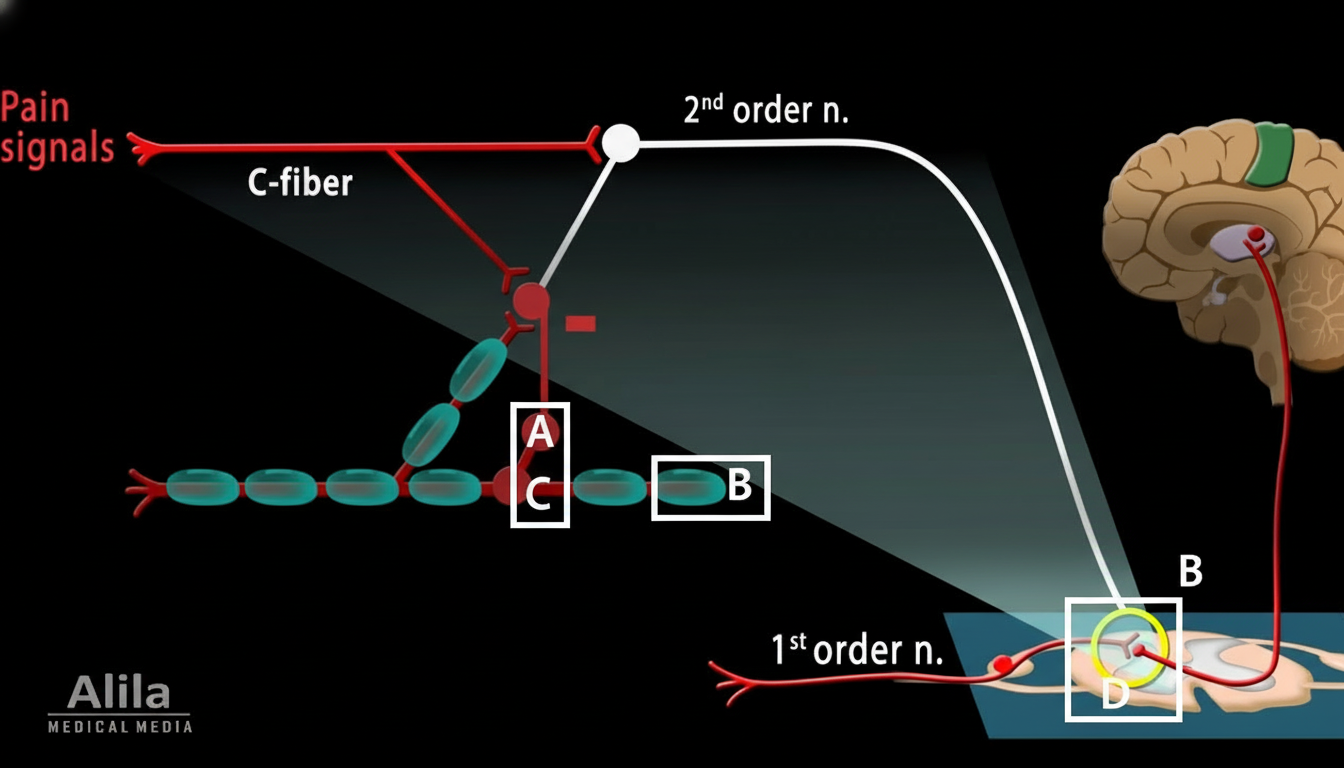
Explanation: **Explanation:** Pain localization depends significantly on the dual activation of different sensory pathways. While pain itself is primarily mediated by free nerve endings, these receptors are relatively poor at providing precise spatial localization. **1. Why Option A is Correct:** The highest degree of pain localization occurs when **free nerve endings (pain receptors)** and **tactile receptors (mechanoreceptors)** are stimulated simultaneously. Tactile signals are transmitted via the **Dorsal Column-Medial Lemniscal (DCML)** system, which has a high degree of somatotopic organization. When a painful stimulus also triggers tactile fibers, the brain uses the precise spatial information from the tactile system to "pinpoint" the exact location of the pain. **2. Analysis of Incorrect Options:** * **Option B:** Bradykinin is a chemical mediator that stimulates free nerve endings (chemosensitive nociceptors). While it causes intense pain, it does not improve localization. * **Option C:** The **Paleospinothalamic tract** (Type C fibers) is responsible for slow, chronic, aching pain. It has very poor localization, often projecting to the reticular formation rather than the precise areas of the somatosensory cortex. * **Option D:** **A-delta (δ) fibers** are responsible for "fast pain" and travel via the Neospinothalamic tract. While they provide better localization than C-fibers, they still lack the precision of the tactile system. **NEET-PG High-Yield Pearls:** * **Fast Pain:** A-delta fibers (Glutamate), Neospinothalamic tract, well-localized. * **Slow Pain:** C fibers (Substance P), Paleospinothalamic tract, poorly localized. * **Localization Rule:** The more a sensory pathway utilizes the DCML or Neospinothalamic system, the better the spatial discrimination. * **Dual Stimulation:** If only free nerve endings are stimulated (e.g., internal visceral pain), the pain is "diffuse." If skin is involved (tactile + pain), it is "sharp and localized."
Explanation: ### Explanation **Correct Answer: D. Frontal lobe** Saccadic eye movements are rapid, jerky, voluntary movements used to shift the gaze between two points of fixation. These movements are primarily controlled by the **Frontal Eye Fields (FEF)**, located in **Brodmann area 8** within the **Frontal lobe**. When the FEF is stimulated, it triggers contralateral conjugate saccades. The FEF sends signals to the **Paramedian Pontine Reticular Formation (PPRF)** in the brainstem, which acts as the "horizontal gaze center" to coordinate the extraocular muscles. **Why other options are incorrect:** * **Parietal lobe:** This lobe is primarily involved in **Smooth Pursuit** movements (slow, tracking movements of a moving object). The Posterior Parietal Cortex (Area 7) helps in visual attention but does not initiate the saccade itself. * **Prefrontal lobe:** While involved in executive functions and complex decision-making regarding *where* to look, the specific motor control for saccades is localized to the Frontal Eye Fields in the posterior part of the frontal lobe, not the prefrontal cortex. * **Temporal lobe:** This lobe is mainly responsible for auditory processing and memory (hippocampus). It has no direct role in the motor control of eye movements. **High-Yield Clinical Pearls for NEET-PG:** * **Lesion of Frontal Eye Field:** Results in the eyes "looking toward the side of the lesion" (ipsilateral deviation) because the opposing FEF is unopposed. * **Superior Colliculus:** This midbrain structure also contributes to saccades, particularly those triggered by sudden external stimuli (reflexive saccades). * **Smooth Pursuit Control:** Controlled by the **Vestibulo-Ocular reflex (VOR)** and the **Parieto-occipital cortex**. * **Vertical Gaze Center:** Located in the **riMLF** (Rostral interstitial nucleus of Medial Longitudinal Fasciculus) in the midbrain.
Explanation: **Explanation:** The human eye is sensitive to a specific portion of the electromagnetic spectrum known as **visible light**. This range is determined by the physical properties of the photoreceptors (rods and cones) in the retina and the transparency of the ocular media. 1. **Why Option A is Correct:** The standard physiological range for visible light is approximately **400 nm to 700 nm**. Within this spectrum, the shortest wavelengths (~400 nm) are perceived as violet/blue, while the longest wavelengths (~700 nm) are perceived as red. This range corresponds to the energy levels required to trigger a conformational change in **rhodopsin** and cone opsins, initiating the process of phototransduction. 2. **Why Other Options are Incorrect:** * **Option B (500-800 nm):** 800 nm falls into the **Infrared** spectrum, which is invisible to humans as it lacks the energy to excite retinal pigments. * **Option C (700-900 nm):** This range is entirely within the Infrared region. While some animals can detect these wavelengths, humans perceive them only as heat. * **Option D (300-600 nm):** 300 nm falls into the **Ultraviolet (UV)** range. UV light is largely absorbed by the cornea and lens to protect the retina from oxidative damage. **High-Yield Clinical Pearls for NEET-PG:** * **Peak Sensitivity:** Under photopic (daylight) conditions, the eye is most sensitive to **555 nm** (greenish-yellow). Under scotopic (dark) conditions, sensitivity shifts to **505 nm** (Purkinje shift). * **Aphakia:** Patients without a lens (aphakia) may perceive near-UV light because the natural UV filter of the eye is removed. * **Visible Spectrum Mnemonic:** **VIBGYOR** (Violet, Indigo, Blue, Green, Yellow, Orange, Red). Violet has the highest energy/shortest wavelength; Red has the lowest energy/longest wavelength.
Explanation: ### Explanation **Correct Answer: D. Basilar membrane** The correct answer is the **Basilar membrane** because of the **Place Theory of Hearing** (von Békésy’s Traveling Wave Theory). When sound waves enter the cochlea, they create a traveling wave in the perilymph that displaces the basilar membrane. Each frequency has a specific point along the membrane where it reaches its **maximum amplitude**: * **High-frequency sounds** peak at the **base** of the cochlea (near the oval window), where the membrane is narrow and stiff. * **Low-frequency sounds** peak at the **apex** (near the helicotrema), where the membrane is wide and compliant. This spatial mapping is known as **tonotopic organization**. **Why other options are incorrect:** * **A. Tympanic membrane:** It vibrates in response to sound waves to transmit energy to the ossicles but does not differentiate frequencies by amplitude peaks. * **B. Ear ossicles:** These act as a mechanical lever system to amplify pressure (impedance matching) to overcome the resistance of cochlear fluid; they do not have frequency-specific amplitude peaks. * **C. Semicircular canals:** These are part of the vestibular system responsible for detecting angular acceleration (balance), not sound perception. **High-Yield Clinical Pearls for NEET-PG:** * **Endocochlear Potential:** The scala media has a high $K^+$ concentration and a positive potential of **+80 mV**, which is vital for hair cell depolarization. * **Organ of Corti:** Located on the basilar membrane, it contains the actual sensory receptors (hair cells). * **Presbycusis:** Age-related hearing loss typically starts at the **base** of the cochlea, leading to a loss of high-frequency sound perception first. * **Helicotrema:** The point where the scala vestibuli and scala tympani communicate at the apex.
Explanation: **Explanation:** Amacrine cells are interneurons located in the inner nuclear layer of the retina. They play a critical role in lateral inhibition and the processing of visual signals by connecting bipolar cells to ganglion cells. **1. Why Acetylcholine is Correct:** Amacrine cells are chemically diverse and are known to secrete several inhibitory and excitatory neurotransmitters. However, a specific subtype known as **Starburst Amacrine Cells** is well-documented for secreting **Acetylcholine (ACh)**. These cells are essential for directional selectivity in the retina. In addition to ACh, other amacrine cells may secrete GABA, Glycine, or Dopamine, but among the given options, Acetylcholine is the recognized neurotransmitter. **2. Analysis of Incorrect Options:** * **Glutamate:** This is the primary excitatory neurotransmitter of the vertical pathway in the retina. It is secreted by **Photoreceptors** (rods and cones), **Bipolar cells**, and **Ganglion cells**, but not typically by amacrine cells. * **Adrenaline & Noradrenaline:** These are catecholamines primarily associated with the sympathetic nervous system and specific brainstem nuclei (like the locus coeruleus). While the retina contains **Dopamine** (secreted by a subset of amacrine cells), it does not utilize adrenaline or noradrenaline for primary signal processing. **High-Yield Facts for NEET-PG:** * **Horizontal Cells:** Primarily secrete **GABA** (Lateral inhibition in the outer retina). * **Amacrine Cells:** The "diverse" cells; they secrete **GABA, Glycine, Acetylcholine, and Dopamine**. * **Vertical Pathway:** Photoreceptor → Bipolar Cell → Ganglion Cell (All use **Glutamate**). * **Mnemonic:** Remember **"A"** for **A**macrine and **A**cetylcholine.
Explanation: **Explanation:** Thermoreceptors are specialized sensory receptors that detect changes in temperature. This question explores their physiological structure and functional range. * **Option A (Activation):** Thermoreceptors function across a spectrum. While specific "warm" and "cold" receptors detect innocuous temperatures, **nociceptive thermoreceptors** are activated by extreme temperatures (severe cold <10°C or severe heat >45°C) to signal potential tissue damage (pain). * **Option B (Location):** These receptors are located in the **superficial layers of the skin** (dermis and epidermis) to allow for rapid detection of environmental temperature changes before they affect the body's core temperature. * **Option C (Nerve Fibers):** Thermoreceptors are the free dendritic endings of specific nerve fibers. **Cold receptors** are primarily associated with **Aδ (delta) fibers** (thinly myelinated, faster), while **warm receptors** are associated with **C fibers** (unmyelinated, slower). Since all three statements accurately describe the characteristics of thermoreceptors, **Option D is the correct answer.** **High-Yield NEET-PG Pearls:** * **TRP Channels:** Temperature sensation is mediated by **Transient Receptor Potential (TRP)** ion channels. For example, **TRPV1** is activated by noxious heat and capsaicin (chili), while **TRPM8** is activated by cold and menthol. * **Density:** Cold receptors are generally 3 to 10 times more numerous than warm receptors in most areas of the skin. * **Adaptation:** Thermoreceptors exhibit marked **phasic adaptation**; they respond strongly to a change in temperature but decrease their firing rate if the temperature remains constant.
Explanation: **Explanation:** The visual pathway is unique because the first three orders of neurons are located entirely within the retina. Understanding the sequence of these neurons is crucial for NEET-PG: 1. **First-order neurons:** These are the **Photoreceptors** (Rods and Cones). They convert light stimuli into electrical signals. 2. **Second-order neurons:** These are the **Bipolar cells**. They receive input from the photoreceptors and transmit it to the ganglion cells. 3. **Third-order neurons:** These are the **Ganglion cells**. Their axons form the optic nerve, optic chiasma, and optic tract, eventually terminating in the Lateral Geniculate Body (LGB). **Analysis of Options:** * **A. Bipolar cells (Correct):** As stated above, they represent the second link in the neuronal chain within the retina. * **B. Lateral geniculate body:** This contains the **fourth-order neurons**. Axons from the LGB form the optic radiations that project to the primary visual cortex (Area 17). * **C. Photoreceptors:** These are the **first-order neurons** (sensory receptors) of the visual system. * **D. Superior colliculus:** This is a midbrain structure involved in visual reflexes (e.g., saccadic eye movements) but is not part of the primary conscious visual pathway (geniculostriate pathway). **High-Yield Clinical Pearls:** * **Mnemonic:** **P-B-G-L** (Photoreceptors → Bipolar → Ganglion → LGB). * The **Optic Nerve** is technically a tract of the CNS, not a peripheral nerve, as it is formed by the axons of the third-order neurons (Ganglion cells). * **Meyer’s Loop:** Fibers of the optic radiation that loop around the temporal horn of the lateral ventricle; a lesion here causes "pie in the sky" (superior quadrantanopia) visual field defects.
Explanation: **Explanation:** The **foveola centralis** is the site of maximum visual acuity (resolution) in the human eye. Located at the very center of the fovea, it is a tiny pit (approx. 0.35 mm in diameter) that contains the highest density of **cones** and is entirely devoid of rods. **Why it is the correct answer:** 1. **High Cone Density:** It contains only long-wavelength (red) and medium-wavelength (green) cones, packed tightly to provide high spatial resolution. 2. **Anatomical Specialization:** In this region, the overlying layers of the retina (ganglion cells and bipolar cells) are displaced laterally. This allows light to strike the photoreceptors directly without being scattered or absorbed by other neural layers. 3. **1:1 Ratio:** Each cone in the foveola synapses with a single midget bipolar cell, which in turn connects to a single ganglion cell, ensuring a private line to the brain for maximum detail. **Analysis of Incorrect Options:** * **Macula lutea:** This is the yellowish area surrounding the fovea. While it is responsible for central vision, the foveola is a specific sub-region within it that provides even higher resolution. * **Blind spot (Optic Disc):** This is the point where the optic nerve exits the eye. It contains no photoreceptors (rods or cones), resulting in zero visual resolution. **High-Yield Facts for NEET-PG:** * **Avascular Zone:** The foveola is completely avascular (Foveal Avascular Zone - FAZ), receiving oxygen solely from the underlying choriocapillaris. * **Henle’s Layer:** The axons of the photoreceptors in the fovea are diverted laterally and are known as the fibers of Henle. * **Macular Sparing:** In certain cortical strokes (PCA territory), central vision is often preserved because the macula has a dual blood supply or a large representation in the visual cortex.
Explanation: ### Explanation **1. Why Optic Tract is Correct:** The visual pathway is organized such that fibers from the **ipsilateral temporal retina** (representing the contralateral nasal field) and the **contralateral nasal retina** (representing the contralateral temporal field) join together at the **optic tract**. Because the optic tract carries information from both eyes regarding the *same half* of the visual field (the opposite side), a lesion here results in **Contralateral Homonymous Hemianopia** (loss of the same side of the visual field in both eyes). **2. Why Other Options are Incorrect:** * **Retina:** Lesions here cause localized deficits (scotomas) or monocular field loss restricted to the affected eye's anatomy. * **Optic Nerve:** A complete lesion of the optic nerve results in **ipsilateral monocular blindness** (total loss of vision in one eye) because it carries all fibers from that specific eye before they decussate. * **Optic Chiasma:** A lesion at the midline of the chiasma (e.g., Pituitary Adenoma) affects the decussating nasal fibers from both eyes. This results in **Bitemporal Hemianopia** (loss of both outer/temporal fields). **3. Clinical Pearls & High-Yield Facts for NEET-PG:** * **Meyer’s Loop (Temporal lobe):** Lesion causes "Pie in the sky" (Superior Quadrantanopia). * **Baum’s Loop (Parietal lobe):** Lesion causes "Pie on the floor" (Inferior Quadrantanopia). * **Occipital Cortex:** Lesions (e.g., PCA stroke) cause Homonymous Hemianopia with **Macular Sparing** (due to dual blood supply from the MCA). * **Rule of Thumb:** Any lesion **behind** the chiasma (tract, radiation, or cortex) will always produce a **homonymous** defect.
General Sensory Physiology
Practice Questions
Somatosensation
Practice Questions
Pain Physiology
Practice Questions
Vision and Optics
Practice Questions
Retinal Physiology
Practice Questions
Visual Pathways and Processing
Practice Questions
Auditory System
Practice Questions
Vestibular System
Practice Questions
Taste and Smell
Practice Questions
Sensory Integration
Practice Questions
Get full access to all questions, explanations, and performance tracking.
Start For Free