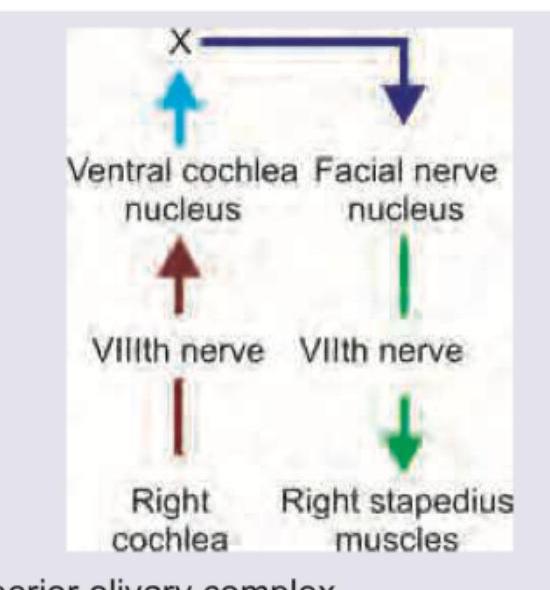
The image given below shows stapedial reflex. What does ' $X$ ' denote?
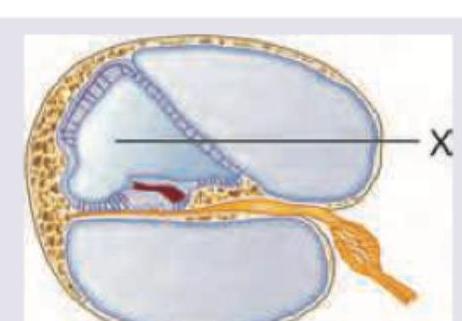
What is correct about the composition of fluid in the area marked as X?
A woman suffered a sunburn while enjoying a vacation on the beach. Now, while taking a shower, the lukewarm water (40° C) touching her back caused her to feel pain. What types of receptors were activated by the lukewarm water, and why did she experience pain?
Select the correct option regarding the function of receptors:
Sour taste is mediated by which of the following receptors?
Match the following receptors with their correct functions: Receptors: 1. Ruffini corpuscle 2. Merkel cells 3. Pacinian corpuscle 4. Meissner's corpuscle Functions: A. Vibration B. Sustained pressure C. Stretching D. Fine touch Select the option that correctly matches each receptor (1-4) with its function (A-D).
Find the correct Auditory pathway sequence.
The bitter taste of toxic substances prevents us from their consumption, which of the following elicits the bitterness?
Pacinian corpuscle is stimulated by which of the following?
An exaggerated pain response to a normally painful stimulus is called:
Explanation: ***Superior olivary complex*** - The image depicts the neural pathway for the **stapedial reflex**, where sound input from the cochlea is processed, and the signal travels to the superior olivary complex. - From the superior olivary complex (labeled 'X'), signals project to the **facial nerve nucleus**, which then innervates the **stapedius muscle** to contract and dampen sound. *Medial geniculate body* - The medial geniculate body is part of the **thalamus** and is involved in processing auditory information before it reaches the auditory cortex. - It is a more rostral structure in the auditory pathway and is not directly involved in the brainstem reflex arc of the stapedius reflex at the labeled point 'X'. *Superior colliculus* - The superior colliculus is primarily involved in **visual reflexes** and directing gaze towards salient stimuli. - Although it has some multimodal sensory integration, it is not a key relay in the auditory pathway for the stapedial reflex. *Lateral lemniscus* - The lateral lemniscus is an **ascending auditory pathway** in the brainstem, carrying information from the cochlear nuclei and superior olivary complex to higher centers like the inferior colliculus. - While it carries auditory signals, "X" represents a more specific processing center (superior olivary complex) that integrates bilateral auditory input and projects to motor nuclei for acoustic reflexes.
Explanation: ***Na = 3 mEq/L, K = 150 mEq/L, Chloride = 125 mEq/L*** - The area marked as X points to the **endolymph** within the scala media of the cochlea, which has a unique high **potassium concentration** (~150 mEq/L) and low **sodium concentration** (~3 mEq/L). - This composition is maintained by the **stria vascularis** and is essential for proper **hair cell function** and hearing transduction. - The high K⁺/low Na⁺ ratio creates the **endocochlear potential** (+80 mV) necessary for cochlear amplification. *Na = 150 mEq/L, K = 3 mEq/L, Chloride = 125 mEq/L* - This represents typical **extracellular fluid** or **perilymph** composition with high sodium and low potassium, which is the opposite of endolymph. - The **perilymph** is found in the scala vestibuli and scala tympani, not in the area marked as X (scala media). *Na = 152 mEq/L, K = 30 mEq/L, Chloride = 125 mEq/L* - The sodium level is too high and potassium too low to represent **endolymph**, which requires an extreme K⁺/Na⁺ gradient for proper cochlear function. - These intermediate values don't match any specific **cochlear fluid compartment** and would not support normal hearing. *Na = 50 mEq/L, K = 30 mEq/L, Chloride = 125 mEq/L* - Both sodium and potassium levels are insufficient to create the **electrochemical gradient** necessary for cochlear hair cell depolarization. - These values don't correspond to either **endolymph** or **perilymph** compositions found in the inner ear.
Explanation: ***Thermal nociceptors & allodynia*** - Sunburn causes tissue damage, leading to the sensitization of **thermal nociceptors** (e.g., TRPV1 channels), making them responsive to normally innocuous thermal stimuli. - **Allodynia** is the perception of pain from a stimulus that does not ordinarily cause pain, such as lukewarm water after a sunburn, due to increased sensitivity of the pain pathways. *Thermal nociceptors & nociceptive pain* - While thermal nociceptors are involved, **nociceptive pain** typically refers to pain caused by direct tissue damage from a noxious (harmful) stimulus. Here, the lukewarm water itself is not noxious. - The pain experienced from the lukewarm water is not due to a *new* noxious stimulus but rather an exaggerated response to a *non-noxious* one. *Innocuous thermal receptors and hyperalgesia* - **Innocuous thermal receptors** (e.g., TRPM8 for cold, TRPV3/TRPV4 for warmth) normally detect non-painful temperature changes, not pain from sunburn. - **Hyperalgesia** is an increased response to a stimulus that *is* normally painful, but applied at a lower intensity. The lukewarm water is not normally painful. *Innocuous thermal receptors and allodynia* - As mentioned, **innocuous thermal receptors** are not primarily responsible for pain transmission, even in a sensitized state, as they are not nociceptors. - While **allodynia** is an accurate description of the pain type, the primary receptors activated for the pain sensation are sensitized nociceptors, not innocuous thermal receptors.
Explanation: ***Pacinian corpuscle - fast vibration*** - **Pacinian corpuscles** are rapidly adapting mechanoreceptors that are highly sensitive to **vibrations** and **deep pressure**. - Their layered structure allows them to detect even slight deformations and transmit information about **rapid changes** in mechanical stimuli. *Merkel cells - slow vibration* - **Merkel cells** are slow-adapting mechanoreceptors primarily responsible for sensing **light touch**, **texture**, and sustained pressure. - They are not associated with the detection of vibrations, whether slow or fast. *Meissner's corpuscle - stretch* - **Meissner's corpuscles** are rapidly adapting mechanoreceptors that detect **light touch**, **low-frequency vibration**, and discriminatory touch. - **Stretch sensation** is primarily mediated by Ruffini corpuscles and muscle spindle organs. *Ruffini corpuscle - light touch* - **Ruffini corpuscles** are slow-adapting mechanoreceptors that respond to **sustained pressure**, skin **stretch**, and joint position. - **Light touch** is primarily detected by Merkel cells and Meissner's corpuscles.
Explanation: ***OTOP1*** - The **OTOP1** receptor, an **otopetrin protein**, is responsible for detecting the **sour taste** sensation by mediating proton influx. - It functions as a **proton channel**, allowing hydrogen ions (H+) from acidic substances to enter taste receptor cells. *T1R1* - **T1R1** is a component of the **umami (savory) taste receptor**, forming a heterodimer with T1R3 to detect glutamate. - It does not directly detect sourness but is involved in the perception of amino acids. *T1R2* - **T1R2** is a component of the **sweet taste receptor**, forming a heterodimer with T1R3 to detect sugars. - This receptor is not involved in the transduction of sour taste. *T1R3* - **T1R3** is a common subunit that combines with **T1R1** for umami taste and with **T1R2** for sweet taste. - While essential for sweet and umami, it does not directly mediate the perception of sourness.
Explanation: ***1C 2B 3A 4D*** - **Ruffini corpuscles** (1) detect **stretching** (C) of the skin. They are **slow-adapting Type II mechanoreceptors** located deep in the dermis, responding to sustained skin stretch and contributing to proprioception. - **Merkel cells** (2) detect **sustained pressure** (B) and fine texture discrimination. They are **slow-adapting Type I mechanoreceptors** with the highest spatial resolution, providing detailed information about touch. - **Pacinian corpuscles** (3) detect **vibration** (A), particularly high-frequency vibrations (200-300 Hz). They are **rapidly adapting receptors** with an onion-like lamellated structure located deep in the dermis and subcutaneous tissue. - **Meissner's corpuscles** (4) detect **fine touch** (D) and light pressure. They are **rapidly adapting receptors** located in dermal papillae of glabrous (hairless) skin, particularly abundant in fingertips and lips. *1C 2D 3B 4A* - Incorrectly assigns Merkel cells to fine touch (should be sustained pressure) and Pacinian corpuscles to sustained pressure (should be vibration). - Meissner's corpuscles are mismatched with vibration instead of fine touch. *1D 2C 3B 4A* - Incorrectly assigns Ruffini corpuscles to fine touch (should be stretching) and Merkel cells to stretching (should be sustained pressure). - Pacinian corpuscles are mismatched with sustained pressure (should be vibration). - Meissner's corpuscles are mismatched with vibration (should be fine touch). *1B 2A 3D 4C* - Completely incorrect matching: Ruffini to sustained pressure, Merkel to vibration, Pacinian to fine touch, and Meissner's to stretching. - Demonstrates fundamental misunderstanding of mechanoreceptor functions.
Explanation: ***Eight nerve → cochlear nuclei → superior olivary nucleus → lateral lemniscus → inferior colliculus → medial geniculate body → auditory cortex*** - This sequence accurately traces the path of auditory information from the **vestibulocochlear nerve (cranial nerve VIII)**, through various brainstem and thalamic nuclei, to the **auditory cortex** for processing. - Each component plays a crucial role in the **processing and relay of sound signals**, including localization, integration, and perception. *Superior olivary nucleus → lateral lemniscus → inferior colliculus → medial geniculate body → auditory cortex → Eight nerve → Cochlear nuclei* - This sequence is incorrect because it begins with the **superior olivary nucleus**, which receives input from the cochlear nuclei, not the initial auditory input. - The **eight nerve (vestibulocochlear nerve)** and **cochlear nuclei** are placed at the end, whereas they are the primary initial structures in the pathway. *Cochlear nuclei → superior olivary nucleus → lateral lemniscus → inferior colliculus → medial geniculate body → auditory cortex → Eight nerve* - This sequence incorrectly places the **eight nerve** at the very end of the pathway, instead of at the beginning where it transmits signals from the cochlea. - The **cochlear nuclei** are the first central nervous system stations for auditory processing, receiving direct input from the eight nerve. *Superior olivary nucleus → inferior colliculus → medial geniculate body → auditory cortex → Eight nerve → Cochlear nuclei → lateral lemniscus* - This sequence is incorrect as it starts with the **superior olivary nucleus**, bypassing the initial input from the **eight nerve** and **cochlear nuclei**. - The order of several components, such as the placement of the **eight nerve** and **cochlear nuclei** near the end and the delayed appearance of the **lateral lemniscus**, disrupts the physiological pathway.
Explanation: ***Alkaloids*** - **Alkaloids** are a large group of naturally occurring chemical compounds that are mostly produced by plants, often having marked physiological actions on humans and other animals. - Many alkaloids, such as **quinine** and **strychnine**, have a characteristic **bitter taste**, which serves as a natural defense mechanism for plants against herbivores. *Aldehyde* - **Aldehydes** are organic compounds characterized by a carbonyl group to which a hydrogen atom and an R-group are attached. - While some aldehydes may have strong or pungent odors, they do not typically elicit a **bitter taste** in the same way alkaloids do; some might be sweet or fruity. *Hydrogen ions* - **Hydrogen ions (H+)** are responsible for **acidity** and are detected as a **sour taste**. - The sensation of sourness is directly related to the concentration of hydrogen ions in a substance, not bitterness. *Amino acids* - **Amino acids** are the building blocks of proteins and can elicit various tastes depending on their specific structure. - Some amino acids are **sweet** (e.g., alanine, glycine), some are **umami** (e.g., glutamate), and some are **bitter** only in certain contexts or at high concentrations, but they are not the primary group defining a broad bitter taste like alkaloids.
Explanation: ***Pressure*** - **Pacinian corpuscles** are rapidly adapting mechanoreceptors that detect **deep pressure** and **vibrations**. - Their layered, onion-like structure allows them to be very sensitive to rapid changes in pressure. *Pain* - **Pain** is primarily detected by **nociceptors**, which are free nerve endings, not Pacinian corpuscles. - Nociceptors respond to various noxious stimuli, including mechanical, thermal, and chemical. *Temperature* - **Temperature** changes are detected by **thermoreceptors**, such as Krause end bulbs for cold and Ruffini endings for warmth, not Pacinian corpuscles. - These receptors have specific temperature ranges over which they are active. *Touch* - **Touch** sensation is broadly detected by several mechanoreceptors, including **Meissner's corpuscles** (light touch), **Merkel discs** (sustained touch), and hair follicle receptors. - While Pacinian corpuscles contribute to sensing touch through deep pressure, they are not the primary receptors for general light or sustained touch.
Explanation: ***Hyperalgesia*** - This term describes an **increased sensitivity to pain** where a stimulus that is normally painful is perceived as even more painful than usual. - It often results from **damage to nociceptive afferent pathways** or central sensitization. *Causalgia* - This is an older term now largely replaced by complex regional pain syndrome type II (**CRPS II**), characterized by severe, burning pain following a **nerve injury**. - Unlike hyperalgesia, it specifically refers to a **syndrome of severe pain** after nerve trauma, not just an increased response to noxious stimuli. *Allodynia* - This refers to pain caused by a stimulus that **does not normally provoke pain**, such as light touch or brushing of the skin. - It differs from hyperalgesia, which is an exaggerated response to a **normally painful stimulus**. *Hypersensitivity* - This is a **general term** meaning an increased physical or allergic sensitivity to a substance or condition. - It is a **broader concept** and not as specific to pain perception as hyperalgesia or allodynia.
General Sensory Physiology
Practice Questions
Somatosensation
Practice Questions
Pain Physiology
Practice Questions
Vision and Optics
Practice Questions
Retinal Physiology
Practice Questions
Visual Pathways and Processing
Practice Questions
Auditory System
Practice Questions
Vestibular System
Practice Questions
Taste and Smell
Practice Questions
Sensory Integration
Practice Questions
Get full access to all questions, explanations, and performance tracking.
Start For Free