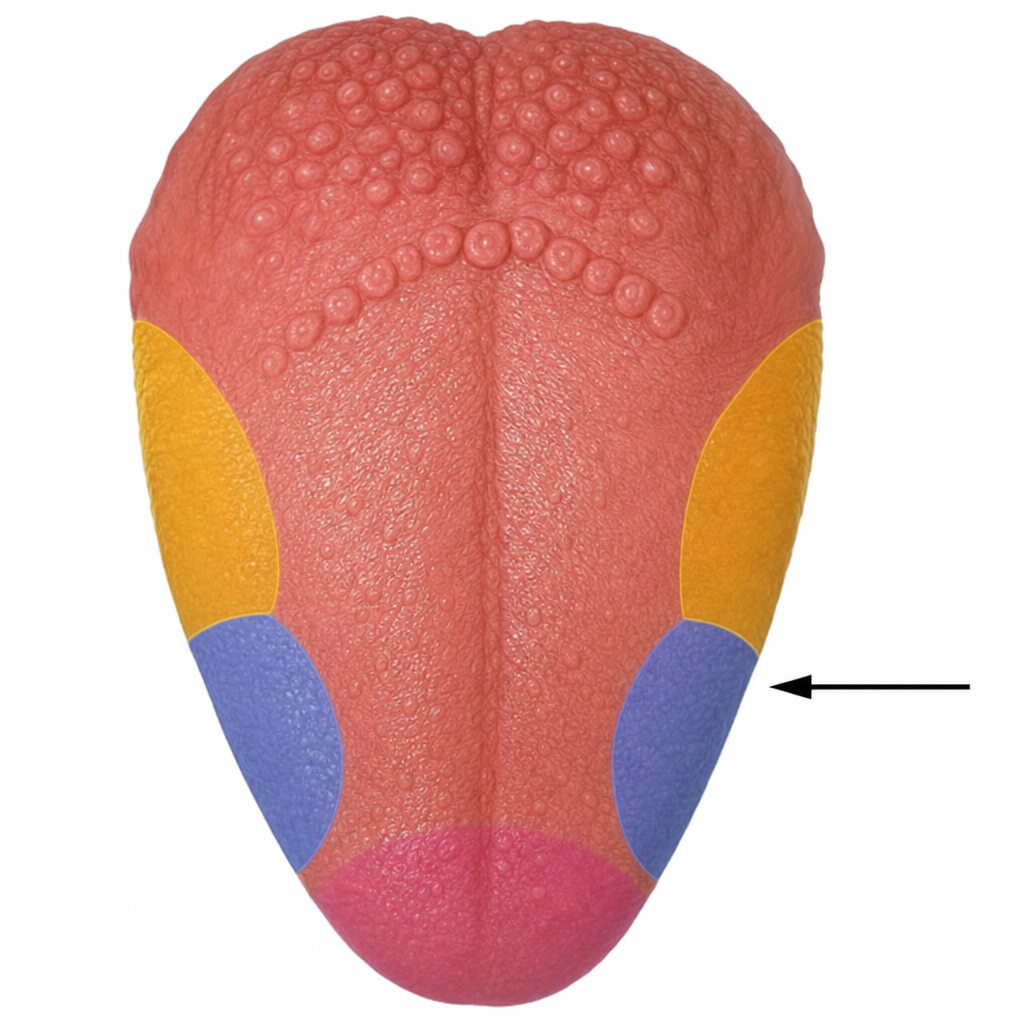
Sharp pain is transmitted by which type of nerve fibers?
Depolarization in hair cells of the organ of Corti occurs due to:
Touch sensation is carried by which nerve fibers?
Rhodopsin has a peak sensitivity to light of which wavelength?
Sudden loud sound is more likely to damage the cochlea than prolonged sounds because?
Why is the blind spot on the retina not usually perceived?
Which nucleus controls the pupillary reflex?
Which of the following is a chemoreceptor?
Processing of tactile stimulation occurs in Brodmann's area?
Which of the following sensations is NOT carried through the anterolateral system?
Explanation: **Explanation:** Pain perception is categorized into two distinct pathways based on the speed of transmission and the type of nerve fiber involved. **Why Aδ (A-delta) is correct:** Aδ fibers are **thinly myelinated**, medium-diameter axons that conduct impulses at a velocity of 6–30 m/s. They are responsible for **"fast pain"** or **"first pain."** This is characterized as sharp, pricking, and well-localized. These fibers primarily terminate in Rexed laminae I and V of the spinal cord dorsal horn and utilize glutamate as their primary neurotransmitter. **Analysis of Incorrect Options:** * **Aα (Alpha):** These are the thickest, most heavily myelinated fibers. They carry proprioceptive information from muscles and joints and serve as motor neurons to skeletal muscles. * **Aβ (Beta):** These are large, myelinated fibers that transmit non-noxious stimuli such as touch, pressure, and vibration. According to the **Gate Control Theory**, stimulation of Aβ fibers can inhibit pain transmission at the spinal level. * **C Fibers:** These are **unmyelinated**, small-diameter fibers that conduct slowly (0.5–2 m/s). They transmit **"slow pain"** or **"second pain,"** which is described as dull, aching, burning, and poorly localized. They utilize Substance P as a neurotransmitter. **NEET-PG High-Yield Pearls:** * **Fast Pain (Aδ):** Sharp, localized, glutamate-mediated, Neospinothalamic tract. * **Slow Pain (C):** Dull, diffuse, Substance P-mediated, Paleospinothalamic tract. * **Susceptibility:** **Type B** fibers are most sensitive to local anesthetics; **Type C** are most sensitive to local anesthetics among sensory fibers; **Type A** are most sensitive to pressure/hypoxia.
Explanation: **Explanation:** The **Organ of Corti** is the transducer organ of hearing. The process of sensory transduction begins when sound waves cause pressure changes in the perilymph, leading to the **vibration of the basilar membrane**. 1. **Why Option A is correct:** When the basilar membrane moves upward, it creates a **shearing force** between the hair cell stereocilia and the overlying tectorial membrane. This mechanical displacement is the primary trigger that initiates the entire electrical cascade of hearing. 2. **Why Option B is incorrect:** Depolarization occurs when **shorter stereocilia move toward the taller ones**. This stretches the "tip links" (cadherin-23 proteins), which mechanically opens **MET (Mechano-Electrical Transducer) channels**. Movement in the opposite direction (taller to shorter) leads to hyperpolarization. 3. **Why Option C is incorrect:** Unlike most excitable cells, hair cell depolarization is mediated by an **influx of Potassium (K+)**, not Sodium. The stereocilia are bathed in **endolymph**, which is uniquely high in K+ (produced by the stria vascularis). When MET channels open, K+ flows down its electrochemical gradient into the hair cell. **High-Yield NEET-PG Pearls:** * **Endocochlear Potential:** The endolymph has a positive potential of **+80 mV**, the highest resting potential in the body, which provides the driving force for K+ influx. * **Tip Links:** These are the molecular "springs" that open the K+ channels. * **Glutamate:** This is the primary excitatory neurotransmitter released at the base of the hair cell following depolarization and subsequent Ca2+ influx. * **Outer vs. Inner Hair Cells:** Inner hair cells (single row) are primarily responsible for sensory transduction, while outer hair cells (three rows) act as "cochlear amplifiers" via the protein **prestin**.
Explanation: **Explanation:** The sensation of touch is mediated by two distinct types of nerve fibers depending on the nature of the stimulus: 1. **A-beta (Aβ) fibers:** These are large, myelinated fibers with fast conduction velocities. They carry **fine touch**, pressure, and vibration from specialized mechanoreceptors (like Meissner’s and Pacinian corpuscles). 2. **A-delta (Aδ) fibers:** These are small, thinly myelinated fibers. While primarily known for carrying "fast pain" and temperature, they also transmit **crude touch** (non-discriminative touch). Since "touch" as a general modality encompasses both fine and crude touch, **Option D** is the most accurate choice. **Analysis of Options:** * **Option A (A-beta only):** Incorrect because it excludes the crude touch component carried by A-delta fibers. * **Option B (A-delta only):** Incorrect because it excludes the primary fibers responsible for discriminative (fine) touch. * **Option C (C fibers):** Incorrect. C fibers are unmyelinated and primarily carry "slow pain," temperature, and itch. While a specific subset (C-tactile afferents) exists for "pleasant touch," they are not the primary mediators of standard touch sensation. **High-Yield Clinical Pearls for NEET-PG:** * **Erlanger-Gasser Classification:** Remember the order of fiber diameter and velocity: **Aα > Aβ > Aγ > Aδ > B > C**. * **Pathway:** Fine touch (Aβ) travels via the **Dorsal Column-Medial Lemniscal (DCML)** system, while crude touch (Aδ) travels via the **Anterior Spinothalamic Tract**. * **Susceptibility:** Large myelinated fibers (A type) are most sensitive to **pressure**, while small unmyelinated fibers (C type) are most sensitive to **local anesthetics**.
Explanation: **Explanation:** **Rhodopsin**, also known as visual purple, is the photosensitive pigment found in the **rod cells** of the retina. It is a G-protein-coupled receptor (GPCR) consisting of the protein opsin bound to 11-cis-retinal. 1. **Why 505 nm is correct:** Rhodopsin is responsible for **scotopic vision** (vision under low-light conditions). While it can be activated by a range of wavelengths in the visible spectrum, its absorption spectrum peaks at approximately **505 nm**. This corresponds to the blue-green portion of the spectrum. At this wavelength, the probability of a photon being absorbed and triggering the photo-transduction cascade is highest. 2. **Why other options are incorrect:** * **100 nm:** This falls within the **Ultraviolet (UV-C)** range. Such short wavelengths are ionizing and are absorbed by the cornea and lens before reaching the retina; they do not stimulate visual pigments. * **355 nm:** This is in the **Ultraviolet (UV-A)** range. While some animals can see UV light, the human rhodopsin molecule does not have a peak sensitivity here. * **Photopic peaks:** For comparison, the three types of cones (responsible for color vision) have peak sensitivities at different wavelengths: Blue (437 nm), Green (533 nm), and Red (564 nm). **High-Yield Clinical Pearls for NEET-PG:** * **Vitamin A Connection:** Rhodopsin is synthesized from Vitamin A (retinol). Deficiency leads to **Nyctalopia** (night blindness), the earliest clinical sign of Vitamin A deficiency. * **Wald’s Visual Cycle:** The process of rhodopsin bleaching (conversion of 11-cis-retinal to all-trans-retinal) and regeneration is a frequent exam topic. * **Dark Adaptation:** The "rod-cone break" in dark adaptation curves occurs because rods (rhodopsin) take longer to regenerate than cones but eventually achieve a much lower threshold for light detection.
Explanation: ### Explanation **1. Why the Correct Answer is Right:** The **Attenuation Reflex** (also known as the acoustic or stapedial reflex) is a protective mechanism where loud sounds trigger the contraction of the **stapedius** and **tensor tympani** muscles. This contraction increases the rigidity of the ossicular chain, reducing the transmission of low-frequency sound energy to the cochlea by approximately 30 to 40 decibels. However, this reflex is not instantaneous. It has a **latent period of 40 to 160 milliseconds**. Because of this delay, a sudden, impulsive sound (like an explosion or a gunshot) reaches and potentially damages the sensitive hair cells of the cochlea before the muscles have time to contract and provide protection. **2. Why the Incorrect Options are Wrong:** * **Option A:** Basilar fibers do not "adapt" to prolonged sounds in a way that prevents damage; in fact, prolonged exposure leads to metabolic exhaustion of hair cells and permanent hearing loss. * **Option B:** While intensity matters, a prolonged sound of the same decibel level can carry more cumulative energy than a short burst. The vulnerability to sudden sound is specifically due to the *failure of the protective mechanism*, not just the energy level. * **Option C:** The tympanic membrane does not become flaccid; rather, the attenuation reflex makes the entire conduction system **stiffer** to impede sound transmission. **3. Clinical Pearls & High-Yield Facts:** * **Muscles involved:** The **Stapedius** (innervated by CN VII) is the primary muscle of this reflex in humans. The **Tensor Tympani** (innervated by CN V3) also contributes. * **Function:** The reflex primarily masks low-frequency sounds in loud environments, allowing for better perception of high-frequency sounds (like human speech). * **Hyperacusis:** Paralysis of the stapedius muscle (e.g., in **Bell’s Palsy**) leads to hyperacusis, where normal sounds appear abnormally loud and painful. * **Reflex Arc:** Sound → CN VIII → Cochlear Nuclei → Superior Olivary Complex → CN VII Nucleus → Stapedius Muscle.
Explanation: ### Explanation The **blind spot** (physiological scotoma) corresponds to the **optic disc**, the region where the optic nerve exits the retina. Since this area lacks photoreceptors (rods and cones), it cannot transduce light into neural signals. **Why Option C is Correct:** The primary reason we do not perceive a "hole" in our vision is **binocularity**. The blind spot is located approximately 15° temporal to the visual axis in each eye. Because of the lateral separation of the eyes, the blind spot of the right eye falls on a portion of the visual field that is "seen" by the left eye, and vice versa. The brain integrates these two overlapping fields, using information from one eye to "fill in" the missing data from the other. Additionally, the brain performs **perceptual filling-in**, using surrounding textures and colors to complete the image. **Why Other Options are Incorrect:** * **Option A:** The blind spot is actually quite large (approx. 5°–7° in diameter), which is significantly larger than the receptive fields of individual sensory cells. * **Option B:** The optic disc is a permanent anatomical structure present throughout life; it does not disappear after childhood. * **Option D:** While microsaccades (constant eye motion) help prevent image fading, they do not eliminate the blind spot. Even with one eye closed and the eye held still, the brain still "fills in" the gap based on the surrounding context. **High-Yield Clinical Pearls for NEET-PG:** * **Location:** The optic disc is located **nasally** on the retina, but its projection in the visual field is **temporal**. * **Glaucoma Connection:** Pathological enlargement of the blind spot is seen in conditions like glaucoma (e.g., Seidel’s scotoma). * **Papilledema:** Swelling of the optic disc (due to increased intracranial pressure) leads to an enlargement of the physiological blind spot on perimetry. * **Macula vs. Optic Disc:** The macula lutea (site of highest visual acuity) is lateral to the optic disc. The disc itself is often called the "blind spot" because it is devoid of photoreceptors.
Explanation: The **Edinger-Westphal (EW) nucleus** is the correct answer as it serves as the parasympathetic preganglionic nucleus for the oculomotor nerve (CN III). ### 1. Why Edinger-Westphal Nucleus is Correct The pupillary light reflex involves a four-neuron arc. When light hits the retina, the signal travels via the optic nerve to the **pretectal nucleus** in the midbrain. From there, fibers project bilaterally to the **Edinger-Westphal nuclei**. The EW nucleus sends parasympathetic fibers via the oculomotor nerve to the **ciliary ganglion**, which then innervates the **sphincter pupillae** muscle, causing pupillary constriction (miosis). ### 2. Why Other Options are Incorrect * **Nucleus Tractus Solitarius (NTS):** This is the primary sensory nucleus for visceral afferents (taste via CN VII, IX, X and baroreceptor/chemoreceptor inputs via CN IX, X). * **Nucleus Ambiguus:** This is a motor nucleus that gives rise to branchial efferent fibers of CN IX and X, controlling muscles of the pharynx, larynx, and upper esophagus (swallowing and phonation). * **Dorsal Vagus Nucleus:** This provides parasympathetic innervation to the thoracic and abdominal viscera (heart, lungs, and GI tract), not the eye. ### 3. High-Yield Clinical Pearls for NEET-PG * **Consensual Reflex:** Light in one eye causes bilateral constriction because the pretectal nucleus sends fibers to **both** the left and right EW nuclei. * **Argyll Robertson Pupil:** Seen in neurosyphilis; the pupil "accommodates but does not react" to light. This is due to a lesion in the pretectal area, sparing the accommodation pathway. * **Hutchinson’s Pupil:** A dilated, non-reactive pupil caused by compression of the oculomotor nerve (and its superficial parasympathetic fibers) by an uncal herniation.
Explanation: **Explanation:** **Correct Answer: A. Osmoreceptors** Osmoreceptors, primarily located in the **anterior hypothalamus** (specifically the OVLT and SFO), are specialized **chemoreceptors**. They function by detecting changes in the chemical composition of the blood—specifically the **osmotic pressure** or solute concentration of the extracellular fluid. When plasma osmolarity increases, these receptors shrink, triggering the release of ADH (Vasopressin) and the sensation of thirst to maintain water homeostasis. **Analysis of Incorrect Options:** * **B. Rods & Cones:** These are **photoreceptors** located in the retina. They convert electromagnetic radiation (light) into electrical signals (phototransduction). * **C. Hair Cells:** These are **mechanoreceptors** found in the cochlea (for hearing) and vestibular apparatus (for balance). They respond to mechanical displacement caused by sound waves or head movement. * **D. Merkel’s Disc:** These are **mechanoreceptors** located in the basal layer of the epidermis. They are slow-adapting (Type I) receptors that respond to steady pressure and texture (fine touch). **High-Yield Clinical Pearls for NEET-PG:** * **Other Chemoreceptors:** Peripheral chemoreceptors (Carotid and Aortic bodies) detect $PO_2$, $PCO_2$, and $pH$; Central chemoreceptors (Medulla) detect $H^+$ concentration in the CSF. * **Classification Tip:** Always classify receptors by their **adequate stimulus**. If the stimulus is a chemical change (ions, gases, osmolarity), it is a chemoreceptor. * **Baroreceptors:** These are mechanoreceptors (not chemoreceptors) that detect "stretch" in blood vessel walls to regulate blood pressure.
Explanation: **Explanation:** The correct answer is **A (Brodmann’s areas 1, 2, 3)**. These areas constitute the **Primary Somatosensory Cortex (S1)**, located in the postcentral gyrus of the parietal lobe. This region is the primary destination for sensory information traveling via the Dorsal Column-Medial Lemniscal (DCML) pathway and the Spinothalamic tract. It is responsible for processing tactile sensations (touch, pressure), vibration, and proprioception. Specifically, Area 3 receives the bulk of thalamocortical projections, while Areas 1 and 2 are involved in higher-order processing like texture and shape recognition. **Analysis of Incorrect Options:** * **B (4, 6):** These represent the **Primary Motor Cortex (4)** and **Premotor/Supplementary Motor Cortex (6)** located in the frontal lobe. They are responsible for the execution and planning of voluntary motor movements, not sensory processing. * **C (44, 45):** These areas form **Broca’s Area** in the dominant hemisphere (usually left). They are responsible for motor speech production. * **D (41, 42):** These represent the **Primary Auditory Cortex**, located in the Superior Temporal Gyrus (Heschl’s gyri), responsible for processing sound. **High-Yield Clinical Pearls for NEET-PG:** * **Sensory Homunculus:** The body is represented upside-down in S1, with the face and hands having disproportionately large representations due to high receptor density. * **Lesion Effect:** A lesion in areas 1, 2, and 3 leads to **contralateral hemi-anesthesia** and loss of discriminative touch (astereognosis). * **Secondary Somatosensory Area (S2):** Located in the wall of the sylvian fissure; it handles less discrete sensory functions. * **Brodmann Area 5 & 7:** These are the **Sensory Association Areas**; lesions here lead to **Astereognosis** and **Amorphosynthesis** (neglect of the opposite side of the body).
Explanation: The sensory pathways of the spinal cord are divided into two major systems: the **Anterolateral System (ALS)** and the **Dorsal Column-Medial Lemniscal (DCML) System**. ### Why Proprioception is the Correct Answer **Proprioception** (position sense), along with fine touch, vibration, and two-point discrimination, is carried by the **DCML pathway**. These fibers enter the spinal cord and ascend ipsilaterally in the gracile and cuneate fasciculi before decussating in the medulla. Therefore, it is not a component of the anterolateral system. ### Why Other Options are Incorrect The Anterolateral System (Spinothalamic tract) primarily carries "protopathic" sensations. These fibers synapse in the dorsal horn, decussate immediately at the spinal level, and ascend in the anterior and lateral columns: * **Pain (C):** Carried via the Lateral Spinothalamic tract. * **Temperature (B):** Carried via the Lateral Spinothalamic tract. * **Crude touch (D):** Carried via the Anterior Spinothalamic tract (along with pressure). ### High-Yield Clinical Pearls for NEET-PG * **Brown-Séquard Syndrome:** A hemisection of the spinal cord results in **ipsilateral** loss of proprioception/vibration (DCML) and **contralateral** loss of pain/temperature (ALS) below the level of the lesion. * **Fiber Types:** Pain and temperature are carried by slow **A-delta and C fibers**, whereas proprioception is carried by fast, heavily myelinated **A-alpha and A-beta fibers**. * **Syringomyelia:** Classically affects the anterior white commissure first, leading to a "cape-like" loss of pain and temperature while sparing proprioception (dissociated sensory loss).
General Sensory Physiology
Practice Questions
Somatosensation
Practice Questions
Pain Physiology
Practice Questions
Vision and Optics
Practice Questions
Retinal Physiology
Practice Questions
Visual Pathways and Processing
Practice Questions
Auditory System
Practice Questions
Vestibular System
Practice Questions
Taste and Smell
Practice Questions
Sensory Integration
Practice Questions
Get full access to all questions, explanations, and performance tracking.
Start For Free