Vibration sense is carried by which of the following structures?
Fast pain has a conduction velocity of _____ m/sec?
Which of the following structures contains endolymph?
Which of the following does NOT present in the auditory pathway?
What is the consequence of removing one side of the auditory cortex?
When stereocilia of an auditory hair cell are deflected in the appropriate direction, potassium channels open in the apical membrane of the cell and?
What is the neurotransmitter employed by rods and cones?
Direction of sound is differentiated by which structure?
Which is the last discovered taste sensation?
Which of the following is TRUE regarding the sense of smell EXCEPT?
Explanation: **Explanation:** The correct answer is **Pacinian corpuscles**. Vibration sense (pallesthesia) is mediated by specialized mechanoreceptors that are sensitive to high-frequency mechanical stimuli. **Pacinian corpuscles** are rapidly adapting (RA II) receptors located deep in the dermis and subcutaneous tissue. They have a large receptive field and are specifically tuned to detect high-frequency vibrations (ranging from 60–400 Hz, with peak sensitivity around 250 Hz). When a vibratory stimulus is applied, the concentric lamellae of the Pacinian corpuscle deform, triggering an action potential in the sensory nerve fiber. **Analysis of Incorrect Options:** * **Meckel’s disks:** These are slowly adapting (SA I) receptors located in the basal layer of the epidermis. They are responsible for detecting static touch, pressure, and vertical indentation (e.g., feeling the edges of an object). * **Ruffini corpuscle end-organs:** These are slowly adapting (SA II) receptors found in the deep dermis. They respond primarily to skin stretch and joint rotation. * **Free nerve endings:** These are non-specialized endings that primarily mediate pain (nociception) and temperature (thermoreception). **Clinical Pearls for NEET-PG:** * **Pathway:** Vibration sense is carried via the **Dorsal Column-Medial Lemniscal (DCML) pathway**. * **Clinical Testing:** Vibration is often the first sense lost in peripheral neuropathies (e.g., Diabetic neuropathy) and is tested using a **128 Hz tuning fork** over bony prominences. * **Meissner’s Corpuscles:** These also detect vibration, but at much lower frequencies (30–40 Hz), often described as "flutter." * **Rule of Thumb:** If the question specifies "high-frequency vibration," the answer is always Pacinian corpuscles.
Explanation: **Explanation:** Pain is transmitted to the central nervous system via two distinct pathways involving different nerve fiber types. The correct answer is **15 m/sec**, which falls within the characteristic range for **Aδ (A-delta) fibers**. 1. **Why 15 m/sec is correct:** Fast pain (also known as "pricking" or "acute" pain) is carried by **Aδ fibers**. These are thinly myelinated fibers with a diameter of 2–5 μm. Their conduction velocity typically ranges from **6 to 30 m/sec**. Therefore, 15 m/sec is the most accurate representative value among the choices. 2. **Analysis of incorrect options:** * **1 m/sec (Option A):** This is the velocity for **C fibers**, which transmit **slow pain** (dull, aching, or burning). These fibers are small and unmyelinated (0.5–2 m/sec). * **5 m/sec (Option B):** This is too slow for Aδ fibers and too fast for typical C fibers; it does not represent the standard "fast pain" velocity. * **50 m/sec (Option D):** This velocity is characteristic of **Aβ (A-beta) fibers**, which carry non-noxious stimuli like touch and pressure. **High-Yield NEET-PG Pearls:** * **Double Pain Sensation:** When you stub your toe, the initial sharp sting is Fast Pain (Aδ), followed seconds later by a dull ache, which is Slow Pain (C fibers). * **Neurotransmitter:** Fast pain uses **Glutamate** (fast-acting), while slow pain uses **Substance P** (slow-releasing). * **Termination:** Fast pain fibers terminate mainly in **Laminae I and V** of the dorsal horn; slow pain fibers terminate in **Laminae II and III (Substantia Gelatinosa)**. * **Lateral vs. Medial:** Fast pain travels via the **Neospinothalamic tract**, whereas slow pain travels via the **Paleospinothalamic tract**.
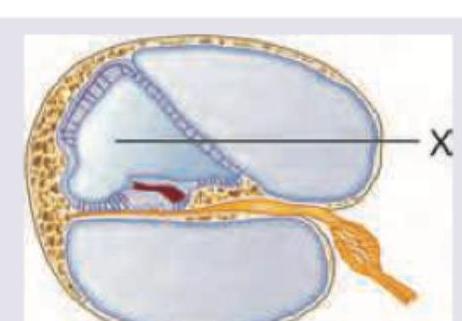
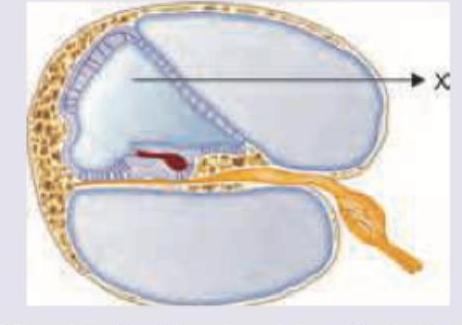
Explanation: The inner ear consists of a bony labyrinth containing a membranous labyrinth. Understanding the fluid distribution within these compartments is a high-yield topic for NEET-PG. ### **Explanation of the Correct Answer** The **Scala Media** (also known as the cochlear duct) is the middle compartment of the cochlea and is part of the **membranous labyrinth**. It is filled with **endolymph**, a unique extracellular fluid that is high in Potassium ($K^+$) and low in Sodium ($Na^+$), resembling intracellular fluid. This high potassium concentration is essential for the depolarization of hair cells during auditory transduction. ### **Analysis of Incorrect Options** * **Scala Vestibuli (D) and Scala Tympani (C):** These are parts of the **bony labyrinth**. They are filled with **perilymph**, which is high in Sodium ($Na^+$) and low in Potassium ($K^+$), similar to cerebrospinal fluid (CSF). The Scala vestibuli is separated from the scala media by Reissner’s membrane, while the Scala tympani is separated by the Basilar membrane. * **Helicotrema (A):** This is the narrow opening at the apex of the cochlea where the Scala vestibuli and Scala tympani meet. Since it connects two perilymph-filled spaces, it contains **perilymph**, not endolymph. ### **High-Yield Clinical Pearls** * **Source of Endolymph:** It is secreted by the **Stria Vascularis** located in the lateral wall of the scala media. * **Endocochlear Potential:** The scala media has a positive potential of **+80 mV** relative to the perilymph, providing the driving force for sound transduction. * **Meniere’s Disease:** Caused by the "endolymphatic hydrops" (excess accumulation of endolymph), leading to the triad of vertigo, sensorineural hearing loss, and tinnitus.
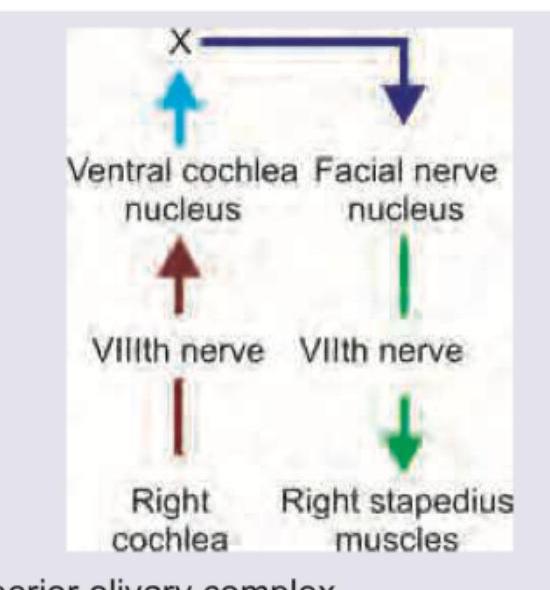
Explanation: The auditory pathway follows a specific sequence of relay stations often remembered by the mnemonic **E. COLIM** (Eighth nerve, Cochlear nuclei, Superior Olivary complex, Lateral lemniscus, Inferior colliculus, Medial geniculate body). ### Why Medial Lemniscus is the Correct Answer: The **Medial Lemniscus** is a major ascending pathway for the **Dorsal Column-Medial Lemniscal System (DCML)**. It carries sensory information related to fine touch, conscious proprioception, and vibration from the body to the thalamus (VPL nucleus). It is **not** involved in the transmission of auditory signals. The corresponding structure in the auditory system is the **Lateral Lemniscus**. ### Explanation of Incorrect Options: * **Superior Olivary Nucleus (A):** Located in the pons, this is the first site where auditory information from both ears converges. It plays a critical role in sound localization by detecting time and intensity differences. * **Medial Geniculate Body (C):** This is the "thalamic relay station" for hearing. All auditory fibers synapse here before projecting to the primary auditory cortex (Heschl’s gyrus). * **Trapezoid Body (D):** This consists of decussating fibers from the ventral cochlear nuclei. It is a vital part of the auditory pathway where fibers cross to the contralateral superior olivary nucleus. ### High-Yield NEET-PG Pearls: * **Lateral Lemniscus = Listening:** Always associate the *Lateral* lemniscus with the auditory system and the *Medial* lemniscus with somatosensory (touch) systems. * **MGB vs. LGB:** **M**edial Geniculate Body is for **M**usic (Hearing); **L**ateral Geniculate Body is for **L**ight (Vision). * **Primary Auditory Cortex:** Located in the superior temporal gyrus (Brodmann areas 41 and 42).
Explanation: **Explanation:** The auditory pathway is characterized by extensive **bilateral representation**. From the level of the superior olivary complex onwards, auditory information from each ear ascends via both ipsilateral and contralateral pathways to reach the auditory cortex (Heschl’s gyrus) in both hemispheres. **1. Why "Decreased sound localization" is correct:** Sound localization depends on the brain’s ability to compare the **interaural time difference** and **interaural intensity difference** between the two ears. This complex processing requires integrated input from both hemispheres. While a unilateral lesion does not cause deafness, it disrupts the spatial processing required to pinpoint the exact origin of a sound in the environment, particularly in the contralateral field. **2. Why other options are incorrect:** * **A & B (Total/Mild hearing loss):** Because each ear sends signals to both sides of the brain, the intact hemisphere continues to receive significant input from both ears. Therefore, unilateral cortical damage does not result in a significant loss of hearing acuity (threshold). * **D (Decreased sound interpretation):** Interpretation (understanding meaning/speech) is primarily a function of **Wernicke’s area** in the dominant hemisphere. A lesion in the non-dominant auditory cortex would not significantly impair speech interpretation. **High-Yield Clinical Pearls for NEET-PG:** * **Primary Auditory Cortex:** Located in the Superior Temporal Gyrus (Brodmann areas 41 & 42). * **Tonotopic Organization:** The auditory cortex is organized by frequency; high frequencies are processed deeply/medially, and low frequencies are processed peripherally/laterally. * **Lesion Rule:** Unilateral lesions of the auditory pathway **distal to the cochlear nuclei** (e.g., lateral lemniscus, medial geniculate body, or cortex) do not cause deafness but affect localization and binaural integration. Only lesions at the level of the cochlea or auditory nerve cause unilateral deafness.
Explanation: ### Explanation The auditory system features a unique ionic environment that defies the standard rules of cellular neurophysiology. **1. Why Option D is Correct:** The apical portion of auditory hair cells is bathed in **endolymph**, which is secreted by the stria vascularis. Unlike typical extracellular fluid, endolymph is rich in **Potassium (K⁺)** and has a high positive potential (+80 mV). The intracellular fluid of the hair cell, however, has a low K⁺ concentration and a negative resting potential (-60 mV). When stereocilia deflect toward the tallest cilium (kinocilium), mechanical tip links pull open **MET (Mechano-Electrical Transducer) channels**. Due to the massive electrochemical gradient (the "endocochlear potential"), **K⁺ ions rush into the cell**. This influx of positive charge causes **depolarization**, which subsequently opens voltage-gated calcium channels, leading to neurotransmitter release. **2. Why Other Options are Incorrect:** * **Options A & B:** In most other body tissues, K⁺ concentration is higher inside the cell, so opening K⁺ channels causes an *efflux* (outflow). In the inner ear, the gradient is reversed; thus, K⁺ does not flow out during the initial excitation. * **Option C:** While K⁺ does flow into the cell, an influx of positive ions always leads to **depolarization** (making the membrane potential less negative), never hyperpolarization. **3. High-Yield Clinical Pearls for NEET-PG:** * **Endolymph vs. Perilymph:** Endolymph (high K⁺, low Na⁺) resembles intracellular fluid; Perilymph (high Na⁺, low K⁺) resembles ECF/CSF. * **Stria Vascularis:** Often called the "battery of the cochlea" because it maintains the +80 mV endocochlear potential. * **Tip Links:** These are composed of **Cadherin-23**. Mutations in these proteins lead to **Usher Syndrome** (congenital deafness and retinitis pigmentosa). * **Repolarization:** Interestingly, K⁺ also exits the cell through the *basolateral* membrane into the perilymph to repolarize the cell, completing the circuit.
Explanation: **Explanation:** The correct answer is **Glutamate**. In the retina, photoreceptors (rods and cones) are specialized neuroepithelial cells that maintain a constant release of the excitatory neurotransmitter **glutamate** in the dark. **Why Glutamate is Correct:** Photoreceptors exhibit a unique physiological behavior called the "dark current." In the absence of light, rods and cones are relatively depolarized (approx. -40 mV), leading to the continuous release of glutamate onto bipolar cells. When light strikes the retina, it triggers a G-protein coupled cascade (involving transducin and phosphodiesterase) that closes sodium channels, causing **hyperpolarization**. This hyperpolarization *decreases* the release of glutamate. Thus, the signal for light is actually a reduction in glutamate secretion. **Analysis of Incorrect Options:** * **A. Dopamine:** In the retina, dopamine is primarily secreted by **amacrine cells** and interplexiform cells. it plays a role in light adaptation and circadian rhythms, but it is not the primary transmitter for photoreceptors. * **B. Serotonin:** While found in some invertebrate visual systems, it is not the neurotransmitter for mammalian rods and cones. * **D. Nitric Oxide:** This acts as a retrograde gaseous signaling molecule in various parts of the CNS but does not serve as the primary neurotransmitter for the first synapse in the visual pathway. **High-Yield NEET-PG Pearls:** * **The Visual Paradox:** Photoreceptors are the only sensory receptors that **hyperpolarize** in response to an adequate stimulus (light). * **Bipolar Cells:** Glutamate has different effects depending on the receptor: it inhibits **On-center** bipolar cells (via mGluR6 receptors) and excites **Off-center** bipolar cells (via AMPA/Kainate receptors). * **Vitamin A:** Retinal, a derivative of Vitamin A, is the prosthetic group of rhodopsin; its deficiency leads to Nyctalopia (night blindness).
Explanation: **Explanation:** The localization of sound (directionality) is a complex process involving the integration of binaural cues—specifically **Interaural Time Differences (ITD)** and **Interaural Intensity Differences (IID)**. While the **Superior Olivary Complex** is the first site where these binaural inputs converge, the **Inferior Colliculus (IC)** is the principal midbrain nucleus that processes this information to create a spatial map of the auditory environment. The IC integrates information from lower brainstem nuclei to differentiate the direction and origin of sound before relaying it to higher centers. **Analysis of Options:** * **Inferior Colliculus (Correct):** It acts as the major integrative center for auditory signals. It is specifically responsible for processing sound localization and the startle reflex (via the tectospinal tract). * **Auditory Cortex (A):** Located in the temporal lobe (Heschl’s gyrus), it is responsible for the conscious perception and interpretation of sound (pitch, rhythm, and meaning), rather than the primary differentiation of direction. * **Medial Geniculate Body (B):** This is the thalamic relay station for auditory pathways. It functions as a "gateway" to the cortex but does not primarily differentiate sound direction. * **Lateral Geniculate Body (C):** This is part of the **visual pathway**, relaying signals from the optic tract to the visual cortex. (Mnemonic: **M**edial for **M**usic/Auditory; **L**ateral for **L**ight/Visual). **High-Yield Facts for NEET-PG:** * **Auditory Pathway Mnemonic:** **E-COLI-MA** (**E**xternal ear, **C**ochlear nucleus, **O**livary complex, **L**ateral lemniscus, **I**nferior colliculus, **M**edial geniculate body, **A**uditory cortex). * **Superior Olivary Complex:** The very first site of binaural interaction (crucial for the initial detection of sound lag). * **Lesion of Auditory Cortex:** Does not result in total deafness (due to bilateral representation) but leads to difficulty in interpreting complex sounds and fine spatial localization.
Explanation: **Explanation:** The correct answer is **Umami**. For decades, the tongue was believed to perceive only four primary tastes. However, Umami was officially recognized as the fifth primary taste sensation in the late 20th century after the identification of specific G-protein coupled receptors (mGluR4 and T1R1/T1R3) on the tongue. **Why Umami is correct:** Umami (a Japanese word meaning "savory" or "delicious") is triggered by **L-glutamate** and certain nucleotides like inosinate and guanylate. It is the last discovered sensation because it was only scientifically validated as a distinct primary taste (with its own dedicated receptors) long after the traditional four were established. It is commonly associated with protein-rich foods like meat, cheese, and MSG (Monosodium Glutamate). **Why other options are incorrect:** * **Sweet, Sour, and Bitter:** These are the "classical" taste sensations known since antiquity. * **Sweet** (triggered by sugars/glycols) and **Bitter** (triggered by alkaloids/long-chain organics) utilize G-protein coupled receptors. * **Sour** (triggered by H+ ions) and **Salty** (triggered by Na+ ions) primarily utilize ion channels. **High-Yield Facts for NEET-PG:** * **Receptor Types:** Sweet, Bitter, and Umami use **G-protein coupled receptors (GPCRs)**; Salty and Sour use **Ion channels**. * **Signal Transduction:** For GPCR-linked tastes, the specific G-protein involved is called **Gustducin**. * **Innervation:** The anterior 2/3 of the tongue is supplied by the **Chorda Tympani (CN VII)**; the posterior 1/3 by the **Glossopharyngeal nerve (CN IX)**; and the epiglottis/pharynx by the **Vagus nerve (CN X)**. * **Ageusia:** The clinical term for loss of taste sensation.
Explanation: In the context of the NEET-PG exam, understanding the unique physiology of the olfactory system is crucial. Here is the breakdown of the question: ### **Explanation of the Correct Answer (B)** The statement **"Affects a larger area" is FALSE** (and thus the correct answer for an "EXCEPT" question). Olfaction is characterized by **spatial localization**. Odorant molecules must bind to specific receptors located in a relatively small, specialized area called the **olfactory epithelium** (located in the roof of the nasal cavity). Unlike general sensations like touch or temperature, which can affect the entire body surface, smell is restricted to this specific anatomical niche. ### **Analysis of Incorrect Options** * **A. Rapidly adapting:** This is **TRUE**. Olfactory receptors are phasic; they adapt by about 50% in the first second after stimulation and very slowly thereafter. This explains why we stop noticing a persistent odor after a short period. * **C. Bipolar neuron:** This is **TRUE**. The olfactory receptor cell is a unique **primary sensory neuron** that is bipolar in shape. It is one of the few neurons in the adult human body that undergoes continuous turnover (regeneration) from basal cells. * **D. Threshold of smell is low:** This is **TRUE**. The olfactory system is remarkably sensitive. For example, methyl mercaptan (added to natural gas) can be detected at a concentration of less than one-billionth of a milligram per liter of air. ### **High-Yield Clinical Pearls for NEET-PG** * **First-Order Neurons:** Olfactory receptors are the only primary sensory neurons whose axons transmit impulses directly to the brain (Olfactory bulb) without a thalamic relay for the initial pathway. * **Anosmia:** Loss of smell is an early diagnostic marker for neurodegenerative diseases like **Parkinson’s** and **Alzheimer’s**. * **Kallmann Syndrome:** Characterized by hypogonadotropic hypogonadism and anosmia due to failure of GnRH and olfactory neurons to migrate.
General Sensory Physiology
Practice Questions
Somatosensation
Practice Questions
Pain Physiology
Practice Questions
Vision and Optics
Practice Questions
Retinal Physiology
Practice Questions
Visual Pathways and Processing
Practice Questions
Auditory System
Practice Questions
Vestibular System
Practice Questions
Taste and Smell
Practice Questions
Sensory Integration
Practice Questions
Get full access to all questions, explanations, and performance tracking.
Start For Free