An anesthetized patient is mechanically ventilated at her normal tidal volume but at twice her normal frequency. When mechanical ventilation is stopped, the patient fails to breathe spontaneously for 1 minute. This temporary cessation of breathing occurs because:
What is the cause of "Raptures of the deep"?
What is the amount of air that can be inhaled above the tidal volume by maximum inspiratory effort?
What is true regarding the alveolar-arterial oxygen gradient (A-a gradient)?
Under resting conditions, what is the total body oxygen consumption?
Apneusis occurs when there is damage to:
Which of the following is a typical manifestation of chronic hyperventilation?
One gram of hemoglobin, when fully saturated in arterial blood, carries what volume of oxygen?
Which is the slowest acting buffer system in the human body?
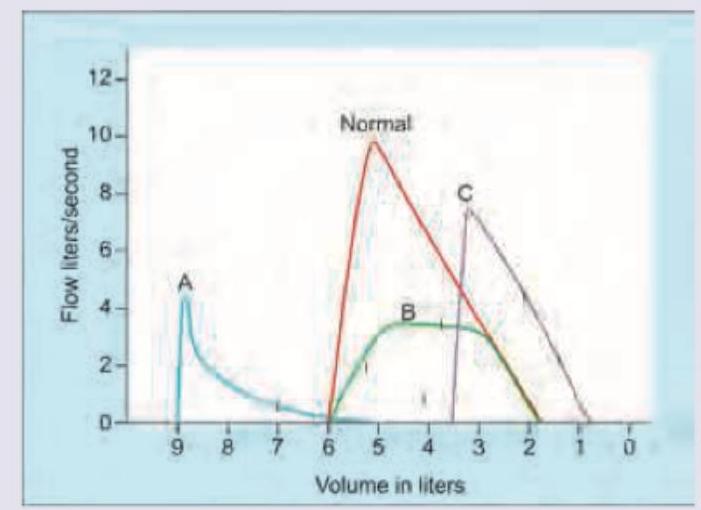
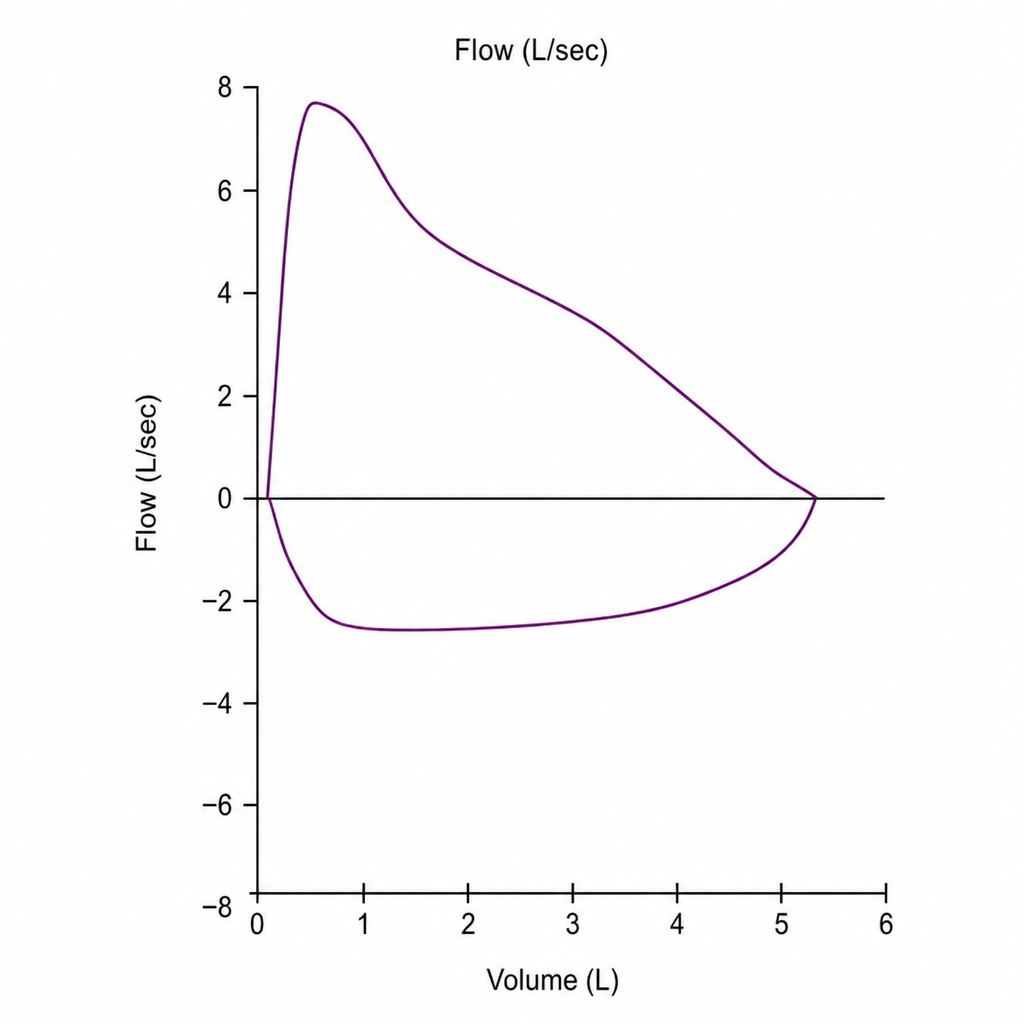
On spirometry, decreased FEV1, normal FVC, increased TLC, and decreased DLCO2 suggest which diagnosis?
Explanation: ### Explanation **1. Why Option D is Correct:** The primary drive for spontaneous respiration in a healthy individual is the **arterial partial pressure of carbon dioxide (PaCO₂)** acting on **central chemoreceptors** (located in the medulla). When the patient is ventilated at twice the normal frequency (hyperventilation), excessive CO₂ is "washed out" of the lungs, leading to **hypocapnia** (lowered PaCO₂). This decrease in PaCO₂ results in a decrease in hydrogen ion [H⁺] concentration in the cerebrospinal fluid (CSF). Since central chemoreceptors are exquisitely sensitive to [H⁺] changes, the lack of stimulus leads to a temporary cessation of breathing, known as **post-hyperventilation apnea**, until PaCO₂ levels rise back to the threshold required to trigger the respiratory center. **2. Why Other Options are Incorrect:** * **Options A & B:** While hyperventilation increases PaO₂, the peripheral chemoreceptors are only significantly stimulated when PaO₂ drops below **60 mmHg** (hypoxic drive). Elevated PaO₂ has a negligible effect on inhibiting normal respiratory drive compared to the potent effect of CO₂. Furthermore, central chemoreceptors do not respond to O₂ levels at all. * **Option C:** Nitrogen is an inert gas in the respiratory cycle at sea level. Its concentration does not act as a chemical regulator of the respiratory drive. **3. NEET-PG High-Yield Pearls:** * **Central Chemoreceptors:** Respond to **↑ PaCO₂** (via H⁺ in CSF). They do **not** respond to hypoxia or direct arterial pH changes (as H⁺ cannot cross the blood-brain barrier). * **Peripheral Chemoreceptors (Carotid/Aortic bodies):** Primary sensors for **hypoxia (↓ PaO₂)**. They also respond to ↑ PaCO₂ and ↓ pH, but are less sensitive to CO₂ than central receptors. * **Breaking Point:** The level of PaCO₂ at which an individual can no longer voluntarily hold their breath is approximately **50 mmHg**. * **Hering-Breuer Reflex:** This is a stretch reflex to prevent over-inflation, not the chemical drive responsible for post-ventilation apnea.
Explanation: **Explanation:** **Nitrogen Narcosis** (Option C) is the correct answer. Often referred to as "Raptures of the Deep," this condition occurs in deep-sea divers who breathe compressed air at depths typically exceeding 100 feet (approx. 4 atmospheres). According to **Henry’s Law**, the solubility of a gas in a liquid is proportional to its partial pressure. At high pressures, nitrogen—which is normally physiologically inert—dissolves into the lipid-rich membranes of neurons. This produces an anesthetic effect similar to nitrous oxide, leading to euphoria, impaired judgment, and disorientation, which can be fatal for a diver. **Why other options are incorrect:** * **Carbon monoxide narcosis (A):** CO has a high affinity for hemoglobin, leading to hypoxia, but it does not cause the specific "rapture" or anesthetic effect associated with deep diving. * **Carbon dioxide narcosis (B):** While high levels of $CO_2$ can cause confusion and coma (often seen in severe COPD), it is not the primary cause of the "raptures" sensation in diving. * **Oxygen toxicity (D):** Also known as the **Paul Bert effect**, high partial pressures of oxygen cause oxidative stress and seizures, but this is distinct from the narcotic effect of nitrogen. **High-Yield Pearls for NEET-PG:** * **The Martini Effect:** A common rule of thumb is that every 50 feet of depth is equivalent to drinking one dry martini on an empty stomach. * **Heliox:** To prevent nitrogen narcosis, deep-sea divers use a mixture of Helium and Oxygen. Helium is used because it has low lipid solubility and lower density. * **Decompression Sickness (The Bends):** Caused by rapid ascent where dissolved nitrogen forms bubbles in tissues/blood. This is different from narcosis, which occurs *at* depth.
Explanation: ### Explanation **Correct Answer: C. Inspiratory reserve volume (IRV)** The **Inspiratory Reserve Volume (IRV)** is defined as the maximum volume of air that can be inspired over and above the normal **Tidal Volume (TV)**. It represents the "reserve" capacity of the lungs during deep inspiration. In a healthy adult male, the IRV is approximately **3000 mL**. #### Analysis of Options: * **A. Vital Capacity (VC):** This is the maximum volume of air a person can exhale after a maximum inhalation ($VC = IRV + TV + ERV$). It represents the total "usable" lung volume, not just the portion above tidal volume. * **B. Inspiratory Capacity (IC):** This is the total amount of air one can breathe in starting from the normal expiratory level ($IC = TV + IRV$). While it includes the IRV, it also includes the tidal volume itself. * **D. Functional Residual Capacity (FRC):** This is the volume of air remaining in the lungs after a normal passive expiration ($FRC = ERV + RV$). It acts as a buffer to maintain gas exchange between breaths. #### High-Yield NEET-PG Pearls: 1. **Formula to Remember:** $IC = TV + IRV$. Therefore, $IRV = IC - TV$. 2. **Static vs. Dynamic:** All volumes mentioned in the options are **Static Lung Volumes**, measured by simple spirometry. Note that **Residual Volume (RV)** and capacities containing it (FRC, TLC) cannot be measured by simple spirometry (require Helium dilution or Body plethysmography). 3. **Clinical Correlation:** IRV decreases in **restrictive lung diseases** (like pulmonary fibrosis) due to decreased lung compliance, making it harder to expand the lungs beyond tidal breathing.
Explanation: The **Alveolar-arterial (A-a) oxygen gradient** is a clinical measure used to differentiate between causes of hypoxemia. It represents the difference between the oxygen concentration in the alveoli ($P_AO_2$) and the arterial blood ($P_aO_2$). ### **Explanation of Options** * **Option A (Normal Gradient):** In a healthy young adult, the normal A-a gradient is typically **5–15 mmHg**. It increases naturally with age (estimated as $[Age/4] + 4$). A value of 15 mmHg is considered the upper limit of normal. * **Option B (Pulmonary Collapse):** Pulmonary collapse (atelectasis) leads to a **Right-to-Left Shunt**. Blood perfuses non-ventilated alveoli, entering the arterial system without being oxygenated. This significantly widens (increases) the A-a gradient. * **Option C (Venous Admixture):** This refers to the mixing of deoxygenated blood with oxygenated blood. Physiologically, this occurs via the **Thebesian veins** (draining the myocardium) and **bronchial veins**. This "physiological shunt" is the primary reason why a small A-a gradient exists even in healthy individuals. ### **High-Yield NEET-PG Pearls** 1. **Normal A-a Gradient Hypoxemia:** Occurs in **Alveolar Hypoventilation** (e.g., opioid overdose, neuromuscular weakness) and **High Altitude**. 2. **Increased A-a Gradient Hypoxemia:** Occurs in **V/Q Mismatch** (e.g., PE, pneumonia), **Diffusion defects** (e.g., ILD), and **Shunts** (e.g., Atelectasis, ASD/VSD). 3. **Formula:** $P_AO_2 = FiO_2(P_{atm} - P_{H2O}) - (P_aCO_2 / R)$. 4. **Key Distinction:** Hypoxemia due to shunting is the only type that **does not** fully correct with 100% supplemental oxygen.
Explanation: **Explanation:** **1. Why Option D is Correct:** Under basal resting conditions, an average adult (70 kg) consumes approximately **250 ml of oxygen per minute ($VO_2$)**. This value represents the metabolic demand required to maintain vital organ functions. It is calculated using the **Fick Principle**, which states that oxygen consumption is the product of Cardiac Output ($CO$) and the Arterio-venous oxygen difference ($A-V O_2$ difference). * Calculation: $CO$ (5000 ml/min) × $[$Arterial $O_2$ (20 ml/dL) – Venous $O_2$ (15 ml/dL)$]$ = $5000 \times 0.05 = 250 \text{ ml/min}$. **2. Why Other Options are Incorrect:** * **Option A (100 ml/min):** This is significantly lower than the basal metabolic rate of a healthy adult. * **Option B (150 ml/min):** This value is insufficient for a 70 kg adult but may be seen in individuals with a very small body mass or severe hypometabolic states. * **Option C (200 ml/min):** While closer, the standard physiological reference for a resting adult is 250 ml/min. Carbon dioxide production ($VCO_2$) is approximately **200 ml/min**, which is often confused with $O_2$ consumption. **3. NEET-PG High-Yield Pearls:** * **Respiratory Quotient (RQ):** The ratio of $CO_2$ produced to $O_2$ consumed ($200/250$) is **0.8** on a mixed diet. * **MET (Metabolic Equivalent):** 1 MET is defined as $3.5 \text{ ml/kg/min}$ of $O_2$ consumption. For a 70 kg man: $70 \times 3.5 \approx 250 \text{ ml/min}$. * **Exercise:** During strenuous exercise, $O_2$ consumption can increase up to 20-fold (approx. 5000 ml/min) in elite athletes. * **Utilization Coefficient:** At rest, tissues extract about **25%** of the oxygen delivered by arterial blood.
Explanation: **Explanation:** **Understanding Apneusis:** Apneusis is a pathological breathing pattern characterized by prolonged, gasping inspirations followed by a very short, inefficient expiration. This occurs due to the unopposed activity of the **Apneustic Center** (located in the lower pons), which normally promotes inspiration by stimulating the Dorsal Respiratory Group (DRG). **Why Option D is Correct:** Under normal physiological conditions, the "inspiratory off-switch" is triggered by two main inhibitory inputs to the apneustic center: 1. **The Pneumotaxic Center (Upper Pons):** It limits the duration of inspiration. 2. **The Vagus Nerve:** It carries inhibitory signals from pulmonary stretch receptors (Hering-Breuer Reflex). If **both** the pneumotaxic center is damaged (e.g., upper pontine lesion) **and** the vagus nerves are severed (bilateral vagotomy), the apneustic center loses all inhibitory control. This results in continuous, unchecked inspiratory discharge, leading to **Apneusis**. **Why Other Options are Wrong:** * **Options A & B:** Damage to the apneustic center itself would *prevent* apneusis, as this center is the driver of the gasping inspiratory effort. * **Option C:** If the pneumotaxic center is damaged but the **vagi are intact**, the vagal feedback is sufficient to terminate inspiration. Breathing becomes slower and deeper (increased tidal volume), but true apneusis does not occur. **High-Yield Facts for NEET-PG:** * **Location:** Pneumotaxic center (Nucleus Parabrachialis) is in the **Upper Pons**; Apneustic center is in the **Lower Pons**. * **Function:** The Pneumotaxic center primarily controls the **rate and depth** of breathing. * **Lesion Localization:** Apneustic breathing in a clinical setting usually indicates a lesion in the **mid-to-lower pons** (e.g., due to a basilar artery stroke). * **Sectioning below the Medulla:** Results in complete cessation of respiration (apnea).
Explanation: **Explanation:** The correct answer is **Tetany**. **Mechanism:** Chronic hyperventilation leads to excessive "washing out" of carbon dioxide ($CO_2$), resulting in **respiratory alkalosis**. In an alkaline state, the concentration of hydrogen ions ($H^+$) in the blood decreases. To compensate, $H^+$ ions dissociate from plasma proteins (like albumin). This frees up binding sites on albumin, which then bind to **ionized calcium ($Ca^{2+}$)**. Consequently, the level of free ionized calcium in the plasma drops (**hypocalcemia**), even though total body calcium remains normal. Since ionized calcium is crucial for stabilizing neuronal membranes, its deficiency increases membrane permeability to sodium, leading to nerve hyperexcitability and involuntary muscle contractions known as **tetany**. **Analysis of Incorrect Options:** * **A. Hypoxemia:** Hyperventilation actually increases alveolar $PO_2$ and typically results in normal or elevated arterial oxygen levels, not hypoxemia. * **B. Hyperphosphatemia:** Respiratory alkalosis causes an intracellular shift of phosphate to support increased glycolysis, typically leading to **hypophosphatemia**. * **D. Clubbing:** This is a sign of chronic hypoxia or underlying suppurative lung diseases (like bronchiectasis) and is not a physiological result of hyperventilation. **High-Yield Clinical Pearls for NEET-PG:** * **Trousseau’s sign** (carpal spasm with BP cuff inflation) and **Chvostek’s sign** (facial twitching) are classic bedside tests for latent tetany. * **Acute Management:** Breathing into a paper bag helps by increasing the fraction of inspired $CO_2$, reversing the alkalosis. * **Henderson-Hasselbalch Link:** Remember that $pH$ is inversely proportional to $pCO_2$. A decrease in $pCO_2$ always shifts the equation toward alkalemia.
Explanation: ### Explanation **1. Why Option B is Correct:** The oxygen-carrying capacity of hemoglobin (Hb) is a fundamental physiological constant. Theoretically, one molecule of hemoglobin can bind four molecules of oxygen. Based on its molecular weight, the maximum theoretical capacity is **1.39 mL** of oxygen per gram of Hb. However, in vivo (within the human body), a small fraction of hemoglobin exists as inactive forms such as methemoglobin or carboxyhemoglobin, which do not bind oxygen. Therefore, the **physiological/actual oxygen-carrying capacity** is measured at **1.34 mL of oxygen per gram of Hb**. This value (Hüfner's constant) is used in clinical calculations for oxygen content. **2. Why Other Options are Incorrect:** * **Option A (1.24 mL):** This value is too low and does not correspond to any standard physiological measurement of Hb binding. * **Option C (1.39 mL):** This is the **theoretical maximum** capacity of pure, 100% functional hemoglobin. While chemically accurate in a lab setting, it is not the standard value used for arterial blood in human physiology due to the presence of non-functional Hb. * **Option D (1.43 mL):** This is an incorrect figure and exceeds even the theoretical binding capacity of hemoglobin. **3. NEET-PG High-Yield Pearls:** * **Total Oxygen Content Equation:** $CaO_2 = (1.34 \times Hb \times SaO_2) + (0.003 \times PaO_2)$. * **Dissolved Oxygen:** Only **0.003 mL** of $O_2$ is dissolved per 100 mL of blood per mmHg of $PO_2$. This is why Hb is essential for life. * **Normal Hb values:** For calculation purposes, assume 15g/dL. Thus, 100 mL of blood carries approximately **20.1 mL** of oxygen ($15 \times 1.34$). * **P50 Value:** The $PO_2$ at which Hb is 50% saturated is **26-27 mmHg**. A shift to the right (increased P50) indicates decreased affinity (e.g., increased $CO_2$, Temp, or 2,3-BPG).
Explanation: The human body maintains acid-base balance through three primary lines of defense, which differ significantly in their speed and capacity. ### **Explanation of the Correct Answer** **D. Renal regulation of bicarbonate and hydrogen ions** is the slowest but most powerful buffer system. While chemical and respiratory systems respond in seconds to minutes, the kidneys require **several hours to 3–5 days** to reach maximal effectiveness. The renal system regulates pH by excreting hydrogen ions ($H^+$), reabsorbing filtered bicarbonate ($HCO_3^-$), and generating new bicarbonate. Because this involves physical transport of ions and metabolic synthesis (like ammonia production), it is inherently the most time-consuming mechanism. ### **Analysis of Incorrect Options** * **A & C (Immediate chemical buffers):** These represent the **first line of defense**. Systems like bicarbonate, phosphate, and proteins (e.g., hemoglobin) act **instantaneously** (within seconds) to minimize pH changes. They are the fastest but have limited capacity. * **B (Respiratory regulation):** This is the **second line of defense**. By altering the rate and depth of ventilation to eliminate or retain $CO_2$, the lungs can adjust pH within **1 to 15 minutes**. It is significantly faster than the renal system. ### **NEET-PG High-Yield Pearls** * **Hierarchy of Speed:** Chemical Buffers (Seconds) > Respiratory System (Minutes) > Renal System (Days). * **Hierarchy of Power:** Renal > Respiratory > Chemical. The kidneys are the only system that can eliminate fixed acids (like lactic acid or phosphoric acid) from the body. * **The Bicarbonate Buffer System** is the most important **extracellular** buffer, while **Proteins and Phosphates** are the primary **intracellular** buffers. * **Ammonia ($NH_3$)** is the most important urinary buffer for the excretion of $H^+$ during chronic acidosis.
Explanation: **Explanation:** The clinical picture described—obstructive pathology with hyperinflation and impaired gas exchange—is characteristic of **Emphysema**. 1. **Why Emphysema is correct:** * **Decreased FEV1:** Emphysema is an obstructive lung disease. Destruction of alveolar walls leads to a loss of elastic recoil and premature airway closure during expiration, significantly reducing the Forced Expiratory Volume in 1 second (FEV1). * **Increased TLC:** Loss of elastic "pull" allows the chest wall to expand outward, leading to hyperinflation and an increased Total Lung Capacity (TLC). * **Decreased DLCO:** This is the **pathognomonic finding** that distinguishes emphysema from other obstructive diseases like asthma. The destruction of the alveolar-capillary membrane reduces the surface area available for gas exchange, leading to a low Diffusion Capacity of Carbon Monoxide (DLCO). 2. **Why other options are incorrect:** * **Bronchial Asthma:** While it shows decreased FEV1, the **DLCO is typically normal or increased** because the alveolar-capillary membrane remains intact. * **Pulmonary Fibrosis:** This is a restrictive lung disease. It would show **decreased TLC** and a decreased FVC, with a normal or increased FEV1/FVC ratio. * **Respiratory Muscle Paralysis:** This presents as a restrictive pattern (decreased TLC and FVC) but with a **normal DLCO**, as the lung parenchyma itself is healthy. **High-Yield Clinical Pearls for NEET-PG:** * **FEV1/FVC Ratio:** Decreased (<0.7) in obstructive diseases (Emphysema, Asthma); Normal or Increased in restrictive diseases (Fibrosis). * **DLCO Rule:** Obstructive + Low DLCO = Emphysema; Obstructive + Normal/High DLCO = Asthma. * **Pink Puffers:** Clinical phenotype of emphysema patients who maintain oxygenation by hyperventilating, often presenting with a barrel chest (increased TLC).
Mechanics of Breathing
Practice Questions
Pulmonary Ventilation
Practice Questions
Pulmonary Circulation
Practice Questions
Gas Exchange in the Lungs
Practice Questions
Oxygen and Carbon Dioxide Transport
Practice Questions
Control of Breathing
Practice Questions
Respiratory Adjustments in Health and Disease
Practice Questions
High Altitude Physiology
Practice Questions
Diving Physiology
Practice Questions
Respiratory Function Tests
Practice Questions
Get full access to all questions, explanations, and performance tracking.
Start For Free