Stimulation of the proximal cut end of the vagus nerve causes which of the following?
Central chemoreceptors are most sensitive to which of the following changes in blood?
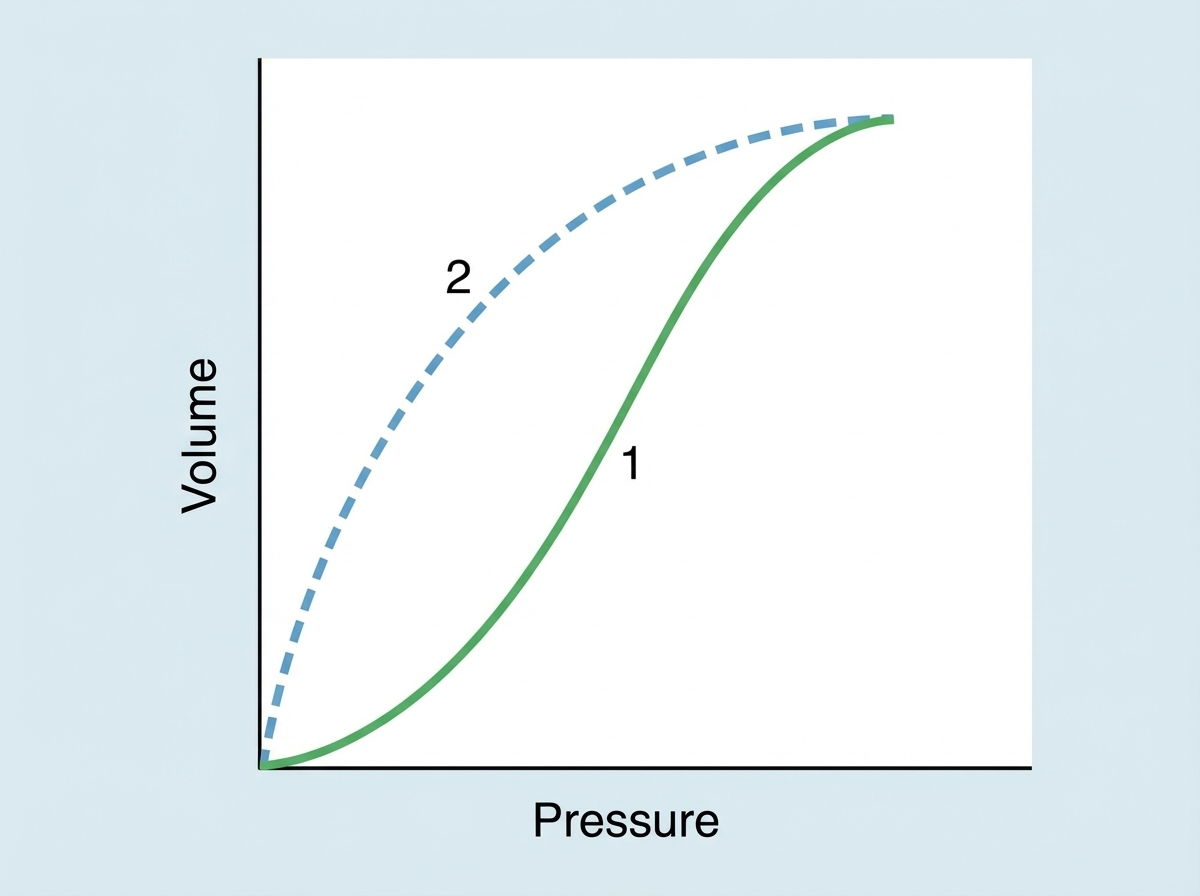
Pulmonary compliance is decreased in all of the following conditions, except?
What percentage of oxygen is transported from the lungs to the tissues?
Which of the following methods best measures residual volume?
A person has normal lung compliance and increased airway resistance. What is the most economical way of breathing for this individual?
The diffusion capacity of lung (DLCO) is decreased in all of the following conditions except?
Which of the following neural centers primarily controls the depth of inspiration?
What is the typical total lung capacity in an adult male?
FEV1/FVC is decreased in which of the following conditions?
Explanation: **Explanation:** The correct answer is **Apnea**. This phenomenon is primarily explained by the **Hering-Breuer Inflation Reflex**. **Why Apnea is the correct answer:** The vagus nerve (Cranial Nerve X) carries sensory (afferent) fibers from stretch receptors located in the smooth muscles of the bronchi and bronchioles. When the **proximal cut end** of the vagus is stimulated, it mimics a state of extreme lung inflation. These afferent signals travel to the solitary tract nucleus (NTS) in the medulla, which then inhibits the dorsal respiratory group (DRG) and the apneustic center. This inhibition abruptly halts inspiration, leading to a cessation of breathing, known as **apnea**. **Analysis of Incorrect Options:** * **B & C (Increased HR and BP):** Vagal stimulation typically has the opposite effect. The vagus is the primary nerve of the parasympathetic nervous system; its stimulation generally leads to bradycardia (decreased heart rate) and a subsequent drop in blood pressure via the sinoatrial (SA) node. * **D (No change):** This is incorrect because the vagus is the major conduit for pulmonary-to-brainstem feedback. Severing and then stimulating it significantly alters the rhythmic control of respiration. **High-Yield Clinical Pearls for NEET-PG:** * **Hering-Breuer Inflation Reflex:** Acts as a protective mechanism to prevent over-inflation of the lungs. In adults, it is typically active only during high tidal volumes (e.g., exercise). * **Vagotomy Effect:** Bilateral vagotomy (cutting both vagi) leads to a **slow and deep** breathing pattern because the "switch-off" signal for inspiration is lost. * **Key Nucleus:** The **Nucleus Tractus Solitarius (NTS)** is the primary sensory relay station for vagal afferents involving respiratory and cardiovascular reflexes.
Explanation: **Explanation:** The central chemoreceptors, located on the ventrolateral surface of the medulla oblongata, are the primary regulators of the drive to breathe. **Why PCO2 is the correct answer:** While central chemoreceptors are technically stimulated by **Hydrogen ions (H+)** within the brain interstitial fluid, H+ ions cannot cross the blood-brain barrier (BBB). However, **CO2 is lipid-soluble** and diffuses readily across the BBB. Once in the cerebrospinal fluid (CSF), CO2 reacts with water (catalyzed by carbonic anhydrase) to form H2CO3, which dissociates into H+ and HCO3-. It is this local rise in H+ that stimulates the receptors. Therefore, a change in **arterial PCO2** is the most potent physiological stimulus that triggers this central mechanism. **Analysis of Incorrect Options:** * **B. PO2:** Central chemoreceptors are **not** sensitive to hypoxia. Low PO2 is sensed exclusively by **peripheral chemoreceptors** (carotid and aortic bodies). * **C. H+:** Although H+ is the direct stimulant at the receptor level, *blood* H+ (pH) does not cross the BBB easily. Thus, central receptors do not respond directly to systemic metabolic acidosis/alkalosis. * **D. CO2:** While technically correct in substance, **PCO2** (Partial Pressure) is the precise physiological parameter measured in clinical medicine and respiratory physiology to describe the gas tension that drives diffusion. **High-Yield NEET-PG Pearls:** * **Main Stimulus:** Central chemoreceptors account for ~70-80% of the ventilatory response to CO2. * **Location:** Specifically the **Retrotrapezoid Nucleus (RTN)** in the medulla. * **CO2 Narcosis:** Extremely high levels of PCO2 (>80-100 mmHg) can actually depress the CNS and inhibit respiration. * **CSF Buffering:** CSF has less protein than blood, making it a poor buffer; therefore, small changes in PCO2 cause significant changes in CSF pH.
Explanation: **Explanation:** **Compliance** is defined as the change in lung volume per unit change in transpulmonary pressure ($C = \Delta V / \Delta P$). It represents the "stretchability" or ease with which the lungs expand. **Why COPD is the correct answer:** In **COPD (specifically Emphysema)**, there is a destruction of the alveolar septa and elastic fibers. This loss of elastic recoil means the lungs offer less resistance to expansion, leading to an **increase in pulmonary compliance**. Because the lungs are "too stretchy" and lose their ability to snap back, air becomes trapped, leading to hyperinflation. **Why the other options are incorrect:** * **Pulmonary Congestion (A):** The presence of excess fluid/blood in the interstitial spaces increases the stiffness of the lung tissue, making it harder to expand, thereby **decreasing** compliance. * **Decreased Surfactant (C):** Surfactant reduces surface tension. A deficiency (as seen in ARDS or NRDS) increases surface tension, causing alveoli to collapse and making the lungs stiff, which **decreases** compliance. * **Pulmonary Fibrosis (D):** This is the classic "Restrictive Lung Disease." The replacement of flexible elastic tissue with scarred, fibrotic tissue significantly increases lung stiffness, leading to a marked **decrease** in compliance. **High-Yield NEET-PG Pearls:** * **Compliance $\propto$ 1 / Elasticity:** High compliance means low elastic recoil (Emphysema); low compliance means high elastic recoil (Fibrosis). * **Surfactant:** Produced by Type II Pneumocytes; its primary role is to increase compliance and prevent alveolar collapse at low lung volumes. * **Specific Compliance:** Compliance divided by Functional Residual Capacity (FRC); used to compare lungs of different sizes.
Explanation: **Explanation:** Oxygen transport in the blood occurs in two distinct forms: **bound to hemoglobin** and **dissolved in plasma**. 1. **The Correct Answer (D - 97%):** Under normal physiological conditions, approximately **97%** of oxygen is transported in chemical combination with hemoglobin inside red blood cells (Oxyhemoglobin). Hemoglobin has a high affinity for oxygen in the high-partial-pressure environment of the lungs, allowing it to carry the bulk of the oxygen required for tissue metabolism. 2. **The Remaining 3%:** The remaining **3%** of oxygen is transported in a **physically dissolved state** in the water of the plasma and cells. Although this percentage is small, it is this dissolved oxygen that exerts partial pressure ($PO_2$) and determines the gradient for oxygen diffusion. **Why other options are incorrect:** * **A (70%):** This value is more characteristic of **Carbon Dioxide ($CO_2$) transport**, specifically the amount of $CO_2$ transported as **bicarbonate ions** ($HCO_3^-$). * **B & C (86% & 91%):** These values do not correspond to standard physiological constants for oxygen or carbon dioxide transport in a healthy individual at sea level. **High-Yield NEET-PG Pearls:** * **Oxygen Carrying Capacity:** 1 gram of Hemoglobin can carry approximately **1.34 ml** of oxygen (Hüfner's constant). * **Dissolved Oxygen:** According to Henry’s Law, the amount of dissolved $O_2$ is $0.003 \, \text{ml/100ml/mmHg}$. * **CO2 Transport Breakdown:** Bicarbonate (70%), Carbaminohemoglobin (23%), and Dissolved in plasma (7%). * **Shift to the Right:** Factors like increased $H^+$ (decreased pH), $CO_2$, Temperature, and 2,3-BPG decrease hemoglobin's affinity for $O_2$, facilitating tissue delivery.
Explanation: **Explanation:** **1. Why Body Plethysmography is the Correct Answer:** Residual Volume (RV) is the volume of air remaining in the lungs after a maximal expiration. It cannot be measured by direct spirometry because it never leaves the lungs. While both Helium Dilution and Body Plethysmography can measure RV, **Body Plethysmography (Option A)** is considered the "Gold Standard" and the **best** method. The underlying principle is **Boyle’s Law** ($P \times V = \text{constant}$). It measures the *total* thoracic gas volume, including air trapped behind closed airways (e.g., in COPD or asthma). Because it accounts for non-communicating gas, it provides a more accurate measurement of the true functional residual capacity (FRC) and RV than gas dilution techniques. **2. Why Other Options are Incorrect:** * **Helium Dilution (Option B):** This is a "wash-in" technique based on the law of conservation of mass. It only measures gas that is in **communication** with the conducting airways. In patients with obstructive lung diseases (like emphysema), it significantly underestimates RV because it cannot measure "trapped air." * **Spirometry (Option C):** Direct spirometry can only measure volumes that can be inhaled or exhaled. Therefore, it **cannot** measure RV, FRC, or Total Lung Capacity (TLC). * **All of the above (Option D):** Incorrect because spirometry is incapable of measuring RV. **3. Clinical Pearls for NEET-PG:** * **The "Cannot" Rule:** Spirometry cannot measure **RV, FRC, or TLC.** * **Calculation:** $FRC = ERV + RV$. Once FRC is determined via plethysmography, RV is calculated by subtracting the Expiratory Reserve Volume (measured via spirometry). * **High-Yield Formula:** Body Plethysmography uses the formula $\Delta V = \Delta P \times (V/P)$. * **Clinical Context:** If a question mentions "trapped air" or "obstructive lung disease," always prioritize **Body Plethysmography** over Helium Dilution.
Explanation: **Explanation:** The "Work of Breathing" (WOB) is the energy expended by respiratory muscles to overcome two main forces: **Elastic Resistance** (compliance of lungs/chest wall) and **Non-elastic Resistance** (airway resistance). **1. Why "Slow and Deep" is correct:** In patients with **increased airway resistance** (e.g., Asthma, COPD), the work required to move air through narrowed tubes increases significantly with the velocity of airflow. By breathing **slowly**, the flow rate decreases, which minimizes turbulence and reduces the pressure needed to overcome resistance. To maintain adequate alveolar ventilation despite a slow rate, the individual must take **deeper breaths**. This pattern minimizes the "frictional" work of breathing. **2. Analysis of Incorrect Options:** * **Rapid and Shallow (B):** This is the most economical pattern for patients with **decreased compliance** (e.g., Pulmonary Fibrosis). Rapid breathing minimizes the work needed to stretch stiff lungs, while shallow breaths avoid the high elastic tension of deep inspiration. In airway obstruction, however, rapid breathing increases turbulence and resistance, making it inefficient. * **Rapid and Deep (A):** This significantly increases both elastic and resistive work, leading to rapid respiratory muscle fatigue. * **Slow and Shallow (D):** While this reduces resistive work, it leads to inadequate alveolar ventilation and hypoxia because a large portion of each shallow breath only fills the anatomical dead space. **Clinical Pearls for NEET-PG:** * **Total Work of Breathing** is minimized at a specific respiratory rate. * **Obstructive Diseases:** Work is dominated by airway resistance $\rightarrow$ Favors **Slow, Deep** breathing. * **Restrictive Diseases:** Work is dominated by elastic recoil $\rightarrow$ Favors **Rapid, Shallow** breathing. * **High-Yield Formula:** $Work = Pressure \times Volume$. In obstructive disease, the pressure component (to overcome resistance) is the primary target for reduction.
Explanation: **Explanation:** The **Diffusion Capacity of the Lung for Carbon Monoxide (DLCO)** measures the ability of the lungs to transfer gas from inhaled air to the red blood cells in pulmonary capillaries. It depends on the surface area of the alveolar-capillary membrane, its thickness, and the volume of hemoglobin available to bind CO. **Why Goodpasture’s Syndrome is the Correct Answer:** In **Goodpasture’s syndrome**, there is acute **alveolar hemorrhage**. The presence of free hemoglobin within the alveoli binds to the inhaled carbon monoxide during the test. This results in an **increased DLCO** (or a falsely elevated reading) because more CO is "soaked up" by the extravasated blood, rather than a decrease. **Analysis of Incorrect Options:** * **Interstitial Lung Disease (ILD):** DLCO is **decreased** due to the thickening and scarring of the alveolar-capillary membrane (increased diffusion distance). * **Emphysema:** DLCO is **decreased** because the destruction of alveolar walls reduces the total surface area available for gas exchange. * **Primary Pulmonary Hypertension:** DLCO is **decreased** because of reduced pulmonary capillary blood volume and structural changes in the pulmonary vasculature. **High-Yield Clinical Pearls for NEET-PG:** * **Increased DLCO is seen in:** Alveolar hemorrhage (Goodpasture’s, Wegener’s), Polycythemia (more Hb), Left-to-right shunts, and Exercise. * **Decreased DLCO is seen in:** Anemia (less Hb), Emphysema, ILD, Pulmonary embolism, and Sarcoidosis. * **Note:** DLCO is the most sensitive test to differentiate between Chronic Bronchitis (Normal DLCO) and Emphysema (Decreased DLCO).
Explanation: The **Pneumotaxic center**, located in the upper pons (nucleus parabrachialis), acts as the "off-switch" for inspiration. Its primary function is to limit the duration of inspiration by inhibiting the dorsal respiratory group (DRG). By shortening the inspiratory phase, it effectively controls the **depth of inspiration** (tidal volume) and secondarily increases the respiratory rate. A strong signal from this center leads to shallow, rapid breathing, while a weak signal results in deep, slow breathing. **Explanation of Incorrect Options:** * **Posterior Medulla:** This area contains the **Dorsal Respiratory Group (DRG)**, which is primarily responsible for the basic rhythm of respiration and generating the inspiratory "ramp" signal, rather than limiting its depth. * **Apneustic Center:** Located in the lower pons, this center promotes inhalation by exciting the DRG. It increases the depth of inspiration by delaying the "off-switch" signal. However, in physiological conditions, it is subordinated to the pneumotaxic center. * **Pons:** While both the pneumotaxic and apneustic centers are in the pons, "Pons" is too general. The question asks for the specific neural center; the pneumotaxic center is the precise regulatory site for inspiratory depth. **High-Yield Clinical Pearls for NEET-PG:** * **Hering-Breuer Reflex:** A protective mechanism where stretch receptors in the lungs prevent over-inflation, similar to the pneumotaxic center’s "off-switch" function. * **Apneusis:** Damage to the upper pons (removing pneumotaxic control) results in prolonged inspiratory gasps, a pattern known as apneustic breathing. * **Vagus Nerve:** If both the pneumotaxic center and the vagus nerves are inhibited/severed, the animal will breathe with extremely deep, prolonged inspirations (maximal apneusis).
Explanation: **Explanation:** **Total Lung Capacity (TLC)** is the maximum volume of air the lungs can hold after a maximal inspiratory effort. It is the sum of all lung volumes: **TLC = Vital Capacity (VC) + Residual Volume (RV)**. In a healthy adult male of average height and weight, the standard value for TLC is approximately **6,000 mL (6 Liters)**. **Analysis of Options:** * **A (2.4 L):** This value is closer to the **Functional Residual Capacity (FRC)**, which is the volume of air remaining in the lungs after a normal tidal expiration (ERV + RV). * **B (3.6 L):** This represents the average **Inspiratory Capacity (IC)**, which is the total amount of air that can be inhaled starting from the resting expiratory level (TV + IRV). * **D (10 L):** This is physiologically impossible for a human; such high volumes are not seen even in elite athletes or tall individuals. **High-Yield NEET-PG Pearls:** 1. **Gender Differences:** TLC is typically 20-25% lower in females (approx. 4.2–4.7 L) due to smaller thoracic dimensions. 2. **Measurement:** Unlike other volumes, TLC cannot be measured by simple spirometry because it includes **Residual Volume (RV)**. It must be measured using **Helium Dilution, Nitrogen Washout, or Body Plethysmography**. 3. **Clinical Correlation:** TLC is **decreased in Restrictive Lung Diseases** (e.g., Pulmonary Fibrosis, Kyphoscoliosis) and **increased in Obstructive Lung Diseases** (e.g., Emphysema) due to hyperinflation and air trapping.
Explanation: **Explanation:** The **FEV1/FVC ratio** (Tiffeneau-Pinelli index) is the primary tool used to differentiate between obstructive and restrictive lung diseases. **1. Why Asthma is Correct:** Asthma is an **obstructive lung disease** characterized by increased airway resistance. In obstructive conditions, patients have difficulty exhaling air rapidly. While both FEV1 (Forced Expiratory Volume in 1 second) and FVC (Forced Vital Capacity) may decrease, the **FEV1 decreases disproportionately more** than the FVC. This results in a **decreased FEV1/FVC ratio (typically <70%)**. **2. Why the other options are incorrect:** * **Fibrosis (Option D):** This is a **restrictive lung disease** (intrinsic). In restriction, the lungs are "stiff," reducing total lung volume (FVC). However, because airway patency is maintained (and sometimes increased due to radial traction), the FEV1 decreases in proportion to the FVC. Therefore, the **FEV1/FVC ratio remains normal or is even increased**. * **Kyphosis and Scoliosis (Options B & C):** These are **extrapulmonary restrictive conditions**. They limit chest wall expansion, leading to reduced lung volumes (low FVC). Similar to fibrosis, the FEV1/FVC ratio remains **normal or high** because there is no airway obstruction. **High-Yield NEET-PG Pearls:** * **Obstructive Pattern:** ↓FEV1, ↓FVC, **↓↓FEV1/FVC ratio**, ↑TLC (due to air trapping). *Examples: Asthma, COPD, Bronchiectasis, Emphysema.* * **Restrictive Pattern:** ↓FEV1, ↓FVC, **Normal/↑FEV1/FVC ratio**, ↓TLC. *Examples: Interstitial Lung Disease (Fibrosis), Chest wall deformities (Scoliosis), Obesity, Neuromuscular weakness.* * **Flow-Volume Loop:** Obstructive disease shows a "scooped-out" appearance; Restrictive disease shows a "tall, narrow" (witch’s hat) appearance.
Mechanics of Breathing
Practice Questions
Pulmonary Ventilation
Practice Questions
Pulmonary Circulation
Practice Questions
Gas Exchange in the Lungs
Practice Questions
Oxygen and Carbon Dioxide Transport
Practice Questions
Control of Breathing
Practice Questions
Respiratory Adjustments in Health and Disease
Practice Questions
High Altitude Physiology
Practice Questions
Diving Physiology
Practice Questions
Respiratory Function Tests
Practice Questions
Get full access to all questions, explanations, and performance tracking.
Start For Free