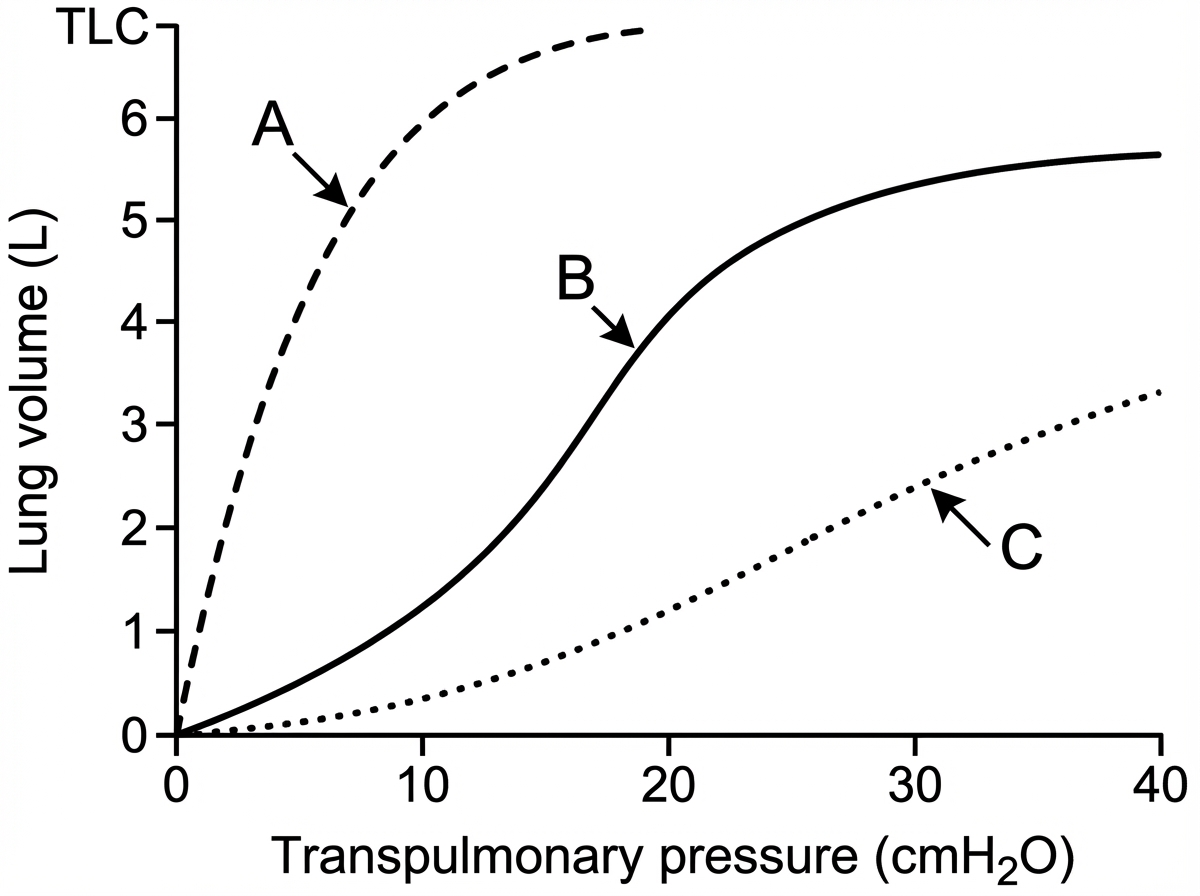
CO2 is primarily transported in the arterial blood as:
What is true regarding the respiratory center?
Partial pressure of carbon dioxide (CO2) is lowest in which of the following?
Alveolar hypoventilation is observed in which of the following conditions?
Carbon monoxide poisoning causes which of the following?
Stagnant hypoxia is seen in which of the following conditions?
Which medullary respiratory center is primarily responsible for setting the pace of respiration?
Which of the following is responsible for the movement of O2 from the alveoli into the blood in the pulmonary capillaries?
The volume in question is after:

What is the stimulus for the Hering-Breuer reflex of respiration?
Explanation: **Explanation:** Carbon dioxide (CO₂) is transported in the blood in three primary forms. The correct answer is **Bicarbonate (D)** because it accounts for approximately **70%** of the total CO₂ transport in arterial blood. **Mechanism:** When CO₂ enters the Red Blood Cells (RBCs), it reacts with water to form carbonic acid ($H_2CO_3$), a reaction catalyzed by the enzyme **Carbonic Anhydrase**. This acid quickly dissociates into hydrogen ions ($H^+$) and bicarbonate ions ($HCO_3^-$). The bicarbonate then exits the RBC into the plasma in exchange for chloride ions (the **Chloride Shift** or Hamburger phenomenon), serving as the major transport vehicle for CO₂. **Why other options are incorrect:** * **A. Dissolved CO₂:** Only about **7%** of CO₂ is transported physically dissolved in the plasma. While small, this portion is crucial as it determines the partial pressure of CO₂ ($PaCO_2$). * **B. Carbonic Acid:** This is a transient intermediate state. It is highly unstable and rapidly dissociates; therefore, it is never a primary transport form. * **C. Carbamino-hemoglobin:** About **23%** of CO₂ binds to the amino groups of hemoglobin (not the heme iron). While significant, it is secondary to bicarbonate. **High-Yield Pearls for NEET-PG:** 1. **Haldane Effect:** Deoxygenation of blood increases its ability to carry CO₂. This occurs in systemic tissues. 2. **Chloride Shift (Hamburger Phenomenon):** In systemic capillaries, $HCO_3^-$ leaves the RBC and $Cl^-$ enters. In pulmonary capillaries, this process reverses. 3. **Carbonic Anhydrase:** It is one of the fastest enzymes known; it is absent in plasma but highly concentrated in RBCs. 4. **CO₂ vs. O₂:** CO₂ is roughly 20-25 times more soluble in plasma than Oxygen.
Explanation: **Explanation:** The respiratory center, located in the brainstem, is responsible for the rhythmic generation of breathing. **Why Option B is Correct:** The respiratory center is **inhibited during swallowing** (deglutition). This is a protective reflex known as **"Deglutition Apnea."** When the bolus of food passes through the pharynx, the respiratory center in the medulla is inhibited to prevent the aspiration of food into the trachea. This ensures that the airway is protected while the upper esophageal sphincter opens. **Why Other Options are Incorrect:** * **Option A:** The central chemoreceptors in the medulla are primarily sensitive to changes in **H+ concentration and PaCO2**, not PaO2. A fall in PaO2 (hypoxia) is sensed by **peripheral chemoreceptors** (carotid and aortic bodies), which then send signals to the respiratory center. * **Option C:** While the respiratory and cardiac centers are anatomically close in the medulla and show functional coordination (e.g., Sinus Arrhythmia), they are distinct functional units. The question asks for a fundamental physiological property; inhibition during swallowing is a more definitive functional characteristic. * **Option D:** The respiratory centers are situated in the **Medulla** (Dorsal and Ventral Respiratory Groups) and the **Pons** (Pneumotaxic and Apneustic centers), not the midbrain. **High-Yield Pearls for NEET-PG:** * **Pneumotaxic Center:** Located in the upper pons; acts as a "switch-off" point for inspiration, thereby increasing respiratory rate. * **Apneustic Center:** Located in the lower pons; prolongs inspiration (apneusis). * **Hering-Breuer Reflex:** A protective reflex that prevents over-inflation of the lungs via stretch receptors and the Vagus nerve. * **Central Chemoreceptors:** Located on the ventral surface of the medulla; they do **not** respond to hypoxia.
Explanation: ### Explanation The partial pressure of carbon dioxide ($PCO_2$) in the respiratory system is determined by the mixing of atmospheric air with alveolar air. **1. Why Expired Air is Correct:** Expired air (mixed expired air) is a combination of **Alveolar air** (where $PCO_2$ is ~40 mmHg) and **Anatomic Dead Space air** (where $PCO_2$ is ~0 mmHg). Because the dead space air dilutes the CO2 coming from the alveoli, the total $PCO_2$ in expired air drops to approximately **27–32 mmHg**. This makes it the lowest among the given options. **2. Analysis of Incorrect Options:** * **Venous Blood:** Contains the highest $PCO_2$ (~46 mmHg) as it carries CO2 produced by tissue metabolism back to the lungs. * **Arterial Blood:** After gas exchange in the lungs, arterial $PCO_2$ equilibrates with alveolar air, resulting in a value of approximately **40 mmHg**. * **End-Tidal Air:** This represents the very last portion of air expired, which comes entirely from the alveoli. Therefore, End-tidal $PCO_2$ ($EtCO_2$) is roughly **40 mmHg**, reflecting arterial $PCO_2$. **3. High-Yield NEET-PG Pearls:** * **Hierarchy of $PCO_2$:** Venous blood (46) > Arterial blood (40) = Alveolar air (40) = End-tidal air (40) > Expired air (27-32) > Atmospheric air (0.3). * **Dead Space Calculation:** The difference between arterial $PCO_2$ ($PaCO_2$) and expired $PCO_2$ ($PeCO_2$) is used in the **Bohr Equation** to calculate physiological dead space. * **Clinical Correlation:** In a healthy individual, $EtCO_2$ is a reliable non-invasive surrogate for $PaCO_2$. However, in lung diseases (increased V/Q mismatch), the gradient between $PaCO_2$ and $EtCO_2$ increases.
Explanation: **Explanation:** **Alveolar hypoventilation** occurs when the volume of fresh air reaching the alveoli is insufficient to maintain normal gas exchange, leading to hypercapnia (increased $PaCO_2$) and hypoxemia. **1. Why Guillain-Barré Syndrome (GBS) is correct:** GBS is an acute inflammatory demyelinating polyneuropathy. The underlying mechanism for hypoventilation is **neuromuscular weakness**. As the ascending paralysis progresses, it involves the **diaphragm and intercostal muscles**. When these primary muscles of respiration fail, the "pump" mechanism of the lungs is compromised, leading to a decrease in tidal volume and subsequent alveolar hypoventilation. **2. Why the other options are incorrect:** * **Acute Asthma:** This is an obstructive airway disease. While it causes ventilation-perfusion (V/Q) mismatch, patients typically present with **hyperventilation** (tachypnea) and hypocapnia in early stages. Hypoventilation only occurs in "near-fatal" asthma due to muscle fatigue. * **Bronchiectasis:** This is a chronic obstructive condition characterized by permanent dilation of bronchi. It primarily causes V/Q mismatch and impaired mucus clearance rather than primary alveolar hypoventilation. * **CREST Syndrome:** A form of systemic sclerosis that can lead to **Interstitial Lung Disease (ILD)** or Pulmonary Arterial Hypertension. ILD is a restrictive lung disease that typically presents with tachypnea and increased minute ventilation, not primary hypoventilation. **High-Yield Clinical Pearls for NEET-PG:** * **The Hallmark of Alveolar Hypoventilation:** An elevated $PaCO_2$ (Hypercapnia). * **Other causes of Hypoventilation:** Opioid overdose (depressed respiratory center), Myasthenia Gravis, Obesity Hypoventilation Syndrome (Pickwickian syndrome), and Flail chest. * **GBS Monitoring:** In GBS, the **Forced Vital Capacity (FVC)** and **Maximal Inspiratory Pressure (MIP)** are monitored closely; an FVC <15-20 mL/kg is a classic indication for elective intubation.
Explanation: **Explanation:** **Why Option B is Correct:** Carbon Monoxide (CO) has an affinity for hemoglobin approximately **210–240 times greater** than that of oxygen. When CO binds to one of the four heme sites (forming carboxyhemoglobin), it induces a conformational change in the hemoglobin molecule. This change increases the affinity of the remaining heme sites for oxygen. Consequently, oxygen binds more tightly and is not easily released to the tissues. This **decreased P50** and increased affinity manifest as a **Leftward Shift** of the Oxygen Dissociation Curve (ODC). **Why Other Options are Incorrect:** * **A. Hypoxic Hypoxia:** CO poisoning causes **Anemic Hypoxia**. The arterial partial pressure of oxygen ($PaO_2$) remains normal, but the total oxygen-carrying capacity of the blood is reduced because CO occupies hemoglobin binding sites. * **C. Cyanosis:** Cyanosis requires a high concentration of deoxygenated hemoglobin (>5g/dL). In CO poisoning, carboxyhemoglobin is **cherry-red** in color. Therefore, patients typically present with a "cherry-red" appearance rather than the bluish tint of cyanosis. * **D. Diffusion Capacity ($DL_{CO}$):** While CO is used to *measure* diffusion capacity, the poisoning itself does not decrease the lung's intrinsic ability to transfer gases across the alveolar-capillary membrane. **High-Yield Clinical Pearls for NEET-PG:** * **The Double Whammy:** CO poisoning is lethal because it simultaneously reduces oxygen loading (anemic hypoxia) and impairs oxygen unloading (left shift). * **Pulse Oximetry ($SpO_2$):** Standard pulse oximeters cannot distinguish between oxyhemoglobin and carboxyhemoglobin, often giving **falsely normal** readings. * **Treatment:** 100% Hyperbaric Oxygen (HBO) is the treatment of choice to reduce the half-life of carboxyhemoglobin.
Explanation: **Explanation:** **Stagnant Hypoxia** (also known as hypokinetic hypoxia) occurs when there is a **decrease in the velocity of blood flow**, leading to inadequate delivery of oxygen to the tissues despite normal arterial $PO_2$ and oxygen content. **Why Shock is Correct:** In **Shock** (and Congestive Heart Failure), the cardiac output falls significantly. This results in a slow, sluggish circulation. Because the blood stays in the capillaries longer, tissues extract more oxygen than usual, leading to a high arteriovenous oxygen difference. However, the overall delivery rate is insufficient to meet metabolic demands, resulting in stagnant hypoxia. **Analysis of Incorrect Options:** * **COPD (Chronic Obstructive Pulmonary Disease):** This causes **Hypoxic Hypoxia**. The primary defect is inadequate oxygenation of blood in the lungs due to ventilation-perfusion mismatch or alveolar hypoventilation, leading to low arterial $PO_2$. * **Anemia:** This causes **Anemic Hypoxia**. The arterial $PO_2$ is normal, but the total oxygen-carrying capacity of the blood is reduced due to low hemoglobin levels. * **CO (Carbon Monoxide) Poisoning:** This is also a form of **Anemic Hypoxia**. CO binds to hemoglobin with high affinity, preventing oxygen binding and shifting the oxygen-dissociation curve to the left, hindering oxygen release to tissues. **High-Yield NEET-PG Pearls:** 1. **Arterial $PO_2$** is **Normal** in Anemic, Stagnant, and Histotoxic hypoxia; it is **Low** only in Hypoxic hypoxia. 2. **Cyanosis** is most prominent in Stagnant hypoxia due to the excessive buildup of reduced hemoglobin in the stagnant capillary beds. 3. **Histotoxic Hypoxia** (e.g., Cyanide poisoning) occurs when tissues cannot utilize oxygen despite normal delivery (due to inhibition of Cytochrome Oxidase).
Explanation: **Explanation:** The **Pre-Bötzinger complex (pre-BötC)** is a cluster of interneurons located in the ventrolateral medulla. It is widely recognized as the **pacemaker of respiration**, responsible for generating the basic rhythmic pattern of breathing. These neurons possess intrinsic rhythmic activity (similar to the SA node in the heart) that initiates the respiratory cycle. **Analysis of Options:** * **Dorsal Respiratory Group (DRG):** Located in the nucleus tractus solitarius, the DRG is primarily responsible for **inspiration**. While it sends the primary rhythmic drive to the diaphragm via the phrenic nerve, it does not generate the rhythm itself; it receives the pace from the pre-BötC. * **Pneumotaxic Center:** Located in the upper pons (nucleus parabrachialis), its primary role is to act as an **"off-switch"** for inspiration. It limits the duration of inspiration, thereby increasing the respiratory rate. * **Apneustic Center:** Located in the lower pons, it promotes inhalation by exciting the DRG. If the pneumotaxic center is damaged, the apneustic center causes prolonged, gasping inspirations (apneustic breathing). **High-Yield Clinical Pearls for NEET-PG:** * **Location:** The Pre-Bötzinger complex is part of the **Ventral Respiratory Group (VRG)**. * **Opioid Sensitivity:** Opioid receptors are highly expressed in the pre-BötC. This is why opioid overdose leads to fatal respiratory depression—it shuts down the pacemaker itself. * **Hering-Breuer Reflex:** This is a protective mechanism where stretch receptors in the lungs prevent over-inflation by inhibiting the DRG, mediated via the Vagus nerve.
Explanation: ### Explanation **Correct Answer: D. Passive diffusion** The exchange of gases (O2 and CO2) across the alveolar-capillary membrane occurs exclusively via **passive diffusion**. This process is governed by **Fick’s Law**, which states that the rate of gas transfer is proportional to the surface area and the partial pressure gradient, and inversely proportional to the thickness of the membrane. Oxygen moves from the alveoli (where $P_{A}O_2$ is ~104 mmHg) into the pulmonary capillary blood (where $P_{v}O_2$ is ~40 mmHg) simply because it moves down its **concentration/partial pressure gradient**. No cellular energy (ATP) or carrier proteins are required for this movement. **Why other options are incorrect:** * **A. Active transport:** This requires ATP to move substances against a gradient. Gas exchange does not consume energy and follows a downward pressure gradient. * **B. Filtration:** This is the movement of water and solutes across a membrane due to hydrostatic or osmotic pressure (common in the Glomerulus), not applicable to gas exchange. * **C. Facilitated diffusion:** This requires specific carrier proteins (e.g., GLUT transporters for glucose). Oxygen molecules are small and lipid-soluble, allowing them to pass directly through the phospholipid bilayer of the respiratory membrane without carriers. **High-Yield Clinical Pearls for NEET-PG:** * **Diffusion Limitation vs. Perfusion Limitation:** Under normal resting conditions, O2 transfer is **perfusion-limited** (equilibrium is reached 1/3rd of the way along the capillary). In states of fibrosis or intense exercise, it can become **diffusion-limited**. * **Diffusion Capacity ($D_L$):** Carbon Monoxide (CO) is used to measure the diffusing capacity of the lung ($D_LCO$) because it is strictly diffusion-limited. * **Solubility:** CO2 is **20 times more soluble** than O2; therefore, it diffuses much faster despite a smaller pressure gradient.
Explanation: ***Maximum expiration*** - **Residual Volume (RV)** remains in the lungs after maximum expiration, approximately **1200 mL**, which cannot be expelled voluntarily. - This volume prevents **alveolar collapse** and maintains gas exchange even after forced expiration. *Maximum inspiration* - After maximum inspiration, the lungs contain **Total Lung Capacity (TLC)** of approximately **6000 mL**. - This includes all lung volumes: **TV + IRV + ERV + RV**, representing the maximum air the lungs can hold. *Normal inspiration* - After normal inspiration, lungs contain **Functional Residual Capacity (FRC)** plus **Tidal Volume (TV)**. - This equals approximately **2800 mL** (**FRC 2300 mL + TV 500 mL**), much more than residual volume alone. *Normal expiration* - After normal expiration, **Functional Residual Capacity (FRC)** remains, approximately **2300 mL**. - FRC includes both **Expiratory Reserve Volume (ERV)** and **Residual Volume (RV)**, maintaining lung stability.
Explanation: ### Explanation The **Hering-Breuer Inflation Reflex** is a protective mechanism designed to prevent the over-inflation of the lungs. **1. Why Option A is Correct:** In healthy adults, the Hering-Breuer reflex is **not active during normal quiet breathing**. It is triggered only when the lungs are significantly stretched. The threshold for activating the pulmonary stretch receptors (located in the smooth muscle of the bronchi and bronchioles) is a **Tidal Volume (TV) exceeding 1.5 liters (or >1000 ml)**. When triggered, impulses travel via the **Vagus nerve (CN X)** to the Dorsal Respiratory Group (DRG) and the apneustic center in the medulla, inhibiting inspiration and initiating expiration. **2. Why the Other Options are Incorrect:** * **Options B & C:** A Tidal Volume of 500 ml represents normal resting breathing. At this volume, the stretch receptors are not sufficiently stimulated to override the rhythmic discharge of the respiratory centers. * **Option D:** Volumes below 1000 ml are insufficient to reach the threshold required for this reflex in adults. **3. High-Yield Clinical Pearls for NEET-PG:** * **Afferent Pathway:** Vagus Nerve (CN X). * **Efferent Pathway:** Phrenic nerve (inhibition leads to diaphragm relaxation). * **Physiological Role:** It serves as a "switch-off" signal for inspiration, increasing the respiratory rate by shortening the inspiratory phase. * **Newborns:** Unlike adults, this reflex is active in neonates during normal breathing to help regulate their respiratory cycle. * **Hering-Breuer Deflation Reflex:** A separate reflex where extreme lung deflation triggers an increase in respiratory rate (hyperpnea) to prevent lung collapse.
Mechanics of Breathing
Practice Questions
Pulmonary Ventilation
Practice Questions
Pulmonary Circulation
Practice Questions
Gas Exchange in the Lungs
Practice Questions
Oxygen and Carbon Dioxide Transport
Practice Questions
Control of Breathing
Practice Questions
Respiratory Adjustments in Health and Disease
Practice Questions
High Altitude Physiology
Practice Questions
Diving Physiology
Practice Questions
Respiratory Function Tests
Practice Questions
Get full access to all questions, explanations, and performance tracking.
Start For Free