Surfactant is secreted by which of the following cells?
A PO2 of over 8 kPa corresponds to what hemoglobin saturation?
Which of the following is NOT caused by oxygen toxicity?
Negative intrapleural pressure is due to which of the following?
Surfactant is secreted by:
All of the following factors influence the oxygen-hemoglobin dissociation curve, except?
In cases of hypercapnia, what happens to the pH of the blood?
Chloride shift is due to which of the following?
Which of the following is the best-known metabolic function of the lung?
Which of the following represents a change in pulmonary function seen in Emphysema?
Explanation: **Explanation:** **1. Why Type 2 Pneumocytes are correct:** Pulmonary surfactant is a surface-active lipoprotein complex (primarily Dipalmitoylphosphatidylcholine - DPPC) synthesized and secreted by **Type 2 pneumocytes** (granular pneumocytes). These cells are cuboidal in shape and contain characteristic secretory organelles called **Lamellar bodies**, which store surfactant. Surfactant reduces surface tension at the air-liquid interface of the alveoli, preventing alveolar collapse (atelectasis) during expiration and increasing lung compliance. **2. Why other options are incorrect:** * **Type 1 pneumocytes:** These are thin, squamous cells covering ~95% of the alveolar surface area. Their primary function is to facilitate **gas exchange**, not secretion. * **Epithelial cells:** While pneumocytes are specialized epithelial cells, "epithelial cells" is too broad a term. In the respiratory tract, other epithelial cells (like Clara/Club cells) secrete different substances (e.g., CC16), but not surfactant. * **Macrophages:** Alveolar macrophages (Dust cells) are part of the immune system. Their role is to **phagocytose** debris, pathogens, and exhausted surfactant; they do not produce it. **3. High-Yield Clinical Pearls for NEET-PG:** * **Composition:** Surfactant is 90% lipids and 10% proteins. The most important phospholipid is **DPPC (Lecithin)**. * **Development:** Surfactant production begins around **24–28 weeks** of gestation, but adequate levels are usually reached only after **35 weeks**. * **Clinical Correlation:** Deficiency of surfactant in premature neonates leads to **Infant Respiratory Distress Syndrome (IRDS)** or Hyaline Membrane Disease. * **L/S Ratio:** An Amniotic fluid Lecithin/Sphingomyelin ratio **> 2** indicates fetal lung maturity. * **Glucocorticoids:** These are administered to mothers in preterm labor to accelerate surfactant synthesis by stimulating Type 2 pneumocytes.
Explanation: This question tests your understanding of the **Oxygen-Hemoglobin Dissociation Curve (OHDC)**, which describes the relationship between the partial pressure of oxygen ($PO_2$) and the percentage saturation of hemoglobin ($SaO_2$). ### **Explanation of the Correct Answer** The OHDC is sigmoid (S-shaped) due to the cooperative binding of hemoglobin. To solve this, you must convert the units: **1 kPa is approximately 7.5 mmHg.** * $8 \text{ kPa} \times 7.5 \approx \mathbf{60 \text{ mmHg}}$. * On the standard OHDC, a $PO_2$ of **60 mmHg** corresponds to an arterial oxygen saturation ($SaO_2$) of approximately **90%**. * This is a critical physiological "shoulder" point: above 60 mmHg, the curve is relatively flat (ensuring high saturation despite minor drops in $PO_2$), but below 60 mmHg, the curve becomes very steep, leading to rapid desaturation. ### **Analysis of Incorrect Options** * **A (60%):** This corresponds to a $PO_2$ of approximately **30 mmHg**. * **B (70%):** This corresponds to a $PO_2$ of approximately **37-40 mmHg**. * **C (80%):** This corresponds to a $PO_2$ of approximately **45-50 mmHg**. ### **High-Yield NEET-PG Clinical Pearls** 1. **The 40-50-60 Rule:** A quick mnemonic for the OHDC: * $PO_2$ 27 mmHg $\approx$ 50% Saturation ($P_{50}$) * $PO_2$ 40 mmHg $\approx$ 70-75% Saturation (Mixed venous blood) * $PO_2$ 60 mmHg $\approx$ 90% Saturation (Threshold for respiratory failure) 2. **$P_{50}$:** The $PO_2$ at which hemoglobin is 50% saturated. Normal value is **26.7 mmHg**. 3. **Right Shift (Decreased Affinity):** Caused by ↑ $CO_2$, ↑ H+ (Acidosis/Bohr effect), ↑ 2,3-BPG, and ↑ Temperature. 4. **Left Shift (Increased Affinity):** Caused by ↓ $CO_2$, ↓ H+ (Alkalosis), ↓ 2,3-BPG, ↓ Temperature, and **Carbon Monoxide (CO) poisoning**.
Explanation: **Explanation:** Oxygen toxicity occurs due to the overproduction of **Reactive Oxygen Species (ROS)** like superoxide and hydroxyl radicals when breathing high partial pressures of oxygen ($FiO_2 > 0.5$) for prolonged periods. **Why "Rupture of Alveoli" is the correct answer:** Oxygen toxicity causes chemical and structural damage to the alveolar-capillary membrane, but it does **not** cause mechanical rupture of the alveoli. Alveolar rupture is typically a result of **barotrauma** (excessive pressure), such as during mechanical ventilation with high tidal volumes or high PEEP, rather than the oxidative stress associated with oxygen toxicity. **Analysis of Incorrect Options:** * **Atelectasis (Absorption Atelectasis):** High concentrations of $O_2$ wash out nitrogen (the "stenting" gas) from the alveoli. When $O_2$ is rapidly absorbed into the blood, the alveoli lose their volume and collapse. * **Pulmonary Edema:** ROS damage the pulmonary capillary endothelium and Type I alveolar cells, increasing permeability. This leads to the leakage of fluid into the interstitial and alveolar spaces (similar to ARDS). * **Convulsions:** This is a manifestation of **Central Nervous System toxicity (Paul Bert Effect)**. High arterial $PO_2$ causes cerebral vasoconstriction and direct neuronal damage, leading to seizures. **High-Yield Facts for NEET-PG:** 1. **Lorrain Smith Effect:** Refers to Pulmonary Oxygen Toxicity (presents as tracheobronchitis and pulmonary edema). 2. **Paul Bert Effect:** Refers to CNS Oxygen Toxicity (presents as convulsions/seizures). 3. **Retrolental Fibroplasia:** Now known as Retinopathy of Prematurity (ROP), it is a form of oxygen toxicity seen in neonates. 4. **Safe Limit:** To prevent toxicity, it is generally advised to keep $FiO_2$ below 50-60% for long-term therapy.
Explanation: ### Explanation The **intrapleural pressure** is the pressure within the pleural cavity (the space between the visceral and parietal pleura). Under normal physiological conditions, this pressure is **sub-atmospheric (negative)**, typically around -5 cmH₂O at rest. **Why "Absorption by lymphatics" is correct:** The primary mechanism maintaining this negative pressure is the constant pumping of fluid from the pleural space into the **lymphatic vessels**. The pleural space is a "potential space" that contains a thin layer of serous fluid. The lymphatic system continuously drains this fluid and any excess proteins. This drainage creates a partial vacuum, effectively "sucking" the visceral pleura toward the parietal pleura. This suction force counteracts the natural elastic recoil of the lungs (which want to collapse) and the chest wall (which wants to expand), maintaining the negative pressure. **Analysis of Incorrect Options:** * **A. Uniform distribution of surfactant:** Surfactant reduces surface tension within the *alveoli* to prevent collapse; it does not directly generate intrapleural pressure. * **B. Negative intraalveolar pressure:** Intraalveolar pressure fluctuates during breathing (negative during inspiration, positive during expiration), but intrapleural pressure remains negative throughout the normal respiratory cycle. * **D. Presence of cartilage:** Cartilage provides structural support to the trachea and bronchi to prevent airway collapse but has no role in pleural pressure dynamics. **High-Yield Clinical Pearls for NEET-PG:** * **Pneumothorax:** If the pleural cavity is breached (e.g., trauma), air enters the space, intrapleural pressure becomes equal to atmospheric pressure (0 cmH₂O), and the lung collapses due to its inherent elastic recoil. * **Most negative point:** Intrapleural pressure is most negative at the **end of inspiration** (approx. -7.5 to -8 cmH₂O). * **Gravity effect:** In a standing position, intrapleural pressure is **more negative at the apex** of the lung than at the base.
Explanation: **Explanation:** **Correct Answer: B. Pneumocyte II** Pulmonary surfactant is a surface-active lipoprotein complex (primarily composed of **Dipalmitoylphosphatidylcholine - DPPC**) secreted by **Type II Pneumocytes** (granular pneumocytes). These cells are cuboidal in shape and contain characteristic secretory organelles called **lamellar bodies**. Surfactant reduces alveolar surface tension, preventing the collapse of small alveoli during expiration (atelectasis) and increasing lung compliance. **Analysis of Incorrect Options:** * **A. Pneumocyte I:** These are thin, squamous cells covering approximately 95% of the alveolar surface area. Their primary function is to form the blood-gas barrier for efficient **gas exchange**, not secretion. * **C. Goblet cells:** These are specialized epithelial cells found in the conducting airways (trachea and bronchi). Their function is to secrete **mucus** to trap inhaled particles; they are absent in the actual alveoli. * **D. Pulmonary vessels:** These are responsible for the transport of deoxygenated blood to the lungs and oxygenated blood to the heart; they have no secretory role in surfactant production. **High-Yield Clinical Pearls for NEET-PG:** * **Development:** Surfactant production begins around **24–28 weeks** of gestation, but adequate levels are often not reached until **35 weeks**. * **L/S Ratio:** A Lecithin/Sphingomyelin ratio of **>2:1** in amniotic fluid indicates fetal lung maturity. * **Clinical Correlation:** Deficiency of surfactant in premature infants leads to **Infant Respiratory Distress Syndrome (IRDS)** or Hyaline Membrane Disease. * **Glucocorticoids:** These are administered to mothers in preterm labor to accelerate surfactant synthesis by stimulating Type II pneumocytes.
Explanation: The oxygen-hemoglobin (O2-Hb) dissociation curve represents the relationship between the partial pressure of oxygen ($PO_2$) and the percentage saturation of hemoglobin. Factors that shift this curve influence the affinity of hemoglobin for oxygen. **Why Chloride ion concentration is the correct answer:** While chloride ions are crucial for the **"Chloride Shift" (Hamburger Phenomenon)**—which maintains electrical neutrality during $CO_2$ transport in RBCs—they do not directly influence the O2-Hb dissociation curve. The curve is primarily affected by factors that stabilize either the Tense (T) state or Relaxed (R) state of hemoglobin; chloride concentration is not a primary physiological regulator of this affinity. **Explanation of Incorrect Options:** * **$CO_2$ Tension & pH (Bohr Effect):** Increased $PCO_2$ and decreased pH (increased $H^+$) shift the curve to the **right**, facilitating oxygen unloading in tissues. * **Temperature:** Increased body temperature (e.g., during exercise or fever) shifts the curve to the **right**, decreasing Hb affinity for $O_2$ to meet metabolic demands. * **2,3-DPG (2,3-Bisphosphoglycerate):** This byproduct of glycolysis binds to the beta chains of deoxyhemoglobin, stabilizing the T-state and shifting the curve to the **right**. **High-Yield Clinical Pearls for NEET-PG:** * **Right Shift (CADET, face Right!):** **C**O2, **A**cidosis, **D**PG, **E**xercise, **T**emperature. A right shift means **decreased affinity**, making it easier to unload $O_2$ to tissues. * **Left Shift:** Fetal Hb (HbF), Carbon Monoxide (CO) poisoning, Hypothermia, and Alkalosis. A left shift means **increased affinity**, making Hb "stingy" with $O_2$. * **HbF:** Shifts the curve to the **left** because it has a lower affinity for 2,3-DPG compared to adult Hb (HbA).
Explanation: ### Explanation **Underlying Medical Concept** Hypercapnia refers to an elevation in the partial pressure of carbon dioxide ($PCO_2$) in the arterial blood. According to the **Henderson-Hasselbalch equation**, blood pH is inversely proportional to $PCO_2$. When $CO_2$ levels rise, it reacts with water ($H_2O$) in the presence of the enzyme **carbonic anhydrase** to form carbonic acid ($H_2CO_3$), which subsequently dissociates into hydrogen ions ($H^+$) and bicarbonate ($HCO_3^-$). The reaction is: $CO_2 + H_2O \rightleftharpoons H_2CO_3 \rightleftharpoons H^+ + HCO_3^-$ An increase in $H^+$ ions leads to a **decrease in pH**, resulting in a state known as **respiratory acidosis**. **Analysis of Options** * **Option A (Incorrect):** An increased pH (alkalemia) occurs in hypocapnia (decreased $CO_2$), typically caused by hyperventilation, leading to respiratory alkalosis. * **Option C (Incorrect):** pH cannot remain the same during acute hypercapnia because the buffering systems and renal compensation take time (hours to days) to restore pH toward normal. * **Option D (Incorrect):** Hypercapnia is often associated with hypoventilation, which typically leads to *decreased* oxygen concentration (hypoxemia), not an increase. **NEET-PG High-Yield Pearls** * **Central Chemoreceptors:** Located in the medulla, these are primarily sensitive to changes in $H^+$ concentration in the CSF, which is directly influenced by arterial $PCO_2$ (as $CO_2$ crosses the blood-brain barrier easily). * **CO2 Narcosis:** Extremely high levels of $PCO_2$ (typically >70–80 mmHg) can cause CNS depression and coma. * **Bohr Effect:** Increased $PCO_2$ and decreased pH shift the Oxygen-Hemoglobin dissociation curve to the **right**, facilitating oxygen unloading at the tissues.
Explanation: **Explanation:** **Chloride Shift (Hamburger Phenomenon)** is a crucial mechanism for CO2 transport in the blood. 1. **Why Option A is Correct:** When CO2 enters the RBC from tissues, it reacts with water (catalyzed by **Carbonic Anhydrase**) to form carbonic acid, which dissociates into **H+** and **Bicarbonate (HCO3-)**. As HCO3- levels rise, it diffuses out of the RBC into the plasma via the **Anion Exchanger 1 (Band 3 protein)**. To maintain electrical neutrality, one **Chloride ion (Cl-)** moves from the plasma into the RBC for every HCO3- that leaves. Thus, the generation of HCO3- is the primary driver of this shift. 2. **Why Other Options are Incorrect:** * **Option B:** Glucose metabolism (glycolysis) provides energy (ATP) and 2,3-BPG for RBCs but does not directly trigger the ionic exchange of chloride. * **Option C:** The formation of Oxyhemoglobin (O2-Hb) occurs in the lungs. This actually triggers the **Reverse Chloride Shift**, where Cl- leaves the RBC as HCO3- re-enters to be converted back to CO2 for exhalation. * **Option D:** K+ is the major intracellular cation, but the chloride shift is an **anion exchange** mechanism. Potassium levels remain relatively stable during this process. **High-Yield Clinical Pearls for NEET-PG:** * **Water follows Chloride:** As Cl- enters the RBC in systemic capillaries, osmotic pressure increases, causing water to enter and the **RBC to swell slightly**. Consequently, the **Hematocrit of venous blood is ~3% higher** than arterial blood. * **Haldane Effect:** Deoxygenated hemoglobin acts as a better buffer for H+, promoting more HCO3- production and thus enhancing the Chloride Shift. * **Enzyme:** Carbonic Anhydrase is one of the fastest enzymes known and contains **Zinc** as a cofactor.
Explanation: The lungs are not merely organs of gas exchange; they serve a vital **non-respiratory metabolic function** by processing various endogenous substances circulating in the blood. ### **Why Option B is Correct** The conversion of **Angiotensin I to Angiotensin II** is the most clinically significant metabolic function of the lung. This process is mediated by **Angiotensin-Converting Enzyme (ACE)**, which is located on the luminal surface of the pulmonary capillary endothelial cells. Since the entire cardiac output passes through the pulmonary circulation, the lungs provide a massive surface area for this conversion, making it a central component of the Renin-Angiotensin-Aldosterone System (RAAS) for blood pressure regulation. ### **Analysis of Incorrect Options** * **Option A & C:** While the lungs do inactivate **Serotonin** and **Bradykinin** (also via ACE), these are considered secondary metabolic functions. The conversion of Angiotensin I is the "best-known" and most physiologically impactful function tested in exams. * **Option D:** While the lungs contain cytochrome P450 enzymes, the **liver** is the primary site for the metabolism of basic drugs. Pulmonary drug metabolism is negligible compared to hepatic clearance. ### **High-Yield NEET-PG Pearls** * **Substances Inactivated by Lungs:** Bradykinin (up to 80%), Serotonin, Prostaglandins (E and F series), and Noradrenaline (partial). * **Substances NOT affected by Lungs:** Adrenaline, Dopamine, Oxytocin, and Vasopressin (ADH) pass through the pulmonary circulation unchanged. * **Clinical Correlation:** ACE inhibitors (used in hypertension) prevent the conversion of Angiotensin I and the breakdown of Bradykinin; the resulting accumulation of Bradykinin in the lungs is responsible for the common side effect of a **dry cough**.
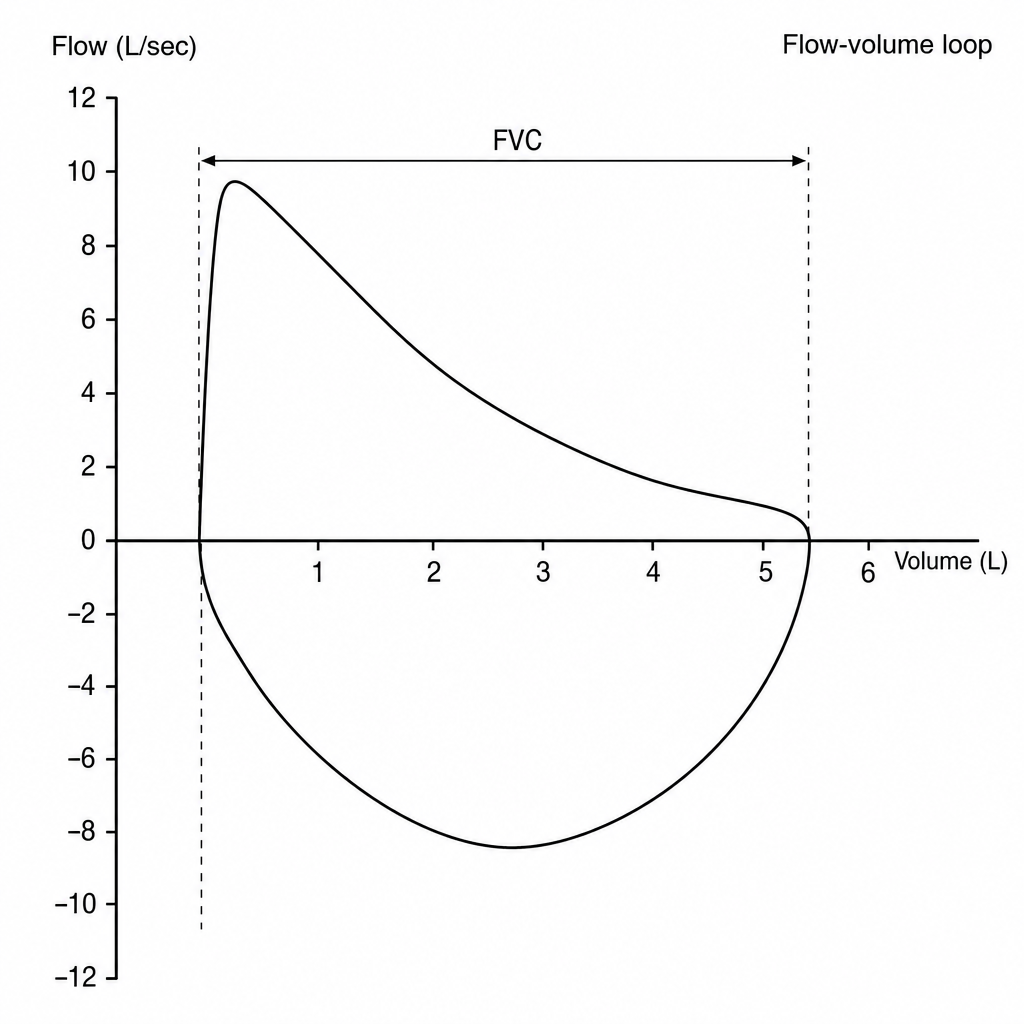
Explanation: **Explanation** In **Emphysema**, the primary pathological process is the permanent enlargement of airspaces distal to the terminal bronchioles, accompanied by the **destruction of alveolar walls**. This destruction leads to a significant loss of surface area available for gas exchange and damage to the pulmonary capillary bed. **Why DLCO is the Correct Answer:** The **Diffusing Capacity of the Lung for Carbon Monoxide (DLCO)** is a direct measure of the lung's ability to transfer gas from the inhaled air to the red blood cells. Because emphysema destroys the alveolar-capillary membrane, the surface area for diffusion decreases, leading to a **decreased DLCO**. This is a hallmark finding that helps differentiate emphysema from other obstructive diseases like chronic bronchitis or asthma (where DLCO is typically normal or elevated). **Analysis of Incorrect Options:** * **A. Total Lung Capacity (TLC):** In emphysema, loss of elastic recoil leads to hyperinflation. Therefore, TLC is **increased**, not decreased. * **B. Residual Volume (RV):** Due to air trapping and early airway closure during expiration, the RV is characteristically **increased**. * **C. Forced Expiratory Volume in 1 second (FEV1):** As an obstructive lung disease, emphysema causes a **decrease** in FEV1 due to increased airway resistance and loss of radial traction. **High-Yield Clinical Pearls for NEET-PG:** * **Pink Puffers:** The classic clinical phenotype of emphysema (thin, tachypneic, using accessory muscles). * **Compliance:** Emphysema is characterized by **increased lung compliance** due to the loss of elastic fibers (elastin). * **Flow-Volume Loop:** Shows a characteristic **"scooped-out"** appearance during expiration. * **Centriacinar vs. Panacinar:** Centriacinar is most common in smokers (upper lobes); Panacinar is associated with **Alpha-1 Antitrypsin deficiency** (lower lobes).
Mechanics of Breathing
Practice Questions
Pulmonary Ventilation
Practice Questions
Pulmonary Circulation
Practice Questions
Gas Exchange in the Lungs
Practice Questions
Oxygen and Carbon Dioxide Transport
Practice Questions
Control of Breathing
Practice Questions
Respiratory Adjustments in Health and Disease
Practice Questions
High Altitude Physiology
Practice Questions
Diving Physiology
Practice Questions
Respiratory Function Tests
Practice Questions
Get full access to all questions, explanations, and performance tracking.
Start For Free