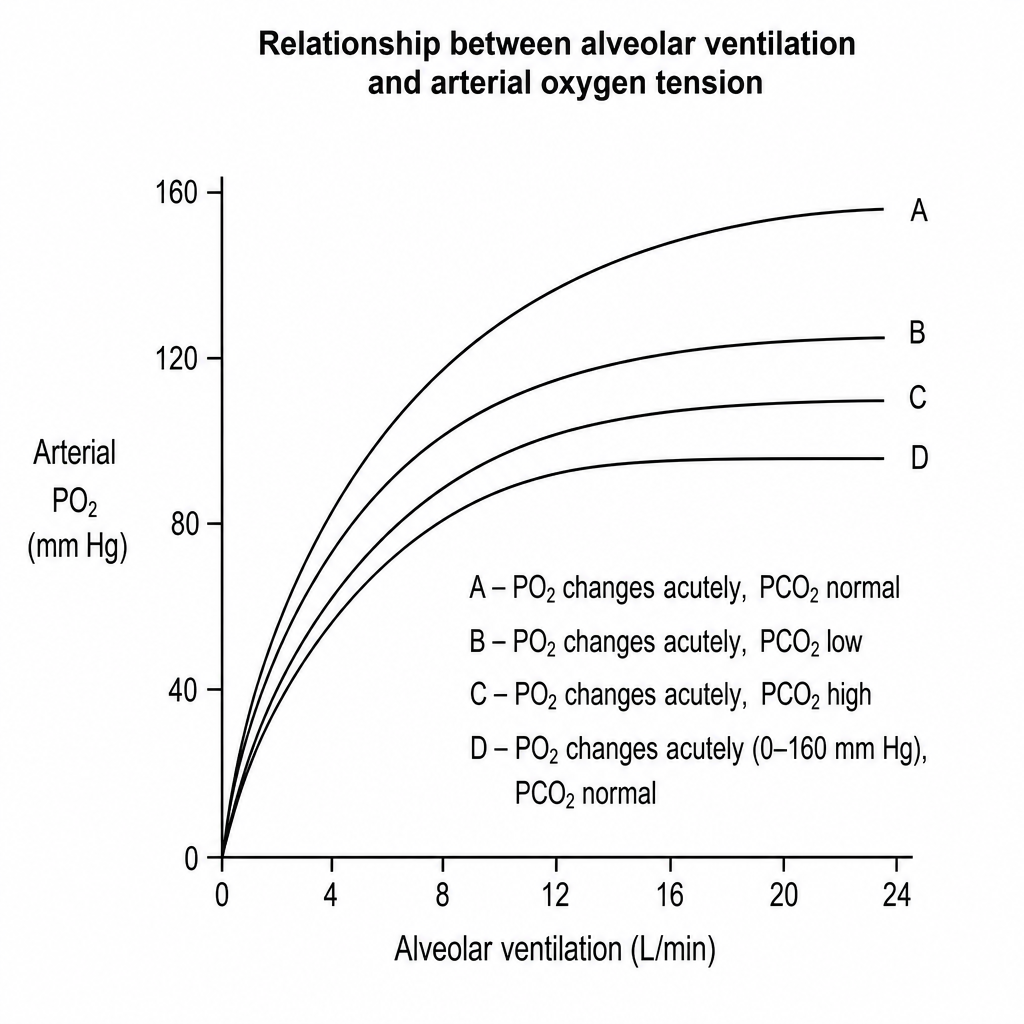
Which of the following is NOT TRUE regarding carbon monoxide (CO) poisoning?
What is the mechanism of overdrive observed during hyperventilation?
What is the normal intrapleural pressure?
Given a respiratory rate of 12 breaths/min, calculate the minute ventilation.
Which of the following occurs after hyperventilation with 6% CO2 in inspired air?
Oxygen delivery to tissues is decreased by which of the following factors?
In obstructive lung disease, all the following are true EXCEPT:
Which of the following is not reduced in an elderly patient?
Functional residual capacity is best measured by?
All the following are true regarding COPD EXCEPT?
Explanation: **Explanation:** Carbon monoxide (CO) poisoning is a high-yield topic in NEET-PG, primarily focusing on its interaction with hemoglobin. **1. Why Option C is the Correct Answer (The "Not True" statement):** While CO does bind to cytochrome c oxidase in mitochondria, the **primary mechanism** of clinical toxicity is **hypoxia** caused by the displacement of oxygen from hemoglobin. CO has an affinity for hemoglobin approximately **210–250 times greater** than oxygen. The clinical symptoms are almost entirely due to the reduction in oxygen-carrying capacity and impaired oxygen unloading, rather than direct cellular tissue toxicity. **2. Analysis of Other Options:** * **Option A (Shift to the Left):** CO binds to one of the four heme sites, increasing the affinity of the remaining three sites for oxygen. This prevents the release of oxygen to tissues, shifting the oxyhemoglobin dissociation curve to the **left** (Haldane-like effect). * **Option B (Lethality at 0.6 mmHg):** Because of its massive affinity, even a minute partial pressure of CO ($P_{CO}$) can saturate 50% of hemoglobin. A $P_{CO}$ of 0.4 to 0.6 mmHg in alveolar air can be fatal as it competes effectively with atmospheric oxygen ($P_{O2}$ ~100 mmHg). * **Option D (Hyperbaric Oxygen):** This is the treatment of choice. It works by physically dissolving more oxygen in the plasma and drastically reducing the half-life of carboxyhemoglobin (from ~5 hours in room air to ~20 minutes in a hyperbaric chamber). **High-Yield Clinical Pearls for NEET-PG:** * **Cherry-red discoloration** of skin/mucosa is a classic (though often post-mortem) finding. * **$PaO_2$ remains normal** in CO poisoning because dissolved oxygen is unaffected; however, **total oxygen content** is severely decreased. * Pulse oximetry is **unreliable** as it cannot distinguish between oxyhemoglobin and carboxyhemoglobin.
Explanation: **Explanation:** The mechanism of "overdrive" or the cessation of the respiratory drive following hyperventilation is primarily mediated by a **decrease in PaCO2 (Hypocapnia)**. Carbon dioxide is the most potent physiological stimulant for the central chemoreceptors located in the medulla. During voluntary hyperventilation, CO2 is "washed out" of the lungs and blood. As PaCO2 levels drop below the **apneic threshold** (the level of CO2 required to stimulate breathing), the chemical drive to the respiratory center is removed. This results in a period of apnea or significantly reduced ventilation until metabolic processes allow PaCO2 to rise back to a level that re-stimulates the respiratory centers. **Analysis of Options:** * **Option A (Increased PVR):** While hypoxia causes pulmonary vasoconstriction, hyperventilation (which increases O2 and decreases CO2) generally does not increase PVR in a way that affects respiratory drive. * **Option B (Decreased cerebral blood flow):** Hypocapnia *does* cause cerebral vasoconstriction and decreased cerebral blood flow (which can cause lightheadedness), but this is a *consequence* of hyperventilation, not the mechanism that suppresses the respiratory drive. * **Option C (Increased CVP):** Hyperventilation involves increased intrathoracic pressure swings, but CVP changes do not regulate the central respiratory rhythm. **High-Yield Clinical Pearls for NEET-PG:** * **Breaking Point:** The point at which a person can no longer hold their breath is usually when PaCO2 reaches about **50 mmHg**. * **Pre-oxygenation vs. Hyperventilation:** Hyperventilation before breath-holding (e.g., by divers) extends underwater time by lowering starting CO2 levels, but it is dangerous as it can lead to **"shallow water blackout"** because O2 levels may drop to critical levels before the CO2 rises enough to trigger the urge to breathe. * **Hering-Breuer Reflex:** This reflex prevents over-inflation of the lungs via stretch receptors but is not the primary mechanism for post-hyperventilation apnea.
Explanation: **Explanation:** The **intrapleural pressure (IPP)** is the pressure within the pleural cavity (the space between the visceral and parietal pleura). Under normal physiological conditions, this pressure is **sub-atmospheric (negative)**. **1. Why Option D is Correct:** At the end of a quiet expiration (Functional Residual Capacity), the intrapleural pressure is approximately **-3 to -4 mm Hg** (relative to atmospheric pressure). This negativity is created by two opposing elastic forces: * The **lungs** have a natural tendency to recoil inward. * The **chest wall** has a natural tendency to expand outward. These opposing forces "pull" the pleural layers away from each other, creating a vacuum-like effect that maintains the negative pressure, keeping the lungs inflated. **2. Analysis of Incorrect Options:** * **Options A & B (1-2 and 2-4 mm Hg):** These represent positive values. Positive intrapleural pressure is pathological (e.g., tension pneumothorax), as it would cause the lung to collapse. * **Option C (9.5-10 mm Hg):** While IPP becomes *more* negative during deep inspiration (reaching -6 to -8 mm Hg), a value of -10 mm Hg is not the "normal" resting baseline. Positive 10 mm Hg would indicate severe respiratory distress or injury. **3. Clinical Pearls for NEET-PG:** * **Inspiration:** IPP becomes more negative (approx. **-6 mm Hg**) as the chest wall expands, further pulling on the lungs. * **Müller's Maneuver:** Forced inspiration against a closed glottis can drop IPP to **-40 mm Hg**. * **Valsalva Maneuver:** Forced expiration against a closed glottis can make IPP positive (up to **+50 to +100 mm Hg**). * **Pneumothorax:** If the pleural cavity is breached, IPP equilibrates with atmospheric pressure (becomes 0), leading to immediate lung collapse.
Explanation: ### Explanation **1. Why the Correct Answer is Right:** Minute Ventilation ($\dot{V}_E$) is the total volume of gas entering (or leaving) the lungs per minute. It is calculated using the formula: $$\text{Minute Ventilation} = \text{Tidal Volume (TV)} \times \text{Respiratory Rate (RR)}$$ In a healthy adult, the standard **Tidal Volume (TV)** is approximately **500 mL** (0.5 L). Given the **Respiratory Rate (RR)** is **12 breaths/min**: $$\dot{V}_E = 500 \text{ mL} \times 12 = 6,000 \text{ mL/min} = \mathbf{6 \text{ L/min}}$$ Therefore, Option D is the correct physiological calculation. **2. Why the Incorrect Options are Wrong:** * **Options A & B (1 L/min & 2 L/min):** These values are physiologically insufficient to sustain life in an adult. Such low volumes would lead to rapid hypercapnia (CO2 retention) and hypoxia. * **Option C (4 L/min):** This value is closer to the **Alveolar Ventilation** ($\dot{V}_A$). Alveolar ventilation subtracts the dead space volume ($V_D \approx 150 \text{ mL}$) from the tidal volume: $(500 - 150) \times 12 = 4.2 \text{ L/min}$. While 4 L/min is a significant respiratory parameter, it does not represent the total *minute* ventilation. **3. Clinical Pearls & High-Yield Facts for NEET-PG:** * **Anatomical Dead Space:** Usually estimated as **2 mL/kg** of ideal body weight (approx. 150 mL in a 70 kg adult). * **Alveolar Ventilation:** This is the most important factor for gas exchange. If a patient breathes shallowly (low TV), even with a high RR, alveolar ventilation may drop to zero if TV $\leq$ Dead Space. * **Hyperventilation vs. Tachypnea:** Hyperventilation specifically refers to an increase in alveolar ventilation that lowers arterial $PCO_2$, whereas tachypnea simply refers to an increased respiratory rate.
Explanation: ### Explanation The correct answer is **A. Continued hyperventilation**. **Mechanism and Concept:** Hyperventilation normally leads to a period of **apnoea** (voluntary or involuntary) because it washes out $CO_2$ from the blood, leading to hypocapnia. Since $CO_2$ is the primary chemical drive for respiration via central chemoreceptors, its absence removes the stimulus to breathe. However, in this specific scenario, the subject is hyperventilating with **6% $CO_2$**. This concentration is higher than the normal atmospheric $CO_2$ (0.04%) and even higher than the normal alveolar $PCO_2$ (approx. 5.3% or 40 mmHg). Instead of washing out $CO_2$, the individual is continuously inhaling a potent respiratory stimulant. The high $PCO_2$ keeps the central chemoreceptors activated, ensuring the respiratory center continues to fire. Therefore, hyperventilation persists to attempt to eliminate the excess $CO_2$ load. **Analysis of Incorrect Options:** * **B. Apnoea:** This occurs after hyperventilating with **room air** (due to hypocapnia). It does not occur here because the inspired $CO_2$ prevents the $PCO_2$ from falling below the "apnoeic threshold." * **C. Cheyne-Stokes Breathing:** This is a form of periodic breathing characterized by crescendo-decrescendo patterns followed by apnoea. It is seen in heart failure or brain injury, not as a direct result of $CO_2$ inhalation. * **D. Kussmaul’s Breathing:** This is a deep, sighing respiratory pattern seen in **metabolic acidosis** (e.g., Diabetic Ketoacidosis) as a compensatory mechanism to blow off $CO_2$. **High-Yield Pearls for NEET-PG:** * **Breaking Point:** The point at which a person can no longer hold their breath. It is primarily reached when arterial $PCO_2$ rises to about 50 mmHg. * **CO2 Narcosis:** While low concentrations of $CO_2$ stimulate breathing, very high concentrations (>7–10%) act as a CNS depressant and can lead to respiratory failure. * **Primary Stimulus:** For a healthy individual, the **central chemoreceptors** (responding to $H^+$ changes in the CSF derived from $CO_2$) provide 70-80% of the respiratory drive.
Explanation: **Explanation** The delivery of oxygen to tissues ($DO_2$) is determined by the product of Cardiac Output ($CO$) and the Arterial Oxygen Content ($CaO_2$). The formula for oxygen content is: $$CaO_2 = (1.34 \times Hb \times SaO_2) + (0.003 \times PaO_2)$$ **Why Option A is Correct:** As seen in the formula, **Hemoglobin (Hb) level** is the primary determinant of oxygen-carrying capacity. A decrease in hemoglobin (anemia) directly reduces the $CaO_2$, thereby decreasing the total oxygen delivery to tissues, even if the partial pressure of oxygen ($PaO_2$) remains normal. **Analysis of Incorrect Options:** * **B. Increased hemoglobin level:** This increases the oxygen-carrying capacity of the blood (polycythemia), thereby increasing $DO_2$ (up to a point where viscosity might limit flow). * **C. Increased $PaCO_2$:** An increase in $PaCO_2$ causes a **right shift** of the Oxygen-Dissociation Curve (Bohr Effect). This actually **facilitates** the unloading of oxygen from hemoglobin to the tissues, effectively improving delivery at the cellular level. * **D. Increased $HCO_3$:** High bicarbonate levels (metabolic alkalosis) cause a left shift of the curve, which increases Hb-O2 affinity. While this makes unloading harder, it does not decrease the total delivery capacity as significantly as a drop in hemoglobin itself. **High-Yield Clinical Pearls for NEET-PG:** * **The 1.34 Constant:** This is Hüfner's constant, representing the amount of $O_2$ (ml) carried by 1 gram of fully saturated hemoglobin. * **Right Shift Factors (CADET, face Right!):** **C**O2 increase, **A**cidosis, **D**PG (2,3-BPG) increase, **E**xercise, and **T**emperature increase all shift the curve to the right, decreasing affinity and helping tissue oxygenation. * **Dissolved $O_2$:** The $0.003 \times PaO_2$ represents oxygen dissolved in plasma, which is negligible (only ~0.3ml/100ml) compared to Hb-bound oxygen.
Explanation: In obstructive lung diseases (e.g., Asthma, COPD, Emphysema), the primary pathology is **increased airway resistance**, making it difficult to exhale air completely. ### Why Option A is the Correct Answer (The "Except") In obstructive disease, **Residual Volume (RV) is NOT normal; it is increased.** Because of premature airway closure (air trapping) and loss of elastic recoil (in emphysema), air remains "trapped" in the lungs at the end of expiration. This leads to hyperinflation, which increases RV, Functional Residual Capacity (FRC), and Total Lung Capacity (TLC). ### Explanation of Other Options * **B. FEV decreases:** Forced Expiratory Volume (FEV) in the first second (FEV1) decreases significantly because the narrowed airways limit the speed at which air can be exhaled. * **C. FEV1/FVC decreases:** This is the **hallmark** of obstructive disease. While both FEV1 and FVC may decrease, FEV1 falls much more drastically, resulting in a ratio of **< 0.7 (70%)**. * **D. Vital Capacity (VC) is normal:** In early or mild obstructive disease, the VC can remain normal. However, as air trapping increases (increasing the RV), the VC may eventually decrease because the lungs are already "full" of trapped air. ### High-Yield Clinical Pearls for NEET-PG * **Flow-Volume Loop:** Obstructive disease shows a characteristic **"scooped-out"** appearance on the expiratory limb. * **Restrictive vs. Obstructive:** In Restrictive disease, the FEV1/FVC ratio is **normal or increased**, while all lung volumes (TLC, FRC, RV) are decreased. * **Emphysema Specific:** It is the only obstructive disease where **DLCO (Diffusing Capacity)** is significantly decreased due to alveolar wall destruction.
Explanation: In the elderly, the respiratory system undergoes structural changes often referred to as "senile emphysema." The primary driver is the **loss of elastic recoil** of the lung parenchyma and increased stiffness of the chest wall. **Explanation of the Correct Answer:** * **Functional Residual Capacity (FRC):** As lung elasticity decreases, the lungs' inward pull weakens, while the chest wall's tendency to expand remains relatively unopposed. This shifts the equilibrium point outward, leading to an **increase** (or maintenance) of FRC and Residual Volume (RV). Therefore, FRC is **not reduced**; it typically increases with age. **Explanation of Incorrect Options:** * **Arterial Oxygen Tension ($PaO_2$):** This **decreases** with age due to an increase in the alveolar-arterial (A-a) gradient. This is caused by early airway closure (increased closing volume) leading to ventilation-perfusion ($V/Q$) mismatch. * **Alveolar Oxygen Tension ($PAO_2$):** While $PAO_2$ itself stays relatively stable if ventilation is adequate, the question asks what is *not reduced*. In many clinical contexts of aging (like decreased chest wall compliance), $PAO_2$ may slightly decline, but $PaO_2$ is the more significant clinical drop. * **Forced Expiratory Volume ($FEV_1$):** This **decreases** significantly (approx. 20-30 ml/year) due to the loss of elastic recoil, which reduces the driving pressure for expiratory airflow and leads to premature small airway collapse. **High-Yield Clinical Pearls for NEET-PG:** * **Increases with age:** FRC, Residual Volume (RV), Closing Volume (CV), and A-a gradient. * **Decreases with age:** Vital Capacity (VC), $FEV_1$, $PaO_2$, and Chest wall compliance. * **Unchanged:** Total Lung Capacity (TLC) generally remains constant as the increase in RV offsets the decrease in VC. * **Formula for $PaO_2$ decline:** $PaO_2 = 100 - (0.3 \times \text{Age in years})$.
Explanation: **Explanation:** **Functional Residual Capacity (FRC)** is the volume of air remaining in the lungs at the end of a normal tidal expiration. It consists of Expiratory Reserve Volume (ERV) and Residual Volume (RV). **Why Pulmonary Plethysmography is the correct answer:** While Helium dilution and Nitrogen washout can measure FRC, **Pulmonary Plethysmography (Body Box)** is considered the "Gold Standard" and the most accurate method. It is based on **Boyle’s Law** ($P_1V_1 = P_2V_2$ at constant temperature). Unlike gas dilution techniques, plethysmography measures the **total thoracic gas volume**, including air trapped behind closed airways (e.g., in COPD, asthma, or bullous disease). Therefore, it provides a more "true" measurement of FRC in patients with obstructive lung pathologies. **Analysis of Incorrect Options:** * **B. Helium Dilution Method:** This is a closed-circuit method. It only measures "communicating" gas volume. In patients with air trapping, it significantly underestimates the true FRC. * **C. Spirometry:** This is the most common pitfall. Spirometry **cannot** measure FRC, Residual Volume (RV), or Total Lung Capacity (TLC) because it cannot measure the air that never leaves the lungs during a forced expiration. * **D. Nitrogen Washout Method:** This is an open-circuit method where the patient breathes 100% $O_2$. Like helium dilution, it only measures ventilated lung volumes and underestimates FRC in the presence of airway obstruction. **High-Yield Clinical Pearls for NEET-PG:** * **FRC = ERV + RV.** * **Cannot be measured by Spirometry:** RV, FRC, and TLC. * **FRC in Disease:** Increased in obstructive diseases (hyperinflation) and decreased in restrictive diseases (e.g., pulmonary fibrosis). * **Closing Capacity:** If Closing Capacity exceeds FRC (as seen in elderly patients or when supine), small airway collapse occurs during normal breathing, leading to V/Q mismatch.
Explanation: **Explanation:** Chronic Obstructive Pulmonary Disease (COPD) is characterized by chronic airflow limitation due to airway narrowing (bronchitis) and loss of elastic recoil (emphysema). This leads to **air trapping** and **hyperinflation**. **Why Option C is the Correct Answer (The False Statement):** In COPD, the **Residual Volume (RV)** increases significantly more than the **Total Lung Capacity (TLC)**. Because the numerator (RV) increases disproportionately to the denominator (TLC), the **RV/TLC ratio actually increases** (often >30-40%). A decreased ratio is not seen in obstructive diseases; therefore, this statement is false. **Analysis of Incorrect Options (True Statements):** * **A. Increased Residual Volume:** Air trapping occurs because airways collapse during expiration (especially in emphysema). This prevents the lungs from emptying completely, leading to a pathologically high RV. * **B. Increased Total Lung Capacity:** To compensate for air trapping and reduced elastic recoil, the chest wall expands (barrel chest), leading to an increase in TLC (hyperinflation). * **D. Decreased Vital Capacity:** Since TLC = VC + RV, and the increase in RV is massive, the Vital Capacity (VC) is often reduced because the "trapped air" occupies space that would otherwise be available for usable lung volume. **High-Yield Clinical Pearls for NEET-PG:** * **Gold Standard Diagnosis:** Spirometry showing a post-bronchodilator **FEV1/FVC ratio < 0.70**. * **Flow-Volume Loop:** Shows a characteristic **"scooped-out"** appearance during expiration. * **Compliance:** Lung compliance is **increased** in emphysema due to the destruction of alveolar septa and elastic fibers. * **Diffusion Capacity (DLCO):** Characteristically **decreased** in emphysema but normal in pure chronic bronchitis.
Mechanics of Breathing
Practice Questions
Pulmonary Ventilation
Practice Questions
Pulmonary Circulation
Practice Questions
Gas Exchange in the Lungs
Practice Questions
Oxygen and Carbon Dioxide Transport
Practice Questions
Control of Breathing
Practice Questions
Respiratory Adjustments in Health and Disease
Practice Questions
High Altitude Physiology
Practice Questions
Diving Physiology
Practice Questions
Respiratory Function Tests
Practice Questions
Get full access to all questions, explanations, and performance tracking.
Start For Free