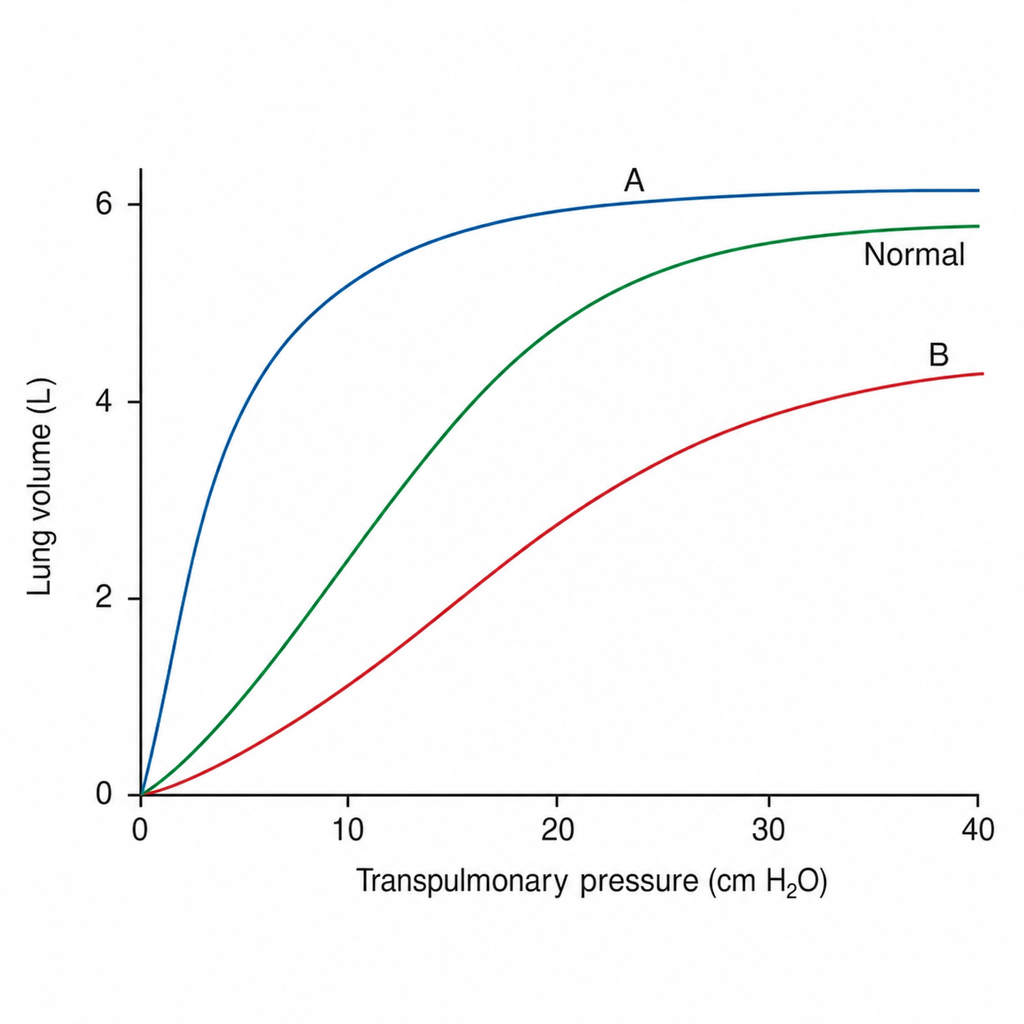
All of the following are risks seen in the administration of pure oxygen to hypoxic patients, except?
What is true about ascent to high altitude?
In the work of breathing, what percentage fraction does tissue resistance contribute?
Pulmonary function abnormalities in interstitial lung diseases include all of the following except?
Hyperventilation at high altitude is due to what physiological change?
All of the following pulmonary changes are seen in restrictive lung disease except:
What is the normal partial pressure of oxygen (PaO2) in a healthy adult?
FEV1/FVC ratio is reduced in which of the following conditions?
What is the sensitivity of chemoreceptors in COPD?
Vital capacity is the sum of which of the following?
Explanation: **Explanation:** The correct answer is **C. 2,3-DPG toxicity**. This is because 2,3-DPG (2,3-bisphosphoglycerate) is a metabolic byproduct of glycolysis in red blood cells that helps regulate hemoglobin's affinity for oxygen. It is not a substance that causes "toxicity" during oxygen therapy. In fact, chronic hypoxia typically *increases* 2,3-DPG levels to facilitate oxygen unloading to tissues. **Analysis of Options:** * **A. Apnea (Hypoxic Drive):** In patients with chronic hypercapnia (e.g., COPD), the central chemoreceptors become desensitized. Their primary stimulus for breathing becomes "hypoxic drive" via peripheral chemoreceptors. Administering pure oxygen removes this stimulus, potentially leading to respiratory depression or apnea. * **B. Pulmonary Edema:** High concentrations of oxygen (hyperoxia) lead to the formation of Reactive Oxygen Species (ROS) like superoxide radicals. These damage the alveolar-capillary membrane, leading to "Oxygen Toxicity" (Lorrain Smith effect), which manifests as pulmonary congestion and edema. * **D. Convulsions:** Exposure to high partial pressures of oxygen (hyperbaric oxygen) can affect the Central Nervous System (Paul Bert effect), leading to symptoms such as dizziness, muscle twitching, and generalized seizures (convulsions). **High-Yield Clinical Pearls for NEET-PG:** 1. **Absorption Atelectasis:** Pure oxygen can wash out nitrogen (which normally keeps alveoli splinted open), leading to alveolar collapse. 2. **Retinopathy of Prematurity (ROP):** In neonates, excessive oxygen therapy causes retinal vasoconstriction followed by abnormal vascular proliferation. 3. **Haldane Effect:** High $O_2$ promotes the displacement of $CO_2$ from hemoglobin, which can acutely worsen hypercapnia in certain patients.
Explanation: ### Explanation **1. Why Acetazolamide is the Correct Answer:** Acetazolamide is a carbonic anhydrase inhibitor and the drug of choice for the prophylaxis of **Acute Mountain Sickness (AMS)**. At high altitudes, the low partial pressure of oxygen ($FiO_2$) triggers peripheral chemoreceptors, leading to hyperventilation. This causes respiratory alkalosis, which normally inhibits the respiratory center and limits further compensation. Acetazolamide induces a **bicarbonate diuresis** (metabolic acidosis), which offsets the respiratory alkalosis. This "acidifies" the blood, stimulating the central chemoreceptors to maintain a higher respiratory rate, thereby improving oxygenation and accelerating acclimatization. **2. Why the Other Options are Incorrect:** * **A. Respiratory Acidosis:** Incorrect. Ascent to high altitude causes hyperventilation to compensate for hypoxia, which washes out $CO_2$. This results in **Respiratory Alkalosis**, not acidosis. * **B. Polycythemia due to dehydration:** Incorrect. While dehydration can cause "relative" polycythemia, the primary mechanism at high altitude is **absolute polycythemia**. Hypoxia stimulates the kidneys to release **Erythropoietin (EPO)**, which increases red blood cell production to enhance oxygen-carrying capacity. * **C. Acute Mountain Sickness (AMS) timing:** Incorrect. AMS typically develops within **6 to 24 hours** of ascent, not the 7th day. Symptoms usually peak around 24–48 hours and resolve as acclimatization occurs. **Clinical Pearls for NEET-PG:** * **Cheyne-Stokes Respiration:** The most common breathing pattern seen during sleep at high altitudes. * **Oxygen Dissociation Curve:** Initially shifts to the **right** (due to increased 2,3-BPG) to favor unloading of $O_2$ at tissues. * **High Altitude Pulmonary Edema (HAPE):** Caused by uneven hypoxic pulmonary vasoconstriction leading to pulmonary hypertension; treated with **Nifedipine**. * **High Altitude Cerebral Edema (HACE):** A medical emergency treated with **Dexamethasone**.
Explanation: **Explanation:** The "Work of Breathing" (WOB) refers to the energy expended by the respiratory muscles to overcome the mechanical impedances of the respiratory system. This resistance is broadly divided into two categories: **Elastic Resistance** (65%) and **Non-elastic/Viscous Resistance** (35%). The **Non-elastic resistance** is further subdivided: 1. **Airway Resistance (80% of non-elastic):** Caused by friction between the air molecules and the walls of the tracheobronchial tree. 2. **Tissue Resistance (20% of non-elastic):** Also known as viscous resistance, this is caused by the friction between the lungs and the chest wall, and the sliding of the pleural surfaces. **Why 7% is correct:** Mathematically, tissue resistance accounts for approximately 20% of the non-elastic resistance. Since non-elastic resistance is 35% of the total work, the calculation is: **20% of 35% = 7%**. Therefore, tissue resistance contributes roughly 7% to the total work of breathing in a healthy individual. **Analysis of Incorrect Options:** * **B (14%):** This value is too high for tissue resistance in normal physiology; it may be seen in specific restrictive pathologies but is not the standard physiological value. * **C (28%):** This represents the majority of the non-elastic resistance (Airway Resistance), which is roughly 28% of the total work (80% of 35%). * **D (65%):** This represents the **Elastic Resistance** (Compliance work), which is the energy required to expand the elastic tissues of the lungs and chest wall. **High-Yield Facts for NEET-PG:** * **Most of the work of breathing** (65%) is spent overcoming elastic recoil. * **Airway resistance** is highest in the **medium-sized bronchi** (generations 2-5) and lowest in the terminal bronchioles due to the large total cross-sectional area. * In diseases like **Emphysema**, work increases due to loss of elastic recoil, while in **Asthma**, work increases due to high airway resistance.
Explanation: ### Explanation Interstitial Lung Diseases (ILD) are the prototype of **Restrictive Lung Diseases**. The core pathology involves inflammation and fibrosis of the alveolar walls, making the lungs "stiff" and less compliant. **1. Why "Reduced FEV1/FVC ratio" is the correct answer:** In restrictive diseases like ILD, both the Forced Expiratory Volume in 1 second (FEV1) and the Forced Vital Capacity (FVC) decrease proportionately because the lungs are small and stiff. Consequently, the **FEV1/FVC ratio remains normal or is often increased** (due to increased radial traction on the airways, which keeps them open during expiration). A *reduced* FEV1/FVC ratio (<0.7) is the hallmark of **Obstructive** lung diseases (e.g., Asthma, COPD). **2. Why the other options are incorrect:** * **Reduced Vital Capacity (VC) & Total Lung Capacity (TLC):** Because the lung parenchyma is fibrotic and non-compliant, the lungs cannot expand fully. This leads to a global reduction in all lung volumes and capacities (VC, TLC, FRC, and RV). * **Reduced Diffusion Capacity (DLCO):** The thickening of the alveolar-capillary membrane (interstitial fibrosis) increases the diffusion distance for gases, leading to a characteristic drop in DLCO. This is often the earliest functional abnormality in ILD. ### High-Yield Clinical Pearls for NEET-PG: * **Gold Standard Diagnosis:** HRCT (High-Resolution CT) showing "honeycombing" or "ground-glass opacities." * **Flow-Volume Loop:** In ILD, the loop is shifted to the right, appearing tall and narrow (witches' hat appearance). * **Compliance:** Static lung compliance is significantly **decreased** in ILD. * **Rule of Thumb:** * Obstructive = Ratio ↓ * Restrictive = Volumes ↓ (Ratio Normal/↑)
Explanation: **Explanation:** At high altitudes, the barometric pressure decreases, leading to a fall in the partial pressure of inspired oxygen ($PiO_2$). This results in **arterial hypoxemia**. The peripheral chemoreceptors (primarily in the carotid bodies) sense this low $PaO_2$ and trigger the respiratory center to increase the rate and depth of breathing. **1. Why Respiratory Alkalosis is Correct:** The compensatory hyperventilation causes an excessive "washout" of Carbon Dioxide ($CO_2$). Since $CO_2$ is an acid, its depletion leads to a rise in blood pH (alkalosis). Therefore, the primary physiological state resulting from hyperventilation at high altitude is **Respiratory Alkalosis**. **2. Why the other options are incorrect:** * **B. Respiratory acidosis:** This occurs during hypoventilation (e.g., COPD or opioid overdose) where $CO_2$ is retained, not during hyperventilation. * **C. Hypercapnia:** This refers to high $PaCO_2$. Hyperventilation specifically causes *hypocapnia* (low $PaCO_2$). * **D. Decreased concentration of bicarbonate:** While bicarbonate levels do eventually decrease, this is a **delayed renal compensation** (taking 24–48 hours) to normalize the pH. It is a *consequence* of the alkalosis, not the immediate cause of hyperventilation itself. **High-Yield NEET-PG Pearls:** * **The "Hypoxic Drive":** Hyperventilation at altitude is driven by $PaO_2$ falling below **60 mmHg**. * **Oxygen-Dissociation Curve:** Respiratory alkalosis causes a **Left Shift** of the curve (increasing hemoglobin's affinity for $O_2$ in the lungs). * **Acetazolamide:** This drug is used for altitude sickness because it inhibits carbonic anhydrase, forcing bicarbonate excretion and creating a mild metabolic acidosis to counteract the respiratory alkalosis, thereby stimulating ventilation.
Explanation: In restrictive lung diseases (e.g., Idiopathic Pulmonary Fibrosis, Sarcoidosis, or Chest Wall deformities), the hallmark is a **reduction in all lung volumes** due to decreased lung compliance or restricted chest expansion. ### **Explanation of the Correct Answer** The question asks for the change **not** typically seen (or the "except" option). However, there is a technical nuance in the options provided. In restrictive lung disease, **VC (Vital Capacity), TLC (Total Lung Capacity), and RV (Residual Volume) all decrease.** The **FEV1/FVC ratio**, however, behaves differently: it remains **normal or is increased** (>0.7 or 70%). This is because both FEV1 and FVC decrease proportionately, or FVC decreases more than FEV1 due to increased elastic recoil of the fibrotic lungs. Therefore, **Option A (FEV1/FVC ratio)** is typically the "exception" because it does not decrease, unlike the absolute volumes. *Note: If the question intended to identify which parameter is "preserved," the answer is the Ratio. If the question implies which parameter is the "defining" feature, TLC is the gold standard.* ### **Analysis of Other Options** * **TLC (Total Lung Capacity):** This is the **gold standard** for diagnosing restriction. A decrease in TLC (<80% of predicted) is mandatory for the diagnosis. * **RV (Residual Volume):** Generally decreases in parenchymal restrictive diseases as the lungs become "stiff" and smaller. * **VC (Vital Capacity):** Decreases significantly because the total volume of air the patient can exhale after maximum inspiration is limited by the stiff lung tissue. ### **NEET-PG High-Yield Pearls** 1. **Obstructive vs. Restrictive:** In Obstructive disease (COPD/Asthma), FEV1/FVC is **decreased**; in Restrictive disease, it is **normal/increased**. 2. **Flow-Volume Loop:** In restrictive disease, the loop is shifted to the right, appearing narrow and tall ("Witch’s Hat" appearance). 3. **Compliance:** Restrictive diseases are characterized by **decreased lung compliance**.
Explanation: **Explanation:** The partial pressure of arterial oxygen (**PaO2**) represents the amount of oxygen dissolved in the arterial blood. In a healthy adult breathing room air (21% O2) at sea level, the normal range is typically **80 to 100 mm Hg**. This value is determined by the alveolar oxygen tension (PAO2) and the efficiency of gas exchange across the alveolar-capillary membrane. **Why Option C is correct:** 80 mm Hg falls within the standard physiological range for a healthy adult. While the theoretical maximum at sea level is closer to 100 mm Hg, factors like the physiological shunt (bronchial and thebesian veins) slightly lower the arterial tension. **Analysis of Incorrect Options:** * **A (45 mm Hg):** This is the normal partial pressure of arterial **carbon dioxide (PaCO2)** or the partial pressure of oxygen in **mixed venous blood (PvO2)**. * **B (110 mm Hg):** This value is higher than what is achievable breathing room air at sea level. It would only be seen with supplemental oxygen therapy. * **D (60 mm Hg):** This is the threshold for **hypoxemia** and respiratory failure. At this point, the oxygen-hemoglobin dissociation curve enters its steep phase, leading to a rapid drop in SaO2. **High-Yield Clinical Pearls for NEET-PG:** * **Alveolar Gas Equation:** $PAO_2 = FiO_2(P_{atm} - P_{H2O}) - (PaCO_2 / R)$. * **A-a Gradient:** The difference between alveolar (A) and arterial (a) oxygen. Normal is **5–15 mm Hg**; an increase indicates intrinsic lung disease or a V/Q mismatch. * **Hypoxemia vs. Hypoxia:** Hypoxemia is low PaO2 in blood; Hypoxia is low oxygen delivery to tissues. * **P50 Value:** The PaO2 at which hemoglobin is 50% saturated is **26.7 mm Hg**.
Explanation: ### Explanation The **FEV1/FVC ratio** (Tiffeneau-Pinelli index) is the primary diagnostic tool used to differentiate between obstructive and restrictive lung diseases. **1. Why Asthma is Correct:** Asthma is an **obstructive lung disease**. In these conditions, airway resistance is increased (due to bronchospasm, inflammation, or mucus). While both FEV1 (Forced Expiratory Volume in 1 second) and FVC (Forced Vital Capacity) decrease, the **FEV1 decreases much more significantly** than the FVC because the obstruction limits the speed of air outflow. Consequently, the ratio (FEV1/FVC) falls below the normal limit (typically <0.7 or 70%). **2. Why Other Options are Incorrect:** * **Lung Fibrosis & Pleural Effusion:** These are **restrictive lung diseases** (intrinsic and extrinsic, respectively). In restriction, the lungs cannot expand fully, leading to a decrease in total lung volume. Both FEV1 and FVC decrease proportionately, or the FVC decreases more than the FEV1. Therefore, the FEV1/FVC ratio remains **normal or is even increased** (due to increased radial traction on airways in fibrosis). **3. High-Yield Clinical Pearls for NEET-PG:** * **Obstructive Pattern (↓ Ratio):** Asthma, COPD, Bronchiectasis, Cystic Fibrosis. * **Restrictive Pattern (Normal/↑ Ratio):** Interstitial Lung Disease (Fibrosis), Chest wall deformities (Kyphoscoliosis), Neuromuscular disorders (Polio, Myasthenia Gravis), and Pleural diseases. * **Flow-Volume Loops:** Look for a "scooped-out" appearance in obstructive disease and a "miniature/narrow" version of a normal loop in restrictive disease. * **Reversibility:** An increase in FEV1 of >12% and >200ml after bronchodilator inhalation suggests Asthma over COPD.
Explanation: **Explanation:** In patients with Chronic Obstructive Pulmonary Disease (COPD), the respiratory center undergoes significant adaptation due to chronic hypercapnia (elevated $PCO_2$). **Why Option C is Correct:** Under normal physiological conditions, the central chemoreceptors are primarily sensitive to changes in $H^+$ concentration in the brain extracellular fluid, which is driven by arterial $PCO_2$. In chronic COPD, there is a persistent elevation of $PCO_2$. To prevent dangerous acidosis, the kidneys compensate by retaining bicarbonate ($HCO_3^-$), which crosses the blood-brain barrier to buffer the $H^+$ ions. This "resets" the sensitivity. While it is often taught that the drive "shifts" to oxygen, the physiological reality tested here is that the **sensitivity to $PCO_2$ remains the dominant (though blunted) chemical drive**, and any acute rise in $PCO_2$ above the patient's new baseline triggers a response. In the context of competitive exams, the "increased sensitivity" refers to the body's reliance on $PCO_2$ fluctuations to maintain the new steady state. **Why Other Options are Wrong:** * **A & B (H+ Sensitivity):** While $H^+$ is the direct stimulant for central chemoreceptors, in chronic COPD, the buffering action of bicarbonate actually **decreases** the sensitivity of the receptors to $H^+$ to prevent overstimulation of the respiratory center. * **D (PO2 Sensitivity):** In end-stage COPD, patients may develop a "hypoxic drive" where low $PO_2$ becomes the primary stimulus for ventilation. However, this is a compensatory mechanism of the **peripheral** chemoreceptors, not an inherent increase in sensitivity of the central chemoreceptors. **High-Yield Clinical Pearls for NEET-PG:** * **Hypoxic Drive:** In severe COPD, giving high-flow oxygen can suppress the hypoxic drive, leading to CO2 narcosis and respiratory arrest. * **Central Chemoreceptors:** Located in the medulla; respond to $H^+$ (via $CO_2$ crossing the BBB). * **Peripheral Chemoreceptors:** Located in Carotid and Aortic bodies; primarily respond to low $PO_2$ ($<60$ mmHg).
Explanation: **Explanation:** **Vital Capacity (VC)** is the maximum volume of air a person can exhale from the lungs after a maximum inspiration. It represents the total "functional" or "usable" air within the lungs. Mathematically, it is the sum of three primary lung volumes: **VC = TV + IRV + ERV** * **Tidal Volume (TV):** Air breathed in/out during normal quiet respiration (~500 mL). * **Inspiratory Reserve Volume (IRV):** Extra air inhaled with maximum effort after a normal inspiration (~3000 mL). * **Expiratory Reserve Volume (ERV):** Extra air exhaled with maximum effort after a normal expiration (~1100 mL). **Analysis of Incorrect Options:** * **Option B & C:** These include **Residual Volume (RV)**. RV is the air remaining in the lungs after forceful expiration and cannot be measured by simple spirometry. Adding RV to VC gives the **Total Lung Capacity (TLC)**. * **Option D:** This is an incomplete and incorrect combination of volumes. **NEET-PG High-Yield Pearls:** 1. **Spirometry:** Can measure VC, TV, IRV, and ERV. It **cannot** measure RV, FRC (Functional Residual Capacity), or TLC because they all contain Residual Volume. 2. **Clinical Significance:** VC is decreased in **Restrictive Lung Diseases** (e.g., Pulmonary Fibrosis) due to reduced lung compliance, but remains relatively normal in obstructive diseases (though FEV1 decreases). 3. **Positioning:** VC is higher in the standing position compared to the supine position due to the effect of gravity on the diaphragm and increased thoracic volume. 4. **Formula to remember:** TLC = VC + RV.
Mechanics of Breathing
Practice Questions
Pulmonary Ventilation
Practice Questions
Pulmonary Circulation
Practice Questions
Gas Exchange in the Lungs
Practice Questions
Oxygen and Carbon Dioxide Transport
Practice Questions
Control of Breathing
Practice Questions
Respiratory Adjustments in Health and Disease
Practice Questions
High Altitude Physiology
Practice Questions
Diving Physiology
Practice Questions
Respiratory Function Tests
Practice Questions
Get full access to all questions, explanations, and performance tracking.
Start For Free