A 5-year-old child at sea level has the following arterial blood gas results: pH 7.41, PaO2 100 mmHg, and PaCO2 40 mmHg. The child is being ventilated with 80% oxygen. What is the alveolar-arterial oxygen gradient (A-a PO2)?
The condition in which the arterial PO2 is normal but the amount of hemoglobin available to carry O2 is reduced?
What is the primary direct stimulus for excitation of central chemoreceptors regulating ventilation?
A patient with severe anemia has normal lungs. What would you expect?
Physiological effects of emphysema may include all of the following, except?
Hypercapnia is NOT seen in which of the following conditions?
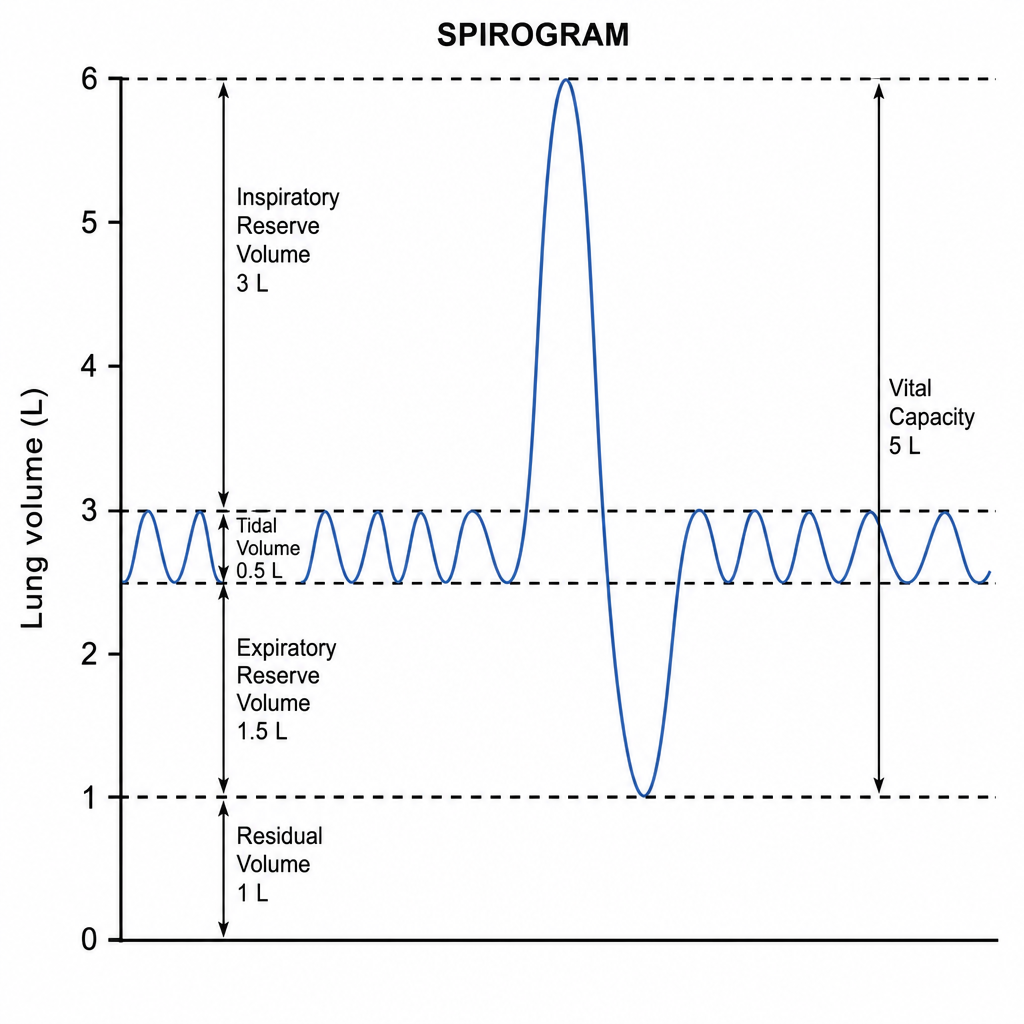
A 45-year-old male patient has a vital capacity of 4000 ml, with inspiratory reserve volume (IRV) = 500 ml, expiratory reserve volume (ERV) = 500 ml, and a respiratory rate of 22/min. Calculate the minute ventilation of the patient.
All of the following statements about a normal subject in the erect position are true EXCEPT?
Biot breathing is seen in?
An intern calculated the concentration of O2 in blood as 0.0025 ml/ml of blood. Considering atmospheric pressure as 760 mmHg, what is the approximate O2 tension in the blood?
Explanation: ### Explanation To calculate the **Alveolar-arterial (A-a) oxygen gradient**, we must first determine the Alveolar Oxygen Tension ($PAO_2$) using the **Alveolar Gas Equation**: $$PAO_2 = [FiO_2 \times (P_{atm} - PH_2O)] - (PaCO_2 / R)$$ **1. Calculate $PAO_2$:** * **$FiO_2$ (Fraction of inspired oxygen):** 80% = 0.8 * **$P_{atm}$ (Atmospheric pressure at sea level):** 760 mmHg * **$PH_2O$ (Water vapor pressure at body temp):** 47 mmHg * **$PaCO_2$ (Arterial $CO_2$):** 40 mmHg * **$R$ (Respiratory quotient):** Assume 0.8 (standard) $$PAO_2 = [0.8 \times (760 - 47)] - (40 / 0.8)$$ $$PAO_2 = [0.8 \times 713] - 50$$ $$PAO_2 = 570.4 - 50 = 520.4 \text{ mmHg}$$ **2. Calculate A-a Gradient:** $$\text{A-a Gradient} = PAO_2 - PaO_2$$ $$\text{A-a Gradient} = 520.4 - 100 = 420.4 \text{ mmHg}$$ Rounding to the nearest option gives **420 mmHg**. --- #### Why the other options are incorrect: * **Option A (570.4 mmHg):** This represents only the inspired oxygen component ($PiO_2$) before accounting for $CO_2$ displacement in the alveoli. * **Option B (520.4 mmHg):** This is the calculated $PAO_2$ (Alveolar oxygen). It fails to subtract the $PaO_2$ (Arterial oxygen) to find the gradient. * **Option C (470.4 mmHg):** This value results from a calculation error, likely subtracting the $PaCO_2$ (40) directly instead of the $PaCO_2/R$ (50). --- #### High-Yield Clinical Pearls for NEET-PG: * **Normal A-a Gradient:** Increases with age. A quick formula is **(Age/4) + 4**. For a 5-year-old, the normal gradient is ~5 mmHg. * **Significance:** A high A-a gradient (like 420 mmHg) indicates a **gas exchange defect** (e.g., V/Q mismatch, Shunt, or Diffusion limitation). * **Hypoxemia with Normal A-a Gradient:** Occurs in **Alveolar Hypoventilation** (e.g., opioid overdose) or **High Altitude**. * **FiO2 Rule:** For every 10% increase in $FiO_2$, the $PAO_2$ increases by approximately 60–70 mmHg.
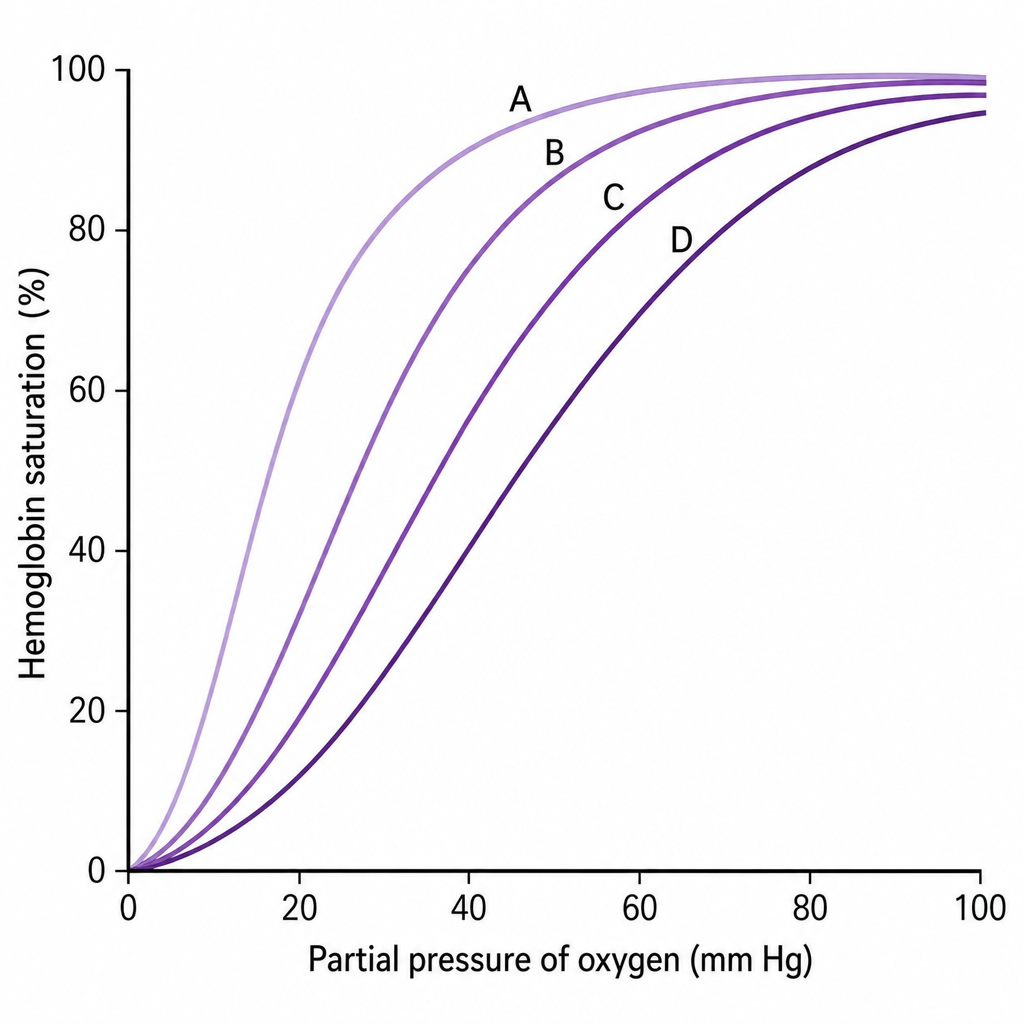
Explanation: ### Explanation The correct answer is **Anaemic hypoxia**. #### 1. Why Anaemic Hypoxia is Correct Hypoxia is defined as a deficiency of oxygen at the tissue level. In **Anaemic hypoxia**, the lungs are functioning normally, so the **arterial $PO_2$ (partial pressure of dissolved oxygen) remains normal**. However, the total **oxygen-carrying capacity** of the blood is reduced because there is either a decrease in the total amount of hemoglobin (as in anemia) or the hemoglobin is unable to bind oxygen (as in Carbon Monoxide poisoning or Methemoglobinemia). Since $O_2$ content = $(1.34 \times Hb \times Saturation) + (0.003 \times PO_2)$, a drop in functional Hb leads to tissue hypoxia despite normal $PO_2$. #### 2. Why Other Options are Incorrect * **Stagnant (Ischemic) Hypoxia:** The $PO_2$ and Hb levels are normal, but blood flow to the tissues is inadequate (e.g., heart failure, shock, or local embolism). * **Histotoxic Hypoxia:** The $PO_2$ and $O_2$ delivery are normal, but the tissues cannot utilize the oxygen because cellular enzymes (like cytochrome oxidase) are inhibited (e.g., Cyanide poisoning). * **Hypoxic Hypoxia:** This is characterized by a **low arterial $PO_2$**. It occurs due to low atmospheric $O_2$ (high altitude), hypoventilation, or V/Q mismatch. #### 3. NEET-PG High-Yield Pearls * **CO Poisoning:** A classic cause of anaemic hypoxia. It shifts the Oxygen-Hemoglobin Dissociation Curve (OHDC) to the **left**, making it harder for the remaining $O_2$ to be released to tissues. * **Arterial $PO_2$ vs. $O_2$ Content:** Remember that $PO_2$ only measures dissolved oxygen, not oxygen bound to hemoglobin. * **Cyanosis:** Usually **absent** in anaemic hypoxia because there isn't enough total hemoglobin to produce the 5g/dL of deoxygenated Hb required to see a blue tint.
Explanation: **Explanation:** The regulation of ventilation by central chemoreceptors (located in the medulla oblongata) is a high-yield concept in respiratory physiology. **1. Why "Increased H+" is correct:** The central chemoreceptors are exquisitely sensitive to the concentration of **Hydrogen ions (H+)** in the brain interstitial fluid. However, H+ ions cannot cross the blood-brain barrier (BBB). Instead, arterial CO2 diffuses across the BBB into the cerebrospinal fluid (CSF), where it reacts with water (catalyzed by carbonic anhydrase) to form carbonic acid, which then dissociates into H+ and HCO3-. It is this **locally generated H+** that directly stimulates the chemosensitive neurons to increase ventilation. **2. Why other options are incorrect:** * **Increased CO2:** While CO2 is the *indirect* stimulus (because it crosses the BBB), it is not the *direct* stimulus. CO2 itself has little direct effect on the neurons; its effect is mediated through the H+ it produces. * **Increased O2 / Decreased CO2:** These would lead to a decrease in ventilatory drive. Central chemoreceptors are **not** sensitive to O2 levels; oxygen levels are monitored exclusively by **peripheral chemoreceptors** (carotid and aortic bodies). **Clinical Pearls for NEET-PG:** * **Location:** Central chemoreceptors are located on the ventrolateral surface of the medulla. * **Main Stimulus:** The most potent stimulus for the *respiratory center* is a rise in arterial PCO2, but the *direct* trigger at the receptor level is H+. * **Adaptation:** In chronic hypercapnia (e.g., COPD), the kidneys retain bicarbonate which crosses into the CSF to buffer the H+, leading to a "resetting" of these receptors. This makes the patient dependent on "hypoxic drive" (peripheral receptors) for ventilation.
Explanation: ### Explanation **1. Why the correct answer is right:** In severe anemia, the hemoglobin (Hb) concentration is low, but the lungs and gas exchange mechanisms are normal. Oxygen concentration (content) in the blood is determined by the formula: $CaO_2 = (1.34 \times Hb \times SaO_2) + (0.003 \times PaO_2)$. While the arterial blood leaves the lungs with normal saturation, the **total oxygen content** is significantly reduced due to low Hb. When this blood reaches the tissues, the tissues extract the required amount of oxygen. Because the starting "reservoir" of oxygen in the arterial blood was low, the remaining oxygen returning to the heart (**mixed venous blood**) will be significantly depleted. Thus, the **mixed venous oxygen concentration ($CvO_2$) and $PvO_2$ are low.** **2. Why the incorrect options are wrong:** * **Option A & B:** $PaO_2$ (dissolved oxygen) and $SaO_2$ (saturation of available Hb) depend on alveolar ventilation and gas exchange across the respiratory membrane. Since the lungs are normal, both $PaO_2$ and $SaO_2$ remain **normal**. Anemia affects the *quantity* of the carrier, not the *pressure* of the gas or the *percentage* of carrier loading. * **Option C:** Oxygen concentration (content) is directly proportional to hemoglobin levels. In anemia, even if saturation is 100%, the total oxygen concentration is **low**. **3. High-Yield Clinical Pearls for NEET-PG:** * **Anemic Hypoxia:** Characterized by normal $PaO_2$, normal $SaO_2$, but decreased $CaO_2$. * **Mixed Venous Oxygen ($SvO_2$):** It is the most sensitive indicator of the balance between oxygen delivery and oxygen consumption. * **Cyanosis:** Does not typically occur in anemia because cyanosis requires at least 5g/dL of *reduced* (deoxygenated) hemoglobin, which is difficult to reach when total hemoglobin is already very low.
Explanation: **Explanation:** In emphysema, the primary pathology is the **destruction of alveolar walls** and the loss of elastic recoil. This leads to several physiological consequences, but **increased vital capacity is NOT one of them.** 1. **Why Option A is the Correct Answer (The Exception):** In emphysema, the loss of elastic recoil leads to **air trapping** and hyperinflation. This significantly increases the **Residual Volume (RV)** and **Total Lung Capacity (TLC)**. However, because the lungs cannot empty effectively (obstructive pattern), the **Vital Capacity (VC)**—the maximum air exhaled after maximum inhalation—actually **decreases** or remains normal, but never increases. 2. **Analysis of Other Options:** * **Impaired gas diffusion (Option C):** This is a hallmark of emphysema. The destruction of alveolar septa reduces the **surface area** available for gas exchange, leading to a decreased **DLCO** (Diffusion Capacity of the Lung for Carbon Monoxide). * **Irregular ventilation (Option B):** Loss of alveolar walls and bronchiolar obstruction occur unevenly throughout the lungs. This creates a **V/Q mismatch** (Ventilation-Perfusion inequality), where some areas are over-ventilated and others are under-ventilated. * **Pulmonary hypertension (Option D):** Chronic hypoxia (due to V/Q mismatch) triggers **hypoxic pulmonary vasoconstriction**. Additionally, the destruction of alveolar capillaries reduces the total pulmonary vascular bed, increasing resistance and leading to pulmonary hypertension and eventually **Cor Pulmonale**. **High-Yield Clinical Pearls for NEET-PG:** * **PFT Pattern:** $\downarrow$ FEV1/FVC ratio, $\uparrow$ TLC, $\uparrow$ RV, and **$\downarrow$ DLCO** (DLCO is normal in chronic bronchitis but decreased in emphysema). * **Pink Puffers:** Emphysema patients often maintain near-normal blood gases by over-ventilating (puffed-out cheeks). * **Compliance:** Emphysema is characterized by **increased lung compliance** due to the loss of elastic fibers.
Explanation: **Explanation:** The hallmark of **Acute Respiratory Distress Syndrome (ARDS)** is **Type 1 Respiratory Failure**, characterized by severe hypoxemia ($PaO_2/FiO_2$ ratio < 300 mmHg) with a normal or low $PaCO_2$. In the early and middle stages of ARDS, patients develop compensatory **tachypnea and hyperventilation** due to stimulation of J-receptors and peripheral chemoreceptors. This leads to increased CO2 washout, resulting in **hypocapnia** rather than hypercapnia. Hypercapnia in ARDS is typically a late, terminal sign indicating respiratory muscle fatigue or is "permissive" during mechanical ventilation. **Analysis of Incorrect Options:** * **Severe Asthma:** In the initial stages, asthma causes hypocapnia. However, as the airway obstruction worsens and the patient tires, it progresses to "silent chest" and CO2 retention. A "normal" $PaCO_2$ in a severe asthma attack is a warning sign of impending respiratory failure (hypercapnia). * **Anaphylaxis:** This leads to acute upper airway obstruction (laryngeal edema) and severe bronchospasm. The resulting alveolar hypoventilation rapidly leads to CO2 retention and respiratory acidosis. * **Inhalational Burn Injury:** This causes upper airway edema and chemical pneumonitis. The physical obstruction and reduced lung compliance often lead to hypoventilation and hypercapnia. **NEET-PG High-Yield Pearls:** * **ARDS Definition (Berlin Criteria):** Acute onset (<1 week), bilateral opacities on imaging, and respiratory failure not fully explained by heart failure/fluid overload. * **Dead Space:** ARDS increases physiological dead space, but hyperventilation usually compensates for this until the very late stages. * **Permissive Hypercapnia:** A lung-protective ventilation strategy used in ARDS where high $PaCO_2$ is tolerated to avoid high tidal volumes and barotrauma (VILI).
Explanation: ### Explanation **1. Understanding the Correct Answer (A: 6600 ml)** To calculate **Minute Ventilation (MV)**, we use the formula: $$MV = \text{Tidal Volume (TV)} \times \text{Respiratory Rate (RR)}$$ The question provides Vital Capacity (VC), IRV, and ERV, but not TV. We must first derive TV using the standard lung capacity formula: $$\text{Vital Capacity (VC)} = \text{IRV} + \text{TV} + \text{ERV}$$ $$4000\text{ ml} = 500\text{ ml} + \text{TV} + 500\text{ ml}$$ $$\text{TV} = 4000 - 1000 = 3000\text{ ml}$$ Now, calculate Minute Ventilation: $$MV = 3000\text{ ml (TV)} \times 22\text{/min (RR)} = \mathbf{6600\text{ ml/min}}$$ **2. Analysis of Incorrect Options** * **B (12000 ml):** This is a common error if a student assumes a "normal" TV of 500 ml and multiplies it by a higher RR, or miscalculates the VC components. * **C (3300 ml):** This occurs if the student mistakenly uses only the IRV or ERV as the TV. * **D (10000 ml):** This is a distractor often chosen if the student incorrectly adds all given values without applying the physiological formula. **3. Clinical Pearls & High-Yield Facts for NEET-PG** * **Tidal Volume (TV):** The volume of air inspired or expired during a normal breath (Normal $\approx$ 500 ml). In this clinical scenario, the patient has an abnormally high TV (hyperpnea). * **Alveolar Ventilation:** Unlike Minute Ventilation, Alveolar Ventilation subtracts the **Dead Space (VD)**: $(\text{TV} - \text{VD}) \times \text{RR}$. If the question asked for Alveolar Ventilation (assuming a standard dead space of 150 ml), the answer would be $(3000 - 150) \times 22 = 62,700\text{ ml}$. * **VC Components:** Remember that VC does **not** include Residual Volume (RV). Therefore, VC cannot be used to measure Total Lung Capacity (TLC) via simple spirometry.
Explanation: **Explanation** In the erect position, gravity creates a vertical gradient in pleural pressure, making it more negative at the apex and less negative at the base. This significantly impacts lung mechanics and gas exchange. **Why Option B is the Correct Answer (The False Statement):** Airway resistance is inversely proportional to lung volume. Due to more negative intrapleural pressure at the **apex**, the alveoli and small airways there are more distended (larger volume) than at the base. Larger airway diameters result in **lower airway resistance** at the apex. Therefore, the statement that resistance is greater at the apex is incorrect. **Analysis of Other Options:** * **Option A:** Alveoli at the apex are already highly distended and sit on the flatter, less steep portion of the pressure-volume curve. Thus, they are **less compliant** (stiffer) compared to the smaller, more expandable alveoli at the base. * **Option C:** Although ventilation and perfusion both increase toward the base, the increase in perfusion is much more dramatic. Because the base receives the highest absolute volume of both air and blood, the **bulk of gas exchange** occurs here. * **Option D:** Perfusion ($Q$) decreases more rapidly than ventilation ($V$) as we move from base to apex. Consequently, the **V/Q ratio is lowest at the base (~0.6)** and highest at the apex (~3.3). **High-Yield Clinical Pearls for NEET-PG:** * **Apex:** High V/Q ratio, high $PAO_2$, low $PACO_2$. This high oxygen tension favors the reactivation of **Mycobacterium tuberculosis**. * **Base:** Low V/Q ratio, high compliance, and the primary site for gas exchange. * **Zone of West:** In the erect position, the apex typically represents Zone 1 or 2, while the base represents Zone 3.
Explanation: **Explanation:** **Biot’s breathing** (also known as ataxic breathing) is characterized by groups of quick, shallow inspirations followed by irregular periods of apnea. It is a sign of severe neurological impairment. 1. **Why Option D is Correct:** Biot breathing is caused by damage to the **medulla oblongata**, often due to strokes, trauma, or uncal herniation. The medulla contains the rhythmicity centers (DRG and VRG); when these are damaged, the normal rhythmic pattern of breathing is lost, leading to the characteristic irregularity. 2. **Why Other Options are Incorrect:** * **Flail Chest:** This results in **paradoxical respiration** (the chest wall moves inward during inspiration and outward during expiration) due to multiple rib fractures. * **Uremia:** This typically presents with **Kussmaul breathing**, which is a deep, rapid, and labored breathing pattern (hyperventilation) intended to blow off CO₂ to compensate for metabolic acidosis. * **High Altitude:** This often triggers **Cheyne-Stokes breathing**, characterized by a gradual waxing and waning of tidal volume followed by apnea, driven by changes in CO₂ sensitivity. **High-Yield Clinical Pearls for NEET-PG:** * **Biot vs. Cheyne-Stokes:** Biot breathing is **irregularly irregular**, whereas Cheyne-Stokes is **regularly irregular** (crescendo-decrescendo). * **Apneustic Breathing:** Seen in lesions of the **Pons** (loss of the pneumotaxic center), characterized by prolonged inspiratory gasps. * **Kussmaul Breathing:** Associated with "MUDPILES" (e.g., Diabetic Ketoacidosis, Uremia).
Explanation: ### Explanation **1. The Underlying Concept: Henry’s Law** The amount of oxygen dissolved in the blood is directly proportional to the partial pressure (tension) of oxygen ($PO_2$). This relationship is governed by **Henry’s Law**. In physiology, the **solubility coefficient of oxygen** in plasma is a constant: **0.003 ml of $O_2$ per 100 ml of blood per mmHg**. To find the $PO_2$, we use the formula: $$\text{Dissolved } O_2 = \text{Solubility Coefficient} \times PO_2$$ **Calculation:** * Given concentration: $0.0025 \text{ ml/ml}$ of blood. * Convert to standard units (per $100 \text{ ml}$): $0.0025 \times 100 = 0.25 \text{ ml/100 ml}$. * Using the formula: $0.25 = 0.003 \times PO_2$ * $PO_2 = 0.25 / 0.003 \approx \mathbf{83.3 \text{ mmHg}}$. The closest approximate option is **80 mmHg**. **2. Analysis of Incorrect Options** * **Option A (40 mmHg):** This is the typical $PO_2$ of mixed venous blood. At this tension, the dissolved $O_2$ would be $0.12 \text{ ml/100 ml}$ ($40 \times 0.003$). * **Option B (60 mmHg):** This is the "shoulder" of the Oxyhemoglobin Dissociation Curve (ODC). Dissolved $O_2$ would be $0.18 \text{ ml/100 ml}$. * **Option D (100 mmHg):** This is the normal $PO_2$ of arterial blood. Dissolved $O_2$ would be $0.3 \text{ ml/100 ml}$ ($100 \times 0.003$). **3. High-Yield Clinical Pearls for NEET-PG** * **Dissolved vs. Bound:** Only dissolved $O_2$ exerts partial pressure and determines the gradient for diffusion; $O_2$ bound to hemoglobin does not contribute to $PO_2$. * **Hyperbaric Oxygen Therapy:** Under normal conditions, dissolved $O_2$ is negligible ($0.3 \text{ vol\%}$). However, in a hyperbaric chamber (3 atm), dissolved $O_2$ can reach $\approx 6 \text{ vol\%}$, which is sufficient to meet tissue demands even without hemoglobin (useful in CO poisoning). * **Solubility:** $CO_2$ is **20–24 times more soluble** than $O_2$, which is why $CO_2$ diffuses much faster across the respiratory membrane despite a lower pressure gradient.
Mechanics of Breathing
Practice Questions
Pulmonary Ventilation
Practice Questions
Pulmonary Circulation
Practice Questions
Gas Exchange in the Lungs
Practice Questions
Oxygen and Carbon Dioxide Transport
Practice Questions
Control of Breathing
Practice Questions
Respiratory Adjustments in Health and Disease
Practice Questions
High Altitude Physiology
Practice Questions
Diving Physiology
Practice Questions
Respiratory Function Tests
Practice Questions
Get full access to all questions, explanations, and performance tracking.
Start For Free