What is the physiological response of the kidney during shock?
What type of narcosis is primarily associated with increased nitrogen solubility under pressure?
Hydrocution is:
A 69-year-old man has an abnormally increased curvature of the thoracic vertebral column. Which of the following conditions is the most likely diagnosis?
Regarding Caisson's disease which statement among the following is CORRECT?
What is the estimated PaO2 after giving FiO2 at 0.5 in a normal person?
Which equation is used to calculate physiological dead space?
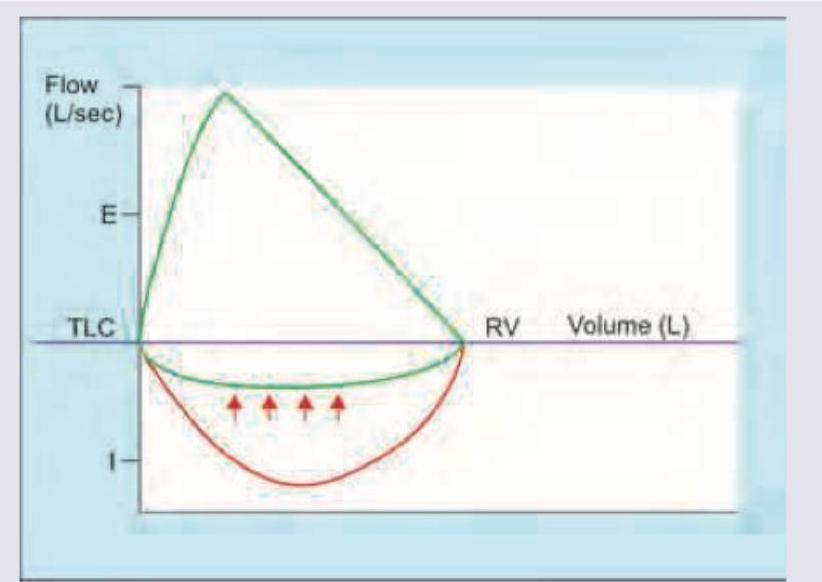
Which flow volume curve recording is shown below?
Cushing reflex is associated with all except?
Nociceptive signals from the face and head are transmitted primarily to which of the following?
Explanation: ***Renal blood flow decreases*** - During shock, the **primary and most fundamental** physiological change affecting the kidney is a marked **reduction in renal blood flow (RBF)**. - Shock triggers intense **sympathetic activation** and **renin-angiotensin system (RAS) activation**, causing preferential **vasoconstriction** of renal vessels to redirect blood to vital organs (brain, heart). - RBF can drop to as low as **20-30% of normal** in severe shock, making this the hallmark renal response. - This reduction in RBF is the **upstream event** that triggers all other renal changes during shock. *Perfusion of kidney decreases* - While technically correct, "decreased perfusion" is **essentially synonymous** with decreased blood flow in this context. - The term "renal blood flow" is the **standard physiological terminology** used in medical literature to describe this phenomenon, making it the more precise answer. *Afferent arteriole resistance increases* - This is a **mechanism** by which RBF decreases, not the overall response itself. - Increased afferent arteriolar resistance is **secondary** to sympathetic activation and angiotensin II effects during shock. - It describes the "how" rather than the "what" of the kidney's response. *GFR decreases* - GFR reduction is a **consequence** of decreased RBF and increased afferent arteriolar resistance. - While clinically important (oliguria/acute kidney injury), it's a **downstream effect** rather than the primary physiological response. - The relationship: ↓RBF → ↓Glomerular hydrostatic pressure → ↓GFR
Explanation: ***N2 narcosis*** - **Nitrogen narcosis**, also known as **inert gas narcosis** or **depth intoxication**, is caused by the increased partial pressure and resulting increased solubility of nitrogen in body tissues, particularly the brain, at depth. - This leads to altered mental states, similar to alcohol intoxication, including impaired judgment, confusion, and euphoria, posing significant risks to divers. *CO narcosis* - **Carbon monoxide (CO) narcosis** is a rare condition that would only occur if the air supply being breathed by the diver was contaminated with CO. - CO poisoning results from carbon monoxide binding to **hemoglobin** with high affinity, forming **carboxyhemoglobin** and reducing the oxygen-carrying capacity of the blood, leading to tissue hypoxia. *CO2 narcosis* - **Carbon dioxide (CO2) narcosis** occurs due to an excessive buildup of carbon dioxide in the body, which can happen if a diver hypoventilates or if breathing equipment malfunctions, leading to inadequate removal of CO2. - Symptoms include headache, confusion, drowsiness, and in severe cases, loss of consciousness; however, it is not primarily due to increased gas solubility in an inert gas context but rather an imbalance in respiratory gas exchange. *O2 toxicity* - **Oxygen toxicity** is a condition caused by breathing high partial pressures of oxygen for prolonged periods, which can lead to damage in various organ systems, including the central nervous system (CNS) and lungs. - This is a distinct phenomenon from narcosis, where the physiological effects are primarily due to the toxic effects of oxygen on cellular function rather than the inert gas properties of nitrogen dissolving in tissues.
Explanation: ***Immersion syndrome*** - **Hydrocution**, also known as **immersion syndrome**, refers to sudden death that occurs immediately upon immersion in cold water. - It is typically caused by a sudden **vagal nerve reflex** leading to **bradycardia** and **asystole** due to the sudden temperature change and not necessarily due to aspiration of water. *Wet drowning* - **Wet drowning** involves the aspiration of fluid into the lungs, leading to respiratory compromise and subsequent death. - This is not the primary mechanism of death in hydrocution, which is typically a reflex cardiac arrest. *Near drowning* - **Near drowning** refers to survival, at least temporarily, after an immersion incident, regardless of whether aspiration occurred. - Hydrocution results in immediate death, thus it is not considered near drowning. *Dry drowning* - **Dry drowning** occurs when the glottis spasms and prevents water from entering the lungs, leading to asphyxia. - While aspiration of water does not occur, the mechanism differs from hydrocution where death is due to a vagal reflex affecting the heart.
Explanation: ***Kyphosis*** - **Kyphosis** is defined as an exaggerated posterior curvature of the **thoracic spine**, often seen in older adults due to **osteoporosis** or degenerative disc disease. - The patient's age and description of an "abnormally increased curvature of the thoracic vertebral column" directly correspond to the definition of **kyphosis**. *Meningocele* - A **meningocele** is a type of **spina bifida** where the meninges protrude through an opening in the spine, forming a sac. - This condition involves a **neural tube defect** and typically presents at birth, not as an acquired condition in a 69-year-old. *Meningomyelocele* - A **meningomyelocele** is a more severe form of **spina bifida** where the spinal cord and meninges protrude through an opening in the spine. - Like meningocele, it is a congenital birth defect and does not present as an abnormally increased spinal curvature in an elderly individual. *Lordosis* - **Lordosis** is an exaggerated anterior curvature, most commonly affecting the **lumbar spine**. - It results in an inward swayback appearance, which is the opposite of an increased posterior curvature of the thoracic spine.
Explanation: ***Pain in the joints is due to nitrogen bubbles*** - Caisson's disease, or **decompression sickness**, is characterized by the formation of nitrogen gas bubbles in tissues and blood due to rapid depressurization. - These gas bubbles can accumulate in joints, causing **severe pain** often referred to as "the bends." *Lung damage is caused by air embolism* - While air embolism can occur due to **pulmonary barotrauma** during ascent (rapid depressurization), the primary lung damage associated with decompression sickness is not typically directly caused by an air embolism reaching the lungs from within the body. - Air embolism from pulmonary barotrauma is a distinct complication, where air from ruptured alveoli enters the arterial circulation, potentially leading to cerebral or cardiac ischemia. *Tremors are seen due to nitrogen narcosis* - **Nitrogen narcosis** is a condition that occurs at high ambient pressures when breathing compressed air, causing a reversible alteration in consciousness similar to alcohol intoxication, but it does not primarily cause tremors. - Tremors are more characteristic of other neurological conditions or high-pressure nervous syndrome, not nitrogen narcosis itself. *High pressure Nervous syndrome can be prevented by using mixtures of Oxygen & Helium* - **High-pressure nervous syndrome (HPNS)** is indeed associated with deep dives using helium-oxygen mixtures. Its symptoms include tremors. - HPNS is actually **prevented or mitigated** by adding small amounts of narcotic gases like nitrogen to the helium-oxygen mixture (e.g., trimix) to counteract the excitatory effects of helium, rather than solely using oxygen and helium.
Explanation: ***> 200 mmHg*** - In a **normal healthy person** breathing FiO2 of 0.5 (50% oxygen), the expected **PaO2** is typically **250-300 mmHg**. - Using the **alveolar gas equation**: PAO2 = FiO2(PB - PH2O) - PaCO2/RQ = 0.5(760 - 47) - 40/0.8 ≈ **306 mmHg** - The normal **A-a gradient** is 5-15 mmHg, so PaO2 = 306 - 10 ≈ **296 mmHg** - **Clinical rule of thumb**: PaO2 ≈ 5 × FiO2% = 5 × 50 = **250 mmHg** (approximation accounting for physiological shunt) - Therefore, the expected range is clearly **> 200 mmHg** in a normal individual *150–200 mmHg* - This range would indicate **mild oxygenation impairment** or increased shunt fraction - While adequate for tissue oxygenation, this is **lower than expected** for a normal person on 50% oxygen - May suggest underlying **mild V/Q mismatch** or early pulmonary dysfunction *100–150 mmHg* - This represents **moderate impairment** in oxygen transfer - Indicates significant **pulmonary pathology** such as pneumonia, ARDS, or substantial shunt - Not consistent with normal lung function on FiO2 0.5 *< 100 mmHg* - This represents **severe hypoxemia** despite supplemental oxygen - Indicates **critical pulmonary dysfunction** with large shunt or severe V/Q mismatch - Requires immediate intervention and is never expected in a healthy individual on 50% oxygen
Explanation: ***Bohr equation*** - The Bohr equation is used to calculate **physiological dead space**, which is the sum of anatomical dead space and alveolar dead space. - It relates the partial pressure of carbon dioxide in arterial blood to the partial pressure of carbon dioxide in expired air, along with **tidal volume** and expired volume. *Dalton's law* - Dalton's law states that the **total pressure** exerted by a mixture of non-reactive gases is equal to the **sum of the partial pressures** of individual gases. - It is used to calculate partial pressures of gases in a mixture, not dead space. *Charles's law* - Charles's law describes the relationship between the **volume and temperature** of a gas at constant pressure. - It states that the volume of a given mass of gas is directly proportional to its absolute temperature. *Boyle's law* - Boyle's law describes the inverse relationship between the **pressure and volume** of a gas at constant temperature. - It is fundamental to understanding mechanics of breathing, but not dead space calculation.
Explanation: ***Variable extrathoracic obstruction*** - This flow-volume loop shows a **flattening** of the **inspiratory limb** (I), while the expiratory limb (E) remains relatively normal. - Variable extrathoracic obstructions, such as vocal cord dysfunction or laryngeal edema, predominantly affect airflow during inspiration because the extrathoracic airway pressure becomes more negative than atmospheric pressure during inspiration, leading to airway narrowing. *Parenchymal obstructive airway disease* - Characterized by a **diminished expiratory flow** and a **scooped-out appearance** of the expiratory limb on the flow-volume loop. - The inspiratory limb is usually well preserved, which is not seen here as the inspiratory limb is significantly affected. *Restrictive defect* - Presents as a **miniature version of a normal flow-volume loop**, indicating reduced lung volumes, but usually with preserved flow rates for the given lung volume. - Both inspiratory and expiratory flows would be proportionally reduced, unlike the isolated inspiratory flattening shown. *Variable intrathoracic obstruction* - This typically causes a **flattening or reduction in the expiratory limb** of the flow-volume loop, with a relatively normal inspiratory limb. - During forced expiration, the positive intrathoracic pressure compresses the compromised intrathoracic airway, leading to obstruction.
Explanation: ***Hypotension*** - The **Cushing reflex** is a compensatory response to increased intracranial pressure (ICP) aiming to maintain cerebral perfusion, which typically involves **hypertension**, not hypotension. - While prolonged or severe ICP can lead to decompensation and eventual hypotension, it is not a direct component of the reflex itself. *Increased intracranial pressure* - The **Cushing reflex** is triggered by an elevation in **intracranial pressure (ICP)**, as the body attempts to maintain blood flow to the brain. - This increased ICP reduces cerebral perfusion pressure, prompting a systemic response to raise mean arterial pressure. *Bradycardia* - **Bradycardia** is a classic component of the **Cushing reflex**, occurring as a compensatory response to the reflex hypertension. - The increased arterial blood pressure stimulates carotid and aortic baroreceptors, leading to a vagal response that slows the heart rate. *Irregular respiration* - **Irregular respiration** is another key component of the **Cushing reflex**, often manifesting as **Cheyne-Stokes breathing** or **ataxic breathing**. - This respiratory dysregulation is due to direct compression and dysfunction of the brainstem, specifically the medullary respiratory centers, caused by increased ICP.
Explanation: ***Nucleus caudalis*** - The **nucleus caudalis** (spinal trigeminal nucleus, pars caudalis) is the primary processing center for **nociceptive (pain)** information from the face and head, received via the trigeminal nerve. - It extends into the upper cervical spinal cord and is functionally analogous to the dorsal horn of the spinal cord for body pain. *Limbic system* - The **limbic system** is involved in the **emotional processing** of pain, memory, and motivation, but it does not receive primary nociceptive input directly from the face and head. - It receives projections from areas like the thalamus and somatosensory cortex after initial processing. *Reticular system* - The **reticular system** plays a role in alertness, sleep-wake cycles, and modulates pain perception, but it is not the primary relay for initial nociceptive signals. - It has diffuse connections throughout the brainstem and receives inputs from ascending sensory pathways. *Superior cervical ganglion* - The **superior cervical ganglion** is part of the **sympathetic nervous system** and is involved in controlling functions like pupillary dilation and salivary gland secretion. - It does not directly receive or process nociceptive signals from the face and head.
Get full access to all questions, explanations, and performance tracking.
Start For Free