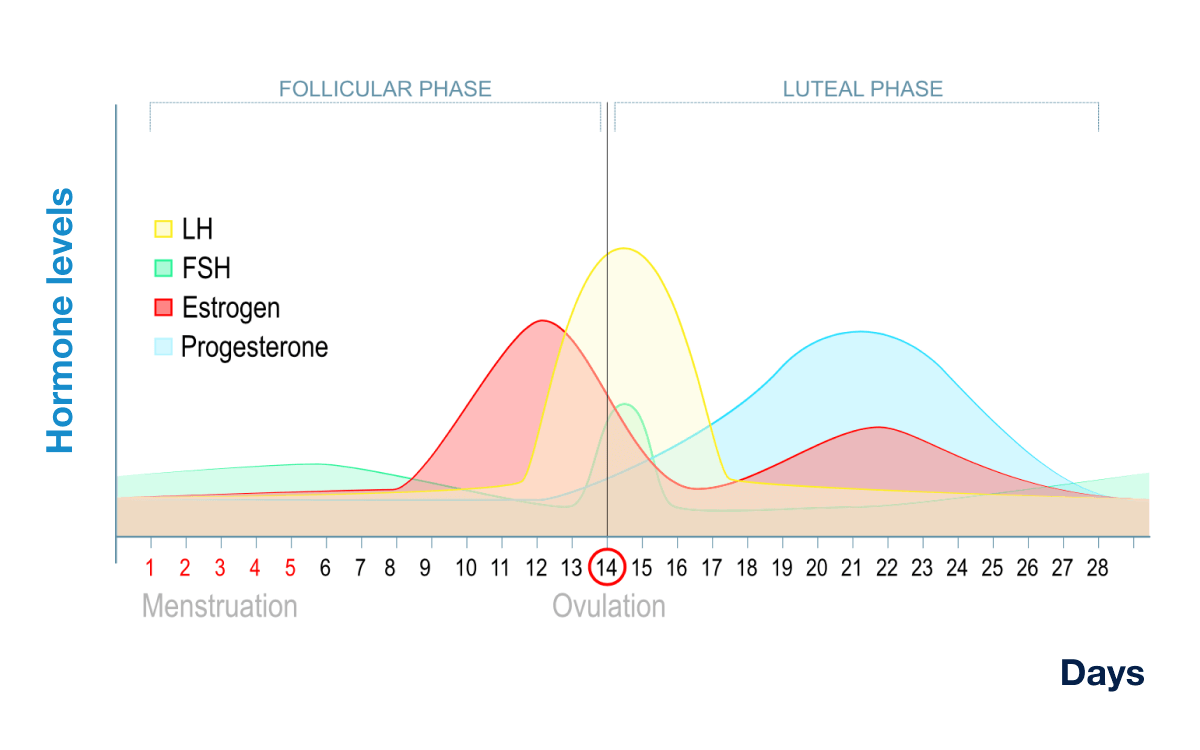
During the female hormonal cycle, when do progesterone levels reach their highest point?
Inhibin is secreted by:
What is the typical ratio of Follicle Stimulating Hormone (FSH) to Luteinizing Hormone (LH) during the reproductive years?
What is the most common site of fertilization?
Which of the following physiological changes is LEAST likely to occur during pregnancy?
What hormonal changes occur at puberty?
Separation of the first polar body occurs at the time of:
In human males, where does meiosis occur?
What will serum levels of different hormones reveal when estimated on the exact day of ovulation?
What is the velocity of sperms in the female genital tract?
Explanation: **Explanation:** The female menstrual cycle is divided into the follicular and luteal phases. Progesterone is primarily secreted by the **corpus luteum**, which forms from the remnants of the Graafian follicle **after ovulation** has occurred. 1. **Why Option A is correct:** Following ovulation (around day 14), the luteal phase begins. The corpus luteum secretes large amounts of progesterone to prepare the endometrium for potential implantation. Progesterone levels peak approximately **7 to 8 days after ovulation** (around day 21–22 of a 28-day cycle), which falls exactly between ovulation and the onset of the next menstruation. 2. **Why the other options are incorrect:** * **Option B:** Immediately before ovulation, the dominant hormone is **Estrogen**, which triggers the LH surge. Progesterone levels are negligible at this stage. * **Option C:** The LH peak (LH surge) occurs 24–36 hours *before* ovulation. At this point, progesterone is only just beginning to rise slightly (pre-ovulatory luteinization); it does not reach its peak until several days later. * **Option D:** The development of primary follicles occurs during the early follicular phase. This stage is dominated by FSH and rising Estrogen, not Progesterone. **NEET-PG High-Yield Pearls:** * **Source:** Progesterone is secreted by the *Granulosa lutein* cells of the corpus luteum. * **Function:** It is the "hormone of pregnancy" and is responsible for the **secretory changes** in the endometrium and the rise in **Basal Body Temperature** (thermogenic effect) post-ovulation. * **Diagnostic Use:** A serum progesterone level >3 ng/mL on day 21 is a reliable indicator that ovulation has occurred.
Explanation: **Explanation:** **Inhibin** is a glycoprotein hormone that plays a crucial role in the negative feedback regulation of the hypothalamic-pituitary-gonadal axis. Its primary function is to selectively inhibit the secretion of **Follicle-Stimulating Hormone (FSH)** from the anterior pituitary. 1. **Why Option A is Correct:** In females, Inhibin (specifically Inhibin A and B) is synthesized and secreted by the **Granulosa cells** of the developing ovarian follicles. In males, it is produced by the **Sertoli cells** of the testes. The secretion of Inhibin is stimulated by FSH, and in turn, Inhibin suppresses FSH to prevent over-stimulation of the follicles, ensuring a controlled reproductive cycle. 2. **Why Other Options are Incorrect:** * **Option B (Endometrial stromal tumor):** These are mesenchymal tumors of the uterus. They typically do not secrete inhibin; their markers are more related to CD10 expression. * **Option C (Endodermal sinus tumor):** Also known as Yolk Sac Tumor, this is a germ cell tumor characterized by the production of **Alpha-Fetoprotein (AFP)**, not inhibin. * **Option D (Endometrial adenocarcinoma):** This is a common malignancy of the uterine lining. It is usually monitored via CA-125 or histopathological grading, as it does not produce inhibin. **High-Yield Clinical Pearls for NEET-PG:** * **Tumor Marker:** Inhibin is a highly specific and sensitive tumor marker for **Granulosa Cell Tumors** of the ovary. It is used for both diagnosis and monitoring recurrence. * **Inhibin B vs. A:** Inhibin B is the primary form during the follicular phase (secreted by small antral follicles), while Inhibin A peaks during the luteal phase (secreted by the corpus luteum). * **Dual Action:** While Inhibin suppresses FSH, **Activin** (also produced by granulosa cells) stimulates FSH secretion.
Explanation: ### Explanation **1. Why the Correct Answer is Right (Option A):** During the reproductive years (menarche to menopause), the basal secretion of **Luteinizing Hormone (LH) is typically higher than Follicle Stimulating Hormone (FSH)**. This is primarily due to the differential sensitivity of gonadotrophs to Gonadotropin-Releasing Hormone (GnRH) pulses and the feedback inhibition by **Inhibin B**, which specifically suppresses FSH secretion from the anterior pituitary. While FSH is essential for early follicular recruitment, LH remains the dominant gonadotropin throughout the cycle to maintain androgen production and trigger ovulation. **2. Why the Other Options are Wrong:** * **Option B:** FSH is greater than LH only during specific life stages: **Infancy (pre-puberty)** and **Post-menopause**. In menopause, the loss of ovarian follicles leads to a drop in Estrogen and Inhibin, removing the negative feedback and causing FSH to rise more dramatically than LH (FSH > LH). * **Option C:** FSH and LH are never equal in a physiological steady state. Their secretion patterns are distinct, driven by different GnRH pulse frequencies (fast pulses favor LH; slow pulses favor FSH). * **Option D:** Both hormones are always present during reproductive years. LH is never absent, as it is required for theca cell function and progesterone production. **3. Clinical Pearls & High-Yield Facts for NEET-PG:** * **FSH:LH Ratio in PCOS:** A classic (though not diagnostic) finding in Polycystic Ovary Syndrome is a **reversed ratio where LH:FSH > 2:1 or 3:1**, leading to hyperandrogenism and anovulation. * **The "FSH > LH" Rule:** Remember that FSH is higher than LH at the "extremes of life" (Childhood and Menopause). * **Inhibin Secretion:** Inhibin **B** is highest in the follicular phase (inhibits FSH), while Inhibin **A** is highest in the luteal phase. * **GnRH Pulse Frequency:** High-frequency pulses favor **LH**; low-frequency pulses favor **FSH**.
Explanation: **Explanation:** **1. Why Ampulla is Correct:** Fertilization typically occurs in the **ampulla** of the fallopian tube. The ampulla is the widest and longest portion of the uterine tube, making it the ideal anatomical site for the meeting of the secondary oocyte and the capacitated spermatozoa. Following ovulation, the oocyte is transported into the tube, where it remains viable for approximately 12–24 hours, awaiting fertilization in this specific segment. **2. Why Other Options are Incorrect:** * **Cervix:** This is the lower part of the uterus that acts as a gateway. While it serves as a reservoir for sperm and filters out poor-quality spermatozoa via cervical mucus, fertilization does not occur here. * **Fimbriae:** These are finger-like projections at the distal end of the fallopian tube. Their primary function is to "sweep" the ovulated oocyte from the peritoneal cavity into the infundibulum; they are not the site of fertilization. * **Uterus:** The uterus is the site of **implantation** (specifically the posterior wall of the fundus). If fertilization occurs here, it is usually unsuccessful or considered abnormal, as the zygote must undergo several divisions (cleavage) in the tube before reaching the uterine cavity as a blastocyst. **3. Clinical Pearls & High-Yield Facts for NEET-PG:** * **Ectopic Pregnancy:** The ampulla is also the **most common site for ectopic pregnancy** (approx. 70-80% of tubal pregnancies). * **Timing:** Fertilization usually occurs within 12–24 hours after ovulation. * **Capacitation:** Sperm must undergo "capacitation" (removal of glycoprotein coat) in the female reproductive tract (mostly in the uterus and tubes) before they can fertilize the egg in the ampulla. * **Zygote Transport:** It takes approximately 3–4 days for the fertilized ovum to travel from the ampulla to the uterine cavity.
Explanation: **Explanation:** The correct answer is **D. A decrease in vital capacity.** In pregnancy, the diaphragm is displaced superiorly by approximately 4 cm due to the enlarging uterus. However, this is compensated for by an increase in the anteroposterior and transverse diameters of the thoracic cage (mediated by relaxin). Consequently, while the **Functional Residual Capacity (FRC)** and **Residual Volume (RV)** decrease, the **Vital Capacity (VC) remains unchanged** or may even show a slight increase. This is a high-yield distinction in maternal physiology. **Analysis of Incorrect Options:** * **Option A:** Pregnancy is a state of "hemodilution." While platelet production increases, the massive increase in plasma volume leads to a relative decrease in concentration, often resulting in **gestational thrombocytopenia** (platelets at the lower end of normal). * **Option B:** The **White Blood Cell (WBC) count increases** during pregnancy (physiologic leukocytosis), typically ranging from 5,000–12,000/mm³ and can rise up to 25,000/mm³ during labor. * **Option C:** Pregnancy is a **hypercoagulable state**. There is a marked increase in most clotting factors (especially VII, VIII, IX, X, and Fibrinogen) and a decrease in Protein S and fibrinolytic activity to prevent postpartum hemorrhage. **NEET-PG High-Yield Pearls:** * **Most common respiratory change:** Increase in **Tidal Volume** (by ~40%), leading to physiologic hyperventilation and respiratory alkalosis. * **Cardiac Output:** Increases by 30-50%, peaking at 28-32 weeks. * **Blood Volume:** Plasma volume increases (50%) more than RBC mass (20-30%), causing **physiologic anemia**.
Explanation: **Explanation:** Puberty is characterized by the reactivation of the **Hypothalamic-Pituitary-Gonadal (HPG) axis**, which remains dormant during childhood. The physiological hallmark of this transition is the pulsatile release of **GnRH** from the hypothalamus, which stimulates the anterior pituitary to secrete gonadotropins (**FSH and LH**). These, in turn, stimulate the gonads to produce sex steroids. **Why Option C is Correct:** In females, the maturation of the HPG axis leads to follicular development and eventually **ovulation**. Once ovulation occurs, the ruptured follicle transforms into the **corpus luteum**, which secretes significant amounts of **progesterone**. Therefore, an increase in progesterone levels is a definitive hormonal marker of the functional maturation of the reproductive system during puberty. **Analysis of Incorrect Options:** * **A & B (Decreased FSH, LH, and GnRH):** These are incorrect because puberty is defined by an **increase** in these hormones. The "gonadostat" becomes less sensitive to negative feedback, leading to a surge in GnRH pulse frequency and amplitude. * **D (Decreased Estrogen):** This is incorrect as estrogen levels **increase** significantly during puberty, responsible for secondary sexual characteristics like breast development (thelarche) and skeletal maturation. **NEET-PG High-Yield Pearls:** * **First Sign of Puberty:** In girls, it is **Thelarche** (breast budding); in boys, it is **Testicular enlargement** (>4ml volume). * **Leptin’s Role:** A critical level of body fat (and the hormone Leptin) is required to trigger the GnRH pulse generator. * **Nocturnal Pulses:** The earliest hormonal change detectable is the **nocturnal (sleep-associated) pulsatile secretion of LH**. * **Sequence in Girls:** Thelarche → Pubarche (adrenarche) → Growth Spurt → Menarche.
Explanation: **Explanation:** The separation of the first polar body is a hallmark of the completion of **Meiosis I**. In the female reproductive cycle, primary oocytes are arrested in the **prophase of Meiosis I (specifically the diplotene stage)** from fetal life until puberty. 1. **Why Ovulation is Correct:** Just prior to ovulation, the **LH (Luteinizing Hormone) surge** triggers the completion of Meiosis I. This division is unequal, resulting in a large **secondary oocyte** and a small, non-functional **first polar body**. Therefore, the first polar body is extruded at the time of ovulation. 2. **Why other options are incorrect:** * **Fertilization:** This is when the **second polar body** is extruded. The secondary oocyte arrests in **Metaphase of Meiosis II** and only completes this division if a sperm penetrates the zona pellucida. * **Implantation:** This occurs approximately 6–7 days after fertilization (at the blastocyst stage) and is unrelated to meiotic division. * **Menstruation:** This is the shedding of the endometrial lining due to progesterone withdrawal; oocyte maturation stages are completed much earlier in the cycle. **High-Yield NEET-PG Pearls:** * **Arrest Points:** Remember "Primary-Prophase" (1st arrest) and "Secondary-Metaphase" (2nd arrest). * **DNA Content:** The first polar body is haploid (23 chromosomes) but contains double-structured DNA (2n chromatids). * **Clinical Correlation:** Failure of polar body extrusion or non-disjunction during these stages is the primary cause of maternal aneuploidies (e.g., Trisomy 21).
Explanation: **Explanation:** **1. Why Seminiferous Tubules is Correct:** The seminiferous tubules are the functional units of the testes where **spermatogenesis** occurs. This complex process involves the transformation of diploid spermatogonia into haploid spermatozoa. Meiosis is the critical reduction division within this process: * **Meiosis I:** Primary spermatocytes (46, XY) undergo the first division to form secondary spermatocytes (23, XY or 23, XX). * **Meiosis II:** Secondary spermatocytes quickly divide to form haploid spermatids. This entire progression occurs within the germinal epithelium of the seminiferous tubules, supported by Sertoli cells. **2. Why Other Options are Incorrect:** * **Epididymis (A):** This is the site for **functional maturation** and storage of sperm. Here, sperm acquire motility and the ability to fertilize an ovum, but no cell division (meiosis) occurs. * **Vas deferens (C):** This is a muscular transport duct that conveys mature sperm from the epididymis to the ejaculatory duct during emission. * **Seminal vesicles (D):** These are accessory glands that secrete a fructose-rich alkaline fluid (constituting ~60-70% of semen volume) to nourish sperm; they are not involved in sperm production. **3. NEET-PG High-Yield Pearls:** * **Blood-Testis Barrier:** Formed by tight junctions between **Sertoli cells**; it protects developing meiotic germ cells from the immune system. * **Duration:** The entire process of spermatogenesis takes approximately **74 days**. * **Temperature:** Spermatogenesis requires a temperature **2–2.5°C lower** than core body temperature, maintained by the pampiniform plexus and scrotal position. * **Hormonal Control:** LH stimulates Leydig cells (testosterone), while FSH stimulates Sertoli cells to support meiosis.
Explanation: ### Explanation **Concept:** Ovulation is triggered by a complex neuroendocrine feedback loop. In the late follicular phase, high levels of **estrogen** (produced by the dominant follicle) exert **positive feedback** on the anterior pituitary. This results in the **LH surge**, which is the primary trigger for the rupture of the Graafian follicle. Simultaneously, a smaller **FSH surge** occurs. On the exact day of ovulation, both gonadotropins (FSH and LH) reach their peak concentrations to ensure follicular rupture and the resumption of meiosis I in the oocyte. **Analysis of Options:** * **Option D (Correct):** Both FSH and LH must remain high (surge) during the midcycle. The LH surge precedes ovulation by about 24–36 hours and peaks roughly 10–12 hours before the egg is released. * **Option A & B:** These are incorrect regarding the steroid profile. On the day of ovulation, **estrogen levels actually begin to decline** slightly after their pre-ovulatory peak, while **progesterone levels begin to rise** (luteinization starts even before the follicle ruptures). * **Option C:** This is incorrect because **Inhibin-B** actually peaks during the midcycle surge (alongside FSH) as it is secreted by the granulosa cells of the pre-ovulatory follicle. **High-Yield NEET-PG Pearls:** 1. **The Trigger:** Estrogen must maintain a concentration of **>200 pg/mL for at least 48 hours** to initiate the LH surge (Positive Feedback). 2. **LH Surge:** This is the most reliable predictor of ovulation. It causes the conversion of the follicle into the corpus luteum. 3. **Meiosis:** The LH surge triggers the completion of **Meiosis I** and arrests the oocyte in **Metaphase of Meiosis II** until fertilization. 4. **Mittelschmerz:** Midcycle pelvic pain associated with ovulation due to follicular fluid or blood irritating the peritoneum.
Explanation: **Explanation:** The correct answer is **A. 1-3 mm/day**. **Understanding the Concept:** Sperm transport through the female genital tract is a complex process involving both intrinsic sperm motility and extrinsic factors like uterine and fallopian tube contractions. While sperm can swim at a rate of approximately 1–4 mm per **minute** in a laboratory setting, their actual net progression through the viscous environment of the female reproductive tract is significantly slower. Standard physiological texts (such as Guyton and Hall) specify that sperms travel at a velocity of approximately **1 to 3 mm/min**, which translates to a net progression often simplified in clinical examinations as **1-3 mm/day** regarding their functional survival and transit time to the ampulla. **Analysis of Options:** * **A (1-3 mm/day):** This is the standard value cited in medical literature for the average rate of sperm progression within the female reproductive tract. * **B, C, and D:** These values (4-10 mm/day) overestimate the average velocity. While individual sperm may move faster in certain segments (like the cervix during ovulation), the overall average velocity remains lower. **Clinical Pearls for NEET-PG:** * **Capacitation:** This is the functional maturation of sperm occurring in the female tract (taking 5–7 hours), involving the removal of cholesterol and inhibitory proteins from the acrosome. * **Site of Fertilization:** The **ampulla** of the fallopian tube. * **Sperm Survival:** Sperms typically survive for **24–48 hours** in the female tract, though some may remain viable for up to 5 days. * **Chemotaxis:** Sperms are guided toward the oocyte by chemical signals (progesterone) and thermotaxis (temperature gradients).
Male Reproductive Physiology
Practice Questions
Spermatogenesis and Sperm Function
Practice Questions
Female Reproductive Physiology
Practice Questions
Menstrual Cycle
Practice Questions
Ovulation and Fertilization
Practice Questions
Physiology of Pregnancy
Practice Questions
Parturition
Practice Questions
Lactation
Practice Questions
Sexual Differentiation and Development
Practice Questions
Reproductive Aging
Practice Questions
Get full access to all questions, explanations, and performance tracking.
Start For Free