Spermatozoa obtain their nourishment from which of the following?
Which enzyme is NOT important in testosterone biosynthesis?
Which of the following is NOT secreted by Sertoli cells?
Sterility in man is defined as a sperm count below which value (in millions/mL)?
Increased gonadal production of estrogen is characteristic of which of the following conditions?
Ferning of cervical mucus depends on which hormone?
Which of the following statements regarding the endometrium is true?
Capacitation of sperm proceeds in which location?
Which is the major hormone secreted by the corpus luteum in a woman of reproductive age?
The production of cervical mucus is stimulated by which hormone?
Explanation: **Explanation:** The correct answer is **Fructose**. **Why Fructose is the correct answer:** Spermatozoa require a constant energy source for motility and survival. The **seminal vesicles** secrete a thick, alkaline fluid that constitutes about 60-70% of the total semen volume. This fluid is rich in **fructose**, which serves as the primary glycolytic fuel for sperm. Unlike most cells in the body that prefer glucose, spermatozoa have adapted to utilize fructose via the GLUT-5 transporter. Fructose provides the necessary ATP through anaerobic and aerobic pathways to power the flagellar movement (motility) required for the journey through the female reproductive tract. **Why other options are incorrect:** * **Glucose:** While glucose can be metabolized by sperm, it is not the primary sugar provided in the seminal vesicle secretion. * **Galactose & Lactose:** These are milk sugars. Galactose is primarily metabolized in the liver, and lactose is a disaccharide found in dairy. Neither is present in significant quantities in seminal fluid nor serves as a physiological energy source for sperm. **High-Yield NEET-PG Pearls:** * **Site of Secretion:** Fructose is exclusively produced by the **seminal vesicles**. * **Clinical Correlation:** In cases of obstructive azoospermia (e.g., congenital bilateral absence of the vas deferens or CBAVD), a **fructose test** is performed on the semen. The **absence of fructose** indicates a blockage or absence of the seminal vesicles. * **Prostaglandins:** Seminal vesicles also secrete prostaglandins, which help thin the cervical mucus and induce retrograde contractions in the female reproductive tract to aid sperm transport. * **pH:** Seminal fluid is alkaline, which helps neutralize the acidic environment of the vagina.
Explanation: **Explanation:** The biosynthesis of testosterone occurs primarily in the Leydig cells of the testes via the steroidogenic pathway. The correct answer is **18-hydroxylase** because this enzyme is specific to the **adrenal cortex** (specifically the Zona Glomerulosa), where it is required for the final steps of **aldosterone synthesis**. It plays no role in the production of androgens. **Analysis of Options:** * **18-hydroxylase (Correct):** Also known as aldosterone synthase, it converts corticosterone to aldosterone. Its absence in the testes ensures that mineralocorticoids are not produced there. * **Delta 5-4 isomerase:** This enzyme (along with 3β-HSD) is crucial for converting pregnenolone to progesterone or dehydroepiandrosterone (DHEA) to androstenedione, which are intermediate steps in testosterone production. * **Alpha-hydroxylase (17-alpha hydroxylase):** This is a key enzyme in the steroidogenic pathway. It converts progesterone/pregnenolone into 17-hydroxy derivatives, which are essential precursors for both cortisol and testosterone. * **5-alpha reductase:** While testosterone is the primary product of the testes, 5-alpha reductase is the enzyme responsible for converting testosterone into its more potent metabolite, **Dihydrotestosterone (DHT)**, in peripheral tissues and the prostate. In the context of "testosterone biosynthesis" pathways often discussed in exams, it is considered part of the androgenic metabolic machinery. **High-Yield NEET-PG Pearls:** * **Rate-limiting step:** The conversion of cholesterol to pregnenolone by the enzyme **Desmolase** (stimulated by LH). * **17β-HSD:** The final enzyme that converts androstenedione to testosterone. * **Congenital Adrenal Hyperplasia (CAH):** A deficiency in 17α-hydroxylase leads to decreased testosterone and cortisol but increased mineralocorticoids (causing hypertension and sexual infantilism).
Explanation: The key to answering this question lies in understanding the **Two-Cell, Two-Gonadotropin Theory** of the testes. ### Why Androgen is the Correct Answer **Androgens (specifically Testosterone)** are synthesized and secreted by the **Leydig cells** (interstitial cells) under the influence of Luteinizing Hormone (LH). Sertoli cells lack the enzyme **17β-hydroxysteroid dehydrogenase**, which is essential for the final step of testosterone synthesis. Therefore, Sertoli cells do not produce androgens; they are the *targets* of androgens. ### Why the Other Options are Incorrect * **Aromatase (B):** Sertoli cells contain the enzyme aromatase, which converts testosterone (diffusing from Leydig cells) into **estrogens**. This is a crucial function for local regulation. * **Inhibin (C):** Sertoli cells secrete **Inhibin B**, which provides negative feedback to the anterior pituitary to inhibit the secretion of Follicle-Stimulating Hormone (FSH). * **ABP (Androgen Binding Protein) (D):** Secreted by Sertoli cells in response to FSH, ABP binds to testosterone to maintain high local concentrations within the seminiferous tubules, which is essential for spermatogenesis. ### High-Yield NEET-PG Pearls * **Sertoli Cell Functions (Mnemonic: "B-A-I-T"):** **B**lood-testis barrier formation, **A**BP/Aromatase/AMH production, **I**nhibin secretion, and **T**rophic support for sperm. * **Anti-Müllerian Hormone (AMH):** Also secreted by Sertoli cells; it causes regression of Müllerian ducts in male fetuses. * **Blood-Testis Barrier:** Formed by **tight junctions** between adjacent Sertoli cells, protecting developing sperm from the immune system. * **Sertoli-only syndrome:** A condition where germ cells are absent, leading to infertility, but testosterone levels remain normal because Leydig cells are unaffected.
Explanation: **Explanation:** The correct answer is **20 million/mL**. In reproductive physiology, while the average sperm count in a healthy male ranges from 100 to 150 million/mL, clinical **sterility (infertility)** is traditionally defined as a sperm count falling below **20 million/mL**. This condition is termed **Oligozoospermia**. **Why 20 million/mL is correct:** Even though only one sperm is required to fertilize an ovum, millions are necessary to ensure that a sufficient number reach the fallopian tubes. Sperm must survive the acidic vaginal environment and navigate the cervical mucus. Furthermore, many sperm are required to collectively release acrosomal enzymes (hyaluronidase and acrosin) to disperse the corona radiata and penetrate the zona pellucida of the oocyte. When the count drops below 20 million/mL, the probability of successful fertilization becomes statistically negligible. **Analysis of Incorrect Options:** * **40, 60, and 80 million/mL:** These values fall within the lower-to-mid range of normal fertility. While a count of 40 million/mL is lower than the average, it is still considered fertile and does not meet the clinical threshold for sterility. **High-Yield Clinical Pearls for NEET-PG:** * **WHO Criteria (Recent):** While 20 million/mL is the classic textbook definition for sterility, the WHO (2010/2021) lower reference limit for a "normal" semen analysis is **15 million/mL**. However, for exam purposes, 20 million/mL remains the standard benchmark. * **Azoospermia:** Total absence of sperm in the ejaculate. * **Asthenozoospermia:** Reduced sperm motility (Normal: >40% motile). * **Teratozoospermia:** Abnormal sperm morphology (Normal: >4% normal forms by Kruger’s criteria). * **Hypospermia:** Semen volume <1.5 mL.
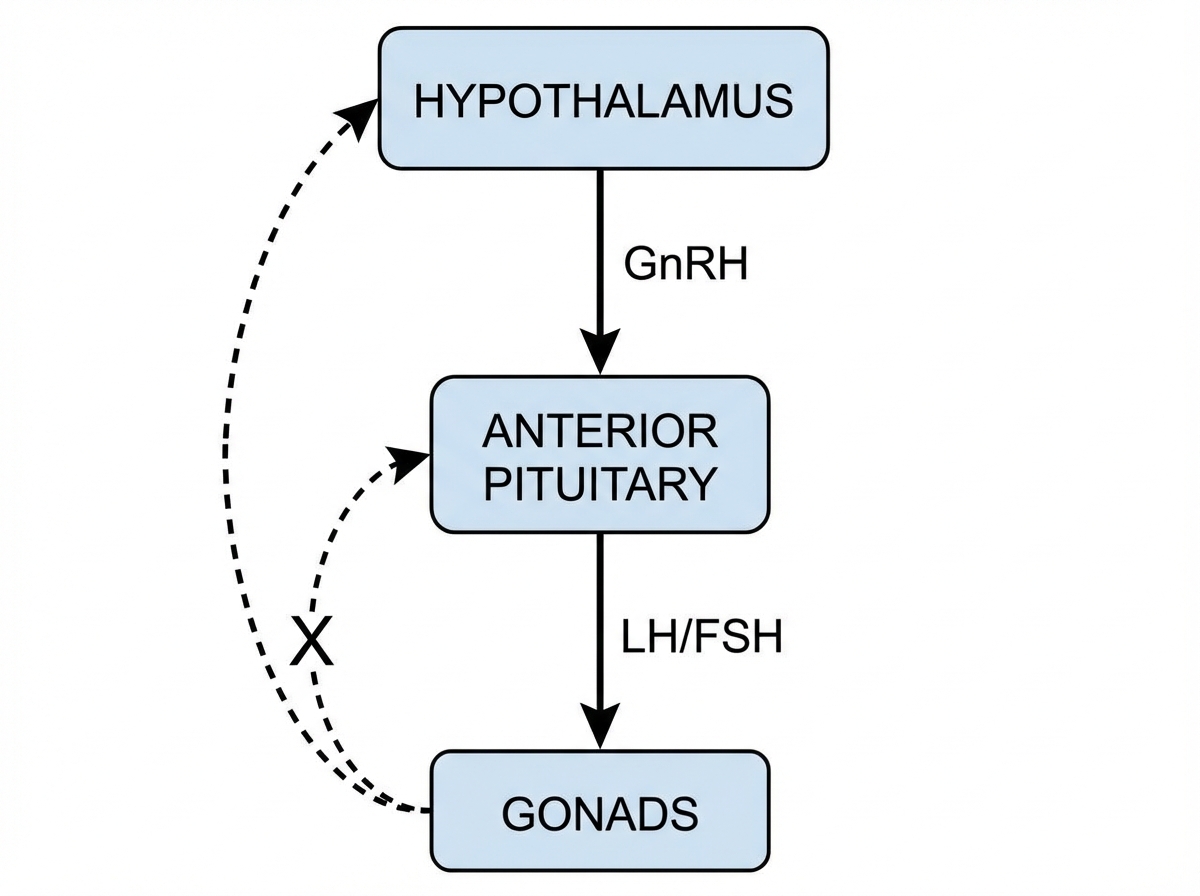
Explanation: **Explanation:** **Testicular Feminization (Androgen Insensitivity Syndrome - AIS)** is the correct answer. In this condition, there is a functional defect in androgen receptors. Because the body cannot respond to testosterone, the negative feedback loop to the hypothalamus and pituitary is disrupted. This leads to **increased LH secretion**, which chronically stimulates the Leydig cells of the testes. Consequently, the testes produce high levels of testosterone, much of which is peripherally converted into **estrogen** via the enzyme aromatase. This increased gonadal production of estrogen leads to female secondary sexual characteristics (e.g., breast development) in a genotypic male (46, XY). **Analysis of Incorrect Options:** * **Polycystic Ovarian Disease (PCOD):** While estrogen levels are often elevated, it is primarily due to the peripheral conversion of androstenedione (androgens) in adipose tissue, rather than direct increased gonadal production of estrogen. * **Congenital Adrenal Hyperplasia (CAH):** This condition typically involves a deficiency in enzymes like 21-hydroxylase, leading to a shunting of precursors toward **androgen** production. Estrogen levels are generally low or normal, not increased. * **Third Trimester of Pregnancy:** During pregnancy, the massive increase in estrogen is primarily produced by the **placenta** (using fetal adrenal precursors), not the maternal gonads (ovaries). **High-Yield Clinical Pearls for NEET-PG:** * **Karyotype in AIS:** 46, XY (Genotypic male, Phenotypic female). * **Key Finding:** Presence of undescended testes (often in the inguinal canal) and a blind-ending vagina with an absent uterus/fallopian tubes (due to normal MIS/AMH action). * **Biochemical Profile:** High Testosterone, High LH, and High Estrogen (relative to normal males).
Explanation: **Explanation:** The correct answer is **Estrogen (Option A)**. **1. Why Estrogen is Correct:** Ferning (or the "Fern Test") refers to the characteristic microscopic pattern of crystallization seen in cervical mucus when it is spread on a glass slide and allowed to air-dry. This phenomenon is directly dependent on high levels of **Estrogen**, which occur during the follicular phase of the menstrual cycle (peaking just before ovulation). Estrogen increases the concentration of **sodium chloride (NaCl)** and water in the cervical mucus. When the mucus dries, the high salt content crystallizes around the organic proteins, creating a pattern resembling fern fronds. **2. Why Other Options are Incorrect:** * **Progesterone (Option B):** Progesterone, dominant during the luteal phase, has the opposite effect. It makes cervical mucus thick, tenacious, and cellular, which **inhibits ferning**. This is known as the "progestational effect," which acts as a barrier to sperm. * **LH and FSH (Options C & D):** While these gonadotropins regulate the ovaries to produce estrogen and progesterone, they do not have a direct biochemical effect on the composition of cervical mucus. **3. NEET-PG High-Yield Pearls:** * **Spinnbarkeit Effect:** Under the influence of estrogen, cervical mucus becomes thin, clear, and highly stretchable (up to 8–10 cm). This is a clinical marker of the "ovulatory window." * **Clinical Use:** The disappearance of the fern pattern after mid-cycle is a presumptive sign that ovulation has occurred (due to the rise in progesterone). * **Amniotic Fluid:** The Fern Test is also used in obstetrics to detect the **Premature Rupture of Membranes (PROM)**, as amniotic fluid also exhibits ferning due to its high salt content.
Explanation: ### Explanation The blood supply to the uterus follows a specific hierarchical branching pattern that is crucial for understanding the menstrual cycle and endometrial shedding. **1. Why Option A is Correct:** The uterine artery gives rise to **arcuate arteries** (located in the myometrium), which branch into **radial arteries**. As the radial arteries cross the myometrium-endometrium junction, they divide into two types of vessels: * **Basal arteries:** Supply the *stratum basalis* (permanent layer). * **Spiral arteries:** Extend directly from the radial arteries to supply the *stratum functionalis* (deciduous layer). **2. Why the Other Options are Incorrect:** * **Option B & C:** Both basal and spiral arteries arise from the **radial arteries**, not directly from the arcuate arteries. Arcuate arteries are located deeper within the myometrium and must first branch into radial arteries to reach the endometrium. * **Option D:** While spiral arteries are located in the **functionalis layer**, radial arteries are located within the **myometrium**. The functionalis layer contains only the spiral arteries and the capillary plexus. ### High-Yield NEET-PG Pearls: * **Hormonal Sensitivity:** Spiral arteries are highly sensitive to progesterone. Their constriction (due to progesterone withdrawal) leads to ischemia and the shedding of the *stratum functionalis* during menstruation. * **Regeneration:** The *stratum basalis* (supplied by basal arteries) does not shed during menses; it serves as the reservoir for regenerating the endometrium during the proliferative phase. * **Sequence Summary:** Uterine artery → Arcuate artery → Radial artery → Spiral/Basal artery.
Explanation: **Explanation:** **Capacitation** is the final stage of sperm maturation, involving physiological changes that render the sperm capable of fertilizing an ovum. While sperm are morphologically mature and motile upon leaving the male reproductive system, they are functionally "deactivated" by inhibitory factors in the seminal fluid. **Why the correct answer is right:** Capacitation occurs exclusively within the **female genital tract** (primarily the uterus and fallopian tubes). The process involves the removal of cholesterol and glycoproteins from the sperm's plasma membrane by female secretions. This increases membrane fluidity and calcium permeability, leading to: 1. **Hyperactivation:** Increased flagellar whip-like movement. 2. **Acrosome Reaction Readiness:** Preparation for the release of enzymes needed to penetrate the zona pellucida. **Why the other options are incorrect:** * **A & D (Epididymis and Testis):** In the male tract, sperm undergo morphological maturation and gain motility (in the epididymis), but they are kept in a decapacitated state to prevent premature enzyme release. * **C (Fallopian tubes):** While capacitation is *completed* in the fallopian tubes, the process *begins* in the uterus. Therefore, "Female genital tract" is the more comprehensive and accurate anatomical description. **High-Yield Facts for NEET-PG:** * **Duration:** Capacitation typically takes **5 to 7 hours**. * **Key Ion:** **Calcium ($Ca^{2+}$)** influx is the critical trigger for hyperactivation. * **In-vitro Fertilization (IVF):** For successful IVF, sperm must be artificially capacitated in a laboratory medium before being introduced to the egg. * **Sequence:** Maturation (Epididymis) $\rightarrow$ Capacitation (Female tract) $\rightarrow$ Acrosome Reaction (Upon contact with Zona Pellucida).
Explanation: ### Explanation **Correct Answer: B. Progesterone** The **corpus luteum** is a temporary endocrine structure formed from the remnants of the ovarian follicle after ovulation. Under the influence of Luteinizing Hormone (LH), the granulosa and theca cells undergo "luteinization." While the corpus luteum secretes both estrogen and progesterone, **progesterone** is the primary and most significant hormone produced. Its main physiological role is to prepare the endometrium for implantation (secretory phase) and maintain early pregnancy by inhibiting uterine contractions. **Analysis of Incorrect Options:** * **A. Estrogen:** Although the corpus luteum secretes 17β-estradiol, it is secondary to progesterone. Estrogen is the dominant hormone of the *follicular phase* (secreted by growing follicles), whereas progesterone dominates the *luteal phase*. * **C. Testosterone:** This is an androgen. While small amounts of androgens are produced by the ovarian theca cells as precursors to estrogen, they are not the major secretion of the corpus luteum. * **D. Thyroxine:** This is secreted by the thyroid gland and is involved in basal metabolic rate, not specifically by the ovarian structures. **High-Yield Clinical Pearls for NEET-PG:** * **Life Span:** In a non-pregnant cycle, the corpus luteum lasts for about **12–14 days** before degenerating into the *corpus albicans* due to a drop in LH. * **Pregnancy Maintenance:** If fertilization occurs, **hCG** (Human Chorionic Gonadotropin) rescues the corpus luteum, allowing it to produce progesterone until the **placenta** takes over (the luteal-placental shift) at approximately **7–9 weeks** of gestation. * **Inhibin B vs. A:** Remember that **Inhibin A** is the predominant form secreted by the corpus luteum, while Inhibin B is secreted by granulosa cells during the follicular phase.
Explanation: **Explanation:** The characteristics and volume of cervical mucus are under direct hormonal control during the menstrual cycle. **1. Why Estradiol is Correct:** During the follicular phase, rising levels of **Estradiol (E2)** stimulate the endocervical glands to produce large quantities of mucus. Under estrogenic influence, the mucus becomes **profuse, watery, alkaline, and clear**. This environment is specifically designed to facilitate sperm transport and survival. High estradiol levels also cause the mucus to exhibit "ferning" (crystallization on a slide) and high "spinnbarkeit" (elasticity/stretchability), which are classic indicators of the periovulatory period. **2. Why the Other Options are Incorrect:** * **Progesterone:** This hormone dominates the luteal phase. It has an antagonistic effect on cervical mucus, making it **thick, viscid, cellular, and scanty**. This creates a "cervical plug" that is hostile to sperm penetration. * **Pregnenolone:** This is a precursor steroid in the biosynthetic pathway of adrenal and gonadal hormones. It does not have a direct physiological effect on the cervical epithelium. * **Estriol:** While an estrogen, it is a weak metabolite primarily significant during pregnancy (produced by the feto-placental unit). Estradiol is the potent, primary estrogen responsible for cyclical changes in the non-pregnant reproductive tract. **High-Yield Clinical Pearls for NEET-PG:** * **Spinnbarkeit Test:** Measures the elasticity of cervical mucus; maximum elasticity (>10 cm) occurs just before ovulation due to peak Estradiol. * **Ferning Pattern:** Caused by increased sodium chloride concentration in mucus under estrogen influence. Progesterone inhibits this pattern. * **Auscultation of Ovulation:** The transition from watery (Estrogen) to thick (Progesterone) mucus is a reliable retrospective indicator that ovulation has occurred.
Male Reproductive Physiology
Practice Questions
Spermatogenesis and Sperm Function
Practice Questions
Female Reproductive Physiology
Practice Questions
Menstrual Cycle
Practice Questions
Ovulation and Fertilization
Practice Questions
Physiology of Pregnancy
Practice Questions
Parturition
Practice Questions
Lactation
Practice Questions
Sexual Differentiation and Development
Practice Questions
Reproductive Aging
Practice Questions
Get full access to all questions, explanations, and performance tracking.
Start For Free