Where does capacitation of sperms occur in the reproductive tract?
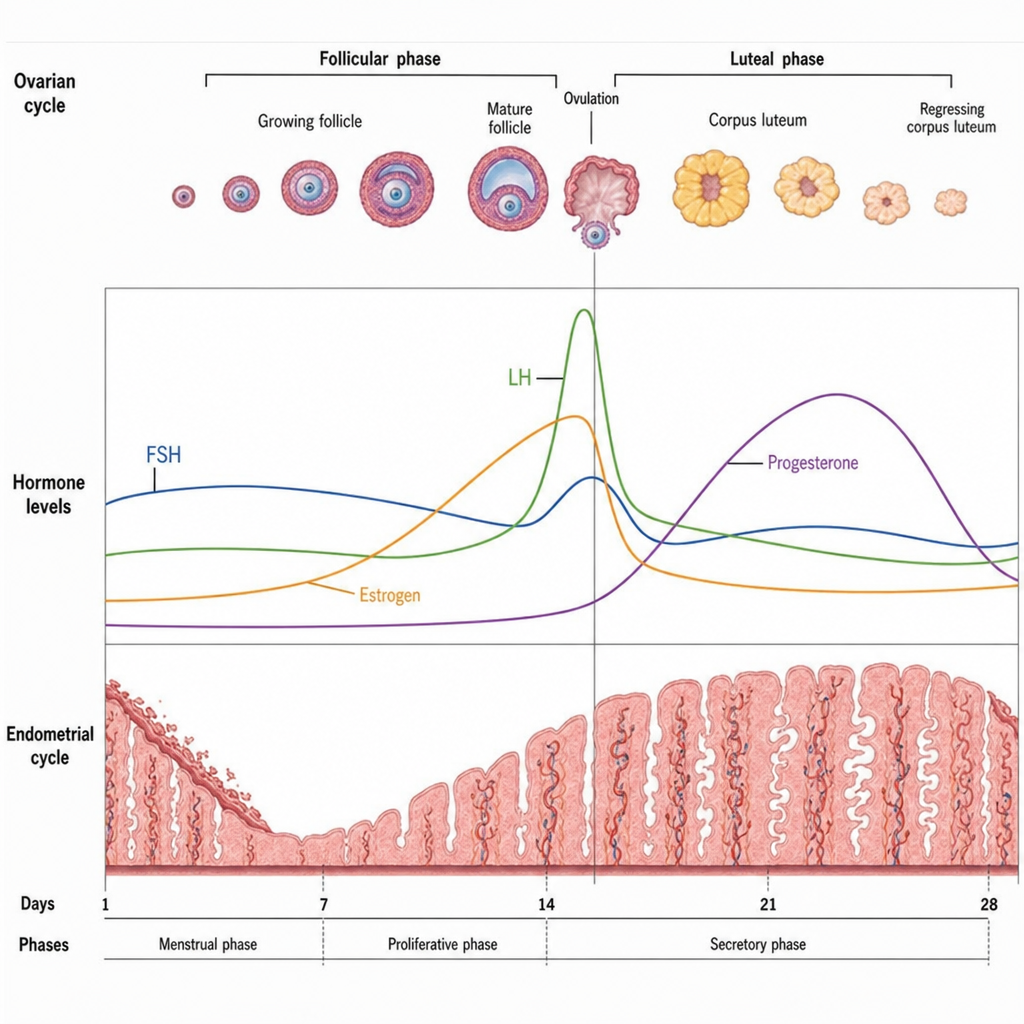
What hormone(s) does the corpus luteum secrete?
In the mother, suckling leads to which of the following responses?
Sertoli cells have receptors for which of the following hormones?
A young woman is given daily injections of a substance beginning on the sixteenth day of her normal menstrual cycle and continuing for 3 weeks. As long as the injections continue, she does not menstruate. The injected substance could be which of the following?
Masculine or feminine features most directly depend on which of the following?
What is the typical vaginal pH?
Human chorionic gonadotropin (hCG) is produced by which of the following?
Which of the following cardiovascular changes in pregnancy is not true?
Lactational amenorrhea is due to which of the following mechanisms?
Explanation: **Explanation:** **Capacitation** is the final stage of sperm maturation, involving physiological changes that allow the sperm to undergo the acrosome reaction and fertilize an oocyte. While sperms are morphologically mature and motile after leaving the epididymis, they are not yet "competent" for fertilization. **Why Uterus is Correct:** Capacitation occurs within the **female reproductive tract**, specifically triggered by secretions from the **uterus and fallopian tubes**. During this process, inhibitory factors (like cholesterol and glycoproteins) added in the male tract are removed from the sperm's plasma membrane. This increases membrane fluidity and calcium permeability, leading to "hyperactivated motility." While it begins in the uterus, it is completed in the isthmus of the fallopian tube. **Why Other Options are Incorrect:** * **Epididymis:** This is the site of **morphological maturation** and the acquisition of motility, but the sperms are kept in a decapacitated state here by inhibitory factors. * **Vas deferens:** This serves primarily as a **conduit and storage** site for mature sperm; no functional maturation occurs here. * **Vagina:** The acidic environment of the vagina is generally hostile to sperm. While sperm pass through it, the biochemical process of capacitation is primarily initiated by the alkaline secretions of the **uterine environment**. **High-Yield Clinical Pearls for NEET-PG:** * **Duration:** Capacitation typically takes **5 to 7 hours**. * **Key Change:** The most significant biochemical change is the **removal of cholesterol** from the sperm membrane. * **In Vitro Fertilization (IVF):** In IVF, capacitation must be induced artificially by washing the sperm in a specific media to mimic the female tract's environment. * **Sequence:** Epididymal maturation (Male) → Capacitation (Female) → Acrosome Reaction (Upon contact with Zona Pellucida).
Explanation: ### Explanation The **corpus luteum** is a temporary endocrine structure formed from the ovarian follicle after ovulation. Its primary function is to prepare the endometrium for potential implantation. **1. Why Option C is Correct:** After the LH (Luteinizing Hormone) surge triggers ovulation, the remaining granulosa and theca cells undergo **luteinization**. * **Granulosa lutein cells** primarily secrete large amounts of **progesterone**. * **Theca lutein cells** (and granulosa cells via aromatization) secrete **estrogen** (mainly estradiol). While progesterone is the dominant hormone of the luteal phase, the corpus luteum must secrete both to maintain the secretory endometrium. **2. Why Other Options are Incorrect:** * **Option A:** While the corpus luteum does secrete estrogen, selecting this alone ignores the massive production of progesterone, which is the hallmark of the luteal phase. * **Option B:** Progesterone is the "hormone of pregnancy," but the corpus luteum is not a single-hormone gland. It continues to produce estrogen to suppress further FSH release and support endometrial growth. **3. High-Yield Clinical Pearls for NEET-PG:** * **Life Span:** If fertilization does not occur, the corpus luteum degenerates into the **corpus albicans** after approximately 12–14 days due to a drop in LH. * **Rescue by hCG:** If pregnancy occurs, **hCG** (Human Chorionic Gonadotropin) from the syncytiotrophoblast "rescues" the corpus luteum, maintaining it for the first 8–10 weeks until the **luteal-placental shift** occurs. * **Inhibin A:** The corpus luteum also secretes **Inhibin A**, which further inhibits FSH secretion during the luteal phase. * **Relaxin:** It also produces relaxin, which helps in softening the cervix and relaxing pelvic ligaments during pregnancy.
Explanation: ### Explanation The act of suckling initiates a neuroendocrine reflex (the **Ferguson reflex** or milk-ejection reflex) that is crucial for lactation. **Why the correct answer is right:** When an infant suckles, tactile receptors on the nipple send afferent signals to the hypothalamus. This stimulus leads to a significant **increase in the synthesis and release of Prolactin** from the anterior pituitary. While the question mentions "hypothalamic prolactin," it refers to the hypothalamic-pituitary axis response where the hypothalamus suppresses its inhibitory control (dopamine), leading to a surge in prolactin levels to stimulate milk production in the mammary alveoli. **Analysis of Incorrect Options:** * **A. Decrease of oxytocin:** Incorrect. Suckling actually **increases** oxytocin release from the posterior pituitary. Oxytocin causes contraction of myoepithelial cells (milk let-down reflex). * **B. Increase of prolactin-inhibiting factor (PIF):** Incorrect. PIF is synonymous with Dopamine. Suckling **inhibits** the release of PIF/Dopamine to allow prolactin levels to rise. * **C. Increase of hypothalamic dopamine:** Incorrect. Dopamine acts as the primary inhibitor of prolactin. For lactation to occur, hypothalamic dopamine secretion must **decrease**. **NEET-PG High-Yield Pearls:** * **Prolactin vs. Oxytocin:** Prolactin is for milk **production** (Alveoli); Oxytocin is for milk **ejection** (Myoepithelial cells). * **Lactational Amenorrhea:** High prolactin levels during suckling inhibit **GnRH pulsatility**, leading to decreased LH/FSH and temporary infertility. * **Dopamine Antagonists:** Drugs like Metoclopramide can cause galactorrhea because they inhibit dopamine, thereby increasing prolactin.
Explanation: **Explanation:** The correct answer is **Follicle-stimulating hormone (FSH)**. **1. Why FSH is correct:** Sertoli cells, often called "nurse cells," are located within the seminiferous tubules and are essential for spermatogenesis. They possess specific G-protein coupled receptors for **FSH**. When FSH binds to these receptors, it stimulates the Sertoli cells to produce androgen-binding protein (ABP), which maintains high local testosterone levels, and various growth factors necessary for sperm maturation. **2. Why the other options are incorrect:** * **Luteinizing hormone (LH):** LH receptors are located on the **Leydig cells** (interstitial cells), not Sertoli cells. LH stimulates Leydig cells to secrete testosterone. * **Inhibin:** Inhibin is actually **produced** by Sertoli cells (as a negative feedback signal to the pituitary to decrease FSH); it does not act on them via primary receptors. * **Progesterone:** While steroid hormones play various roles in feedback, Sertoli cells are primarily regulated by the FSH-Inhibin axis and testosterone. **3. High-Yield Clinical Pearls for NEET-PG:** * **Blood-Testis Barrier:** Sertoli cells form this barrier via tight junctions, protecting developing germ cells from the immune system. * **Müllerian Inhibiting Substance (MIS):** In utero, Sertoli cells secrete MIS (or AMH), which causes regression of Müllerian ducts in male fetuses. * **The "S" Rule:** To remember the associations, use **S** for **S**ertoli, **S**upport, **S**permatogenesis, and **S**timulated by F**S**H. Conversely, **L**eydig cells are stimulated by **L**H. * **Aromatization:** Sertoli cells contain the enzyme aromatase, which converts testosterone into estrogens.
Explanation: **Explanation:** The correct answer is **hCG (Human Chorionic Gonadotropin)**. **Why hCG is correct:** In a normal 28-day menstrual cycle, the corpus luteum begins to degenerate around day 24–26 due to a lack of luteotropic support, leading to a drop in progesterone and estrogen, which triggers menstruation. hCG is a glycoprotein hormone that is structurally and functionally similar to **LH (Luteinizing Hormone)**. When administered starting on day 16 (the early luteal phase), hCG "rescues" the corpus luteum, preventing its involution. This maintains high levels of progesterone and estrogen, which keeps the endometrium in the secretory phase and prevents menstruation. This mimics the physiological process of early pregnancy. **Why the other options are incorrect:** * **FSH:** Primarily functions to stimulate follicular development in the early follicular phase. It does not maintain the corpus luteum or prevent the withdrawal of progesterone. * **Inhibitor of progesterone’s actions:** Progesterone is essential for maintaining the endometrium. Inhibiting its action (e.g., Mifepristone) would induce menstruation or uterine bleeding, not prevent it. * **PGE2 inhibitor:** While prostaglandins are involved in uterine contractions and dysmenorrhea, inhibiting them does not prevent the hormonal withdrawal (progesterone drop) that causes the sloughing of the functional layer of the endometrium. **High-Yield NEET-PG Pearls:** * **Luteal Rescue:** hCG is the signal for "maternal recognition of pregnancy." * **Source:** hCG is secreted by the **syncytiotrophoblast**. * **Structure:** hCG shares a common **alpha subunit** with TSH, FSH, and LH; its specificity is determined by the **beta subunit**. * **Clinical Use:** hCG injections are used in clinical practice for ovulation induction and to support the luteal phase in infertility treatments.
Explanation: **Explanation:** The development and maintenance of masculine or feminine features (phenotypic sex) are most directly determined by the presence or absence of circulating sex steroids, specifically **serum testosterone levels**. 1. **Why Option D is Correct:** While genetic sex (XX or XY) sets the blueprint, the actual physical manifestation of sex depends on hormonal signaling. In the presence of testosterone (and its potent metabolite Dihydrotestosterone), the Wolffian ducts develop, and external genitalia are masculinized. In its absence, the default pathway is feminization. Throughout life, secondary sexual characteristics (hair pattern, muscle mass, voice pitch) are directly maintained by the concentration of these circulating hormones. 2. **Why Other Options are Incorrect:** * **Genetic makeup (B):** This determines **gonadal sex** (whether an individual has testes or ovaries) via the SRY gene. However, if there is an end-organ insensitivity to hormones (e.g., Androgen Insensitivity Syndrome), a person with an XY genotype will develop feminine features. Thus, genes are the blueprint, but hormones are the direct effectors. * **Hypothalamic outflow (C):** The hypothalamus (GnRH) regulates the pituitary-gonadal axis, but it does not directly cause physical changes in the tissues. * **Amygdala (A):** This area of the brain is involved in emotional processing and sexual behavior/orientation but does not dictate physical masculine or feminine morphology. **High-Yield Clinical Pearls for NEET-PG:** * **Default Sex:** The "neutral" or default phenotypic sex is **female**. Masculinization requires active hormonal intervention. * **DHT vs. Testosterone:** Testosterone is responsible for internal male structures (epididymis, vas deferens), while **Dihydrotestosterone (DHT)** is responsible for external virilization (penis, scrotum) and prostate development. * **Critical Period:** The differentiation of external genitalia occurs between the **8th and 12th weeks** of gestation.
Explanation: **Explanation:** The typical vaginal pH in a healthy, reproductive-age woman is **4.0 to 4.5**. This acidic environment is a critical physiological defense mechanism against pathogenic infections. **The Underlying Concept:** The acidity is primarily maintained by **Döderlein’s bacilli** (Lactobacilli). Under the influence of **estrogen**, the vaginal epithelium thickens and accumulates **glycogen**. Lactobacilli metabolize this glycogen into **lactic acid**, which lowers the pH. This acidic milieu inhibits the growth of common pathogens like *Gardnerella vaginalis* and various anaerobes. **Analysis of Options:** * **Option C (4 to 4.5):** This is the standard physiological range during the reproductive years. * **Options A & B (3 to 4):** These values are overly acidic and are rarely seen under normal physiological conditions. * **Option D (4.5 to 5):** While close, a pH consistently above 4.5 is often considered a diagnostic criterion for **Bacterial Vaginosis (BV)** or Trichomoniasis. **High-Yield Facts for NEET-PG:** 1. **Age Variations:** The vaginal pH is **neutral or alkaline** (approx. 7.0) during childhood and after menopause due to low estrogen levels and the absence of Lactobacilli. 2. **Menstruation:** During menses, the pH rises (becomes more alkaline) because blood has a pH of 7.4. 3. **Amsel’s Criteria:** A vaginal pH **> 4.5** is one of the four criteria used to diagnose Bacterial Vaginosis. 4. **Semen Influence:** Semen is alkaline (pH 7.2–8.0), which temporarily neutralizes vaginal acidity to protect sperm.
Explanation: **Explanation:** **1. Why the Placenta is Correct:** Human chorionic gonadotropin (hCG) is a glycoprotein hormone primarily produced by the **syncytiotrophoblast cells** of the placenta. Its primary physiological role is to maintain the **corpus luteum** during the first trimester of pregnancy, ensuring the continued secretion of progesterone until the placenta is mature enough to take over steroidogenesis (the luteal-placental shift). hCG levels typically double every 48–72 hours in early pregnancy, peaking around 8–11 weeks of gestation. **2. Why the Other Options are Incorrect:** * **Kidney:** While hCG is excreted in the urine (forming the basis of most pregnancy tests), it is not produced by renal tissue. * **Pituitary Gland:** The anterior pituitary produces LH, FSH, and TSH, which share the same alpha-subunit as hCG; however, the unique beta-subunit of hCG is placental in origin. * **Liver:** The liver is involved in the metabolism and clearance of hormones but does not synthesize hCG. **3. High-Yield Clinical Pearls for NEET-PG:** * **Subunit Specificity:** hCG consists of an $\alpha$ and $\beta$ subunit. The $\alpha$-subunit is identical to LH, FSH, and TSH. The **$\beta$-subunit** is unique and is what is measured in pregnancy tests. * **LH Mimicry:** hCG acts via **LH receptors** because of its structural similarity to Luteinizing Hormone. * **Tumor Marker:** Pathologically elevated hCG is a sensitive marker for **Gestational Trophoblastic Neoplasia** (Hydatidiform mole/Choriocarcinoma) and certain germ cell tumors (e.g., Dysgerminoma). * **Hyperthyroidism in Pregnancy:** Extremely high levels of hCG can cross-react with TSH receptors, occasionally leading to gestational transient thyrotoxicosis.
Explanation: ### Explanation The correct answer is **D. Increased blood viscosity**. In pregnancy, blood viscosity actually **decreases**. This occurs due to a physiological phenomenon known as **"Physiological Anemia of Pregnancy."** While both plasma volume and red cell mass increase, the plasma volume expands disproportionately (approx. 40–50%) compared to the red cell mass (approx. 20–30%). This hemodilution reduces blood viscosity, which helps lower peripheral vascular resistance and ensures smoother microcirculatory flow to the placenta. #### Analysis of Incorrect Options: * **A. Increased blood volume:** This is a hallmark of pregnancy. Total blood volume increases by 40–50% to meet the metabolic demands of the fetus and protect the mother against hemorrhage during delivery. * **B. Increased heart rate:** The resting heart rate increases gradually throughout pregnancy, typically by 10–20 beats per minute, to support the increased metabolic rate. * **C. Increased cardiac output:** Cardiac output increases by 30–50%. This is achieved initially by an increase in stroke volume and later maintained by the increased heart rate. #### High-Yield Clinical Pearls for NEET-PG: * **Blood Pressure:** Despite increased cardiac output, systemic blood pressure (especially diastolic) **decreases** in the first and second trimesters due to progesterone-induced vasodilation and increased nitric oxide. * **Supine Hypotension Syndrome:** In late pregnancy, the gravid uterus compresses the inferior vena cava (IVC) when the mother lies supine, reducing venous return and cardiac output. * **Heart Sounds:** A physiological S3 and a mid-systolic flow murmur are considered normal findings during pregnancy due to the hyperdynamic circulation.
Explanation: ### Explanation **Mechanism of Lactational Amenorrhea** Lactational amenorrhea is a physiological state of infertility occurring during intense breastfeeding. The primary driver is the hormone **Prolactin**, which is secreted in high amounts by the anterior pituitary in response to the suckling stimulus. **Why Option A is Correct:** High levels of Prolactin exert a negative feedback effect on the **hypothalamus**, specifically inhibiting the pulsatile release of **Gonadotropin-Releasing Hormone (GnRH)**. This occurs through the stimulation of hypothalamic dopamine and the inhibition of Kisspeptin neurons. Without the rhythmic pulses of GnRH, the pituitary cannot secrete adequate Luteinizing Hormone (LH) and Follicle-Stimulating Hormone (FSH). This suppression prevents the LH surge, thereby inhibiting ovulation and causing amenorrhea. **Why Other Options are Incorrect:** * **Options B & D:** While FSH levels may be low or erratic, the *primary* site of inhibition is the hypothalamus (GnRH), not a direct primary inhibition of FSH itself. * **Options C & D:** **Oxytocin** is responsible for the "milk let-down" reflex (contraction of myoepithelial cells) and uterine contractions. It does not play a significant role in the hormonal suppression of the hypothalamic-pituitary-ovarian axis. **High-Yield Clinical Pearls for NEET-PG:** * **Hyperprolactinemia:** Any cause of high prolactin (e.g., Prolactinoma) can lead to secondary amenorrhea and infertility via this same GnRH-suppression mechanism. * **Dopamine's Role:** Dopamine is the primary **Prolactin-Inhibiting Factor (PIF)**. Drugs that block dopamine (antipsychotics) cause hyperprolactinemia. * **Lactational Amenorrhea Method (LAM):** For this to be effective as contraception, the mother must be exclusively breastfeeding, be less than 6 months postpartum, and remain amenorrheic.
Male Reproductive Physiology
Practice Questions
Spermatogenesis and Sperm Function
Practice Questions
Female Reproductive Physiology
Practice Questions
Menstrual Cycle
Practice Questions
Ovulation and Fertilization
Practice Questions
Physiology of Pregnancy
Practice Questions
Parturition
Practice Questions
Lactation
Practice Questions
Sexual Differentiation and Development
Practice Questions
Reproductive Aging
Practice Questions
Get full access to all questions, explanations, and performance tracking.
Start For Free