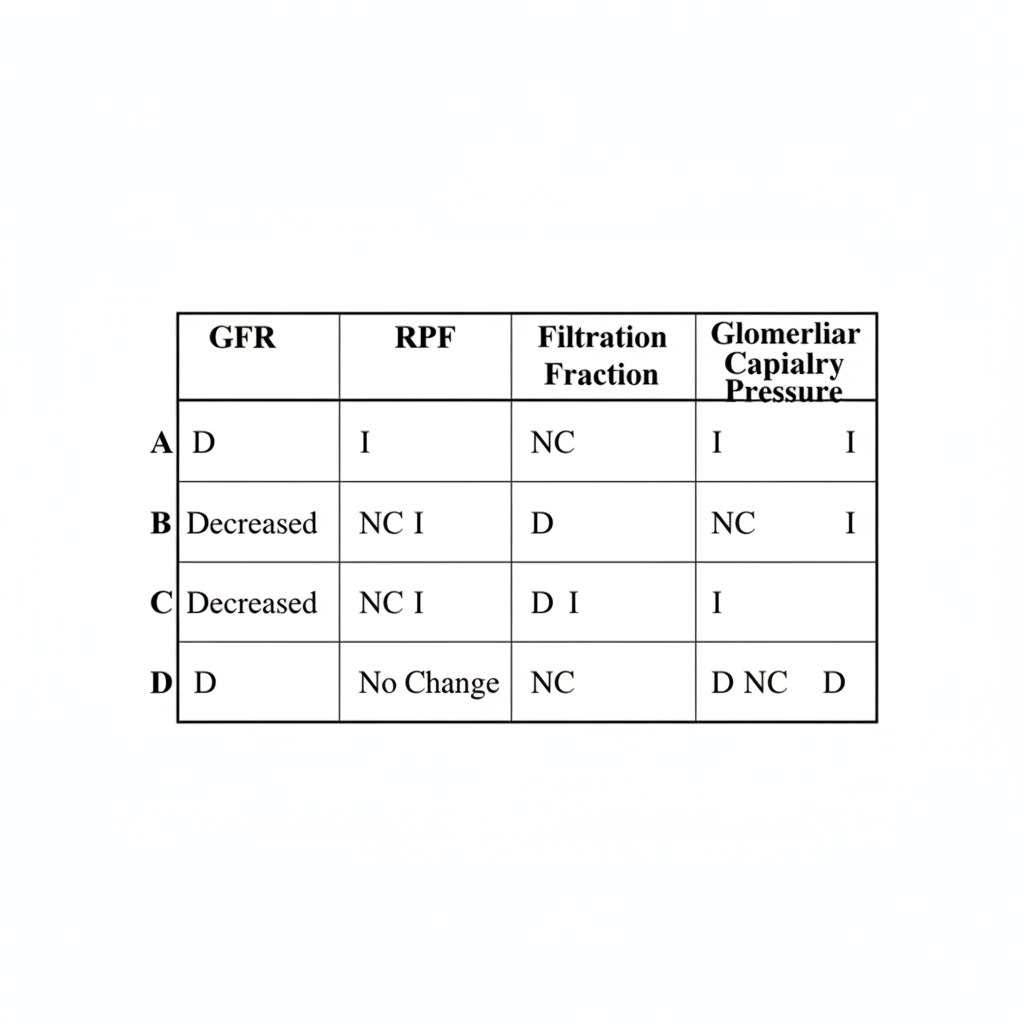
What is the resting ureteric pressure?
Urine concentrating ability of the kidney is increased by?
What is the net filtration pressure?

Which of the following substances does not normally pass through the glomerular filter in the kidney?
Urinary concentrating ability of the kidney is increased by?
Angiotensin-converting enzymes are?
What is the principal site of urine acidification?
Which part of the Henle loop is less permeable to water?
Why is the actual tubular maximum for the kidney in practice less than the calculated value?
In renal disease, why does albumin first appear in the urine?
Explanation: ### Explanation **Correct Answer: D. 0-5 cm H2O** The ureter is a muscular tube that transports urine from the renal pelvis to the urinary bladder via peristalsis. Under normal physiological conditions, the **resting (basal) pressure** within the ureter is very low, typically ranging from **0 to 5 cm H2O**. This low baseline pressure ensures that there is no significant resistance to the entry of urine from the renal pelvis into the ureter. When a peristaltic wave is initiated by the pacemaker cells in the renal pelvis, the pressure rises significantly (reaching 20–60 cm H2O) to propel the urine bolus forward. However, between these contractions, the pressure returns to its near-zero baseline. **Analysis of Incorrect Options:** * **Options A and C (5-10 cm H2O):** These values are slightly higher than the true resting baseline. While pressures may briefly reach these levels during early filling or in specific segments, they do not represent the standard resting state. * **Option B (15-30 cm H2O):** This range corresponds to the **active contraction phase** or the pressure generated during a peristaltic wave. If the resting pressure were this high, it would indicate an obstructive pathology or significant back-pressure from the bladder. **High-Yield Clinical Pearls for NEET-PG:** * **Peristaltic Frequency:** Ureteric contractions occur at a rate of 2–5 times per minute. * **Vesicoureteral Reflux (VUR):** The oblique entry of the ureter into the bladder creates a physiological valve. When bladder pressure rises during micturition, this valve closes to prevent retrograde flow. * **Hydronephrosis:** If the resting pressure chronically exceeds 15-20 cm H2O (due to obstruction like a stone), it leads to dilation of the proximal ureter and renal pelvis. * **Pacemaker:** The electrical activity for ureteric contraction originates in the **minor calyces** of the renal pelvis.
Explanation: **Explanation:** The ability of the kidney to concentrate urine depends primarily on the **corticomedullary osmotic gradient**. For water to be reabsorbed from the collecting ducts via Aquaporin-2 channels (mediated by ADH), the surrounding interstitial fluid must be hyperosmotic relative to the tubular fluid. **1. Why Option A is Correct:** The **medullary hyperosmolarity** (created by the countercurrent multiplier system in the Loop of Henle and urea recycling) provides the driving force for passive water reabsorption. The higher the osmolarity of the renal medulla, the greater the osmotic gradient, allowing more water to be pulled out of the tubules, resulting in highly concentrated urine. **2. Why Other Options are Incorrect:** * **Option B (Increase in RBF):** Specifically, an increase in **vasa recta blood flow** leads to "medullary washout." Rapid blood flow carries away the accumulated solutes (NaCl and urea) from the interstitium, reducing the osmotic gradient and decreasing concentrating ability. * **Option C (Reduction of medullary hyperosmolarity):** This directly opposes the mechanism of concentration. If the gradient is lost, water cannot be reabsorbed, leading to dilute urine (e.g., as seen in central diabetes insipidus or chronic interstitial nephritis). * **Option D (Increase in GFR):** A high GFR often leads to increased flow rate through the tubules (pressure diuresis), leaving less time for solute and water exchange, which typically reduces the efficiency of the concentrating mechanism. **High-Yield Facts for NEET-PG:** * **Countercurrent Multiplier:** Loop of Henle (creates the gradient). * **Countercurrent Exchanger:** Vasa Recta (maintains the gradient). * **Urea Recycling:** Contributes nearly 50% of the medullary hyperosmolarity; protein-malnutrition reduces concentrating ability due to low urea. * **ADH (Vasopressin):** Acts on V2 receptors in the late distal tubule and collecting ducts to increase water permeability.
Explanation: ***10 mm Hg*** - Net filtration pressure is calculated using **Starling forces**: NFP = GHP - (BCOP + PCOP) = 60 - (18 + 32) = **10 mmHg**. - This represents the net driving force for **glomerular filtration** after accounting for opposing pressures. *32 mm Hg* - This value represents the **plasma colloid osmotic pressure** (oncotic pressure), which opposes filtration. - It is one of the **opposing forces** in the NFP calculation, not the final net pressure. *60 mm Hg* - This represents the **glomerular hydrostatic pressure** (GHP), the primary driving force for filtration. - It is the **initial pressure** before subtracting the opposing forces, not the net filtration pressure. *20 mm Hg* - This value does not correspond to any specific **Starling force** component in normal glomerular filtration. - It may represent an incorrect calculation or **partial summation** of pressure values.
Explanation: **Explanation:** The glomerular filtration barrier acts as a highly selective sieve based on two primary factors: **molecular size** and **electrical charge**. It consists of the fenestrated endothelium, the glomerular basement membrane (GBM), and the podocyte slit diaphragms. **Why Albumin is the Correct Answer:** Albumin has a molecular weight of approximately **69,000 Daltons** and a molecular radius of ~3.6 nm. While its size is near the threshold for filtration, it is **negatively charged**. The GBM and the podocyte glycocalyx are coated with negatively charged sialoglycoproteins (like heparan sulfate). This creates **electrostatic repulsion**, preventing albumin from passing into the Bowman’s space. In a healthy kidney, less than 0.1% of plasma albumin is filtered. **Analysis of Incorrect Options:** * **B & C (IgG and Beta globulin):** These are much larger proteins (IgG is ~150,000 Da). While they also do not pass through the filter, **Albumin** is the classic physiological marker used to describe the "charge barrier" in medical exams. However, in the context of this specific question, Albumin is the most clinically significant protein restricted by the healthy glomerular barrier. * **D (Lysozyme):** This is a small molecular weight protein (~14,000 Da). Small proteins and peptides are easily filtered but are typically reabsorbed by the proximal convoluted tubule. **High-Yield Clinical Pearls for NEET-PG:** * **Minimal Change Disease:** The primary pathology is the loss of the negative charge (heparan sulfate) on the GBM, leading to selective proteinuria (mainly albuminuria). * **Neutral vs. Anionic:** For the same molecular radius, a neutral molecule is filtered more easily than an anionic (negative) one. * **Threshold for Filtration:** Molecules with a radius < 2 nm are freely filtered; those > 4 nm are not filtered. Albumin (3.6 nm) sits in the critical zone where its charge determines its exclusion.
Explanation: **Explanation:** The primary mechanism for concentrating urine is the maintenance of a high medullary osmotic gradient and the action of Antidiuretic Hormone (ADH). **Why Option A is correct:** In **ECF volume contraction** (dehydration or hemorrhage), the body initiates several compensatory mechanisms to conserve water: 1. **ADH Secretion:** Low ECF volume stimulates the posterior pituitary to release ADH, which increases water reabsorption in the collecting ducts. 2. **Decreased Medullary Blood Flow:** Sympathetic activation causes vasoconstriction of the vasa recta. Slower blood flow prevents the "washout" of medullary solutes, thereby enhancing the medullary hyperosmolarity required for water reabsorption. 3. **Increased Urea Recycling:** ADH increases the permeability of the inner medullary collecting duct to urea, further strengthening the osmotic gradient. **Why other options are incorrect:** * **B & D (Increase in Renal Blood Flow/GFR):** An increase in renal blood flow (specifically medullary flow) leads to a **"solute washout"** effect, where the high concentration of NaCl and urea in the medulla is carried away, reducing the osmotic gradient and decreasing concentrating ability. Similarly, a high GFR increases tubular flow rate, leaving less time for water reabsorption. * **C (Reduction of medullary hyperosmolarity):** This is the direct opposite of what is needed. The kidney can only concentrate urine if the medulla is hyperosmotic relative to the tubular fluid. **High-Yield Clinical Pearls for NEET-PG:** * **Countercurrent Multiplier:** Loop of Henle (creates the gradient). * **Countercurrent Exchanger:** Vasa Recta (maintains the gradient). * **Urea:** Responsible for nearly 50% of the medullary hyperosmolarity. * **Obligatory Water Loss:** The minimum urine volume required to excrete metabolic waste (approx. 0.5 L/day).
Explanation: ### Explanation **1. Why Option A is Correct:** Angiotensin-Converting Enzyme (ACE), also known as kininase II, is a **zinc-metalloproteinase**. It is primarily located on the luminal surface of vascular endothelial cells, particularly in the pulmonary capillaries. Its primary function is to convert Angiotensin I (a decapeptide) into Angiotensin II (an octapeptide). It achieves this by **cleaving the C-terminal dipeptide** (specifically the His-Leu bond) from Angiotensin I. **2. Why Other Options are Incorrect:** * **Options B & D:** ACE does not cleave a "signal portion." Signal peptides are typically removed during protein synthesis in the endoplasmic reticulum. ACE acts on a circulating peptide in the plasma/endothelium. * **Options C & D:** ACE is strictly a **zinc-dependent** enzyme. Copper is a cofactor for other enzymes like Cytochrome c oxidase or Superoxide dismutase, but it plays no role in the structure or function of ACE. **3. High-Yield Clinical Pearls for NEET-PG:** * **Dual Function:** ACE has two major roles: it activates a vasoconstrictor (**Angiotensin II**) and inactivates a vasodilator (**Bradykinin**). This explains why ACE inhibitors (ACEIs) cause a dry cough—due to the accumulation of bradykinin and substance P in the lungs. * **Location:** While found throughout the body, the highest concentration of ACE is in the **lungs**. * **Alternative Pathway:** Note that Angiotensin II can also be formed via non-ACE pathways (e.g., **Chymase**), which is why ARBs are sometimes more effective than ACEIs in complete blockade. * **ACE2:** A related enzyme, ACE2, converts Angiotensin II to Angiotensin (1-7), which has vasodilatory effects. ACE2 is also the functional receptor for the **SARS-CoV-2** virus.
Explanation: **Explanation:** The **Collecting Duct (CD)**, specifically the **Medullary Collecting Duct**, is the principal site of urine acidification. While the Proximal Convoluted Tubule (PCT) handles the bulk of bicarbonate reabsorption, the final and most significant drop in urinary pH occurs in the distal segments. 1. **Why the Collecting Duct is correct:** The **Alpha-Intercalated cells** of the collecting duct are responsible for active secretion of hydrogen ions ($H^+$) into the tubular lumen via **$H^+$-ATPase** and **$H^+/K^+$-ATPase** pumps. Because the CD has a low permeability to $H^+$ ions (unlike the "leaky" PCT), it can establish a steep concentration gradient, lowering the urinary pH to its minimum value of approximately **4.5**. 2. **Why other options are incorrect:** * **Proximal Convoluted Tubule (PCT):** This is the site of *bulk* bicarbonate reabsorption (85%). Although it secretes $H^+$, the pH only drops slightly (to ~6.7-7.0) because the secreted $H^+$ is consumed in reabsorbing $HCO_3^-$. * **Loop of Henle:** Primarily functions in establishing the medullary osmotic gradient (countercurrent mechanism) rather than active acidification. * **Distal Convoluted Tubule (DCT):** While some $H^+$ secretion occurs here, the maximum acidification and final pH adjustment are finalized in the collecting ducts. **High-Yield Clinical Pearls for NEET-PG:** * **Type 1 (Distal) Renal Tubular Acidosis (RTA):** Caused by a failure of Alpha-Intercalated cells to secrete $H^+$. Patients cannot acidify urine below pH 5.5. * **Urinary Buffers:** Since free $H^+$ ions would damage the epithelium, they are buffered by **Phosphate** (Titratable acid) and **Ammonia** ($NH_3 \rightarrow NH_4^+$). * **Aldosterone** acts on the collecting duct to increase $H^+$ secretion, which is why hyperaldosteronism leads to metabolic alkalosis.
Explanation: The Loop of Henle plays a critical role in the **countercurrent multiplier system**, which allows the kidney to concentrate urine. The differential permeability of its segments to water and solutes is the key to this process. ### **Explanation of the Correct Answer** The **Thin Ascending Limb (tAL)** is the correct answer because it is **virtually impermeable to water** but highly permeable to solutes like sodium and chloride (via passive diffusion). While both the thin and thick ascending limbs are impermeable to water, the question asks which part is "less permeable." In physiological models of the inner medulla, the tAL is characterized by its lack of aquaporins, ensuring that as solutes leave the tubule, water cannot follow, making the tubular fluid progressively more dilute. ### **Analysis of Incorrect Options** * **A. Thin Descending Limb:** This segment is **highly permeable to water** due to the high density of **Aquaporin-1 (AQP1)** channels. It is relatively impermeable to solutes, leading to the concentration of tubular fluid as it descends into the hypertonic medulla. * **C. Thick Ascending Limb (TAL):** While also impermeable to water, the TAL is primarily known for **active transport** of solutes via the **NKCC2 transporter**. In many comparative contexts, the tAL's lack of water permeability is a defining passive characteristic of the deep medullary gradient. * **D. Thick Descending Limb:** This is essentially the straight part of the proximal tubule (Pars Recta). It remains relatively permeable to water, similar to the proximal convoluted tubule. ### **NEET-PG High-Yield Pearls** * **Countercurrent Multiplier:** The ascending limb (both thin and thick) is the "diluting segment" because it removes salt without water. * **Pharmacology Link:** Loop diuretics (e.g., Furosemide) act on the **NKCC2 transporter** in the **Thick Ascending Limb**, not the thin limb. * **Bartter Syndrome:** A genetic defect in the NKCC2 transporter or associated channels in the TAL, presenting with hypokalemia and metabolic alkalosis. * **Mnemonic:** "Descending is for Drinking" (Water out), "Ascending is for Abstraction" (Salt out).
Explanation: ### Explanation The concept of **Transport Maximum ($T_m$)** refers to the maximum rate at which a substance can be reabsorbed or secreted by the renal tubules. While a theoretical $T_m$ is calculated based on the total number of available carriers, the actual observed $T_m$ in a living kidney is lower due to a phenomenon called **Splay**. **1. Why Option A is Correct:** The kidney is composed of approximately 1–1.2 million nephrons. These nephrons are not identical; they exhibit **heterogeneity** in their anatomical length and the density of transport proteins. Some nephrons reach their saturation point (threshold) earlier than others. Consequently, glucose (or other substances) begins to appear in the urine before the total calculated $T_m$ of the entire kidney is reached. This gradual transition from full reabsorption to saturation is what causes the "splay" in the titration curve. **2. Why Other Options are Incorrect:** * **Option B & C:** While GFR and Renal Blood Flow (RBF) determine the **filtered load** (Filtered Load = GFR × Plasma Concentration), they do not change the intrinsic saturation capacity ($T_m$) of the tubular cells themselves. * **Option D:** Blood pressure can influence GFR (via autoregulation), but it does not dictate the molecular limit of transport proteins in the proximal tubule. **3. High-Yield Clinical Pearls for NEET-PG:** * **Glucose $T_m$:** In a healthy adult, the $T_m$ for glucose is approximately **375 mg/min** (men) and **300 mg/min** (women). * **Renal Threshold:** This is the plasma concentration at which glucose first appears in the urine, typically **180 mg/dL**. * **Splay:** The difference between the theoretical threshold and the actual threshold. It is primarily due to nephron heterogeneity and the relatively low affinity of transport carriers near saturation. * **Key Transporter:** SGLT-2 (Sodium-Glucose Co-transporter 2) in the early proximal tubule is responsible for 90% of glucose reabsorption.
Explanation: ### Explanation The filtration of molecules across the glomerular filtration barrier (GFB) is determined by two primary factors: **molecular size** and **electrical charge**. **1. Why the Correct Answer is Right:** The GFB consists of the fenestrated endothelium, the glomerular basement membrane (GBM), and the slit diaphragms of podocytes. The "pore size" of these slit diaphragms is approximately 4 nm. Albumin has a molecular diameter of roughly **6 nm** and a molecular weight of **69,000 Daltons (69 kDa)**. This size is just slightly above the effective filtration threshold. Under normal physiological conditions, albumin is restricted primarily by its **negative charge** (electrostatic repulsion by heparan sulfate in the GBM). However, because its size is so close to the filtration limit, any minor structural damage to the GFB or loss of negative charges (as seen in early renal disease) allows albumin to be the first large protein to "leak" into the filtrate. **2. Why Incorrect Options are Wrong:** * **Option A:** While albumin is the most abundant plasma protein, concentration alone doesn't determine filtration; the physical barrier properties are the primary gatekeepers. * **Option C:** The A:G ratio is a marker of liver function or chronic inflammation but does not dictate the permeability of the glomerular membrane. * **Option D:** Tubular cells actually reabsorb filtered albumin via endocytosis (megalin/cubilin receptors). They are not "sensitive" in a way that causes albuminuria; rather, albuminuria occurs when the filtered load exceeds the tubules' reabsorptive capacity. **Clinical Pearls for NEET-PG:** * **Microalbuminuria:** Defined as 30–300 mg/day. It is the earliest clinical sign of diabetic nephropathy. * **Charge Selectivity:** In **Minimal Change Disease**, the size barrier is intact, but the negative charge of the GBM is lost, leading to selective albuminuria. * **Foot Process Effacement:** This is the hallmark pathological change seen on electron microscopy in diseases presenting with heavy proteinuria.
Renal Blood Flow and Glomerular Filtration
Practice Questions
Tubular Reabsorption and Secretion
Practice Questions
Concentration and Dilution of Urine
Practice Questions
Acid-Base Regulation by the Kidneys
Practice Questions
Sodium and Water Balance
Practice Questions
Potassium Regulation
Practice Questions
Calcium and Phosphate Handling
Practice Questions
Micturition Physiology
Practice Questions
Renal Function Tests
Practice Questions
Integrative Responses to Fluid Challenges
Practice Questions
Get full access to all questions, explanations, and performance tracking.
Start For Free