What is the nerve supply to the musculature of the urinary bladder?
In renal failure, metabolic acidosis is primarily due to which of the following mechanisms?
Insulin clearance closely resembles:
Which of the following is NOT an endocrine function of the kidney?
Maximum potassium reabsorption occurs in which part of the nephron?
Arrange the following in increasing order of their contribution to total renal vascular resistance: Afferent arteriole, Renal artery, Interlobar, arcuate and interlobular arteries, Peritubular capillaries?
In which of the following conditions is renin secretion inhibited?
Over half of the potassium that appears in the urine of a patient, who has ingested some potassium salts, is derived from which source?
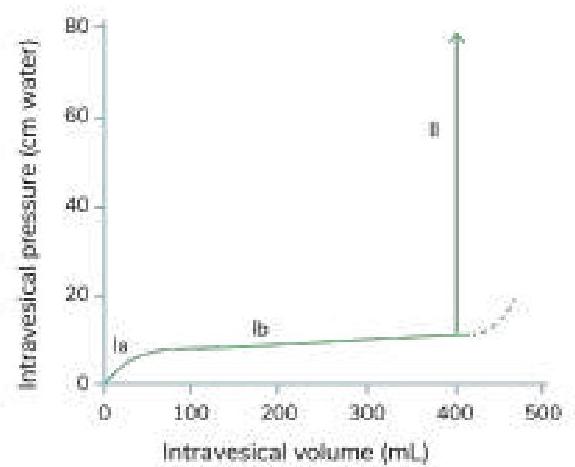
What is the normal bladder pressure during voiding?
Vasopressin acts by which of the following mechanisms?
Explanation: **Explanation:** The urinary bladder is an organ of storage and evacuation, requiring a dual autonomic nerve supply to coordinate these functions. The musculature of the bladder (the **detrusor muscle**) and the internal sphincter are regulated by both the sympathetic and parasympathetic systems. 1. **Parasympathetic Supply (Pelvic Splanchnic Nerves, S2–S4):** This is the primary motor supply for **micturition**. When activated, it causes contraction of the detrusor muscle and relaxation of the internal urethral sphincter, facilitating bladder emptying. 2. **Sympathetic Supply (Hypogastric Nerves, T11–L2):** This system dominates during the **filling phase**. It causes relaxation of the detrusor muscle (via $\beta_3$ receptors) and contraction of the internal sphincter (via $\alpha_1$ receptors), allowing the bladder to store urine without leakage. **Why other options are incorrect:** * **Option A & B:** These are incomplete. While both systems act on the bladder, they serve opposing but complementary roles. Relying on only one would result in either a failure to store urine or a failure to void. * **Option D:** The bladder is an involuntary smooth muscle organ; therefore, it must be governed by the autonomic nervous system. **High-Yield Clinical Pearls for NEET-PG:** * **Somatomotor Supply:** The **Pudendal nerve (S2–S4)** provides voluntary control over the **external urethral sphincter**. * **Micturition Center:** Located in the **Pons** (Pontine Micturition Center/Barrington’s nucleus). * **Receptor Locations:** Detrusor = $M_3$ (Parasympathetic contraction) and $\beta_3$ (Sympathetic relaxation); Internal Sphincter = $\alpha_1$ (Sympathetic contraction). * **Clinical Correlation:** Drugs like **Oxybutynin** (Antimuscarinic) are used for overactive bladder, while **Mirabegron** ($\beta_3$ agonist) aids in urine storage.
Explanation: In renal failure, the kidneys lose their ability to maintain acid-base homeostasis. The primary mechanism behind the resulting **Metabolic Acidosis** is the failure to excrete the daily "fixed" acid load (produced from protein metabolism). ### Why "Decreased excretion of ammonia" is correct: The kidney excretes hydrogen ions ($H^+$) by buffering them with **Ammonia ($NH_3$)** to form Ammonium ($NH_4^+$) and with phosphate buffers (Titratable acidity). In chronic kidney disease (CKD), while the remaining individual nephrons may increase their ammonia production, the **total number of functioning nephrons decreases**. This leads to a significant drop in total renal ammoniagenesis. Since ammonia is the most important adaptive buffer for acid excretion, its deficiency results in the retention of $H^+$ ions, leading to metabolic acidosis. ### Why other options are incorrect: * **A. Decreased chloride loss:** This would typically lead to hyperchloremia, but it is not the primary driver of acidosis in renal failure. In fact, early renal failure often presents with a Normal Anion Gap (hyperchloremic) acidosis, but the root cause remains the failure of $NH_4^+$ excretion. * **B. Loss of bicarbonate:** While some bicarbonate wasting can occur in specific tubular disorders (like Proximal RTA), in general renal failure, the problem is the inability to *regenerate* new bicarbonate due to failed acid excretion. * **C. Use of diuretics:** Most diuretics (like Loop or Thiazides) actually cause metabolic **alkalosis** (due to contraction alkalosis and hypokalemia). Acetazolamide is an exception that causes acidosis, but it is not the primary mechanism of acidosis *in* renal failure. ### High-Yield Clinical Pearls for NEET-PG: * **Anion Gap Transition:** Early CKD often presents with **Normal Anion Gap Metabolic Acidosis (NAGMA)** due to failed ammoniagenesis. As GFR drops below 15-20 mL/min, it converts to **High Anion Gap Metabolic Acidosis (HAGMA)** due to the retention of unmeasured anions like phosphates, sulfates, and urates. * **Site of Ammoniagenesis:** The **Proximal Convoluted Tubule (PCT)** is the primary site where Glutamine is metabolized to produce Ammonia.
Explanation: **Explanation:** The gold standard for measuring the **Glomerular Filtration Rate (GFR)** is the clearance of a substance that is freely filtered by the glomeruli but is neither reabsorbed nor secreted by the renal tubules. **Inulin**, a plant-derived polysaccharide (fructose polymer), perfectly meets these criteria. Since every molecule of inulin filtered at the glomerulus ends up in the urine, its clearance rate is exactly equal to the GFR. **Analysis of Options:** * **A. Glomerular Filtration Rate (GFR):** Correct. Inulin clearance is the reference standard for GFR because its excretion rate equals its filtration rate. * **B. Renal Plasma Flow (RPF):** Incorrect. RPF is measured using substances that are both filtered and completely secreted (like PAH), not just filtered. * **C. Creatinine Clearance:** Incorrect. While used clinically to estimate GFR, creatinine is slightly secreted by the tubules. Therefore, creatinine clearance **overestimates** the true GFR by about 10-20%. * **D. Para-aminohippuric acid (PAH) clearance:** Incorrect. PAH is filtered and almost entirely secreted by the tubules in a single pass. Thus, PAH clearance is used to measure **Effective Renal Plasma Flow (ERPF)**, not GFR. **High-Yield Clinical Pearls for NEET-PG:** * **Criteria for GFR marker:** Freely filtered, not reabsorbed, not secreted, not metabolized, and non-toxic. * **Inulin vs. Creatinine:** Inulin is the most accurate (Gold Standard), but Creatinine is used clinically because it is endogenous (no infusion required). * **Filtration Fraction (FF):** Calculated as GFR / RPF. Normal value is approximately 0.20 (20%). * **Clearance Ratio:** If Clearance of X / Clearance of Inulin < 1, the substance is being reabsorbed (e.g., Glucose). If > 1, the substance is being secreted (e.g., Penicillin).
Explanation: The kidney is a vital organ with both excretory and non-excretory (endocrine) functions. This question tests the ability to distinguish between hormones produced by the kidney versus those that act upon it. ### **Why Option B is Correct** **Natriuretic peptides** (specifically ANP and BNP) are primarily secreted by the **heart** (atria and ventricles, respectively) in response to increased wall stretch or volume overload. While these peptides act on the kidney to promote sodium excretion (natriuresis) and water loss, they are **not produced by the kidney**. ### **Why Other Options are Incorrect** * **Option A (Erythropoietin):** Produced by **interstitial cells in the peritubular capillary bed** of the renal cortex. It stimulates RBC production in the bone marrow in response to hypoxia. * **Option C (1,25-dihydroxyvitamin D3):** The kidney contains the enzyme **1-alpha-hydroxylase** (in the PCT), which converts inactive 25-hydroxyvitamin D into the active form, **Calcitriol**. * **Option D (Renin):** Secreted by the **Juxtaglomerular (JG) cells** of the afferent arteriole. It is the rate-limiting step of the Renin-Angiotensin-Aldosterone System (RAAS). ### **NEET-PG High-Yield Pearls** * **Prostaglandins (PGE2, PGI2):** Also produced by the kidney; they maintain renal blood flow by vasodilating the afferent arteriole. * **Thrombopoietin:** While primarily produced in the liver, a small amount is synthesized in the kidney. * **Chronic Kidney Disease (CKD) Correlation:** Patients with CKD often present with **anemia** (due to EPO deficiency) and **renal osteodystrophy** (due to Vitamin D activation failure).
Explanation: **Explanation** The renal handling of potassium is unique because it involves both filtration, reabsorption, and secretion. **1. Why Proximal Convoluted Tubule (PCT) is correct:** The PCT is the primary site for the bulk reabsorption of most solutes. Approximately **65-70%** of filtered potassium is reabsorbed in the PCT. This process is largely passive and occurs via a **paracellular route**, driven by solvent drag and the positive transtubular potential in the late PCT. Regardless of whether a person is on a high or low-potassium diet, the PCT reabsorbs a constant, major fraction of the filtered load. **2. Why the other options are incorrect:** * **Distal Convoluted Tubule (DCT) & Collecting Ducts (Options B, C, D):** These segments are responsible for the **fine-tuning** of potassium balance. While some reabsorption occurs here (via Type A Intercalated cells) during potassium depletion, these segments are more clinically significant for potassium **secretion** (via Principal cells) under the influence of Aldosterone. Only about 10-15% of potassium reaches these distal segments. **3. Clinical Pearls & High-Yield Facts for NEET-PG:** * **Thick Ascending Limb (TAL):** Reabsorbs about 20% of filtered potassium via the **NKCC2 transporter**. This is the site of action for Loop diuretics (Furosemide). * **Aldosterone:** Acts on the Principal cells of the late DCT and Collecting Duct to increase $K^+$ secretion into the tubular lumen. * **Insulin and Alkalosis:** Both shift potassium into the cells (risk of hypokalemia). * **Rule of Thumb:** For almost all electrolytes (except Magnesium, which is mostly reabsorbed in the TAL), the **PCT** is the site of maximum reabsorption.
Explanation: ### Explanation The total renal vascular resistance is determined by the pressure drop across various segments of the renal vasculature. According to Poiseuille’s Law, resistance is inversely proportional to the fourth power of the radius; thus, smaller vessels contribute more to resistance. **1. Why Option D is Correct:** The renal vasculature is organized in a series. The **Renal Artery**, being a large-diameter vessel, offers the least resistance. As vessels branch into **Interlobar, Arcuate, and Interlobular arteries**, the cumulative resistance increases. The **Peritubular capillaries** provide significant resistance due to their small diameter. However, the **Afferent Arteriole** (along with the Efferent arteriole) is the primary site of resistance in the kidney. It accounts for approximately **26% of the total renal vascular resistance**, acting as the major "gatekeeper" to regulate Glomerular Filtration Rate (GFR) and renal blood flow. **2. Why Other Options are Incorrect:** * **Options A, B, and C** are incorrect because they place the Renal Artery or other larger vessels at higher resistance levels than the Afferent arteriole. In any vascular bed, the largest arteries always have the lowest resistance, while the arterioles (resistance vessels) have the highest. **3. High-Yield Clinical Pearls for NEET-PG:** * **Major Resistance Sites:** The Afferent and Efferent arterioles together account for about **50-60%** of total renal vascular resistance. * **Autoregulation:** The Afferent arteriole is the primary site for the **Myogenic mechanism** and **Tubuloglomerular Feedback (TGF)**, which maintain constant RBF and GFR despite fluctuations in systemic blood pressure (80–170 mmHg). * **Sympathetic Effect:** Increased sympathetic tone causes constriction of both arterioles (Afferent > Efferent), significantly increasing total renal resistance and decreasing RBF. * **Pressure Drop:** The largest drop in hydrostatic pressure occurs across the afferent and efferent arterioles.
Explanation: **Explanation:** Renin is an enzyme secreted by the **Juxtaglomerular (JG) cells** of the afferent arteriole in response to perceived low blood pressure or low sodium delivery. Its primary role is to initiate the Renin-Angiotensin-Aldosterone System (RAAS) to restore blood volume and pressure. **Why Hypervolemia is Correct:** **Hypervolemia** (increased extracellular fluid volume) leads to increased renal perfusion pressure and increased stretch of the afferent arteriole. This inhibits the release of renin. Additionally, hypervolemia often leads to the release of **Atrial Natriuretic Peptide (ANP)** from the heart, which directly inhibits renin secretion to promote sodium and water excretion. **Analysis of Incorrect Options:** * **Cirrhosis:** In advanced cirrhosis, peripheral vasodilation (splanchnic pooling) leads to "effective" arterial underfilling. This triggers the baroreceptors to **increase** renin secretion to maintain blood pressure. * **Exercise:** Exercise activates the **Sympathetic Nervous System**. Sympathetic stimulation of β1-receptors on JG cells is a potent trigger for **increasing** renin release. * **Cardiac Failure:** In heart failure, the reduced cardiac output results in decreased renal perfusion. The body perceives this as hypovolemia, leading to a compensatory **increase** in renin secretion (secondary hyperaldosteronism). **High-Yield Clinical Pearls for NEET-PG:** * **Stimulants of Renin:** Decreased BP, decreased NaCl delivery to Macula Densa (via NKCC2), and Sympathetic stimulation (β1). * **Inhibitors of Renin:** Increased BP, Angiotensin II (negative feedback), ANP, and Hyperkalemia (direct effect). * **Goldblatt Kidney:** A classic experimental model where renal artery stenosis leads to high renin hypertension. * **Bartter Syndrome:** Characterized by hyperplasia of JG cells leading to hyperreninemia.
Explanation: The renal handling of potassium ($K^+$) is unique because, unlike most electrolytes, its urinary excretion is primarily determined by **regulated secretion** rather than the amount filtered at the glomerulus. ### **Explanation of the Correct Answer** **B. Secretion by the distal tubule:** Under normal conditions and especially after potassium ingestion, approximately **90-95%** of filtered $K^+$ is reabsorbed in the proximal tubule and the Loop of Henle before reaching the distal nephron. Therefore, the $K^+$ that eventually appears in the urine is almost entirely derived from secretion by the **Principal cells** of the late distal convoluted tubule and the cortical collecting duct. This process is highly regulated by **Aldosterone** and plasma $K^+$ levels to maintain homeostasis. ### **Why Other Options are Incorrect** * **A. Glomerular filtrate:** While $K^+$ is freely filtered, nearly all of it is reabsorbed in the earlier segments of the nephron. Very little of the original filtrate actually reaches the final urine. * **C. Reabsorption in the proximal tubule:** The proximal tubule is a site of *reabsorption* (approx. 65%), not secretion. Reabsorption here is passive and obligatory, reducing the amount of $K^+$ available in the lumen. * **D. Secretion by the loop of Henle:** The thick ascending limb of the Loop of Henle is a major site of $K^+$ *reabsorption* (approx. 25-30%) via the $Na^+-K^+-2Cl^-$ cotransporter, not secretion. ### **NEET-PG High-Yield Pearls** * **Principal Cells:** Responsible for $K^+$ secretion and $Na^+$ reabsorption (target of Aldosterone). * **Intercalated Cells (Type A):** Responsible for $K^+$ **reabsorption** during periods of potassium depletion (via $H^+-K^+$ ATPase). * **Factors increasing $K^+$ secretion:** High plasma $K^+$, high Aldosterone, alkalosis, and increased tubular flow rate (e.g., due to diuretics). * **Liddle’s Syndrome:** A "pseudo-aldosteronism" where overactive ENaC channels lead to excessive $Na^+$ reabsorption and profound $K^+$ secretion (hypokalemia).
Explanation: **Explanation:** The correct answer is **25-30 mmHg**. **1. Understanding the Mechanism (Why A is correct):** The bladder is a highly compliant organ. During the filling phase, the intravesical pressure remains low (0–10 cm H₂O) due to the Law of Laplace and receptive relaxation. When the micturition reflex is triggered, the **detrusor muscle** contracts. In a normal, healthy individual, a pressure of **25–30 mmHg** (approximately 30–40 cm H₂O) is sufficient to overcome the resistance of the internal and external urethral sphincters and initiate voiding. **2. Analysis of Incorrect Options:** * **B (50-70 mmHg):** This range is higher than normal. While the detrusor can generate this pressure, it usually only occurs during the peak of a strong contraction or if there is mild outflow resistance. * **C & D (70-100+ mmHg):** These are pathological pressures. Such high pressures are typically seen in **Bladder Outlet Obstruction (BOO)**, such as Benign Prostatic Hyperplasia (BPH) or urethral strictures, where the detrusor must undergo compensatory hypertrophy to force urine past an obstruction. **3. High-Yield Clinical Pearls for NEET-PG:** * **Cystometrogram (CMG):** The graphical representation of the relationship between intravesical volume and pressure. * **First Desire to Void:** Occurs at a bladder volume of **150–250 ml**. * **Fullness Sensation:** Occurs at **350–450 ml**. * **Micturition Center:** Located in the **Pons** (Pontine Micturition Center/Barrington’s nucleus). * **Nerve Supply:** Parasympathetic (S2-S4 via Pelvic nerve) causes detrusor contraction; Sympathetic (T11-L2 via Hypogastric nerve) causes bladder filling/relaxation.
Explanation: **Explanation:** **1. Why Option A is Correct:** Vasopressin, also known as Antidiuretic Hormone (ADH), is the primary regulator of water balance. Its main site of action is the **principal cells of the late distal tubule and the entire collecting duct**. * **Mechanism:** ADH binds to **V2 receptors** on the basolateral membrane, activating the Gs-protein/adenylyl cyclase pathway. This increases intracellular cAMP, leading to the insertion of **Aquaporin-2 (AQP2)** water channels into the apical (luminal) membrane. This increases the water permeability of the collecting duct, allowing water to be reabsorbed down the osmotic gradient into the hypertonic medullary interstitium. **2. Why Other Options are Incorrect:** * **Option B:** While water is reabsorbed in the medullary portion of the collecting ducts, the term "medullary ducts" is less precise than the functional unit of the "collecting duct" system. Furthermore, ADH regulates transport across the entire collecting duct (cortical and medullary). * **Option C:** Water is never "secreted" in the loop of Henle. The descending limb of the loop of Henle is permeable to water (via AQP1), but this is a passive process independent of ADH. * **Option D:** In the Proximal Convoluted Tubule (PCT), ~65% of water is reabsorbed **isotonically** via AQP1. This process is constitutive (obligatory) and is not regulated by Vasopressin. **3. NEET-PG High-Yield Pearls:** * **V1 Receptors:** Located on vascular smooth muscle; cause vasoconstriction via the $IP_3/Ca^{2+}$ pathway. * **V2 Receptors:** Located in the kidney; act via the **cAMP pathway**. * **Diabetes Insipidus (DI):** Central DI is a deficiency of ADH secretion; Nephrogenic DI is resistance to ADH action at the V2 receptor or AQP2 level. * **SIADH:** Characterized by excessive ADH, leading to concentrated urine and dilutional hyponatremia. * **Urea Recycling:** ADH also increases the permeability of the inner medullary collecting duct to **urea** (via UT-A1 transporters), which helps maintain the medullary osmotic gradient.
Renal Blood Flow and Glomerular Filtration
Practice Questions
Tubular Reabsorption and Secretion
Practice Questions
Concentration and Dilution of Urine
Practice Questions
Acid-Base Regulation by the Kidneys
Practice Questions
Sodium and Water Balance
Practice Questions
Potassium Regulation
Practice Questions
Calcium and Phosphate Handling
Practice Questions
Micturition Physiology
Practice Questions
Renal Function Tests
Practice Questions
Integrative Responses to Fluid Challenges
Practice Questions
Get full access to all questions, explanations, and performance tracking.
Start For Free