Filtration barriers have pores of what approximate size?
What is true about the H+ secretion by the proximal convoluted tubule (PCT)?
Maximum phosphate is reabsorbed in which part of the nephron?
Aldosterone exerts its action on which part of the nephron?
Renin secretion is increased by all of the following except:
Glomerular feedback for decreased GFR is mediated by which mechanism?
In the micturition reflex, what is the first change to occur?
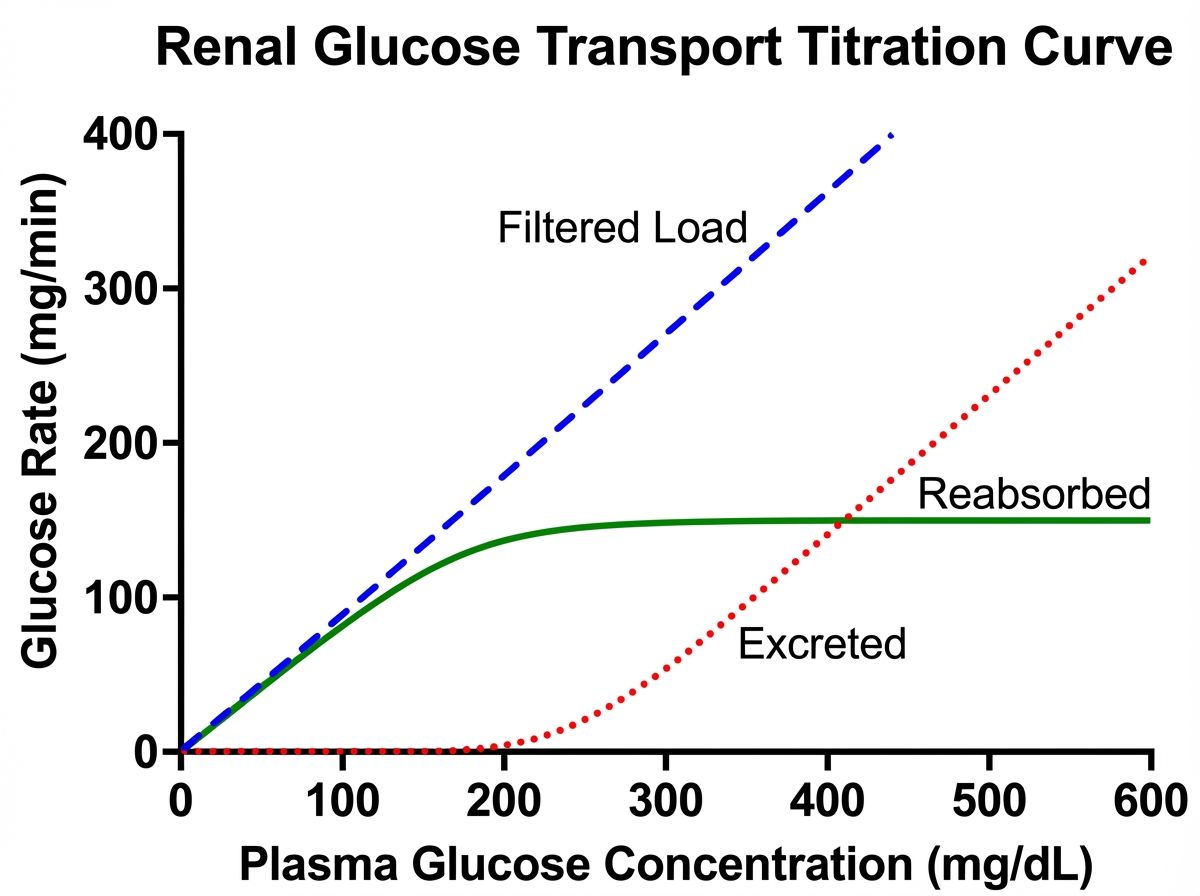
Which of the following is defective in renal glucosuria?
Where is angiotensinogen produced?
What is the effect of acute metabolic acidosis on urinary potassium excretion?
Explanation: The glomerular filtration barrier is a highly specialized biological sieve that allows for the ultrafiltration of plasma while retaining large proteins. It consists of three layers: the fenestrated endothelium, the glomerular basement membrane (GBM), and the podocyte slit diaphragms. ### **Explanation of the Correct Answer** **Option B (4-6 nm)** is correct because the effective pore size of the filtration barrier—specifically the **slit diaphragms** between podocyte foot processes—is approximately **4 to 6 nm**. * **Size Selectivity:** Molecules with a diameter less than 4 nm (like water, glucose, and urea) are freely filtered. * **The Cut-off:** Molecules larger than 8 nm (like most plasma proteins) are almost entirely excluded. * **The "Grey Zone":** Substances between 4–8 nm are filtered based on both their size and their electrical charge. Since the barrier is lined with negatively charged sialoglycoproteins (heparan sulfate), negatively charged molecules like **Albumin** (approx. 6 nm) are repelled despite being small enough to fit through the physical pores. ### **Analysis of Incorrect Options** * **Option A (1-2 nm):** This is too small; it would restrict essential nutrients and electrolytes, leading to renal failure. * **Option C & D (8-12 nm):** These sizes are larger than the diameter of Albumin. If pores were this large, massive proteinuria would occur under normal physiological conditions. ### **High-Yield NEET-PG Pearls** 1. **The Main Barrier:** While the endothelium has large fenestrae (70–100 nm), the **slit diaphragm** (containing the protein **Nephrin**) is the primary size-selective filter. 2. **Charge Selectivity:** The "Polyanionic" nature of the barrier is crucial. In **Minimal Change Disease**, the loss of negative charges leads to selective proteinuria (Albuminuria) even if the physical pore size remains unchanged. 3. **Key Protein:** Mutations in **Nephrin** lead to Congenital Nephrotic Syndrome (Finnish type).
Explanation: In the Proximal Convoluted Tubule (PCT), H+ secretion is primarily coupled with the reabsorption of filtered bicarbonate ($HCO_3^-$), a process essential for maintaining acid-base balance. ### Why Option C is Correct: Approximately 85-90% of filtered bicarbonate is reabsorbed in the PCT. This occurs via the **$Na^+$-$H^+$ Exchanger (NHE3)** on the apical membrane, which secretes $H^+$ into the lumen. In the lumen, $H^+$ combines with filtered $HCO_3^-$ to form $H_2CO_3$. **Carbonic Anhydrase (Type IV)** on the brush border breaks this into $CO_2$ and $H_2O$, which diffuse into the cell. Inside, **Carbonic Anhydrase (Type II)** reforms $HCO_3^-$, which is then transported into the blood. Thus, $H^+$ secretion here is a "shuttle" for bicarbonate reabsorption rather than a means to excrete acid. ### Why Other Options are Incorrect: * **Option A:** Acidification of urine (lowering pH to ~4.5) occurs in the **Alpha-Intercalated cells** of the distal tubule and collecting duct via $H^+$-ATPase. The PCT does not significantly lower urine pH. * **Option B:** $H^+$ secretion in the PCT is **not** against a steep concentration gradient. The luminal pH in the PCT remains relatively high (~6.7-7.0). Active transport against a steep gradient occurs only in the distal nephron. * **Option D:** Diffusion trapping (ammoniagenesis) primarily occurs in the **collecting ducts**, where $NH_3$ combines with $H^+$ to form $NH_4^+$, which is "trapped" and excreted. ### High-Yield Facts for NEET-PG: * **Acetazolamide** (Carbonic Anhydrase Inhibitor) acts on the PCT, blocking this $H^+$ secretion and leading to bicarbonate loss (Proximal Renal Tubular Acidosis/Type 2 RTA). * **NHE3** is the primary transporter for $H^+$ secretion in the PCT. * The PCT is responsible for the **bulk reabsorption** of $HCO_3^-$, while the distal nephron is responsible for **net acid excretion** and the generation of "new" bicarbonate.
Explanation: **Explanation:** The **Proximal Convoluted Tubule (PCT)** is the primary site for the reabsorption of the majority of solutes filtered by the glomerulus. Approximately **80% of filtered phosphate** is reabsorbed in the PCT. **Why PCT is the correct answer:** Phosphate reabsorption in the PCT occurs via **Sodium-Phosphate cotransporters (NaPi-IIa and NaPi-IIc)** located on the apical membrane. This process is secondary active transport, driven by the sodium gradient established by the Na+/K+ ATPase pump. The PCT is the only segment where significant, regulated phosphate transport occurs, making it the most critical site for phosphate homeostasis. **Why other options are incorrect:** * **Distal Convoluted Tubule (DCT) & Collecting Duct:** Only a negligible amount of phosphate (approx. 5-10%) is reabsorbed in the distal segments. These areas are more focused on fine-tuning electrolytes like sodium, potassium, and calcium under hormonal influence (e.g., Aldosterone). * **Loop of Henle:** This segment is primarily involved in the concentration of urine and the reabsorption of sodium, chloride, and water (Thin Descending and Thick Ascending Limbs), but it plays no significant role in phosphate reabsorption. **High-Yield Clinical Pearls for NEET-PG:** 1. **Parathyroid Hormone (PTH):** PTH is the most important regulator of phosphate. It **inhibits** phosphate reabsorption in the PCT by causing the internalization of NaPi-IIa transporters, leading to **phosphaturia**. 2. **FGF-23:** A phosphatonin that also inhibits PCT phosphate reabsorption. 3. **Fanconi Syndrome:** A generalized dysfunction of the PCT resulting in the loss of phosphate (hypophosphatemia), glucose, amino acids, and bicarbonate in the urine. 4. **Threshold:** Phosphate is a "threshold substance"; once the plasma concentration exceeds the transport maximum (TmP), the excess is rapidly excreted in the urine.
Explanation: ### Explanation **Correct Option: D. Collecting duct** Aldosterone is a mineralocorticoid hormone secreted by the adrenal cortex. Its primary site of action is the **Principal cells (P-cells)** of the **late distal tubule** and the **collecting duct** (specifically the cortical collecting duct). **Mechanism of Action:** Aldosterone binds to intracellular mineralocorticoid receptors, leading to the synthesis and insertion of: 1. **ENaC (Epithelial Sodium Channels)** on the apical membrane. 2. **Na+/K+ ATPase pumps** on the basolateral membrane. This results in **sodium reabsorption** and **potassium secretion**. It also acts on the **α-intercalated cells** to promote **H+ secretion**, which is why excess aldosterone leads to metabolic alkalosis. --- ### Why other options are incorrect: * **A. Proximal tubule:** This is the site for bulk reabsorption (65% of Na+ and water), primarily regulated by Angiotensin II and Carbonic Anhydrase, not aldosterone. * **B. Early distal tubule:** This segment is the "diluting segment," where Na+ is reabsorbed via the **NCC (Na+/Cl- cotransporter)**. This is the site of action for Thiazide diuretics. * **C. Loop of Henle:** The thick ascending limb is responsible for 25% of Na+ reabsorption via the **NKCC2 transporter** (site of action for Loop diuretics). Aldosterone has no significant physiological effect here. --- ### High-Yield Facts for NEET-PG: * **Primary Stimuli:** Hyperkalemia (most potent) and Angiotensin II. * **Conn’s Syndrome:** Primary hyperaldosteronism characterized by the triad of **Hypertension, Hypokalemia, and Metabolic Alkalosis.** * **Spironolactone/Eplerenone:** These are aldosterone antagonists used as potassium-sparing diuretics that act on the collecting duct. * **Liddle’s Syndrome:** A genetic condition causing overactive ENaC channels, mimicking high aldosterone levels (Pseudohyperaldosteronism).
Explanation: ### Explanation Renin is a proteolytic enzyme secreted by the **Juxtaglomerular (JG) cells** of the afferent arteriole. Its secretion is the rate-limiting step of the Renin-Angiotensin-Aldosterone System (RAAS), which regulates blood pressure and fluid balance. **Why the Question/Options are structured this way:** The question asks for the factor that does **not** increase renin secretion. However, there is a discrepancy in the provided key: **Sympathetic nerve stimulation actually *increases* renin secretion.** The factor that **decreases** (or does not increase) renin secretion is an **increase in sodium load at the Macula Densa.** #### Analysis of Options: * **Sympathetic nerve stimulation (Option D):** This **increases** renin secretion via the activation of **$\beta_1$-adrenergic receptors** on JG cells. This is a high-yield physiological response to stress or hypotension. * **Low afferent arteriolar pressure (Option B):** JG cells act as **intrarenal baroreceptors**. A drop in pressure (e.g., hemorrhage or renal artery stenosis) directly stimulates these cells to release renin to restore systemic pressure. * **Sodium load in the DCT/Macula Densa (Option C):** This is the most likely intended "Except" answer. According to the **Tubuloglomerular Feedback (TGF)** mechanism, an **increase** in NaCl delivery to the Macula Densa (distal tubule) **inhibits** renin release. Conversely, a *decrease* in sodium load stimulates renin. * **Sodium load in the PCT (Option A):** While the Macula Densa is the primary sensor, changes in PCT reabsorption indirectly affect the delivery of sodium to the distal segments. #### High-Yield Clinical Pearls for NEET-PG: 1. **Stimulators of Renin:** Decreased renal perfusion pressure, increased sympathetic activity ($\beta_1$), and decreased NaCl delivery to the Macula Densa. 2. **Inhibitors of Renin:** Increased NaCl delivery to Macula Densa, Angiotensin II (negative feedback), Atrial Natriuretic Peptide (ANP), and Hypertension. 3. **Prostaglandins (PGE2):** These act as local mediators to **increase** renin release in response to low sodium. NSAIDs can inhibit this, potentially leading to hyporeninemic hypoaldosteronism.
Explanation: This question tests the concept of **Tubuloglomerular Feedback (TGF)**, a vital autoregulatory mechanism of the kidney. ### **Mechanism of the Correct Answer (C)** When the Glomerular Filtration Rate (GFR) decreases, the flow of tubular fluid through the Loop of Henle slows down. This leads to increased reabsorption of Sodium ($Na^+$) and Chloride ($Cl^-$) in the ascending limb, resulting in a **decreased concentration of $NaCl$** reaching the **Macula Densa** cells in the distal tubule. The Macula Densa senses this drop and triggers two compensatory responses: 1. **Afferent Arteriolar Vasodilation:** To increase blood flow into the glomerulus. 2. **Renin Release:** Macula densa cells stimulate the adjacent **Juxtaglomerular (JG) cells** to release renin. Renin converts Angiotensinogen to Angiotensin I, which is then converted to **Angiotensin II**. Angiotensin II causes **vasoconstriction of the Efferent Arterioles**, thereby increasing glomerular hydrostatic pressure and restoring GFR toward normal. ### **Why Other Options are Incorrect** * **A. Vasopressin (ADH):** Primarily regulates water reabsorption in the collecting ducts to maintain plasma osmolarity; it is not the primary mediator of the acute tubuloglomerular feedback loop. * **B. PCT Permeability:** While the Proximal Convoluted Tubule (PCT) reabsorbs the bulk of filtrate, its permeability is relatively constant and not the effector arm for GFR autoregulation. * **D. Renal Sympathetic Activity:** While sympathetic nerves can stimulate renin release, they are part of a systemic response to hypotension or stress, rather than the localized intra-renal feedback mechanism triggered by tubular $NaCl$ levels. ### **High-Yield Clinical Pearls for NEET-PG** * **The "Sensor":** Macula Densa (modified cells of the Thick Ascending Limb). * **The "Effector":** Juxtaglomerular cells (modified smooth muscle cells of the afferent arteriole). * **ACE Inhibitors/ARBs:** These drugs block the compensatory efferent vasoconstriction, which can lead to a significant drop in GFR in patients with renal artery stenosis. * **NKCC2 Transporter:** The Macula Densa senses $NaCl$ via the $Na^+$-$K^+$-$2Cl^-$ co-transporter.
Explanation: **Explanation:** The micturition reflex is a complex autonomic and somatic process. While the reflex is initiated by stretch receptors in the bladder wall (detecting volume), the **first physiological change** that occurs just before the actual expulsion of urine is the **voluntary relaxation of the perineal muscles and the external urethral sphincter.** 1. **Why Option C is Correct:** According to the classic sequence of micturition, the process begins with the voluntary relaxation of the muscles of the pelvic floor (perineal muscles). This relaxation causes a slight downward tug on the bladder neck, which acts as a mechanical trigger for the detrusor muscle to begin contracting. Without this initial relaxation, the resistance in the urethra remains too high for voiding to commence. 2. **Why Other Options are Incorrect:** * **Detrusor Contraction (B):** This occurs *after* the relaxation of the perineal muscles. The contraction is mediated by parasympathetic nerves (S2-S4) but is preceded by the lowering of the pelvic floor. * **Decreased Urethral Pressure (D):** This is a consequence of the relaxation of the external sphincter and the subsequent funneling of the bladder neck; it is a secondary event. * **Trigone Relaxation (A):** The trigone (the base of the bladder) actually contracts during micturition to help close the ureteric orifices and prevent vesicoureteral reflux. **NEET-PG High-Yield Pearls:** * **Center for Micturition:** The primary regulatory center is the **Pontine Micturition Center (Barrington’s nucleus)**. * **Nerve Supply:** The **Pelvic nerve** (Parasympathetic) causes detrusor contraction; the **Pudendal nerve** (Somatic) controls the external sphincter; the **Hypogastric nerve** (Sympathetic) promotes bladder filling (relaxation of detrusor). * **First Sensation of Filling:** Occurs at approximately **150 ml**. * **Fullness/Pain Sensation:** Occurs at approximately **400–500 ml**.
Explanation: **Explanation:** **Renal Glucosuria** is a clinical condition characterized by the excretion of glucose in the urine despite having normal blood glucose levels. This occurs due to a defect in the proximal convoluted tubule’s (PCT) ability to reabsorb glucose. **Why SGLT-2 is the Correct Answer:** Under normal physiological conditions, 100% of filtered glucose is reabsorbed in the PCT. * **SGLT-2 (Sodium-Glucose Co-transporter 2):** This is a high-capacity, low-affinity transporter located in the **S1 and S2 segments** of the PCT. It is responsible for approximately **90%** of total renal glucose reabsorption. Mutations in the *SLC5A2* gene, which encodes SGLT-2, lead to Familial Renal Glucosuria. **Analysis of Incorrect Options:** * **SGLT-1:** This is a high-affinity, low-capacity transporter located in the **S3 segment** of the PCT. It reabsorbs the remaining 10% of glucose. While important, it is not the primary defect associated with classic renal glucosuria. (Note: SGLT-1 is also the primary transporter for glucose/galactose absorption in the small intestine). * **GLUT-2:** This is a facilitated diffusion transporter located on the **basolateral membrane** of the PCT. It moves glucose from the cell into the interstitium. Defects in GLUT-2 cause **Fanconi-Bickel Syndrome**, which presents with generalized proximal tubule dysfunction, not just isolated glucosuria. * **GLUT-1:** This transporter is primarily involved in basal glucose uptake in RBCs and the blood-brain barrier; it plays a minimal role in renal glucose reabsorption. **High-Yield Facts for NEET-PG:** * **Renal Threshold for Glucose:** Typically **180 mg/dL**. In renal glucosuria, this threshold is significantly lowered. * **SGLT-2 Inhibitors (e.g., Dapagliflozin):** A class of oral hypoglycemic drugs that mimic this defect to treat Type 2 Diabetes by promoting glucosuria. * **Inheritance:** Familial Renal Glucosuria is typically inherited in an autosomal recessive or codominant manner.
Explanation: ### Explanation **Correct Answer: A. Liver** The **Renin-Angiotensin-Aldosterone System (RAAS)** is a critical hormonal cascade for regulating blood pressure and fluid balance. **Angiotensinogen** is a large $\alpha_2$-globulin protein synthesized and constitutively secreted into the plasma primarily by the **liver**. It serves as the essential precursor in the RAAS pathway. When blood pressure drops, the enzyme **renin** (secreted by the kidneys) cleaves angiotensinogen to form Angiotensin I, which is subsequently converted to Angiotensin II by ACE (Angiotensin-Converting Enzyme) in the lungs. **Why the other options are incorrect:** * **B. Kidney:** The kidney (specifically the Juxtaglomerular cells) produces **Renin**, not angiotensinogen. Renin is the rate-limiting enzyme that acts *upon* angiotensinogen. * **C. Hypothalamus:** The hypothalamus produces **ADH (Vasopressin)** and **Oxytocin**. While it regulates thirst and fluid balance, it is not the source of angiotensinogen. * **D. Atrium:** The cardiac atria produce **Atrial Natriuretic Peptide (ANP)** in response to stretch. ANP actually antagonizes the RAAS system to lower blood pressure. **High-Yield Clinical Pearls for NEET-PG:** * **Rate-limiting step of RAAS:** The secretion of **Renin** from the JG apparatus. * **Stimulants for Angiotensinogen:** Production in the liver is increased by corticosteroids, estrogens, thyroid hormones, and Angiotensin II itself. * **Clinical Correlation:** The increase in angiotensinogen levels due to **estrogen** (e.g., in pregnancy or Oral Contraceptive Pill use) can sometimes lead to hypertension. * **Site of ACE:** Primarily the luminal surface of vascular endothelial cells, especially in the **lungs**.
Explanation: ### Explanation The correct answer is **C. Decreases urinary potassium excretion.** **1. Underlying Mechanism (Why C is correct):** In acute metabolic acidosis, there is a high concentration of hydrogen ions ($H^+$) in the extracellular fluid. To buffer this, $H^+$ ions move into the cells in exchange for potassium ($K^+$) ions moving out (via the $H^+$-$K^+$ exchange pump). In the **Principal cells** of the late distal tubule and collecting duct: * The intracellular $K^+$ concentration decreases because $K^+$ has shifted out of the cells into the blood. * The high $H^+$ concentration in the peritubular blood inhibits the **Na-K ATPase pump** on the basolateral membrane. * Furthermore, acidosis reduces the permeability of the apical membrane to potassium. Together, these factors reduce the secretion of $K^+$ from the cell into the tubular lumen, leading to **decreased urinary potassium excretion.** **2. Analysis of Incorrect Options:** * **Option A:** While chronic acidosis can have complex effects (eventually increasing $K^+$ excretion due to inhibited proximal water reabsorption), **acute** acidosis consistently decreases excretion. * **Option B:** Acid-base balance is a primary regulator of renal potassium handling; they are never independent. * **Option D:** This is the opposite of the physiological effect. Increased $K^+$ excretion is typically seen in **alkalosis**, where low $H^+$ levels stimulate the Na-K pump and increase apical $K^+$ permeability. **3. Clinical Pearls for NEET-PG:** * **Acute Acidosis:** Leads to **Hyperkalemia** (plasma) but **Hypokaliuria** (urine). * **Chronic Acidosis:** Can lead to **Hyperkaliuria** because it inhibits proximal NaCl and water reabsorption, increasing distal delivery and flow rate, which overrides the direct inhibitory effect on principal cells. * **Aldosterone Connection:** Remember that Aldosterone stimulates both $H^+$ secretion (via intercalated cells) and $K^+$ secretion (via principal cells). In states of primary hyperaldosteronism (Conn’s Syndrome), you see metabolic alkalosis with hypokalemia.
Renal Blood Flow and Glomerular Filtration
Practice Questions
Tubular Reabsorption and Secretion
Practice Questions
Concentration and Dilution of Urine
Practice Questions
Acid-Base Regulation by the Kidneys
Practice Questions
Sodium and Water Balance
Practice Questions
Potassium Regulation
Practice Questions
Calcium and Phosphate Handling
Practice Questions
Micturition Physiology
Practice Questions
Renal Function Tests
Practice Questions
Integrative Responses to Fluid Challenges
Practice Questions
Get full access to all questions, explanations, and performance tracking.
Start For Free