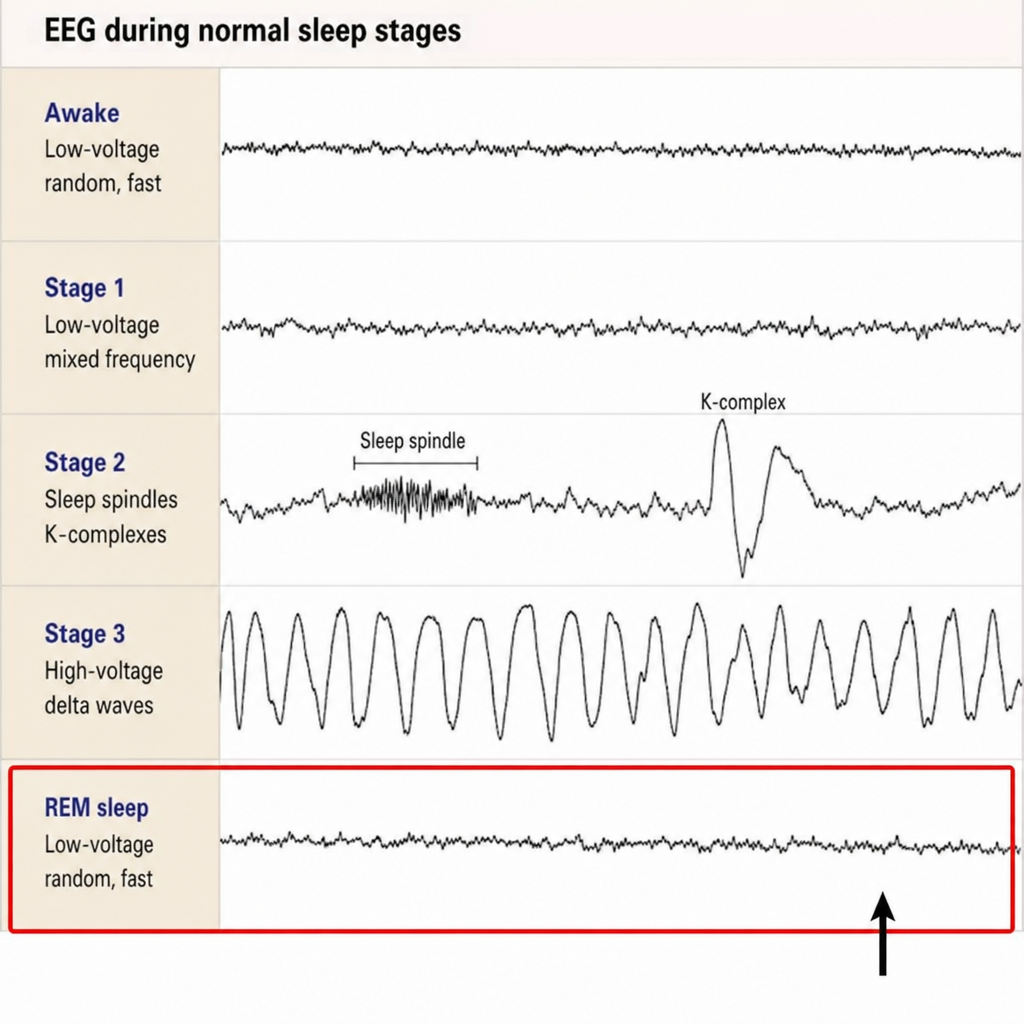
Ponto geniculo occipital spikes are characteristic of which type of sleep?
Cerebral blood flow auto-regulation occurs within which range of mean arterial pressure?
Fragmented RBCs, sliced by fibrin bands, seen in intravascular hemolysis, are known as which of the following?
Damage to Wernicke's area in the dominant hemisphere results in which of the following?
Which type of memory is associated with the basal ganglia?
Noradrenergic neurons are chiefly present in which of the following locations?
What is the normal Cerebrospinal Fluid (CSF) pressure?
Dreaming is common in which stage of sleep?
Which is the first center to get activated before the onset of skilled voluntary movements?
Among the following brain regions, which one contains the highest concentration of noradrenergic neurons?
Explanation: ### Explanation **Correct Option: D (REM Sleep)** Ponto-Geniculo-Occipital (PGO) spikes are phasic electrical potentials that originate in the **pons**, propagate to the **lateral geniculate nucleus** (thalamus), and terminate in the **occipital cortex**. They are considered the neurophysiological hallmark of **REM (Rapid Eye Movement) sleep**. These spikes appear shortly before the onset of REM and persist throughout the stage, correlating closely with the rapid eye movements and the visual imagery associated with dreaming. **Analysis of Incorrect Options:** * **Option A (Stage 1 NREM):** This is a transition phase from wakefulness to sleep characterized by **Alpha and Theta waves**. PGO spikes are absent here. * **Option B (Stage 2 NREM):** This stage is defined by **Sleep Spindles** and **K-complexes**. It is the longest stage of a typical sleep cycle but does not feature PGO activity. * **Option C (Stage 4 NREM):** Also known as Deep Sleep or Slow Wave Sleep (SWS), it is characterized by high-amplitude, low-frequency **Delta waves**. PGO spikes are suppressed during NREM to prevent cortical arousal. **High-Yield Clinical Pearls for NEET-PG:** * **REM Sleep Characteristics:** Also called "Paradoxical Sleep" because the EEG shows high activity (Beta waves) despite the person being asleep. It features muscle atonia (except for extraocular muscles and the diaphragm) and vivid dreaming. * **Neurotransmitters:** REM sleep is "ACh on, NE off." **Acetylcholine** triggers REM and PGO spikes, while Norepinephrine inhibits them. * **Bruxism (Teeth grinding):** Occurs predominantly in Stage 2 NREM. * **Somnambulism (Sleepwalking) and Night Terrors:** Occur during Stage 3/4 NREM (Slow Wave Sleep), not REM.
Explanation: **Explanation:** **Cerebral Autoregulation** is the physiological process that maintains a constant Cerebral Blood Flow (CBF) despite fluctuations in Mean Arterial Pressure (MAP). This ensures the brain receives a steady supply of oxygen and nutrients. 1. **Why Option A is Correct:** In a healthy normotensive individual, the autoregulatory range is typically **60–140 mmHg** (some texts cite up to 150 or 160 mmHg). Within this window, cerebral arterioles undergo **myogenic adaptation**: they constrict when MAP rises and dilate when MAP falls to keep CBF stable at approximately **50 ml/100g/min**. 2. **Why Other Options are Incorrect:** * **Option B (>200 mmHg):** At pressures above the upper limit (>160 mmHg), autoregulation fails. The high pressure forces the vessels to over-distend, leading to "breakthrough perfusion," which can cause cerebral edema and hypertensive encephalopathy. * **Option C (<50 mmHg):** Below the lower limit (~60 mmHg), maximal vasodilation is reached. Any further drop in MAP leads to a linear decrease in CBF, increasing the risk of cerebral ischemia and syncope. * **Option D (<10 mmHg):** This pressure is incompatible with life and represents profound circulatory collapse. **High-Yield Clinical Pearls for NEET-PG:** * **Chronic Hypertension:** The autoregulatory curve **shifts to the right**. These patients require higher MAP to maintain CBF, making them sensitive to rapid blood pressure lowering. * **Most Potent Regulator:** While pressure is important, **Arterial CO₂ (PaCO₂)** is the most potent physiological regulator of CBF. Hypercapnia causes potent vasodilation. * **Cushing’s Reflex:** A triad of hypertension, bradycardia, and irregular respiration, seen when intracranial pressure (ICP) rises to levels approaching MAP.
Explanation: **Explanation:** The correct answer is **Schistocytes**. **Mechanism of Formation:** Schistocytes are fragmented red blood cells (RBCs) that result from mechanical trauma. In conditions involving **Microangiopathic Hemolytic Anemia (MAHA)**, the intravascular space is crisscrossed by fibrin strands (microthrombi). As RBCs circulate, they are literally "sliced" by these fibrin bands, leading to the loss of cell membrane and the formation of irregular, jagged fragments (helmet cells, triangular cells). **Analysis of Incorrect Options:** * **B. Spherocytes:** These are small, dark-staining RBCs lacking central pallor. They occur due to molecular defects in the cytoskeleton (Hereditary Spherocytosis) or partial phagocytosis of antibody-coated RBCs (Autoimmune Hemolytic Anemia). * **C. Leptocytes (Target Cells):** Also known as Codocytes, these have a "bullseye" appearance due to an increased surface area-to-volume ratio. They are typically seen in Thalassemia, Liver disease, and Post-splenectomy states. * **D. Burr cells (Echinocytes):** These are RBCs with short, evenly spaced blunt projections. They are most commonly associated with **Uremia**, pyruvate kinase deficiency, or as an artifact in stored blood. **High-Yield Clinical Pearls for NEET-PG:** * **Key Associations for Schistocytes:** DIC (Disseminated Intravascular Coagulation), TTP (Thrombotic Thrombocytopenic Purpura), HUS (Hemolytic Uremic Syndrome), and prosthetic heart valves. * **Diagnostic Triad of MAHA:** Anemia, Schistocytes on peripheral smear, and Thrombocytopenia. * **Bite Cells vs. Schistocytes:** Do not confuse them. Bite cells (degmacytes) are seen in **G6PD deficiency** due to splenic macrophages removing Heinz bodies.
Explanation: **Explanation:** Wernicke’s area (Brodmann area 22) is located in the posterior part of the superior temporal gyrus of the dominant hemisphere. It is the primary center for **language comprehension** and interpretation. **Why Option A is correct:** When Wernicke’s area is damaged, the patient suffers from **Sensory (Receptive) Aphasia**. While the motor ability to produce speech (Broca’s area) remains intact, the brain cannot monitor or comprehend the words being spoken. This leads to speech that is fluent and rapid but lacks meaning—often described as **"word salad."** The speech is irrelevant because the patient cannot process their own thoughts into coherent language or understand external commands. **Why other options are incorrect:** * **Option B:** Damage to the dominant hemisphere's language centers always results in significant clinical deficits (aphasia). * **Option C:** Difficulty in articulation (dysarthria) or slow, labored speech is characteristic of **Broca’s Aphasia** (Motor Aphasia), where the motor program for speech is disrupted. * **Option D:** While Wernicke’s area is involved in understanding written language, "incomprehension of written language" specifically refers to **Alexia**. While often present in Wernicke's aphasia, the hallmark of the condition is the fluent but nonsensical verbal output. **High-Yield Clinical Pearls for NEET-PG:** * **Wernicke’s Aphasia:** Fluent speech, poor comprehension, poor repetition. Patients are often **unaware** of their deficit (anosognosia). * **Broca’s Aphasia:** Non-fluent speech, intact comprehension, poor repetition. * **Conduction Aphasia:** Damage to the **Arcuate Fasciculus**; results in fluent speech and good comprehension, but **severely impaired repetition**. * **Blood Supply:** Wernicke’s area is supplied by the **Inferior division of the Left Middle Cerebral Artery (MCA)**.
Explanation: **Explanation:** Memory is broadly classified into **Declarative (Explicit)** and **Non-declarative (Implicit)** memory. **Procedural memory** is a subtype of implicit memory that involves learning motor skills, habits, and "how-to" tasks (e.g., riding a bicycle or typing). The **Basal Ganglia** (specifically the striatum) is the primary neuroanatomical substrate for procedural memory. It coordinates with the cerebellum and motor cortex to automate repetitive motor patterns through reinforcement learning. **Analysis of Options:** * **Option A (Conditioning):** While also a type of implicit memory, classical conditioning is primarily associated with the **amygdala** (for emotional responses) and the **cerebellum** (for motor reflexes). * **Option C (Explicit memory):** This refers to the conscious recollection of facts (semantic) and events (episodic). It is mediated by the **hippocampus** and the surrounding medial temporal lobe. Damage here causes anterograde amnesia but leaves procedural memory intact. **High-Yield Clinical Pearls for NEET-PG:** * **Huntington’s & Parkinson’s Disease:** Patients often show deficits in **procedural memory** due to basal ganglia degeneration, while their explicit memory may remain relatively preserved in early stages. * **Hippocampus vs. Basal Ganglia:** Remember the "What" vs. "How" distinction. The Hippocampus handles "What" (facts), while the Basal Ganglia handles "How" (skills). * **Working Memory:** Primarily associated with the **Prefrontal Cortex**. * **Papez Circuit:** Essential for the transition of short-term memory to long-term explicit memory.
Explanation: **Explanation:** The correct answer is **Locus ceruleus**. **1. Why Locus Ceruleus is Correct:** The locus ceruleus (located in the posterior pons) is the primary site for norepinephrine (NE) synthesis in the brain. It contains the largest concentration of noradrenergic neurons, which project widely to the cerebral cortex, cerebellum, and spinal cord. These neurons play a critical role in regulating arousal, attention, sleep-wake cycles, and the "fight or flight" stress response. **2. Analysis of Incorrect Options:** * **Nucleus accumbens:** This is a key component of the mesolimbic pathway and is primarily associated with **Dopamine**. It is known as the "reward center" of the brain. * **Nucleus raphe magnus:** This area is the major source of **Serotonin** (5-HT) in the central nervous system. It is involved in mood regulation and the descending inhibitory pain pathway. * **Nigrostriatal pathway:** This pathway consists of **Dopaminergic** neurons projecting from the substantia nigra pars compacta to the striatum. Degeneration of this pathway is the hallmark of Parkinson’s disease. **3. Clinical Pearls for NEET-PG:** * **Norepinephrine Synthesis:** The rate-limiting enzyme is **Tyrosine Hydroxylase**. NE is converted to Epinephrine in the adrenal medulla by the enzyme **PNMT**. * **REM Sleep:** Locus ceruleus activity decreases significantly during REM sleep (it is "REM-off"). * **Anxiety:** Overactivity of the locus ceruleus is associated with panic attacks and anxiety disorders. * **Mnemonic:** Remember **"Locus Ceruleus = Blue Spot"** (due to neuromelanin granules) and it produces **NE** (No-Epinephrine).
Explanation: **Explanation:** The normal Cerebrospinal Fluid (CSF) pressure in a healthy adult, when measured via lumbar puncture in the **lateral recumbent position**, typically ranges from **70 to 180 mm H₂O** (averaging around 110-150 mm H₂O). Option A (110-180 mm H₂O) is the most accurate representation of this physiological range. This pressure is maintained by a delicate balance between the rate of CSF secretion by the choroid plexus and its absorption into the venous sinuses via arachnoid villi. **Analysis of Incorrect Options:** * **Option B (180-300 mm H₂O):** This range is considered borderline to high. Pressures consistently above 200-250 mm H₂O indicate **Intracranial Hypertension**, seen in conditions like idiopathic intracranial hypertension (IIH) or space-occupying lesions. * **Option C (200-400 mm H₂O):** These are pathologically elevated levels. Such high pressures are characteristic of bacterial meningitis, intracranial hemorrhage, or severe cerebral edema. * **Option D (5-10 mm H₂O):** This is extremely low. While CSF pressure is lower in infants, this value is near zero and would suggest a CSF leak (Intracranial Hypotension). **High-Yield Clinical Pearls for NEET-PG:** * **Positioning:** CSF pressure must be measured in the **lateral decubitus** position. If measured sitting up, the pressure in the lumbar cistern can rise to 200-300 mm H₂O due to hydrostatic pressure. * **Queckenstedt's Test:** Compression of jugular veins normally causes a rapid rise in CSF pressure; failure to rise suggests a spinal subarachnoid block. * **CSF Production Rate:** Approximately **0.5 ml/min** or **500-600 ml/day**, meaning the total CSF volume (approx. 150 ml) is replaced about 3-4 times daily.
Explanation: **Explanation:** **REM (Rapid Eye Movement) sleep** is the correct answer because it is the stage most closely associated with vivid, narrative, and emotionally charged dreaming. During REM sleep, the brain is highly active—often resembling an awake state on an EEG (low-voltage, mixed-frequency waves)—while the body experiences **muscle atonia** (paralysis) to prevent the physical acting out of dreams. **Analysis of Incorrect Options:** * **NREM 1 (Stage 1):** This is the lightest stage of sleep (transition from wakefulness). While "hypnagogic hallucinations" can occur, they are brief fragments rather than structured dreams. * **NREM 2 (Stage 2):** Characterized by **Sleep Spindles** and **K-complexes**. While some mental activity occurs, it lacks the complexity of REM dreams. * **NREM 3 (Stage 3):** Also known as **Deep Sleep** or Slow Wave Sleep (SWS), characterized by Delta waves. This stage is associated with physical restoration. If dreaming occurs here, it is usually conceptual and less vivid. **High-Yield NEET-PG Pearls:** 1. **EEG Pattern:** REM sleep is also called **"Paradoxical Sleep"** because the EEG shows beta-like activity despite the person being sound asleep. 2. **PGO Spikes:** Pontine-Geniculate-Occipital (PGO) spikes are the hallmark triggers for REM sleep. 3. **Clinical Correlation:** **Nightmares** occur during REM sleep, whereas **Night Terrors** and **Sleepwalking (Somnambulism)** occur during NREM 3. 4. **Neurotransmitters:** Acetylcholine (ACh) levels are high during REM, while Norepinephrine and Serotonin are at their lowest.
Explanation: **Explanation:** The initiation of a skilled voluntary movement is a complex process involving the motor cortex, basal ganglia, and cerebellum. The **Neocerebellum** (specifically the cerebrocerebellum and the dentate nucleus) is the correct answer because it is involved in the **planning and programming** of movements. Electrophysiological studies show that neurons in the dentate nucleus fire *before* the primary motor cortex and well before the actual onset of movement. It functions as part of a feedback loop with the motor cortex to coordinate the sequence, timing, and force of skilled tasks. **Analysis of Incorrect Options:** * **Hypothalamus:** This is the primary center for autonomic control and homeostasis (thirst, hunger, temperature). It does not play a direct role in the motor programming of voluntary skeletal muscle movement. * **Pons:** While the pons contains the pontine nuclei (which relay information from the cortex to the cerebellum), it acts as a conduit rather than the primary initiation or planning center for skilled movement. * **Medulla:** This houses vital centers for respiration and cardiovascular function, as well as the decussation of the pyramids. It executes motor commands but does not "plan" them. **High-Yield Facts for NEET-PG:** * **Phylogenetic Classification:** The Neocerebellum is the newest part of the cerebellum, consisting of the lateral cerebellar hemispheres and the dentate nucleus. * **Clinical Correlation:** Lesions to the neocerebellum result in **decomposition of movement**, dysmetria (past-pointing), and intention tremors, as the "program" for smooth movement is lost. * **Sequence of Activation:** Neocerebellum/Basal Ganglia → Premotor/Supplementary Motor Cortex → Primary Motor Cortex → Spinal Cord.
Explanation: **Explanation:** The **Locus Ceruleus (LC)**, located in the posterior part of the rostral pons, is the primary source of norepinephrine (NE) in the central nervous system. It contains the highest concentration of noradrenergic neurons in the brain. These neurons project widely to the cerebral cortex, hippocampus, cerebellum, and spinal cord, playing a critical role in the **"fight or flight"** response, arousal, sleep-wake cycles, and cognitive focus. **Analysis of Options:** * **A. Locus Ceruleus (Correct):** It is the "blue spot" of the brainstem, so named due to neuromelanin granules. It provides nearly 70% of the brain's total norepinephrine. * **B. Nucleus Raphe Magnus:** This region is the primary site for **Serotonergic (5-HT)** neurons. It is part of the descending pain inhibitory pathway. * **C. Periaqueductal Grey (PAG):** This area is rich in **Enkephalins (Opioids)**. It plays a vital role in the modulation of pain and the "freeze" response. * **D. Medial Longitudinal Fasciculus (MLF):** This is a white matter tract, not a nucleus. It coordinates conjugate eye movements by connecting the nuclei of CN III, IV, and VI with the vestibular nuclei. **High-Yield Clinical Pearls for NEET-PG:** * **REM Sleep:** Locus ceruleus activity is **lowest** (almost silent) during REM sleep and highest during wakefulness/stress. * **Neurodegeneration:** Significant loss of noradrenergic neurons in the LC is a hallmark of **Alzheimer’s** and **Parkinson’s disease**, contributing to cognitive decline. * **Anxiety:** Overactivity of the LC is associated with panic attacks and anxiety disorders.
Neurons and Glial Cells
Practice Questions
Synaptic Transmission
Practice Questions
Sensory Processing
Practice Questions
Motor Control Systems
Practice Questions
Autonomic Nervous System
Practice Questions
Hypothalamus and Limbic System
Practice Questions
Cerebral Cortex Functions
Practice Questions
Electroencephalography
Practice Questions
Neuroplasticity
Practice Questions
Sleep and Wakefulness
Practice Questions
Get full access to all questions, explanations, and performance tracking.
Start For Free