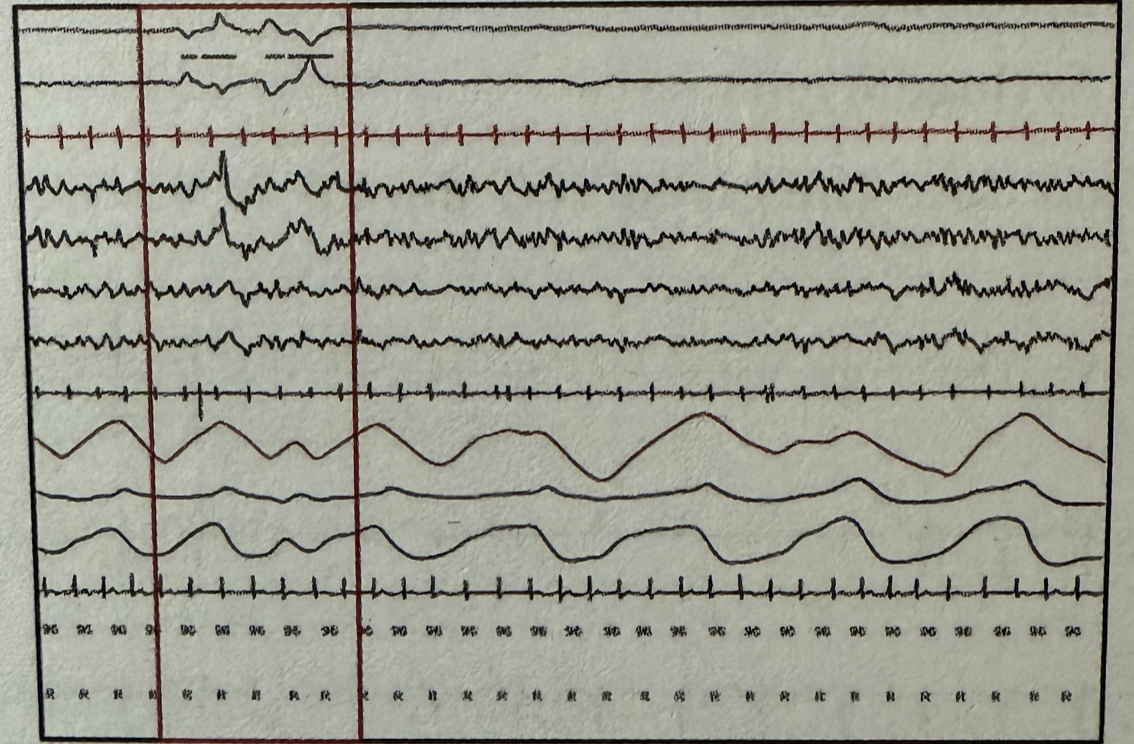
Which test can be used to assess daytime functioning as an index of the adequacy of sleep?
Tremors are observed during movements in which of the following conditions?
Which part of the brain is involved in narcolepsy?
The mu rhythm on EEG arises from which area?
The vestibulo-ocular reflex is primarily concerned with which part of the cerebellum?
What is the principle stating that the dorsal roots of the spinal cord are sensory and the ventral roots are motor?
Cerebral perfusion pressure is measured as?
Which of the following is an inhibitory neurotransmitter in the spinal cord?
Which of the following functions is primarily controlled by the left lobe of the brain?
A patient is unable to speak but can communicate by writing. Which of the following brain areas is most likely affected?
Explanation: **Explanation:** The **Multiple Sleep Latency Test (MSLT)** is the gold standard objective tool used to assess **excessive daytime sleepiness (EDS)** and daytime functioning. It measures the speed with which a person falls asleep in a quiet environment during the day across several trials (usually five naps scheduled two hours apart). * **Why MSLT is correct:** The underlying concept is that the "adequacy" of nocturnal sleep is inversely proportional to daytime sleep propensity. A shorter "sleep latency" (the time taken to fall asleep) indicates higher levels of daytime sleepiness, suggesting inadequate or poor-quality restorative sleep. It is specifically used to diagnose Narcolepsy (looking for Sleep Onset REM Periods - SOREMPs) and Idiopathic Hypersomnia. **Analysis of Incorrect Options:** * **A. Electroencephalogram (EEG):** While EEG is a component of sleep studies (Polysomnography) used to identify sleep stages, a standalone EEG is primarily used to evaluate seizure activity or brain death, not to quantify daytime functioning or sleep adequacy. * **B. Electroretinogram (ERG):** This is a diagnostic test that measures the electrical response of the eye's light-sensitive cells (rods and cones). It is used for retinal diseases (e.g., Retinitis Pigmentosa) and has no role in sleep medicine. **Clinical Pearls for NEET-PG:** * **Normal Sleep Latency:** Usually >10–15 minutes. * **Pathological Sleepiness:** An MSLT score of **<8 minutes** is considered diagnostic of excessive daytime sleepiness. * **Maintenance of Wakefulness Test (MWT):** Unlike MSLT (which measures the ability to fall asleep), MWT measures the ability to *stay awake*, often used to assess treatment efficacy in pilots or drivers. * **Epworth Sleepiness Scale (ESS):** This is the subjective counterpart to the MSLT (a validated questionnaire).
Explanation: ### Explanation The correct answer is **D. Cerebellum injury**. **1. Why Cerebellum Injury is Correct:** The cerebellum is responsible for the coordination, precision, and timing of voluntary movements. It acts as a "comparator," constantly adjusting motor output by comparing intended movement with actual performance. Damage to the **neocerebellum** (posterior lobe) results in **Intention Tremors** (also known as kinetic tremors). These tremors are absent at rest but appear during active, purposeful movement and typically worsen as the limb approaches its target. This occurs due to the loss of the cerebellum's damping effect, leading to "overshooting" and "undershooting" (dysmetria). **2. Why Other Options are Incorrect:** * **Spinal Cord Injury:** Typically results in motor paralysis (upper or lower motor neuron lesions) and sensory loss below the level of the lesion. It may cause spasticity or clonus, but not intention tremors. * **Thalamus Injury:** Usually presents with sensory deficits (Dejerine-Roussy syndrome) or contralateral hemiparesis. While the thalamus is a relay station, isolated injury does not characteristically produce movement-induced tremors. * **Internal Capsule Injury:** This is a common site for strokes, leading to contralateral hemiplegia or hemiparesis due to damage to the corticospinal tract. It results in spasticity, not tremors. **3. NEET-PG High-Yield Pearls:** * **Resting Tremors:** Characteristically seen in **Parkinson’s Disease** (Basal Ganglia/Substantia Nigra lesion). Described as "pill-rolling" tremors. * **Cerebellar Signs (DANISH):** **D**ysdiadochokinesia, **A**taxia, **N**ystagmus, **I**ntention tremor, **S**lurred speech (Scanning speech), **H**ypotonia. * **The Rule of Thumb:** Basal Ganglia lesions = Tremors at **Rest**; Cerebellar lesions = Tremors during **Activity**.
Explanation: **Explanation:** **1. Why Hypothalamus is Correct:** Narcolepsy is primarily a disorder of sleep-wake regulation caused by the loss of **orexin (hypocretin)-producing neurons**. These neurons are located exclusively in the **lateral hypothalamus**. Orexin is a neuropeptide that promotes wakefulness and stabilizes the transition between sleep and wake states. In Narcolepsy Type 1, an autoimmune destruction of these hypothalamic neurons leads to low levels of orexin in the cerebrospinal fluid (CSF), resulting in excessive daytime sleepiness and cataplexy. **2. Why Other Options are Incorrect:** * **Neocortex:** While the neocortex is involved in higher-order functions (cognition, sensory perception) and shows altered activity during sleep, it is not the site of the primary lesion in narcolepsy. * **Cerebellum:** This region is responsible for motor coordination, posture, and balance. It does not regulate the sleep-wake cycle. * **Putamen:** Part of the basal ganglia, the putamen is involved in regulating movements and learning. While movement disorders can involve the putamen, it is not the anatomical substrate for narcolepsy. **3. High-Yield Clinical Pearls for NEET-PG:** * **The Tetrad of Narcolepsy:** 1. Excessive Daytime Sleepiness (most common), 2. Cataplexy (sudden loss of muscle tone triggered by emotion), 3. Sleep Paralysis, 4. Hypnagogic hallucinations. * **Sleep Architecture:** Narcolepsy is characterized by **Shortened REM Latency** (Sleep-onset REM periods or SOREMPs). * **HLA Association:** Strongly associated with **HLA-DQB1*0602**. * **Treatment:** Modafinil (first-line for sleepiness); Sodium Oxybate (effective for cataplexy).
Explanation: **Explanation:** The **Mu rhythm** (also known as the wicket rhythm) is a specific EEG pattern characterized by frequencies between **8–13 Hz**. While it shares a similar frequency range with the Alpha rhythm, it is distinguished by its location and reactivity. 1. **Why the Correct Answer is Right:** The Mu rhythm originates from the **Primary Sensorimotor Area** (around the central sulcus). Its key physiological characteristic is that it is **suppressed by motor activity** or the intention to move (motor imagery). For example, moving the contralateral hand or even thinking about moving it will cause the Mu rhythm to disappear (desynchronization). 2. **Why the Other Options are Wrong:** * **Primary Visual Area (Option A):** This area (occipital lobe) is the site of the **Alpha rhythm**. Alpha waves are prominent during wakeful relaxation with eyes closed and are suppressed by eye-opening or mental concentration. * **Primary Auditory Area (Option B):** EEG rhythms specific to the auditory cortex (temporal lobe) are not typically classified under the standard Greek-letter rhythms like Mu or Alpha in routine clinical EEG. * **Primary Olfactory Area (Option D):** This area is located on the inferior surface of the frontal lobe and uncus; it does not produce a surface-recordable rhythm like the Mu rhythm. **High-Yield Clinical Pearls for NEET-PG:** * **Alpha Rhythm:** 8–13 Hz; Occipital location; suppressed by **eye-opening**. * **Mu Rhythm:** 8–13 Hz; Central/Parietal location; suppressed by **motor activity**. * **Beta Rhythm:** 13–30 Hz; Frontal location; associated with active thinking and anxiety. * **Theta Rhythm:** 4–7 Hz; Normal in children and during sleep; abnormal in awake adults (suggests encephalopathy). * **Delta Rhythm:** <4 Hz; Normal in deep sleep (Stage N3); highest amplitude waves.
Explanation: ### Explanation The **Vestibulo-Ocular Reflex (VOR)** is a mechanism that stabilizes gaze during head movement by producing eye movements in the direction opposite to head movement. This reflex is primarily regulated by the **Flocculonodular lobe** of the cerebellum. **Why the Flocculonodular Lobe is Correct:** The cerebellum is divided into three functional zones. The flocculonodular lobe (comprising the flocculus and nodulus) is functionally known as the **Vestibulocerebellum**. It receives direct sensory input from the vestibular nuclei and the semicircular canals. Its primary role is to coordinate balance, axial muscle tone, and eye movements (VOR). Damage to this area typically results in nystagmus and truncal ataxia. **Analysis of Incorrect Options:** * **Archicerebellum:** While the flocculonodular lobe is the anatomical component of the archicerebellum (the phylogenetically oldest part), the question asks for the specific anatomical part. In medical exams, if both a functional division (Archicerebellum) and a specific anatomical lobe (Flocculonodular) are provided, the **anatomical lobe** is the more precise answer for the site of reflex modulation. * **Neocerebellum:** Also known as the cerebrocerebellum (lateral hemispheres), it is involved in planning, programming, and timing of complex motor sequences. * **Occipital Lobe:** This is a part of the cerebral cortex responsible for visual processing, not a part of the cerebellum or the primary mediator of the subconscious VOR. **High-Yield Clinical Pearls for NEET-PG:** * **Afferent limb of VOR:** Vestibular nerve (CN VIII). * **Efferent limb of VOR:** Oculomotor (CN III), Trochlear (CN IV), and Abducens (CN VI) nerves. * **Doll’s Eye Phenomenon:** A clinical test for VOR used to evaluate brainstem integrity in comatose patients. * **Fastigial Nucleus:** The deep cerebellar nucleus associated with the vestibulocerebellum.
Explanation: ### Explanation **Correct Option: B. Bell-Magendie Law** The **Bell-Magendie Law** is a fundamental principle in neurophysiology which states that the **dorsal (posterior) roots** of the spinal cord contain only sensory (afferent) fibers, while the **ventral (anterior) roots** contain only motor (efferent) fibers. * **Mechanism:** Sensory information from the periphery enters the spinal cord via the dorsal horn. Conversely, motor impulses originate in the ventral horn and exit through the ventral root to reach the muscles. This anatomical separation ensures the unidirectional flow of nerve impulses within the reflex arc. **Analysis of Incorrect Options:** * **A. Laplace’s Law:** Relates to the wall tension of a hollow organ (like the heart or alveoli) to its internal pressure and radius ($T = P \times R$). It explains why smaller alveoli require surfactant to prevent collapse. * **C. Frank-Starling Law:** A cardiovascular principle stating that the force of cardiac muscular contraction is proportional to the initial length of the muscle fiber (preload). * **D. Weber-Fechner Law:** A psychophysical law relating the intensity of a physical stimulus to the perceived intensity of the sensation (the "just noticeable difference"). **High-Yield Clinical Pearls for NEET-PG:** * **Exception to the Law:** Some studies suggest the presence of a small percentage of sensory fibers in the ventral root (recurrent fibers), which may explain why some patients still feel pain after a dorsal rhizotomy. * **Clinical Correlation:** Lesions of the **dorsal root** result in anesthesia and loss of reflexes (e.g., Tabes Dorsalis), while lesions of the **ventral root** lead to lower motor neuron (LMN) type paralysis and muscle atrophy. * **Mnemonic:** **S**ensory = **A**fferent = **D**orsal (**SAD**) / **M**otor = **E**fferent = **V**entral (**MEV**).
Explanation: ### Explanation **Concept:** Cerebral Perfusion Pressure (CPP) is the net pressure gradient that drives oxygen delivery to cerebral tissue. For blood to flow into the cranium, the systemic pressure pushing blood in must overcome the resistance offered by the pressure already existing inside the rigid skull. **Why Option A is Correct:** The formula for CPP is **CPP = MAP – ICP**. * **Mean Arterial Pressure (MAP):** Represents the "push" or inflow pressure from the systemic circulation. * **Intracranial Pressure (ICP):** Represents the "back pressure" or resistance within the skull. In healthy adults, the normal ICP is roughly 5–15 mmHg, and the normal CPP is typically **70–90 mmHg**. If ICP rises (e.g., due to a tumor or hemorrhage) or MAP falls (e.g., shock), the CPP decreases, leading to brain ischemia. **Why Other Options are Incorrect:** * **Option B:** This would result in a negative value under normal physiological conditions, as MAP must always be higher than ICP for perfusion to occur. * **Option C:** This is the formula for **Cerebral Blood Flow (CBF)**, not pressure. According to Ohm’s Law: Flow = Pressure / Resistance. * **Option D:** Adding pressures is physiologically incorrect; perfusion depends on the pressure *gradient* (difference). **High-Yield Clinical Pearls for NEET-PG:** * **Cushing’s Triad:** A clinical sign of increased ICP consisting of hypertension (to maintain CPP), bradycardia, and irregular respiration. * **Critical Threshold:** Brain ischemia usually occurs when CPP falls below **40–50 mmHg**. * **Autoregulation:** The brain maintains a constant CBF despite changes in MAP, provided the MAP remains between **60 and 160 mmHg**. * **Alternative Formula:** If ICP is not available, **Jugular Venous Pressure (JVP)** is sometimes used as the "back pressure," making the formula **CPP = MAP – JVP**. However, MAP – ICP remains the gold standard.
Explanation: **Explanation:** The correct answer is **Glycine**. In the central nervous system, neurotransmitters are classified based on their effect on the postsynaptic membrane. **1. Why Glycine is correct:** Glycine is the **primary inhibitory neurotransmitter in the spinal cord** and brainstem. It acts by binding to ionotropic receptors that open **chloride (Cl⁻) channels**. The influx of negatively charged chloride ions causes hyperpolarization of the postsynaptic neuron, resulting in an Inhibitory Postsynaptic Potential (IPSP), which makes the neuron less likely to fire an action potential. **2. Analysis of Incorrect Options:** * **Glutamic acid (Glutamate):** This is the major **excitatory** neurotransmitter in the entire CNS. It works by opening cation channels (Na⁺/Ca²⁺). * **Histidine:** This is an amino acid precursor to histamine, not a primary neurotransmitter itself. Histamine acts mainly as an excitatory neuromodulator in the hypothalamus. * **GABA (Gamma-Aminobutyric Acid):** While GABA is the major inhibitory neurotransmitter in the **brain** (supraspinal levels), Glycine takes precedence in the spinal cord. **3. High-Yield Clinical Pearls for NEET-PG:** * **Renshaw Cells:** These are inhibitory interneurons in the spinal cord that utilize **Glycine** to mediate recurrent inhibition of alpha motor neurons. * **Strychnine Poisoning:** Strychnine is a potent **Glycine receptor antagonist**. By blocking glycine, it removes spinal inhibition, leading to severe, unchecked muscle convulsions (opisthotonus). * **Tetanus Toxin:** Produced by *Clostridium tetani*, this toxin prevents the **release** of Glycine and GABA from inhibitory interneurons, leading to spastic paralysis and "lockjaw." * **Co-localization:** In many spinal cord synapses, GABA and Glycine are co-released to fine-tune motor control.
Explanation: In neurophysiology, the concept of **Cerebral Lateralization** (or Hemispheric Specialization) dictates that while the two hemispheres are anatomically similar, they are functionally distinct. ### Why Option D is Correct In approximately 95% of right-handed individuals and 70% of left-handed individuals, the **left hemisphere** is the **categorical hemisphere**. It is specialized for sequential, analytical, and symbolic processing. Its primary functions include: * **Language:** Both Broca’s area (speech production) and Wernicke’s area (comprehension) are typically located here. * **Mathematical calculations** and logical reasoning. * **Processing of written and spoken language.** ### Why Other Options are Incorrect Options A, B, and C are primarily functions of the **right hemisphere** (the **representational hemisphere**), which deals with holistic, visuospatial, and creative patterns: * **A. Appreciation of music:** The right hemisphere processes melody, pitch, and the emotional intonation of speech (prosody). * **B. Spatial orientation:** Navigating 3D space and recognizing faces/geometric patterns are right-brain dominant. * **C. Processing of visual stimuli:** While both occipital lobes process vision, the *interpretation* of complex visual patterns and three-dimensional relationships is a right-hemisphere specialty. ### High-Yield Clinical Pearls for NEET-PG * **Wada Test:** Used clinically to determine which hemisphere is dominant for speech before neurosurgery (involves injecting sodium amobarbital into the carotid artery). * **Lesion Correlation:** A left-sided stroke typically results in **Aphasia** (language deficit), whereas a right-sided stroke often leads to **Agnosia** (inability to recognize objects) or **Neglect syndrome**. * **Astereognosis:** The inability to identify an object by touch; usually associated with a lesion in the parietal lobe of the non-dominant (right) hemisphere.
Explanation: ### Explanation **Correct Option: A. Broca’s Area** The patient is presenting with **Broca’s Aphasia** (also known as motor, expressive, or non-fluent aphasia). Broca’s area (Brodmann areas 44 and 45) is located in the posterior part of the inferior frontal gyrus of the dominant hemisphere. It is responsible for the motor programming of speech. * **Key Concept:** In Broca’s aphasia, the patient understands language and can often communicate through writing (as the motor pathways for manual dexterity are distinct) or gestures, but they struggle with the mechanical production of spoken words. Speech is typically "telegraphic" and effortful. **Incorrect Options:** * **B. Wernicke’s Area:** Located in the superior temporal gyrus (Brodmann area 22), damage here causes **Sensory Aphasia**. Patients speak fluently but the content is nonsensical ("word salad"), and they have impaired comprehension of both spoken and written language. * **C. Paracentral Lobule:** This area on the medial surface of the hemisphere controls motor and sensory functions of the contralateral lower limb and the urinary bladder. It is not involved in language production. * **D. Insula:** While the insula plays a role in diverse functions like perception and self-awareness, it is not the primary center for speech production. **High-Yield Clinical Pearls for NEET-PG:** * **Blood Supply:** Broca’s area is supplied by the **Superior division** of the Middle Cerebral Artery (MCA), while Wernicke’s is supplied by the **Inferior division**. * **Arcuate Fasciculus:** The white matter tract connecting Broca’s and Wernicke’s areas. Damage leads to **Conduction Aphasia** (characterized by an inability to repeat phrases). * **Exner’s Area:** Located just above Broca’s area; damage specifically causes **isolated agraphia** (inability to write).
Neurons and Glial Cells
Practice Questions
Synaptic Transmission
Practice Questions
Sensory Processing
Practice Questions
Motor Control Systems
Practice Questions
Autonomic Nervous System
Practice Questions
Hypothalamus and Limbic System
Practice Questions
Cerebral Cortex Functions
Practice Questions
Electroencephalography
Practice Questions
Neuroplasticity
Practice Questions
Sleep and Wakefulness
Practice Questions
Get full access to all questions, explanations, and performance tracking.
Start For Free