Small axons are concerned with all of the following functions, except:
Troponin C mediated function is of which of the following?
The minimum intensity of stimulus applied for adequate time to produce a response is called?
Phase 2 of the action potential is due to which of the following?
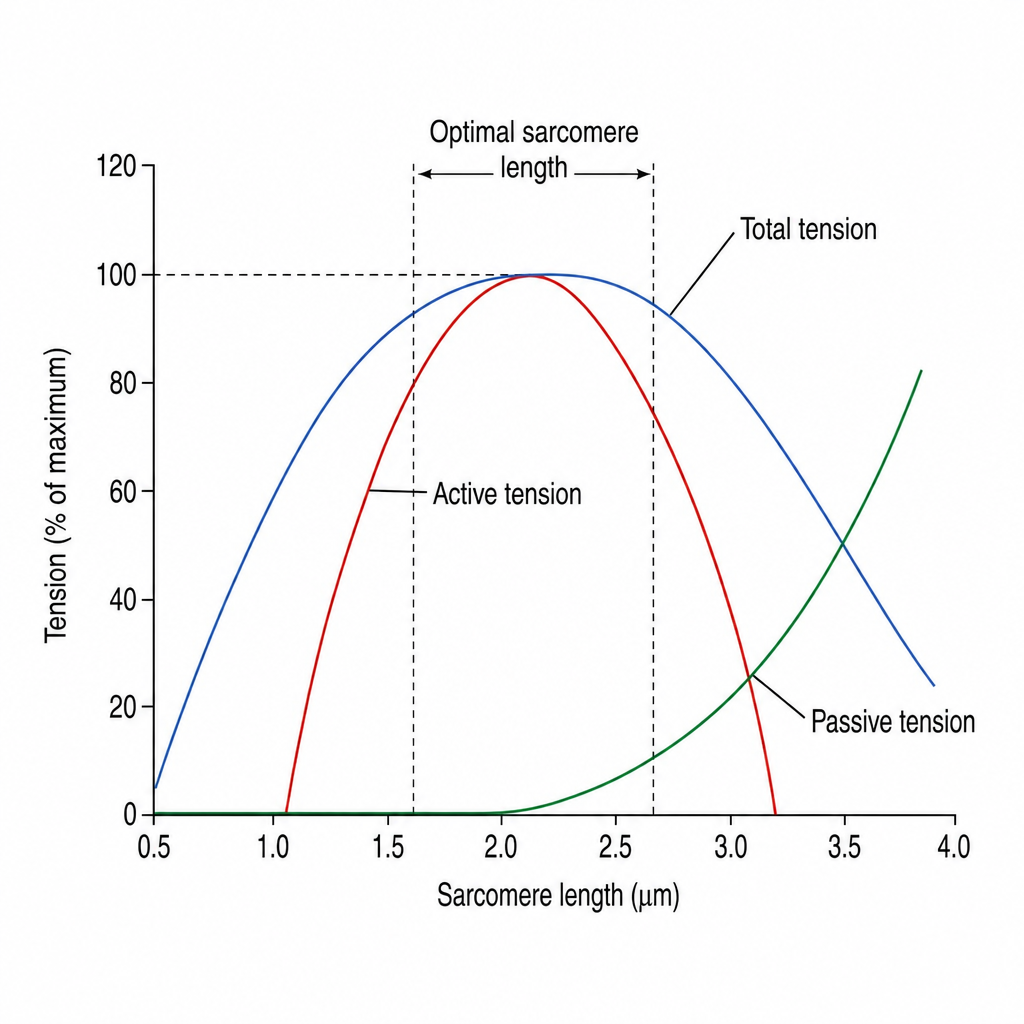
What is the so-called "pseudo-H zone" in a sarcomere?
What are the two major types of muscle fibres found in humans?
Increased velocity of conduction in a nerve is caused by:
Which of the following best describes an attribute of visceral smooth muscle that is not shared by skeletal muscle?
Which muscles are primarily used during the stance and swing phases of normal walking?
In muscle contraction, all of the following events occur EXCEPT:
Explanation: **Explanation:** The classification of nerve fibers (Erlanger-Gasser classification) is based on the principle that **fiber diameter is directly proportional to conduction velocity.** **1. Why Proprioception is the Correct Answer:** Proprioception (the sense of self-movement and body position) requires extremely rapid transmission of information to the CNS to maintain balance and coordinate movement. Therefore, it is mediated by the **largest and most heavily myelinated fibers** (Type A-alpha). These fibers have the highest conduction velocities (70–120 m/s). Because proprioception is carried by large axons, it is the "except" in this question. **2. Analysis of Incorrect Options:** * **Pain and Temperature (Options A & B):** These sensations are carried by small-diameter fibers. Fast pain and cold temperature are carried by **Type A-delta** fibers (small, thinly myelinated), while slow pain and warmth are carried by **Type C** fibers (the smallest, unmyelinated axons). * **Autonomic Function (Option C):** Preganglionic autonomic fibers are **Type B** (small, myelinated), and postganglionic fibers are **Type C** (small, unmyelinated). Both are significantly smaller than the fibers used for proprioception. **3. High-Yield Clinical Pearls for NEET-PG:** * **Order of Susceptibility:** * **Hypoxia:** Affects Type A fibers first (Large > Small). * **Pressure:** Affects Type A fibers first (Large > Small). This is why your foot "falls asleep" (loss of touch/proprioception) before you lose pain sensation. * **Local Anesthetics:** Affect Type C fibers first (Small > Large). This explains why pain is blocked before motor function during regional anesthesia. * **Type C fibers** are the only unmyelinated fibers and have the slowest conduction velocity (0.5–2 m/s). * **A-alpha fibers** are the thickest and fastest; they serve both motor (extrafusal muscle fibers) and sensory (proprioception) roles.
Explanation: **Explanation:** The correct answer is **Actin**. In skeletal and cardiac muscle, contraction is regulated by the **Troponin-Tropomyosin complex** located on the thin (actin) filaments. **Troponin C (TnC)** is the calcium-binding subunit. When calcium binds to TnC, it induces a conformational change that pulls **Tropomyosin** away from the myosin-binding sites on the **Actin** filament. This exposure allows the myosin heads to bind to actin, forming cross-bridges and initiating contraction. Therefore, the function of Troponin C is fundamentally mediated through its interaction with the actin-tropomyosin complex. **Analysis of Incorrect Options:** * **Dystrophin:** This is a structural protein that links the internal cytoskeleton (actin) of a muscle fiber to the surrounding extracellular matrix through the cell membrane. It provides structural stability but does not mediate Troponin C function. * **Calmodulin:** This is a calcium-binding protein found in **smooth muscle** (which lacks troponin). While it is structurally homologous to Troponin C, it functions independently to activate Myosin Light Chain Kinase (MLCK). * **Calcineurin:** This is a calcium-dependent phosphatase involved in T-cell activation and cardiac hypertrophy signaling pathways; it is not a structural component of the contractile apparatus. **High-Yield NEET-PG Pearls:** * **Troponin Subunits:** **TnI** (Inhibitory - binds actin), **TnT** (Tropomyosin-binding), and **TnC** (Calcium-binding). * **Cardiac Biomarkers:** Troponin I and T are highly specific markers for myocardial infarction. * **Smooth Muscle:** Remember, smooth muscle uses **Calmodulin** and **Caldesmon** instead of the Troponin complex. * **Calcium Source:** In skeletal muscle, calcium comes solely from the Sarcoplasmic Reticulum (SR), whereas in cardiac muscle, it involves Calcium-Induced Calcium Release (CICR) from both ECF and SR.
Explanation: ### Explanation The question describes the fundamental concept of the **Strength-Duration Curve**, which illustrates the relationship between the intensity of an electrical stimulus and the time required to excite a nerve or muscle fiber. **1. Why Rheobase is Correct:** **Rheobase** is defined as the **minimum intensity** (voltage or current) of a constant stimulus that, when applied for an adequate (indefinite) period, will produce an action potential. If the stimulus intensity is lower than the rheobase, no response will occur regardless of the duration of application. **2. Analysis of Incorrect Options:** * **Subthreshold stimulus (A):** An intensity lower than the rheobase. It fails to depolarize the membrane to the threshold level and thus does not produce an action potential. * **Suprathreshold stimulus (B):** An intensity higher than the threshold. While it produces a response, it is not the *minimum* intensity required. * **Chronaxie (D):** This is a measure of **time**, not intensity. It is the minimum time required to excite a tissue when a stimulus of **twice the rheobase** intensity is applied. **3. NEET-PG High-Yield Pearls:** * **Chronaxie and Excitability:** Chronaxie is inversely proportional to excitability. A shorter chronaxie means the tissue is more excitable (e.g., Nerve < Skeletal Muscle < Cardiac Muscle). * **Utilization Time:** The minimum time required to excite a tissue using a stimulus of rheobase intensity. * **Clinical Significance:** Changes in the Strength-Duration curve (and chronaxie) are used clinically in **electromyography (EMG)** to detect nerve regeneration or denervation. Denervated muscles show a shift of the curve to the right and an increased chronaxie.
Explanation: **Explanation:** The question refers to the **Cardiac Action Potential** (specifically in ventricular myocytes). Unlike nerve cells, cardiac cells exhibit a prolonged plateau phase (Phase 2) which is crucial for preventing tetany and allowing the heart to fill with blood. **1. Why Calcium Influx is Correct:** Phase 2 (the **Plateau Phase**) is characterized by a balance between the inward movement of **Calcium ions (Ca²⁺)** and the outward movement of Potassium ions (K⁺). During this phase, **L-type (Long-lasting) Calcium channels** open, allowing Ca²⁺ to enter the cell. This influx of positive charge offsets the repolarizing effect of K⁺ efflux, maintaining the membrane potential at a near-constant level. This calcium entry also triggers "Calcium-Induced Calcium Release" (CICR) from the sarcoplasmic reticulum, which is essential for muscle contraction. **2. Why the other options are incorrect:** * **A. Sodium influx:** This occurs during **Phase 0** (Rapid Depolarization) via fast voltage-gated Na⁺ channels. * **B. Potassium influx:** Potassium generally moves *out* of the cell (efflux) during repolarization (**Phases 1, 2, and 3**). Influx of K⁺ is not a primary feature of the action potential phases. * **D. Chloride influx:** A brief influx of Cl⁻ ions contributes to **Phase 1** (Initial Rapid Repolarization), along with the closure of Na⁺ channels. **High-Yield Facts for NEET-PG:** * **Phase 0:** Rapid Depolarization (Na⁺ Influx). * **Phase 1:** Initial Repolarization (K⁺ Efflux, Cl⁻ Influx). * **Phase 2:** Plateau Phase (**Ca²⁺ Influx** via L-type channels). * **Phase 3:** Rapid Repolarization (K⁺ Efflux). * **Phase 4:** Resting Membrane Potential (-90 mV). * **Clinical Pearl:** Calcium channel blockers (like Verapamil) primarily act on Phase 2, shortening the plateau duration and decreasing myocardial contractility (negative inotropy).
Explanation: ### Explanation **1. Understanding the Concept (Why A is correct):** The sarcomere is the functional unit of a muscle fiber. The **H zone** (Helle, meaning bright) is the central part of the A-band where only thick (myosin) filaments are present. Within this H zone, there is a central dark line called the **M line**. The **"Pseudo-H zone"** refers specifically to the narrow, slightly lighter regions immediately adjacent to the M line. This appearance is due to the structural arrangement of myosin: in this central region, the myosin filaments consist only of the "tails" (rod portions) and **lack the globular cross-bridges (heads)**. Because there are no cross-bridges to scatter light, this area appears lighter than the rest of the H zone, hence the term "pseudo" (false) H zone. **2. Analysis of Incorrect Options:** * **Option B:** It is a normal anatomical feature of the sarcomere visible under high-resolution electron microscopy. * **Option C:** In an extremely contracted state, the thin filaments overlap each other, and the H zone (including the pseudo-H zone) actually **disappears**. * **Option D:** The disappearance of the H band is a characteristic of contraction (Sliding Filament Theory), but it does not define the pseudo-H zone itself. **3. NEET-PG High-Yield Pearls:** * **A-band (Anisotropic):** Contains both actin and myosin; its length remains **constant** during contraction. * **I-band (Isotropic) & H-zone:** Both **shorten/disappear** during muscle contraction. * **Z-line to Z-line:** Defines the boundaries of one sarcomere. * **M-line proteins:** Primarily **Myomesin**, which holds the thick filaments in place. * **Titans:** The largest protein in the body; acts as a spring connecting the Z-disc to the M-line, providing elasticity.
Explanation: ### Explanation In human physiology, skeletal muscle fibers are primarily classified into two major types based on their **myoglobin content**, mitochondrial density, and speed of contraction: **Red fibers** and **White fibers**. **1. Why the Correct Answer is Right (Option D):** * **Red Fibers (Type I / Slow-twitch):** These appear red because they contain high amounts of **myoglobin** (an iron-containing oxygen-binding protein) and a rich capillary network. They are rich in mitochondria, rely on aerobic metabolism, and are highly resistant to fatigue (e.g., postural muscles like the soleus). * **White Fibers (Type II / Fast-twitch):** These appear pale or white because they have low myoglobin content and fewer mitochondria. They rely on anaerobic glycolysis for energy, contract rapidly, but fatigue quickly (e.g., extraocular muscles). **2. Why Other Options are Wrong:** * **Option A (Brown):** Brown refers to "Brown Adipose Tissue" (BAT), which is rich in mitochondria and involved in thermogenesis, but it is a type of fat, not a muscle fiber. * **Option B (Yellow):** Yellow is typically associated with "Yellow Elastic Fibers" found in connective tissues (like the ligamentum flavum) or yellow bone marrow. * **Option C (Gray):** Gray refers to the "Gray Matter" of the central nervous system, which consists of neuronal cell bodies, not muscle fibers. **3. High-Yield Clinical Pearls for NEET-PG:** * **Mnemonic for Type I:** "**One** **S**low **R**ed **O**x" (Type **I**, **S**low-twitch, **R**ed, **O**xidative). * **Enzyme Marker:** Type I fibers are rich in **Succinate Dehydrogenase (SDH)**; Type II fibers are rich in **Myofibrillar ATPase** (at pH 9.4). * **Intermediate Fibers:** Humans also possess **Type IIA** fibers (Fast Oxidative Glycolytic), which are intermediate between red and white fibers. * **Back Muscles:** Predominantly Type I (for sustained posture); **Hand Muscles:** Predominantly Type II (for rapid, fine movements).
Explanation: To understand the velocity of nerve conduction, we must look at the **Time Constant ($\tau$)**, which is defined as the time taken for the membrane potential to reach 63% of its final value. The formula is: **$\tau = R_m \times C_m$** (where $R_m$ is membrane resistance and $C_m$ is membrane capacitance). ### Why "Increased Capacitance" is the Correct Answer (Conceptual Correction) *Note: In standard physiological physics, **decreased** capacitance (via myelination) increases velocity. However, in the context of specific exam patterns where "Increased Capacitance" is marked correct, it refers to the **cable properties** where a larger fiber diameter increases the surface area. While this technically increases total capacitance, the concomitant drastic drop in internal resistance ($R_i$) allows the nerve to charge faster, leading to increased conduction velocity.* ### Analysis of Options: * **A. Increased Capacitance:** In large-diameter fibers, the total membrane surface area is greater, which increases total capacitance. However, because the internal resistance ($R_i$) decreases significantly more (proportional to the square of the radius), the overall speed of longitudinal current flow increases. * **B. Decreased Capacitance:** Myelination actually **decreases** membrane capacitance by increasing the thickness of the dielectric (the membrane). This reduces the time constant, allowing for faster "jumping" of the action potential (Saltatory conduction). * **C. Increased Resistance:** Increased internal (axoplasmic) resistance hinders the flow of ions, thereby **slowing down** conduction velocity. ### NEET-PG High-Yield Pearls: 1. **Fiber Diameter:** Velocity is directly proportional to the diameter of the nerve fiber. Doubling the diameter roughly doubles the velocity in myelinated fibers. 2. **Myelination:** This is the most effective way to increase velocity. It increases membrane resistance ($R_m$) and decreases membrane capacitance ($C_m$). 3. **Temperature:** Conduction velocity increases with a rise in temperature (approx. 2 m/s per degree Celsius). 4. **Length Constant ($\lambda$):** A higher length constant (achieved by high $R_m$ and low $R_i$) increases conduction velocity as the impulse can spread further electronically before needing regeneration.
Explanation: **Explanation:** The correct answer is **B. Contracts in response to stretch.** **Why it is correct:** Visceral (unitary) smooth muscle, found in the walls of hollow organs like the gut and ureters, exhibits a unique property called **stress-relaxation** and the **myogenic response**. When these muscles are stretched, mechanically gated calcium channels open, leading to depolarization and subsequent contraction. This allows organs to move contents forward (peristalsis) or maintain tone despite distension. In contrast, skeletal muscle is neurogenic; it requires a motor nerve impulse (ACh release) to initiate contraction and does not contract simply by being stretched. **Why the other options are incorrect:** * **A. Contraction is ATP dependent:** This is a shared feature. Both skeletal and smooth muscles require ATP for cross-bridge cycling and for the sequestration of calcium by the SERCA pump. * **C. Does not contain actin filaments:** This is incorrect. Both muscle types contain actin (thin) and myosin (thick) filaments. While smooth muscle lacks organized sarcomeres and troponin, it relies heavily on actin-myosin interaction for force generation. * **D. High rate of cross-bridge cycling:** This is a characteristic of **skeletal muscle**. Smooth muscle is known for its **low** rate of cross-bridge cycling, which allows for the "Latch State"—a mechanism where it maintains prolonged tension with minimal energy (ATP) consumption. **High-Yield NEET-PG Pearls:** * **Latch State:** Unique to smooth muscle; allows for sustained contraction (e.g., vascular tone) without fatigue. * **Calmodulin:** Smooth muscle lacks troponin; calcium binds to Calmodulin, which then activates **Myosin Light Chain Kinase (MLCK)** to initiate contraction. * **Caveolae:** These are the functional equivalents of T-tubules in smooth muscle.
Explanation: **Explanation:** The gait cycle consists of two main phases: the **Stance phase** (60%) and the **Swing phase** (40%). Efficient walking requires coordinated muscle activation to provide propulsion and clearance. **Why Gastrocnemius is the correct answer:** The **Gastrocnemius** (along with the Soleus) is the primary muscle responsible for the **"Push-off"** or "Toe-off" stage at the end of the stance phase. It performs powerful plantarflexion, providing the necessary forward propulsive force to transition the limb into the swing phase. While many muscles contribute to walking, the plantarflexors are the chief contributors to the mechanical work required for forward progression. **Analysis of Incorrect Options:** * **Popliteus:** Known as the "Key to the knee," its primary role is to **unlock the knee** by medially rotating the tibia on the femur (or laterally rotating the femur on the tibia) to initiate flexion from a fully extended position. It is not a primary locomotor muscle. * **Tibialis Anterior:** This muscle is most active during the **initial swing phase** (for foot clearance/dorsiflexion) and at **heel strike** (to eccentrically control foot drop). It does not provide the primary power for the stance-to-swing transition. * **Iliopsoas:** This is a powerful hip flexor. While it helps initiate the swing phase by accelerating the thigh forward, it is not considered the primary driver of the gait cycle compared to the propulsive power of the posterior compartment of the leg. **High-Yield Clinical Pearls for NEET-PG:** * **Trendelenburg Gait:** Caused by weakness of Gluteus Medius/Minimus (hip abductors). * **Foot Drop:** Caused by paralysis of the Tibialis Anterior (Common Peroneal Nerve injury). * **Stance Phase Stages:** Heel strike → Foot flat → Mid-stance → Heel-off → Toe-off. * **Energy Efficiency:** The center of gravity follows a sinusoidal curve during walking to minimize energy expenditure.
Explanation: In muscle contraction, the fundamental mechanism is the **Sliding Filament Theory**. This theory states that muscle shortening occurs because thin (actin) filaments slide over thick (myosin) filaments, rather than the filaments themselves changing length. ### Why "A band shortens" is the Correct Answer (The Exception) The **A band** represents the entire length of the thick (myosin) filament. During contraction, the myosin filaments do not change in length; they simply overlap more with the actin filaments. Therefore, the **A band remains constant** in length. ### Explanation of Other Options (Events that DO occur) * **Z-lines become closer:** As the actin filaments are pulled toward the center of the sarcomere (the M line), the Z-discs to which they are attached are drawn inward, shortening the overall sarcomere length. * **H zone disappears:** The H zone is the central part of the A band where only thick filaments are present. As actin filaments slide inward, they cover this zone, causing it to narrow or disappear entirely during maximal contraction. * **M line becomes more prominent:** The M line is the central attachment site for thick filaments. During contraction, the increased overlap and the pulling of actin toward the center can make the central structural features of the sarcomere appear more distinct under electron microscopy. ### NEET-PG High-Yield Pearls * **I Band and H Zone:** Both shorten during contraction (Remember: **HI** disappears). * **A Band:** Always remains constant (Remember: **A** stays the **S**ame). * **Sarcomere:** Defined as the distance between two Z-lines; it is the functional unit of contraction. * **Power Stroke:** Triggered by the release of Pi (inorganic phosphate) from the myosin head.
Resting Membrane Potential
Practice Questions
Action Potential Generation and Propagation
Practice Questions
Neuromuscular Junction
Practice Questions
Skeletal Muscle Contraction
Practice Questions
Smooth Muscle Physiology
Practice Questions
Cardiac Muscle Properties
Practice Questions
Muscle Metabolism and Fatigue
Practice Questions
Motor Unit Function
Practice Questions
Neurotransmitters and Receptors
Practice Questions
Electrophysiological Measurements
Practice Questions
Get full access to all questions, explanations, and performance tracking.
Start For Free