Specificity of a diagnostic test is defined as:
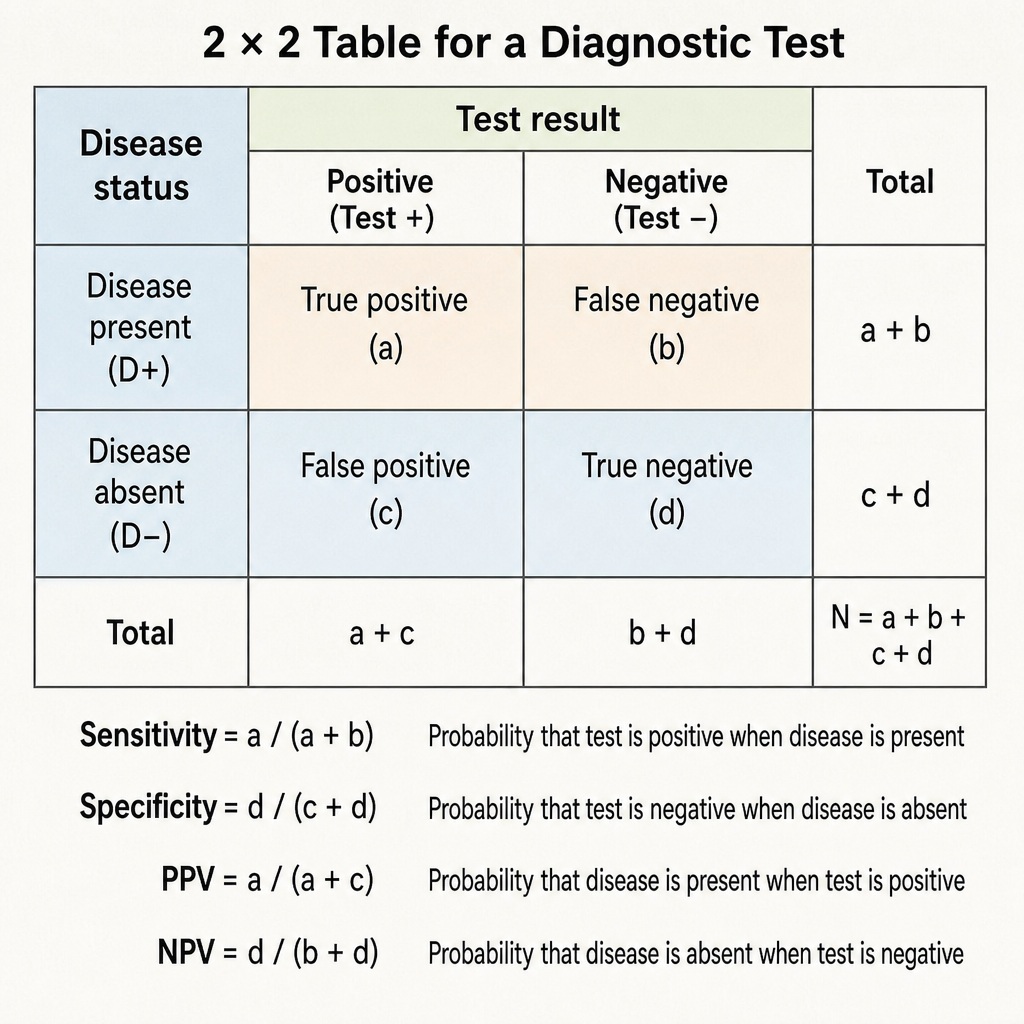
Which of the following best reflects the diagnostic power of a test?
Mr. Murali has 126 mg/dl of fasting plasma glucose. His venous plasma glucose 2h after ingestion of 75g oral glucose load is 149 mg/dl. This patient comes under which stage of WHO diagnostic criteria of diabetes & intermediate hyperglycemia?
What is the most sensitive biochemical marker for a 7-day old myocardial infarction?
Okuda staging contains all except
Cystatin C levels are used for
Procalcitonin is considered a marker for:
Which of the following is the most accurate measure of Glomerular Filtration Rate (GFR)?
What is the recommended daily calcium intake for adult non-pregnant females?
Insulin-like growth factor is secreted by:
Explanation: ***0.95*** - **Specificity** is the proportion of individuals without disease who test negative, calculated as **TN/(TN+FP)**. - A specificity of 0.95 (95%) indicates an excellent test that correctly identifies 95% of healthy individuals as negative. *0.05* - This value represents the **false positive rate** (1 - specificity), not specificity itself. - A specificity of 0.05 would mean only 5% of healthy individuals test negative, indicating a very poor test. *0.4* - This value is too low for specificity and could represent other test parameters like **positive predictive value**. - A specificity of 0.4 would incorrectly classify 60% of healthy individuals as positive, making the test clinically unreliable. *0.8* - This value typically represents **sensitivity**, which is the proportion of diseased individuals who test positive. - **Sensitivity** is calculated as **TP/(TP+FN)**, which is different from specificity that focuses on healthy individuals.
Explanation: ***Sensitivity and specificity*** - **Diagnostic power of a test** refers to its intrinsic ability to correctly identify individuals with and without disease, which is best reflected by **sensitivity and specificity**. - **Sensitivity** (true positive rate) measures the test's power to detect disease when present - the ability to correctly identify diseased individuals. - **Specificity** (true negative rate) measures the test's power to rule out disease when absent - the ability to correctly identify non-diseased individuals. - These are **inherent properties of the test** that remain constant regardless of disease prevalence in the population, making them the true measures of diagnostic power. - Together, they define how well a test can discriminate between diseased and non-diseased states. *Predictive value of a test* - **Predictive values** (positive and negative) indicate the probability of disease given a test result, but they are measures of **clinical utility**, not diagnostic power. - Predictive values are **dependent on disease prevalence** - the same test with identical sensitivity and specificity will have different predictive values in populations with different disease prevalence. - They answer "Given this result, what is the probability of disease?" rather than measuring the test's inherent diagnostic ability. *Specificity alone* - **Specificity alone** is incomplete as it only measures the test's ability to identify non-diseased individuals. - Diagnostic power requires assessment of both the ability to detect disease (sensitivity) and to rule it out (specificity). *Population attributable risk of a test* - **Population attributable risk (PAR)** is an epidemiological measure that quantifies the proportion of disease in a population attributable to a specific risk factor. - It is not a measure of diagnostic test performance and is unrelated to diagnostic power.
Explanation: **Diagnosis of diabetes** - The **fasting plasma glucose (FPG)** of 126 mg/dL meets the WHO criterion for **diabetes**, which is FPG ≥ 126 mg/dL [1]. - Although the 2-hour post-glucose load (149 mg/dL) falls within the **impaired glucose tolerance (IGT)** range (140-199 mg/dL), the elevated fasting glucose alone is sufficient for a diabetes diagnosis according to WHO guidelines. *Decreased glucose resistance* - This term is not a standard diagnostic category recognized by the WHO for glucose metabolism disorders. - Glucose resistance is more commonly associated with conditions like **insulin resistance** rather than a specific diagnostic stage [1]. *IFG - Impaired fasting glucose* - **Impaired fasting glucose (IFG)** is defined by a fasting plasma glucose level between 100 mg/dL and 125 mg/dL. - Mr. Murali's fasting glucose of 126 mg/dL is higher than the upper limit for IFG [1]. *Impaired glucose tolerance* - **Impaired glucose tolerance (IGT)** is defined by a 2-hour post-glucose load plasma glucose level between 140 mg/dL and 199 mg/dL. - While Mr. Murali's 2-hour reading of 149 mg/dL falls within this range, the elevated fasting glucose level takes precedence for the overall diagnosis [1].
Explanation: ***Troponin I/T*** - **Cardiac troponins (I and T)** are highly sensitive and specific biomarkers for **myocardial injury**. - While they rise quickly after an MI, they also remain elevated for an extended period, typically **7 to 10-14 days**, making them ideal for detecting a 7-day-old event. *CPK MB* - **Creatine phosphokinase MB (CPK-MB)** is a well-known cardiac marker, but its elevation is more transient, usually returning to normal within **2-3 days** post-MI. - Therefore, it would likely be undetectable or near baseline 7 days after the event, making it insensitive for this duration. *LDH* - **Lactate dehydrogenase (LDH)** used to be used as a cardiac marker, but it is **non-specific** and found in various tissues. - While it can remain elevated for an extended period after an MI (up to 10-14 days), its lack of specificity makes other markers, particularly troponins, much more reliable for confirming myocardial damage. *Myoglobin* - **Myoglobin** is one of the earliest markers to rise after myocardial injury, but it is also **rapidly cleared** from the bloodstream, usually within 24 hours. - Due to its short half-life, myoglobin would not be elevated 7 days after an MI, making it unsuitable for detecting such a remote event.
Explanation: ***AFP*** - The **Okuda staging system** for hepatocellular carcinoma (HCC) uses parameters related to liver function and tumor burden, but it does **not include AFP levels**. [1] - AFP is a common **tumor marker** for HCC but is not part of the specific criteria for Okuda staging. *Tumor size* - **Tumor size greater than 50%** of the liver parenchyma is one of the four parameters used in the Okuda staging system. - This criterion is crucial for assessing the **extent of the disease**, differentiating between early and advanced cases. *Ascites* - The presence of **ascites** (related to fluid retention) is another key parameter in the Okuda staging system. - Ascites indicates **decompensated liver function**, implying a more advanced stage of disease. *Bilirubin* - **Bilirubin levels higher than 3 mg/dL** are included in the Okuda staging system. - Elevated bilirubin reflects **severe liver dysfunction**, indicating reduced hepatic synthetic capacity and usually a poorer prognosis.
Explanation: ***Estimating GFR*** - **Cystatin C** is a **proteinase inhibitor** produced by all nucleated cells at a constant rate, and its level in the blood is inversely related to the **glomerular filtration rate (GFR)**. - Unlike **creatinine**, Cystatin C levels are less affected by **muscle mass, diet, or inflammation**, making it a more reliable marker for early and subtle changes in GFR, especially in certain populations. *Detecting UTI* - **Urinary tract infections (UTIs)** are primarily detected through **urinalysis** (presence of **leukocytes, nitrites**, and **bacteria**) and **urine culture**. - **Cystatin C** is a serum marker for renal function and has no direct role in detecting the presence of bacterial infection in the urinary tract. *Estimating difference between CRF and ARF* - Differentiating between **chronic renal failure (CRF)** and **acute renal failure (ARF)** typically involves assessing the **chronicity of symptoms**, trend in **creatinine levels**, and **kidney size** and **echogenicity** on ultrasound. - While Cystatin C can reflect current GFR, it doesn't inherently provide discriminatory power between acute and chronic processes without serial measurements or additional clinical context. *Screening for Renal Ca* - **Renal cell carcinoma (RCC)** screening is primarily done using **imaging techniques** like **ultrasonography, CT, or MRI**, especially in individuals with risk factors or symptoms like **hematuria**. - **Cystatin C** is a marker of kidney function and does not serve as a tumor marker for renal cancer.
Explanation: **Sepsis** - **Procalcitonin** (PCT) levels significantly rise in response to bacterial infections and **sepsis**, making it a useful diagnostic and prognostic marker. - Its levels correlate with the severity of bacterial infection and can help differentiate bacterial from viral etiologies. *Medullary thyroid carcinoma* - **Medullary thyroid carcinoma** (MTC) is characterized by the production of **calcitonin**, a different hormone from procalcitonin, by the parafollicular C cells of the thyroid. - While calcitonin is a tumor marker for MTC, **procalcitonin** is not. *Vitamin D resistant rickets* - **Vitamin D resistant rickets** (also known as X-linked hypophosphatemia) is a genetic disorder characterized by impaired phosphate reabsorption in the kidneys [1]. - It is associated with low phosphate levels and bone deformities, but not with elevated procalcitonin [1]. *Parathyroid adenoma* - A **parathyroid adenoma** leads to primary hyperparathyroidism, characterized by excessive production of **parathyroid hormone (PTH)** [1]. - This results in hypercalcemia and hypophosphatemia, with no direct link to procalcitonin levels [1].
Explanation: ***Iothalamate Clearance*** - **Iothalamate clearance** is considered the **gold standard** for directly measuring GFR in clinical practice because it is a substance that is freely filtered by the glomerulus and is neither reabsorbed nor secreted by the renal tubules. - This method provides the most accurate and precise assessment of kidney function by quantifying the actual GFR, often used in research settings or for precise diagnosis. - **Note:** Inulin clearance is the traditional reference standard, but iothalamate is more practical and widely used clinically as it can be measured using radioactive or non-radioactive methods. *Serum creatinine* - **Serum creatinine** is a commonly used biomarker but is an **imperfect measure** of GFR because it can be influenced by factors like muscle mass, diet, and certain medications. - Its levels can remain within the normal range even when GFR has significantly decreased, especially in the early stages of kidney disease. *Cystatin C* - **Cystatin C** is a protein produced by most nucleated cells and is also freely filtered by the glomerulus, with less influence from muscle mass and diet compared to creatinine. - While considered a better marker than serum creatinine, it is still an **estimated measure** and is more expensive and less widely available than creatinine, and can be affected by inflammation or thyroid dysfunction. *Creatinine Clearance* - **Creatinine clearance** (often estimated using urine and serum creatinine levels over a timed collection) attempts to approximate GFR but can be **inaccurate** due to incomplete urine collection and tubular secretion of creatinine. - The **creatinine secretion** by the renal tubules leads to an overestimation of the true GFR, making it less accurate than direct measurement methods.
Explanation: ***1000 mg*** - The recommended daily calcium intake for adult non-pregnant females (ages 19-50) is **1000 mg** according to **WHO and international guidelines** (US RDA/NIH) to maintain bone health and prevent osteoporosis. - This is the **standard recommendation** used in most medical textbooks and international nutritional guidelines. - Adequate calcium intake supports various bodily functions, including **nerve transmission**, **muscle contraction**, and **hormone secretion**. *1200 mg* - While 1200 mg is the recommended intake for **older women (above 50-70 years)** or during **pregnancy/lactation** per some guidelines, it is generally higher than necessary for non-pregnant adult females aged 19-50. - While not harmful, this higher dose is not specifically indicated for the general non-pregnant adult female population. *600 mg* - This amount of calcium is **lower than the internationally recommended daily allowance** for adult women (though it aligns with some regional guidelines like ICMR for sedentary women). - For optimal bone health and prevention of osteoporosis, **1000 mg is the widely accepted standard** in medical education. *800 mg* - This value is **below the internationally recommended daily intake** for adult non-pregnant females, which could lead to long-term calcium deficiency. - Insufficient calcium intake can increase the risk of conditions like **osteopenia** and **osteoporosis**.
Explanation: ***Liver*** - The **liver** is the primary site of **insulin-like growth factor 1 (IGF-1)** production in response to **growth hormone (GH)** stimulation. - IGF-1 mediates many of the growth-promoting effects of GH, affecting various tissues throughout the body. *Pituitary gland* - The **pituitary gland** secretes **growth hormone (GH)**, which then stimulates the liver to produce IGF-1, but it does not directly secrete IGF-1. - Its role is upstream in the GH-IGF-1 axis, initiating the signaling cascade. *Pancreas* - The **pancreas** is primarily known for secreting **insulin** and **glucagon**, which regulate blood glucose levels. - It does not produce significant amounts of IGF-1. *Adrenal glands* - The **adrenal glands** produce hormones like **cortisol**, **aldosterone**, and **androgens**. - They are not involved in the direct secretion of IGF-1.
Get full access to all questions, explanations, and performance tracking.
Start For Free