On insulin administration, what change is expected in the extracellular fluid (ECF)?
Substrate-controlled hormone is
True about oxytocin are all except
Which hormone does not act through cAMP?
Which of the following forms of thyroid hormone is most readily found in the circulation?
Hypothalamus controls the hormone secretion of:
By which mechanism do LH and FSH primarily return to baseline levels after ovulation?
A patient with a known brain tumor learns that his pituitary stalk has been affected. Secretion of which of the following hormones is increased after the sectioning of the pituitary stalk?
Which of the following hormones is controlled by feedback control?
Which hormone is under inhibitory control -
Explanation: **Hypoglycemia (Correct Answer)** - Insulin promotes the uptake of **glucose** from the ECF into cells, primarily muscle and adipose tissue - This action leads to a decrease in ECF **glucose concentration**, resulting in **hypoglycemia** if insulin levels are excessive or glucose intake is insufficient - This is the primary and most significant change in ECF composition after insulin administration *Hyperkalemia (Incorrect)* - Insulin actually stimulates the cellular uptake of **potassium**, moving it from the ECF into the intracellular fluid - Therefore, insulin administration typically causes **hypokalemia**, not hyperkalemia - This effect is sometimes used therapeutically to treat hyperkalemia by driving potassium into cells *Hyponatremia (Incorrect)* - Insulin primarily affects **glucose** and **potassium** metabolism and does not directly cause changes in sodium concentration in the ECF - **Hyponatremia** would be more associated with altered water balance or disorders of kidney function, not direct insulin effects - Sodium homeostasis is regulated by the renin-angiotensin-aldosterone system and ADH *Hypocalcemia (Incorrect)* - Insulin has no direct effect on **calcium** levels or its regulation in the ECF - **Calcium homeostasis** is primarily regulated by parathyroid hormone (PTH), vitamin D, and calcitonin, independent of insulin action - Changes in calcium concentration are not expected with insulin administration
Explanation: ***Glucagon*** - **Glucagon** secretion is primarily regulated by **blood glucose levels**. When blood glucose is low, glucagon is released to increase it. - This direct response to a metabolite concentration (glucose, a substrate) makes it a **substrate-controlled hormone**. *LH* - **Luteinizing hormone (LH)** is a gonadotropin secreted by the anterior pituitary, controlled by **GnRH** from the hypothalamus and feedback from gonadal steroids. - It is part of a complex **neuroendocrine axis**, not directly regulated by a metabolic substrate. *TRH* - **Thyrotropin-releasing hormone (TRH)** is a neurohormone produced in the hypothalamus that stimulates the pituitary to release TSH. - Its release is primarily controlled by **negative feedback** from thyroid hormones and environmental factors, not by a specific metabolic substrate. *FSH* - **Follicle-stimulating hormone (FSH)** is also a gonadotropin, like LH, regulated by **GnRH** and gonadal feedback. - Its regulation involves the **hypothalamic-pituitary-gonadal axis**, not direct substrate control.
Explanation: ***Synthesized by anterior pituitary*** - Oxytocin is **synthesized in the hypothalamus** (specifically in the paraventricular and supraoptic nuclei), not in the anterior pituitary. - The **anterior pituitary** produces different hormones like **FSH, LH, ACTH, TSH, prolactin, and growth hormone**, but does not synthesize oxytocin. *Causes contraction of upper segment* - Oxytocin does cause **contractions of the upper uterine segment** as part of coordinated uterine activity during labor. - This contributes to **fundal dominance** where contractions are strongest at the fundus and weaken toward the cervix. *Causes uterine contraction of body* - Oxytocin stimulates **rhythmic contractions of the myometrium** throughout the uterine body during labor. - These **coordinated contractions** are essential for effective cervical dilation and fetal expulsion. *Secreted by posterior pituitary* - Oxytocin is indeed **stored and released by the posterior pituitary** after being transported from the hypothalamus. - The posterior pituitary acts as a **storage and release site** for both oxytocin and **antidiuretic hormone (ADH)**.
Explanation: ***Insulin*** - Insulin primarily acts through a **tyrosine kinase receptor**, which, upon ligand binding, autophosphorylates and triggers downstream signaling cascades involving various protein kinases and phosphatases. - This mechanism allows insulin to mediate its diverse metabolic effects, such as glucose uptake and storage, independent of the **cAMP pathway**. *TSH (Thyroid-stimulating hormone)* - TSH binds to its receptor on thyroid follicular cells, activating **G protein-coupled receptors** that stimulate **adenylyl cyclase**. - This leads to an increase in intracellular **cAMP**, which then activates protein kinase A (PKA) to promote thyroid hormone synthesis and release. *ACTH (Adrenocorticotropic hormone)* - ACTH acts on the **adrenal cortex** through G protein-coupled receptors, stimulating **adenylyl cyclase** and raising intracellular **cAMP levels**. - Increased cAMP then activates PKA, leading to the synthesis and secretion of **cortisol** and other adrenal steroids. *Adrenaline (Epinephrine)* - Adrenaline can act through various **adrenergic receptors (alpha and beta)**; **beta-adrenergic receptors** are Gs protein-coupled and activate **adenylyl cyclase**. - This increases **cAMP** levels, mediating effects such as bronchodilation, increased heart rate, and glycogenolysis.
Explanation: ***Thyroxine (T4)*** - **Thyroxine (T4)** is the primary thyroid hormone secreted by the thyroid gland and is the most abundant form found in the circulation. - Approximately **80%** of the thyroid hormone released is T4, which then undergoes peripheral deiodination to form the more active T3. *TSH* - **TSH (Thyroid-Stimulating Hormone)** is a pituitary hormone that *regulates* thyroid function, not a thyroid hormone produced by the thyroid gland itself. - TSH levels are used to assess thyroid gland activity, but it is not the most abundant thyroid hormone in circulation. *Thyroglobulin* - **Thyroglobulin** is a large glycoprotein produced by thyroid follicular cells that serves as the precursor and storage protein for thyroid hormones *within* the thyroid gland. - While it contains T3 and T4 residues, most thyroglobulin is not released into circulation under normal physiological conditions; elevated levels can indicate thyroid damage or cancer. *Tri-iodothyronine (T3)* - **Tri-iodothyronine (T3)** is the biologically *active* form of thyroid hormone, but it is primarily derived from the peripheral conversion of T4. - Although T3 is more potent than T4, it is present in much lower concentrations in the circulation compared to T4.
Explanation: ***Anterior hypophysis*** - The hypothalamus controls the **anterior hypophysis** (adenohypophysis) through releasing and inhibiting hormones transported via the **hypothalamic-hypophyseal portal system**. - These hormones stimulate or inhibit the secretion of **tropic hormones** like TSH, ACTH, FSH, LH, GH, and Prolactin from the anterior pituitary. *Posterior hypophysis* - The hypothalamus produces **ADH** and **oxytocin**, which are then stored and released by the posterior hypophysis, but it does not control its *secretion* in the same direct endocrine feedback loop as the anterior pituitary. - The posterior hypophysis (neurohypophysis) is essentially an extension of the hypothalamus, serving primarily as a **storage and release site** for neurohormones produced in the hypothalamic nuclei. *Kidney* - The kidney's hormonal functions, such as producing **erythropoietin** and **renin**, are regulated by factors like blood oxygen levels, blood pressure, and circulating hormones like aldosterone, not directly by the hypothalamus. - While the hypothalamus can influence kidney function indirectly through **ADH secretion** (affecting water reabsorption), it does not control the kidney's own endogenous hormone production. *Pineal gland* - The pineal gland primarily secretes **melatonin**, which is regulated by the **light-dark cycle** detected by the retina and transmitted via the suprachiasmatic nucleus, not directly by hypothalamic releasing hormones. - The hypothalamus influences the pineal gland indirectly through neural pathways, but it primarily *receives* information about circadian rhythms from the pineal gland rather than directly controlling its hormone secretion.
Explanation: ***Negative feedback on GnRH by progesterone*** - After ovulation, the **corpus luteum** secretes **progesterone** (and estradiol), which exerts powerful **negative feedback** on the hypothalamus and pituitary - **Progesterone** is the **dominant hormone** in the **luteal phase** that suppresses **GnRH** pulsatility, leading to decreased secretion of both **LH** and **FSH** to baseline levels - This negative feedback maintains low gonadotropin levels throughout the luteal phase until corpus luteum regression *Negative feedback on GnRH by estradiol* - **Estradiol** does provide negative feedback, particularly in the **early-mid follicular phase**, where it primarily suppresses **FSH** secretion - In the luteal phase, estradiol works **synergistically with progesterone**, but **progesterone is the dominant feedback signal** for returning both LH and FSH to baseline after ovulation - Estradiol alone (without progesterone) triggers the **LH surge** via positive feedback at high concentrations *Negative feedback on GnRH from testosterone* - This mechanism is specific to **males**, where **testosterone** from Leydig cells provides negative feedback to regulate **GnRH**, **LH**, and **FSH** secretion - In females, testosterone plays only a minor role in feedback regulation of the hypothalamic-pituitary-gonadal axis *LH surge* - The **LH surge** is a **positive feedback** phenomenon triggered by high **estradiol** levels in the late follicular phase - This represents the **peak** of LH secretion that triggers ovulation, not a mechanism for returning LH and FSH to **baseline** levels - After the surge, LH falls due to negative feedback from progesterone and estradiol during the luteal phase
Explanation: ***Prolactin*** - Prolactin is **unique** among anterior pituitary hormones as it is under **tonic inhibitory control** by dopamine from the hypothalamus. - Sectioning of the pituitary stalk disrupts dopamine delivery via the hypothalamic-hypophyseal portal system. - This leads to a **loss of tonic inhibition**, causing an **increase in prolactin secretion** from the anterior pituitary. - This phenomenon is known as the **"stalk effect"** or **hyperprolactinemia due to stalk section**. *FSH* - **Follicle-stimulating hormone (FSH)** secretion is regulated by **gonadotropin-releasing hormone (GnRH)** from the hypothalamus, which is **stimulatory**. - Stalk section interrupts GnRH delivery via the portal system, leading to a **decrease** in FSH secretion. *TSH* - **Thyroid-stimulating hormone (TSH)** secretion is positively regulated by **thyrotropin-releasing hormone (TRH)** from the hypothalamus. - Interruption of the pituitary stalk reduces TRH delivery, causing a **decrease** in TSH secretion. *ACTH* - **Adrenocorticotropic hormone (ACTH)** secretion is positively regulated by **corticotropin-releasing hormone (CRH)** from the hypothalamus. - Damage to the pituitary stalk diminishes CRH stimulation, resulting in a **decrease** in ACTH secretion.
Explanation: ***Corticosteroids*** - **Corticosteroids** (particularly cortisol) are the classic example of **negative feedback control** via the **hypothalamic-pituitary-adrenal (HPA) axis**. - **Mechanism:** Hypothalamus releases CRH → Anterior pituitary releases ACTH → Adrenal cortex secretes cortisol → **High cortisol levels inhibit CRH and ACTH release** (negative feedback). - This is one of the most fundamental examples of endocrine feedback regulation taught in physiology. *ADH* - While **ADH** secretion is regulated by osmolality and blood volume changes, this represents a **homeostatic response** to physiological stimuli rather than the classic hormonal feedback loop. - ADH responds directly to osmoreceptors and baroreceptors, not through a multi-tiered hormonal axis with feedback inhibition. *Insulin* - **Insulin** secretion responds to **blood glucose levels** as a direct stimulus-response mechanism. - While it demonstrates homeostatic regulation, it does not involve the classic **hypothalamic-pituitary-target gland feedback axis** that characterizes endocrine feedback control. *Prolactin* - **Prolactin** is primarily under **tonic inhibition by dopamine** from the hypothalamus. - Its regulation involves more complex mechanisms including positive feedback during lactation, but it doesn't follow the classic negative feedback pattern of the HPA, HPT, or HPG axes.
Explanation: ***Correct: Prolactin*** - Prolactin secretion is primarily regulated by **dopamine** from the hypothalamus, which acts as a tonic inhibitory factor. - Absence of this dopamine inhibition, such as via **dopamine antagonists** or conditions affecting the hypothalamus, leads to increased prolactin release. *Incorrect: FSH* - **Follicle-stimulating hormone (FSH)** is primarily under **stimulatory control** by **gonadotropin-releasing hormone (GnRH)** from the hypothalamus. - Its secretion is also modulated by **feedback from gonadal steroids** (**estrogen** and **testosterone**) and **inhibin**, but the primary HPA axis control is stimulatory. *Incorrect: GH* - **Growth hormone (GH)** secretion is mainly regulated by two hypothalamic hormones: **growth hormone-releasing hormone (GHRH)** (stimulatory) and **somatostatin** (inhibitory). - While somatostatin provides an inhibitory component, the *overall* control involves both stimulatory and inhibitory inputs, and its baseline secretion is not solely defined by tonic inhibition. *Incorrect: LH* - **Luteinizing hormone (LH)**, like FSH, is primarily stimulated by **gonadotropin-releasing hormone (GnRH)** from the hypothalamus. - Its release is critically involved in **ovulation** and **testosterone production**, and its regulation is predominantly through positive and negative feedback from gonadal steroids, not tonic inhibition.
Principles of Endocrine Regulation
Practice Questions
Hypothalamus and Pituitary Gland
Practice Questions
Thyroid Physiology
Practice Questions
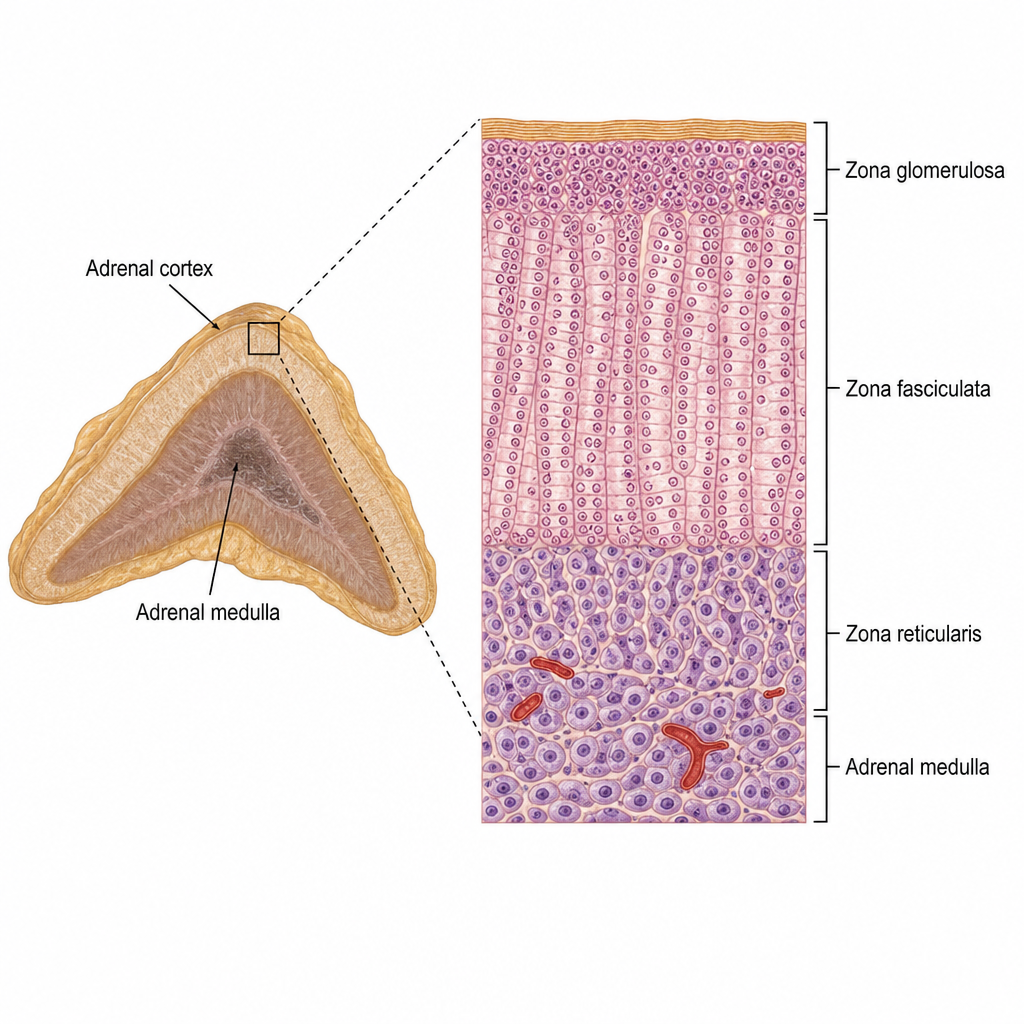
Adrenal Cortex and Medulla
Practice Questions
Pancreatic Hormones and Glucose Metabolism
Practice Questions
Calcium and Phosphate Homeostasis
Practice Questions
Growth Hormone and Growth Factors
Practice Questions
Endocrine Regulation of Metabolism
Practice Questions
Hormone Receptors and Signaling
Practice Questions
Assessment of Endocrine Function
Practice Questions
Get full access to all questions, explanations, and performance tracking.
Start For Free