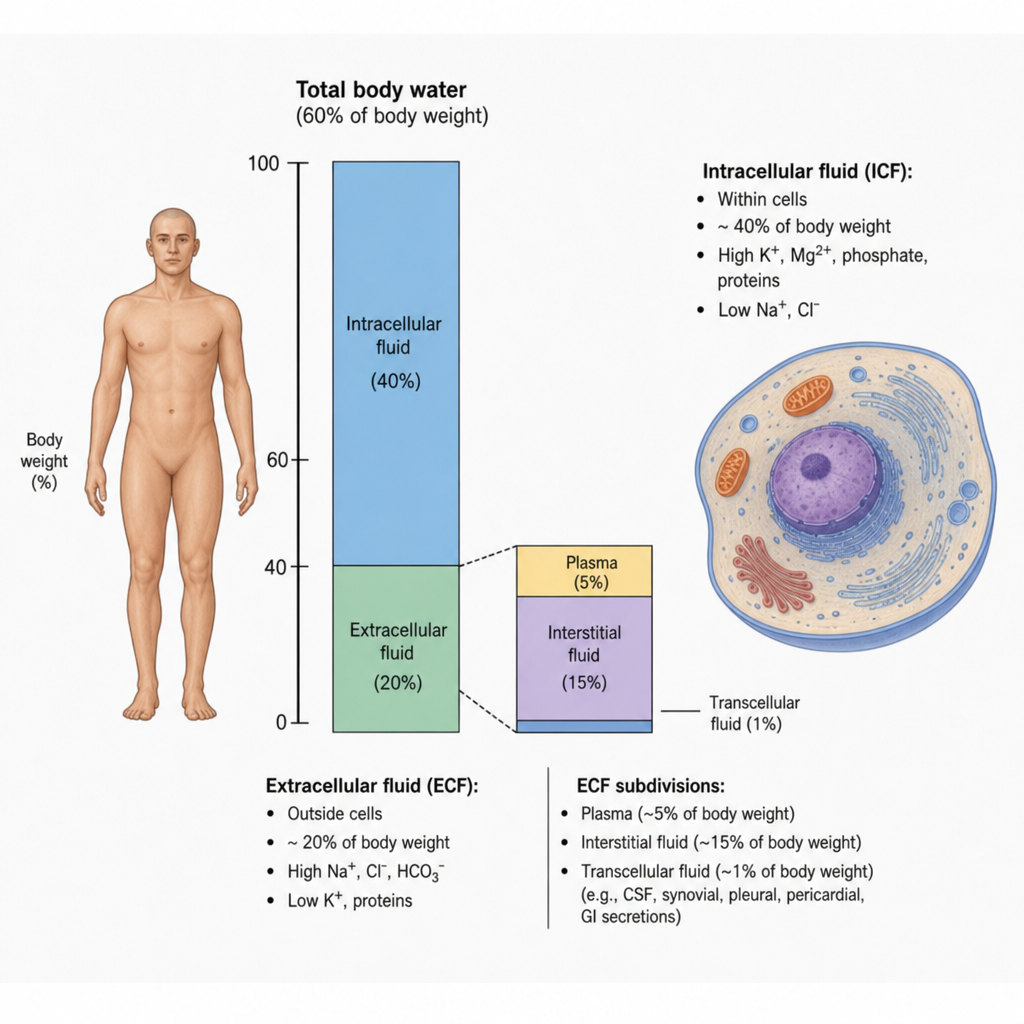
In a study to detect extracellular fluid volume, 10 gm mannitol was injected intravenously. After adequate time for equilibration of levels, the concentration was measured as 50 mg/100 ml. In this time, 10% of the injected mannitol was excreted. What is the calculated volume of extracellular fluid?
If a patient with severe hyperglycemia is given IV insulin, which of the following complications can occur?
All of the following are used to measure extracellular fluid (ECF) volume, except?
D2O (heavy water) is used to measure the volume of which body compartment?
In hypokalaemia, which of the following findings is typically NOT seen?
What is the typical intracellular concentration of potassium (K+)?
All of the following are true about hypernatremia due to diarrhea, except?
Which of the following is an ineffective osmol?
10% dextrose in water is:
Where does the major portion of body water lie?
Explanation: ### Explanation **1. Understanding the Correct Answer (B: 18 Litres)** The volume of a body fluid compartment is calculated using the **Indicator Dilution Principle**: $$Volume = \frac{\text{Amount Injected} - \text{Amount Excreted}}{\text{Final Concentration}}$$ * **Step 1: Calculate Net Amount.** 10 grams were injected, but 10% was excreted. * Excreted = $10\% \text{ of } 10\text{ g} = 1\text{ g}$. * Remaining amount = $10\text{ g} - 1\text{ g} = 9\text{ g}$ (or $9,000\text{ mg}$). * **Step 2: Standardize Units.** The concentration is $50\text{ mg}/100\text{ ml}$, which equals $500\text{ mg/L}$. * **Step 3: Apply Formula.** * $V = \frac{9,000\text{ mg}}{500\text{ mg/L}} = 18\text{ Litres}$. **2. Why Other Options are Incorrect** * **A (10 Litres):** This would be the result if the concentration were $90\text{ mg}/100\text{ ml}$, which is mathematically incorrect based on the data. * **C (42 Litres):** This represents the **Total Body Water (TBW)** in a standard 70 kg male (60% of body weight). Mannitol does not cross cell membranes, so it cannot measure TBW. * **D (52 Litres):** This value is physiologically unlikely for ECF and does not correlate with the calculation provided. **3. Clinical Pearls & High-Yield Facts** * **Indicator Selection:** * **ECF Markers:** Mannitol, Inulin, Sucrose, Sodium ($^{22}\text{Na}$), and Chloride. (Mnemonic: **MISS** - **M**annitol, **I**nulin, **S**ucrose, **S**odium). * **Plasma Volume:** Evans Blue dye or Radio-iodinated Serum Albumin (RISA). * **Total Body Water:** Deuterium oxide ($D_2O$), Tritiated water, or Antipyrine. * **Rule of 60-40-20:** Total Body Water is 60%, ICF is 40%, and ECF is 20% of total body weight. * **Mannitol's Property:** It is the "gold standard" for ECF because it is small enough to pass through capillary pores but too large/polar to cross cell membranes.
Explanation: ### Explanation **Why Hypokalemia is the Correct Answer:** The primary mechanism behind insulin-induced hypokalemia is the activation of the **Na⁺-K⁺ ATPase pump**. Insulin binds to its receptor on skeletal muscle and liver cells, stimulating the pump to move **three Na⁺ ions out** of the cell and **two K⁺ ions into** the cell. This causes a rapid shift of potassium from the extracellular fluid (ECF) into the intracellular fluid (ICF). In patients with severe hyperglycemia (like Diabetic Ketoacidosis), there is often a "pseudo-hyperkalemia" where total body potassium is low due to osmotic diuresis, but serum levels appear normal or high. Administering insulin shifts this remaining serum potassium into cells, potentially leading to life-threatening **hypokalemia**. **Analysis of Incorrect Options:** * **B. Hyperkalemia:** This is incorrect because insulin lowers serum potassium. Hyperkalemia is actually a common finding *before* insulin treatment in acidotic states due to H⁺-K⁺ exchange. * **C. Hyponatremia:** While hyperglycemia itself causes "dilutional hyponatremia" (glucose pulls water into the ECF), insulin therapy corrects this by lowering glucose, which actually helps normalize sodium levels rather than causing further hyponatremia. * **D. Hypernatremia:** Insulin does not directly cause a significant increase in serum sodium. **NEET-PG High-Yield Pearls:** * **Management Rule:** In DKA management, if the patient’s serum potassium is **<3.3 mEq/L**, insulin should be withheld and potassium replacement started first. * **Therapeutic Use:** Because of this shift, a combination of **Insulin + Glucose (G-I drip)** is a standard emergency treatment for severe hyperkalemia. * **Aldosterone vs. Insulin:** Both stimulate the Na⁺-K⁺ ATPase pump, but aldosterone acts primarily on the renal distal tubule, while insulin acts primarily on skeletal muscle.
Explanation: **Explanation:** The measurement of body fluid compartments is based on the **Indicator Dilution Principle** ($V = Q/C$). To measure a specific compartment, the indicator must distribute evenly within that compartment without entering others or being rapidly metabolized. **Why Inulin is the Correct Answer (in the context of this specific MCQ):** There appears to be a technical discrepancy in the question's key. In standard physiology (Guyton/Ganong), **Inulin, Sucrose, and Mannitol** are the "Gold Standards" for measuring **ECF volume** because they are large molecules that cross capillary walls but cannot cross cell membranes. However, in the context of this specific NEET-PG pattern question, **Heavy Water ($D_2O$)** is the "Except" because it measures **Total Body Water (TBW)**, not ECF. Heavy water (and Tritiated water/Antipyrine) distributes uniformly across both ECF and ICF. *Note: If the question identifies Inulin as the "except," it is likely a technical error in the source material, as Inulin is the classic marker for ECF.* **Analysis of Options:** * **A. Sucrose:** A saccharide that remains in the ECF; used to measure ECF volume. * **B. Sodium Chloride (Radioactive Sodium):** Sodium is the primary extracellular cation. While a small amount enters cells, it is commonly used to measure the "functional ECF." * **C. Inulin:** The most accurate substance for measuring ECF volume. * **D. Heavy Water ($D_2O$):** Used to measure **Total Body Water**. **High-Yield Clinical Pearls for NEET-PG:** 1. **Total Body Water (TBW):** Measured by Heavy water ($D_2O$), Tritiated water, or Antipyrine. 2. **Extracellular Fluid (ECF):** Measured by Inulin (Gold Standard), Sucrose, Mannitol, or Thiosulfate. 3. **Plasma Volume:** Measured by **Evans Blue dye (T-1824)** or Radio-iodinated Albumin ($RISA$). 4. **Intracellular Fluid (ICF):** Cannot be measured directly. Calculated as $TBW - ECF$. 5. **Interstitial Fluid:** Calculated as $ECF - Plasma\ Volume$.
Explanation: **Explanation:** The measurement of body fluid compartments is based on the **Indicator Dilution Principle** ($Volume = \frac{Amount\ of\ substance}{Concentration}$). To measure a specific compartment, the indicator used must be able to distribute uniformly throughout that compartment and nowhere else. **Why Total Body Water (TBW) is correct:** **D2O (Deuterium oxide)**, also known as heavy water, is an isotope of water. Because it is chemically almost identical to $H_2O$, it freely crosses all cell membranes and capillary walls, distributing evenly across both the extracellular and intracellular compartments. Other markers for TBW include **Tritium ($H_3O$)** and **Antipyrine** (a lipid-soluble drug). **Analysis of Incorrect Options:** * **A. Blood:** Blood volume is measured using **Radio-labeled Albumin** (for plasma) or **Chromium-51 labeled RBCs** (for red cell mass). * **C. Extracellular Fluid (ECF):** Markers for ECF must be able to cross capillaries but *not* cell membranes. Examples include **Inulin** (Gold Standard), **Mannitol**, and **Sucrose**. * **D. Intracellular Fluid (ICF):** There is no direct marker for ICF because no substance distributes *only* inside cells. It is calculated indirectly: $ICF = TBW - ECF$. **High-Yield Clinical Pearls for NEET-PG:** * **Rule of 60-40-20:** TBW is ~60% of body weight, ICF is ~40%, and ECF is ~20%. * **Plasma Volume:** Measured using **Evans Blue dye** or $I^{131}$-Albumin. * **Interstitial Fluid:** Like ICF, it cannot be measured directly. It is calculated as $ECF - Plasma\ Volume$. * **Inulin** is the most accurate marker for ECF because it is not metabolized and is strictly excluded from the intracellular space.
Explanation: **Explanation:** In hypokalaemia (serum potassium <3.5 mEq/L), the resting membrane potential of cells becomes more negative (hyperpolarized). This increases the threshold required for action potential generation, leading to **decreased excitability** of both skeletal and smooth muscles. **1. Why "Increased peristalsis" is the correct answer:** Since hypokalaemia reduces the excitability of the smooth muscles in the gastrointestinal tract, it leads to **decreased peristalsis** (hypomotility), not an increase. In severe cases, this can progress to **paralytic ileus**. **2. Analysis of incorrect options:** * **Abdominal distension:** This is a direct consequence of decreased peristalsis. As bowel motility slows down, gas and fluids accumulate in the intestinal lumens, leading to clinical distension. * **Effortless vomiting:** This occurs due to the gastric stasis and reverse peristalsis associated with an adynamic (paralytic) ileus. It is "effortless" because it is not driven by forceful gastric contractions but rather by overflow from a distended, atonic stomach. * **Muscular weakness:** Potassium is crucial for skeletal muscle contraction. Hyperpolarization of the sarcolemma makes it harder for muscles to contract, resulting in weakness that typically ascends from the lower limbs to the trunk and respiratory muscles. **NEET-PG High-Yield Pearls:** * **ECG Changes in Hypokalaemia:** Flattened/inverted T waves, **prominent U waves**, ST-segment depression, and prolonged PR interval (Mnemonic: *"U wave is for hypokalaemia"*). * **Muscle involvement:** It can lead to **Rhabdomyolysis** due to impaired vasodilation in exercising muscles. * **Metabolic association:** Hypokalaemia is frequently associated with **Metabolic Alkalosis** (except in cases of RTA or diarrhea).
Explanation: **Explanation:** The distribution of electrolytes across the cell membrane is fundamental to cellular physiology. Potassium ($K^+$) is the **primary intracellular cation**, while Sodium ($Na^+$) is the primary extracellular cation. **Why Option D is Correct:** The intracellular concentration of potassium is approximately **140–150 mEq/L**. This high concentration is actively maintained by the **$Na^+$-$K^+$ ATPase pump**, which pumps three $Na^+$ ions out of the cell and two $K^+$ ions into the cell against their respective concentration gradients. This gradient is essential for maintaining the resting membrane potential (RMP) and regulating cell volume. **Analysis of Incorrect Options:** * **Option A (5.5 mEq/L):** This represents the upper limit of the normal **extracellular (plasma)** potassium range (3.5–5.5 mEq/L). Values above this indicate hyperkalemia. * **Option B (15 mEq/L):** This is the typical **intracellular concentration of Sodium ($Na^+$)**. * **Option C (28 mEq/L):** This value is closer to the concentration of bicarbonate ($HCO_3^-$) in the plasma. **NEET-PG High-Yield Pearls:** * **Ratio:** The ratio of intracellular to extracellular $K^+$ is the main determinant of the **Resting Membrane Potential (RMP)**, calculated via the Nernst equation. * **Total Body Potassium:** About 98% of the body's potassium is intracellular; only 2% is in the ECF. * **Insulin & Catecholamines:** Both stimulate the $Na^+$-$K^+$ ATPase, shifting $K^+$ into cells (used clinically to treat hyperkalemia). * **Acidosis vs. Alkalosis:** In acidosis, $H^+$ enters the cell and $K^+$ leaves (leading to hyperkalemia). In alkalosis, the reverse occurs.
Explanation: ### Explanation Hypernatremia occurs when there is a deficit of free water relative to sodium. In the context of diarrhea, the mechanism depends on the **tonicity** of the fluid lost. **1. Why "Secretory Diarrhea" is the correct (Except) answer:** Hypernatremia is typically caused by **Osmotic Diarrhea** (e.g., viral gastroenteritis, lactulose use), where the stool fluid is **hypotonic** (contains more water than electrolytes). Losing hypotonic fluid leaves the blood concentrated with sodium. In contrast, **Secretory Diarrhea** (e.g., Cholera, VIPoma) involves the loss of **isotonic** fluid. Since water and sodium are lost in equal proportions, it usually leads to *isovolemic hyponatremia* or normal sodium levels, but not hypernatremia. **2. Analysis of other options:** * **Option A (Serum osmolality >295 mOsm/kg):** Hypernatremia by definition increases plasma tonicity. Since Sodium is the primary determinant of serum osmolality ($2 \times Na + Glucose/18 + BUN/2.8$), elevated sodium will always result in high serum osmolality. * **Option C (Urine osmolality >800 mOsm/kg):** In extrarenal causes of water loss (like diarrhea), the kidneys function normally and attempt to conserve water. This results in maximally concentrated urine (Uosm >800 mOsm/kg). * **Option D (Increased circulating AVP):** High serum osmolality stimulates osmoreceptors in the hypothalamus, leading to the release of Arginine Vasopressin (AVP/ADH) from the posterior pituitary to promote water reabsorption in the collecting ducts. ### NEET-PG High-Yield Pearls: * **Osmotic Gap:** In Osmotic diarrhea, the stool osmotic gap is high (>125 mOsm/kg); in Secretory diarrhea, it is low (<50 mOsm/kg). * **Correction Rate:** Never correct chronic hypernatremia faster than **0.5 mEq/L/hr** (or 10-12 mEq/day) to avoid **Cerebral Edema**. * **Commonest Cause:** The most common cause of hypernatremia in clinical practice is impaired thirst or restricted access to water.
Explanation: ### Explanation The concept of **tonicity** vs. **osmolality** is central to understanding fluid shifts. An **ineffective osmol** is a solute that can freely cross the cell membrane. Because it equilibrates across the membrane, it does not create an osmotic gradient and, therefore, does not cause the movement of water (osmosis) out of or into the cell. **Why Urea is the Correct Answer:** Urea is a small, uncharged molecule that moves freely across most cell membranes via urea transporters (UT-A/UT-B). Since it reaches equal concentrations in both the intracellular fluid (ICF) and extracellular fluid (ECF), it is considered an **ineffective osmol**. While urea contributes to measured plasma osmolality, it does not contribute to **effective osmolality (tonicity)**. **Analysis of Incorrect Options:** * **A. Na+ (Sodium):** Sodium is the primary **effective osmol** of the ECF. Although it can enter cells through channels, the Na+/K+-ATPase pump actively extrudes it. This keeps Na+ effectively "restricted" to the ECF, where it exerts osmotic pressure and determines ECF volume. * **B. K+ (Potassium):** Potassium is the primary **effective osmol** of the ICF. Like sodium, its concentration gradient is maintained by active transport, allowing it to exert osmotic pressure from within the cell. **High-Yield Clinical Pearls for NEET-PG:** 1. **Formula for Plasma Osmolality:** $2[Na^+] + \frac{\text{Glucose}}{18} + \frac{BUN}{2.8}$. 2. **Effective Osmolality (Tonicity):** $2[Na^+] + \frac{\text{Glucose}}{18}$. Note that Urea (BUN) is excluded because it is an ineffective osmol. 3. **Clinical Exception:** In the kidneys (specifically the medullary collecting duct), urea *can* act as an effective osmol to help concentrate urine, but in the context of general body fluid compartments, it is always classified as ineffective. 4. **Uremia:** In patients with renal failure, high urea levels increase measured osmolality but do not cause cellular dehydration, unlike high glucose (Hyperglycemia).
Explanation: **Explanation:** The tonicity of an intravenous fluid is determined by its **osmolarity** relative to human plasma (normal range: 275–295 mOsm/L). **1. Why Hypertonic is Correct:** 10% Dextrose in Water (D10W) contains 100 grams of glucose per liter. Since 1 gram of dextrose yields approximately 5 mOsm, the total osmolarity of D10W is **505 mOsm/L**. Because this value is significantly higher than the plasma osmolarity, it is classified as a **hypertonic** solution. When infused, it initially creates an osmotic gradient that draws water out of the cells and into the extracellular space. **2. Why Other Options are Incorrect:** * **Isotonic (Option A):** 5% Dextrose in Water (D5W) is considered isotonic (252 mOsm/L) in the bag. 10% Dextrose is double that concentration, making it hypertonic. * **Hypotonic (Option B):** Solutions with an osmolarity significantly lower than 275 mOsm/L (e.g., 0.45% Normal Saline) are hypotonic. D10W is far above this threshold. **3. Clinical Pearls & High-Yield Facts for NEET-PG:** * **The "Physiological Paradox":** While D10W is *tonically* hypertonic in the bag, it becomes **physiologically hypotonic** once infused. This is because dextrose is rapidly metabolized by insulin into CO₂ and water, leaving behind "free water." * **Indications:** D10W is primarily used in the management of severe hypoglycemia and as part of parenteral nutrition. * **Caution:** Because of its high osmolarity, D10W can cause vein irritation (phlebitis). While it can be given peripherally in emergencies, higher concentrations (D25, D50) ideally require a central line. * **Standard Reference:** * 0.9% NaCl (Normal Saline): Isotonic (308 mOsm/L) * Ringer’s Lactate: Isotonic (273 mOsm/L) * 5% Dextrose: Isotonic (252 mOsm/L)
Explanation: **Explanation:** The total body water (TBW) accounts for approximately **60% of the total body weight** in an average adult male (50% in females due to higher subcutaneous fat). This water is distributed into two primary functional compartments: 1. **Intracellular Fluid (ICF):** This is the fluid contained within the cells. It constitutes the **major portion** of body water, accounting for **2/3 (approx. 40% of body weight)** of the TBW. This is the correct answer because the vast majority of metabolic processes occur within the cellular environment. 2. **Extracellular Fluid (ECF):** This fluid lies outside the cells and constitutes the remaining **1/3 (approx. 20% of body weight)** of the TBW. It is further divided into Interstitial fluid (15%) and Plasma (5%). **Why other options are incorrect:** * **Option A (Extracellular):** While vital for transporting nutrients and waste, it only represents one-third of the total water volume. * **Option C & D:** These are incorrect as the distribution is clearly unequal, with a definitive majority residing inside the cells. **High-Yield Clinical Pearls for NEET-PG:** * **60-40-20 Rule:** A quick mnemonic for TBW (60%), ICF (40%), and ECF (20%) as percentages of total body weight. * **Indicator Dilution Method:** TBW is measured using **Deuterium oxide (D₂O)**, Tritiated water, or Aminopyrine. * **Marker for ECF:** Inulin, Mannitol, or Sucrose. * **Marker for Plasma Volume:** Evans Blue dye (T-1824) or Radio-iodinated Albumin. * **Fat vs. Water:** Adipose tissue contains very little water. Therefore, obese individuals and elderly patients have a lower percentage of TBW compared to lean individuals.
Body Fluid Compartments and Composition
Practice Questions
Osmolality and Tonicity
Practice Questions
Sodium and Water Balance
Practice Questions
Potassium Homeostasis
Practice Questions
Calcium and Phosphate Regulation
Practice Questions
Magnesium Metabolism
Practice Questions
Fluid Shifts Between Compartments
Practice Questions
Edema Formation Mechanisms
Practice Questions
Dehydration Physiology
Practice Questions
Disorders of Electrolyte Balance
Practice Questions
Get full access to all questions, explanations, and performance tracking.
Start For Free