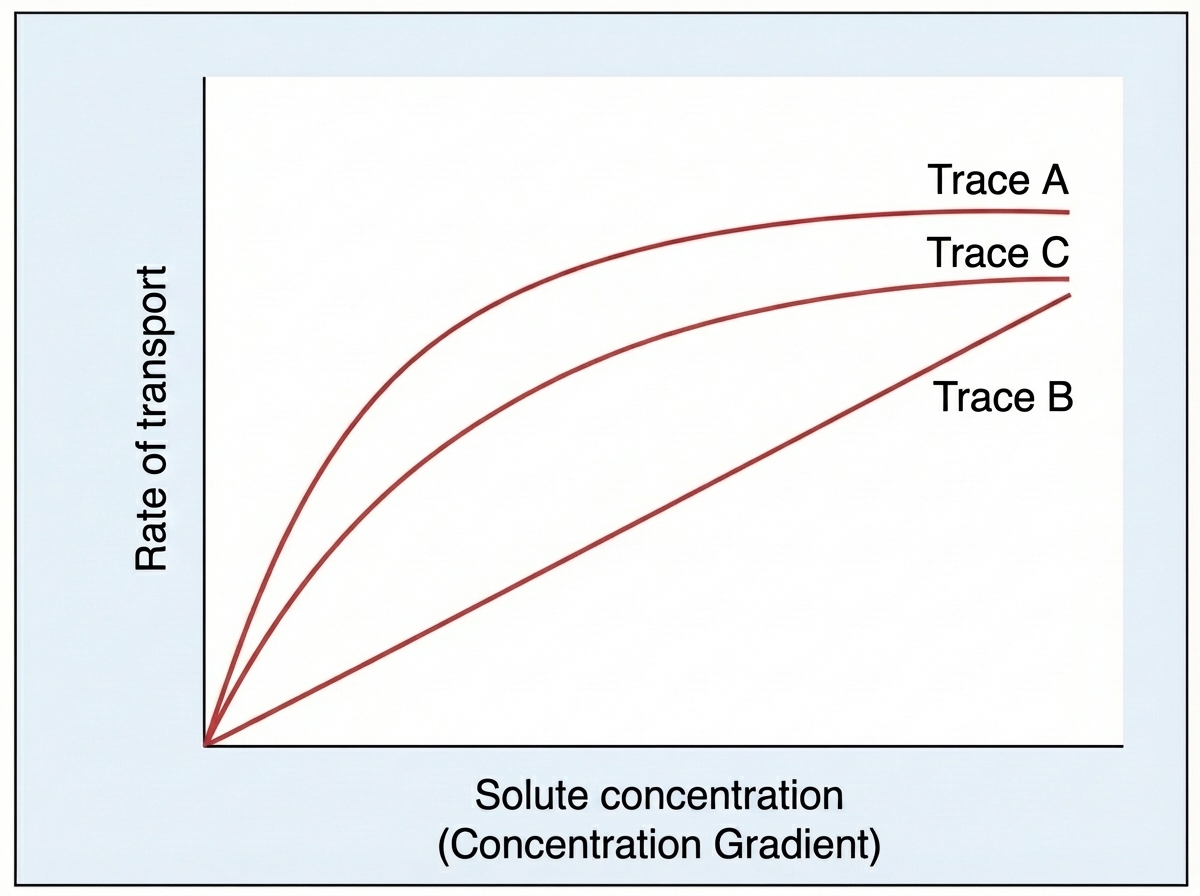
Simple diffusion and facilitated diffusion share which of the following characteristics?
During which phase of the cell cycle are chromosomes formed?
Which of the following phases represents the restriction point in the cell cycle?
Which of the following substances moves most rapidly across cell membranes?
Which of the following processes involves the internalization of material and subsequent lysosomal digestion?
Cells involved in active protein synthesis characteristically exhibit an increase in which of the following organelles?
Tetraethyl ammonium acts by blocking which of the following channels?
Microfilaments are primarily composed of which protein?
The Na+/Glucose cotransporter functions as which type of transporter?
How many aquaporins have been cloned?
Explanation: ### Explanation The core concept distinguishing transport mechanisms is the requirement for energy. Both **simple diffusion** and **facilitated diffusion** are types of **passive transport**. **1. Why the Correct Answer is Right:** Passive transport is driven by the electrochemical gradient (moving from high to low concentration). Because molecules move "downhill," the process occurs spontaneously and **does not require metabolic energy (ATP)**. This is the fundamental shared characteristic between simple and facilitated diffusion. **2. Analysis of Incorrect Options:** * **A & C (Specific Inhibitors and Transport Proteins):** These apply **only to facilitated diffusion**. Simple diffusion occurs directly through the lipid bilayer (e.g., O₂, CO₂, steroid hormones) without the help of proteins. Facilitated diffusion requires specific carrier proteins or channels (e.g., GLUT transporters), which can be competitively or non-competitively inhibited. * **D (Saturation Kinetics):** This is a hallmark of **facilitated diffusion** (and active transport). Because facilitated diffusion relies on a finite number of carrier proteins, the transport rate reaches a maximum ($V_{max}$) when all binding sites are occupied (saturation). Simple diffusion does not saturate; its rate increases linearly with the concentration gradient. --- ### High-Yield NEET-PG Pearls * **Fick’s Law:** Governs simple diffusion. The rate is directly proportional to surface area and concentration gradient, but inversely proportional to membrane thickness. * **GLUT-4:** A classic example of facilitated diffusion; it is the insulin-dependent glucose transporter found in skeletal muscle and adipose tissue. * **Key Distinction:** If a question mentions "carrier-mediated" but "passive," it is always referring to facilitated diffusion. * **Lipid Solubility:** The most important factor determining the rate of simple diffusion across a cell membrane is the substance's oil-water partition coefficient.
Explanation: ### Explanation **Correct Option: D (M Phase)** The formation of distinct, visible chromosomes occurs during the **M (Mitotic) phase**, specifically during **Prophase**. Throughout the interphase (G1, S, G2), DNA exists in a loosely coiled, thread-like state called **chromatin**. For successful cell division, this chromatin must undergo extreme condensation and supercoiling to form the compact structures we recognize as chromosomes. This condensation ensures that the genetic material is organized enough to be separated into two daughter cells without entangling or breaking. **Analysis of Incorrect Options:** * **A (G1 Phase):** This is the "Gap 1" phase characterized by cell growth and RNA/protein synthesis. DNA remains as diffuse chromatin to allow for gene transcription. * **B (S Phase):** This is the "Synthesis" phase where DNA replication occurs. While the amount of DNA doubles (2n to 4n), it remains in an uncoiled chromatin state to allow DNA polymerase access to the strands. * **C (G2 Phase):** This is the "Gap 2" phase where the cell prepares for mitosis by synthesizing tubulin for spindle fibers. Chromatin condensation begins at the very end of G2, but defined chromosomes are the hallmark of the M phase. **High-Yield NEET-PG Pearls:** * **Karyotyping:** Since chromosomes are at their maximum state of condensation during **Metaphase** (a sub-phase of M), this is the stage used for clinical karyotyping to detect numerical or structural abnormalities. * **Colchicine:** A common exam topic; it inhibits mitosis by arresting cells in metaphase (by inhibiting microtubule polymerization), making it useful for chromosomal studies. * **Checkpoints:** The transition from G2 to M is regulated by the **Cyclin B-CDK1** complex (also known as Maturation Promoting Factor).
Explanation: **Explanation:** The **Restriction Point (R point)**, also known as the Start point in yeast, occurs during the **late G1 phase**. It is the critical "point of no return" where the cell commits to the cell cycle independent of external growth factors. **1. Why G1 to S is correct:** Before this point, the cell requires continuous stimulation from growth factors to progress. Once the cell passes the R point, it activates **Cyclin D-CDK4/6 complexes**, which phosphorylate the **Retinoblastoma (Rb) protein**. Phosphorylated Rb releases the transcription factor **E2F**, triggering the expression of genes required for DNA synthesis (S phase). After this transition, the cell is committed to completing the division even if growth factors are removed. **2. Analysis of Incorrect Options:** * **G0 to G1:** This represents "re-entry" into the cell cycle from a quiescent state (e.g., hepatocytes after partial hepatectomy), but it is not the commitment point for DNA replication. * **S to G2:** This transition ensures DNA replication is complete. The major checkpoint here is the DNA damage checkpoint, not the restriction point. * **G2 to M:** This is the second major regulatory threshold (regulated by **Cyclin B-CDK1** or MPF). It ensures the cell is large enough and DNA is fully replicated before mitosis begins. **3. NEET-PG High-Yield Pearls:** * **Rb Protein:** Known as the "Guardian of the Restriction Point." Hypophosphorylated Rb is active (stops cycle); Hyperphosphorylated Rb is inactive (allows cycle). * **p53:** Acts primarily at the G1-S checkpoint by inducing **p21** (a CDK inhibitor) in response to DNA damage. * **Clinical Link:** Mutations in the Rb gene or p16 (inhibitor of CDK4) lead to uncontrolled passage through the R point, a hallmark of many cancers (e.g., Retinoblastoma, Osteosarcoma).
Explanation: The movement of substances across a cell membrane is primarily governed by the **lipid solubility** and the **molecular size** of the substance. ### Why Carbon Dioxide (CO2) is Correct Carbon dioxide is a small, non-polar, and highly **lipid-soluble** gas. According to **Fick’s Law of Diffusion**, the rate of diffusion is directly proportional to the lipid solubility of the substance. Because the cell membrane is a phospholipid bilayer, CO2 dissolves instantly into the lipid matrix and diffuses across the entire surface area of the membrane without requiring specialized channels or transporters. It moves significantly faster than water or any solute. ### Why Other Options are Incorrect * **Water (H2O):** Although water is a small molecule, it is highly **polar** (insoluble in lipids). It can only cross the membrane through specialized protein channels called **aquaporins** or via slow simple diffusion through membrane gaps. * **Glucose:** Glucose is a large, polar molecule. It is completely lipid-insoluble and requires **facilitated diffusion** via specific carrier proteins (GLUT transporters). This process is slower as it is limited by the number of available transporters (saturation kinetics). * **Urea:** Urea is a small, polar molecule. While it is slightly more lipid-soluble than glucose, it is far less soluble than CO2 and typically requires **urea transporters (UT)** to move efficiently. ### High-Yield NEET-PG Pearls * **Permeability Order:** Hydrophobic molecules (O2, CO2, N2) > Small uncharged polar molecules (H2O, Urea) > Large uncharged polar molecules (Glucose) > Ions (Na+, K+). * **Gases:** CO2 is approximately **20 times more soluble** than Oxygen (O2) in the lipid bilayer, explaining its rapid diffusion in alveolar gas exchange. * **Fick’s Law:** Diffusion rate is inversely proportional to the **thickness** of the membrane and the **square root of the molecular weight**.
Explanation: **Explanation:** The process described is **Phagocytosis**, a form of endocytosis often referred to as "cell eating." **1. Why Phagocytosis is correct:** Phagocytosis involves the ingestion of large particulate matter (such as bacteria, dead cells, or tissue debris). The cell membrane extends **pseudopodia** to surround the particle, forming a large vesicle called a **phagosome**. This phagosome then fuses with a **lysosome** to form a **phagolysosome**, where hydrolytic enzymes digest the internalized material. This is a primary function of "professional phagocytes" like macrophages and neutrophils. **2. Why other options are incorrect:** * **Pinocytosis:** Also known as "cell drinking," it involves the non-specific intake of ECF and small solutes via small vesicles. While it involves internalization, it is primarily for fluid balance rather than the digestion of large particles. * **Receptor-mediated endocytosis:** A highly selective process (e.g., uptake of LDL or Iron) using **clathrin-coated pits**. While it involves lysosomal processing, the question specifically points toward the general mechanism of material internalization and bulk digestion characteristic of phagocytosis. * **Exocytosis:** This is the reverse process; it involves the expulsion of materials (like neurotransmitters or hormones) from the cell into the extracellular space. **High-Yield Clinical Pearls for NEET-PG:** * **Opsonization:** Phagocytosis is significantly enhanced when particles are coated with opsonins (e.g., **IgG** or **C3b**). * **Residual Bodies:** Material that remains undigested within the lysosome forms residual bodies (e.g., **Lipofuscin**, the "wear-and-tear" pigment). * **Chediak-Higashi Syndrome:** A clinical condition characterized by a defect in phagosome-lysosome fusion, leading to recurrent infections.
Explanation: **Explanation:** The correct answer is **Rough Endoplasmic Reticulum (RER)**. Protein synthesis occurs via ribosomes. When cells are specialized for high-volume protein production (such as pancreatic acinar cells secreting enzymes or plasma cells secreting antibodies), they possess an extensive network of RER. The RER is "rough" because its cytosolic surface is studded with ribosomes, which are the primary sites for the translation of mRNA into proteins destined for secretion, membrane integration, or lysosomal enzymes. **Analysis of Incorrect Options:** * **Mitochondria:** These are the "powerhouses" of the cell, responsible for ATP production via oxidative phosphorylation. While protein synthesis requires energy, an increase in mitochondria is more characteristic of metabolically active cells with high energy demands, such as cardiac muscle or proximal convoluted tubule cells. * **Golgi Apparatus:** The Golgi functions in the modification, sorting, and packaging of proteins received from the RER. While it is prominent in secretory cells, the actual *synthesis* occurs in the RER. * **Lysosomes:** These contain hydrolytic enzymes for intracellular digestion. An increase in lysosomes is seen in phagocytic cells (like macrophages) rather than those primarily focused on protein synthesis. **High-Yield NEET-PG Pearls:** * **Nissl Bodies:** In neurons, the RER is visualized as Nissl bodies; their disappearance (chromatolysis) indicates axonal injury. * **Free Ribosomes:** Synthesize proteins for *intracellular* use (e.g., hemoglobin, mitochondrial enzymes), whereas **RER-bound ribosomes** synthesize proteins for *export*. * **Smooth ER (SER):** Involved in lipid synthesis, steroid hormone production (adrenal cortex/gonads), and detoxification (liver).
Explanation: **Explanation:** **Correct Answer: C. K+** Tetraethylammonium (TEA) is a classic pharmacological tool used in neurophysiology to study action potentials. It specifically blocks **voltage-gated K+ channels** from the intracellular side. By inhibiting the efflux of potassium ions, TEA prevents the **repolarization** phase of the action potential. This results in a significantly prolonged action potential duration (plateau-like effect) and eliminates the hyperpolarizing afterpotential. **Why other options are incorrect:** * **A. Na+:** Voltage-gated sodium channels are primarily blocked by **Tetrodotoxin (TTX)** (from Pufferfish) and **Saxitoxin** (from red tide algae). These prevent the depolarization phase. * **B. Cl-:** Chloride channels are typically blocked by agents like **Anthracene-9-carboxylic acid (9-AC)** or certain diuretics like ethacrynic acid in specific tissues. * **D. Ca:** Calcium channels are blocked by drugs like **Verapamil, Diltiazem, and Nifedipine** (L-type blockers) or toxins like **ω-conotoxin** (N-type). **NEET-PG High-Yield Pearls:** * **TEA vs. 4-AP:** Both block K+ channels, but TEA is more selective for the delayed rectifier K+ current. * **Action Potential Changes:** If a cell is treated with TEA, the **resting membrane potential** remains largely unchanged, but the **repolarization phase is delayed**, leading to a "broad" action potential. * **Local Anesthetics:** Unlike TEA, local anesthetics (like Lidocaine) work by blocking voltage-gated **Na+ channels** from the inside of the channel pore. * **Batrachotoxin:** (from poison dart frogs) acts by keeping Na+ channels **open**, preventing them from inactivating.
Explanation: **Explanation:** The cytoskeleton of a cell is composed of three main types of protein filaments: microfilaments, intermediate filaments, and microtubules. **Correct Option (A): Actin** Microfilaments are the thinnest components of the cytoskeleton (approx. 7 nm in diameter). They are primarily composed of **G-actin** (globular) subunits that polymerize to form **F-actin** (filamentous) strands. These filaments are essential for maintaining cell shape, muscle contraction (via interaction with myosin), amoeboid movement, and the formation of the cleavage furrow during cytokinesis. **Incorrect Options:** * **B. Tubulin:** This protein forms **microtubules** (approx. 25 nm), which are the largest cytoskeletal elements. They are involved in intracellular transport (kinesin/dynein), cilia/flagella structure, and the mitotic spindle. * **C. Keratin:** This is a type of **intermediate filament** (approx. 10 nm). Keratins are specifically found in epithelial cells and provide mechanical strength to tissues. Other intermediate filaments include vimentin (mesenchymal cells) and desmin (muscle). **High-Yield Clinical Pearls for NEET-PG:** * **Cytochalasin:** A drug that inhibits actin polymerization by binding to the plus end of microfilaments. * **Phalloidin:** A toxin from the "Death Cap" mushroom (*Amanita phalloides*) that stabilizes actin filaments and prevents depolymerization. * **Microvilli:** The core of a microvillus is composed of a bundle of actin microfilaments cross-linked by proteins like **villin and fimbrin**. * **Wiskott-Aldrich Syndrome:** Caused by a defect in the WASP protein, which is necessary for actin cytoskeleton reorganization in hematopoietic cells.
Explanation: **Explanation:** The **Sodium-Glucose Cotransporter (SGLT)** is a classic example of **Secondary Active Transport**. Unlike primary active transport, it does not utilize ATP directly. Instead, it relies on the **electrochemical gradient** of Sodium ($Na^+$) created by the $Na^+/K^+$ ATPase pump (the primary step). As $Na^+$ moves down its concentration gradient into the cell, it provides the energy to "drag" Glucose against its concentration gradient. **Analysis of Options:** * **Secondary Active Transport (Correct):** It uses the energy stored in the $Na^+$ gradient. Specifically, it is a **Symport** mechanism because both $Na^+$ and Glucose move in the same direction (into the cell). * **Primary Active Transport (Incorrect):** This requires direct hydrolysis of ATP by the transporter itself (e.g., $Na^+/K^+$ ATPase, $Ca^{2+}$ ATPase). * **Antiport (Incorrect):** This is a type of secondary active transport where substances move in *opposite* directions (e.g., $Na^+/H^+$ exchanger). SGLT moves them in the *same* direction. * **Uniport (Incorrect):** This involves the movement of a single substance down its gradient. **GLUT** (Glucose Transporter) is a uniporter that facilitates passive diffusion of glucose. **High-Yield Clinical Pearls for NEET-PG:** * **SGLT-1:** Located in the **Small Intestine** (for glucose absorption) and the late proximal tubule of the kidney. * **SGLT-2:** Located in the **Early Proximal Tubule (S1 segment)** of the kidney; it is responsible for 90% of glucose reabsorption. * **Pharmacology Link:** **SGLT-2 Inhibitors** (e.g., Dapagliflozin, Empagliflozin) are "Gliflozins" used to treat Diabetes Mellitus by inducing glucosuria. * **Oral Rehydration Therapy (ORT):** The physiological basis of ORT is the SGLT-1 receptor, where $Na^+$ absorption enhances water and glucose uptake.
Explanation: **Explanation:** Aquaporins (AQPs) are a family of integral membrane proteins that function as selective "water channels," allowing the rapid movement of water molecules across cell membranes while preventing the passage of ions and other solutes. **Why 13 is the correct answer:** In mammals, exactly **13 isoforms** of aquaporins (designated **AQP0 through AQP12**) have been identified and cloned to date. These are broadly categorized into two groups: 1. **Classical Aquaporins:** Selective strictly for water (e.g., AQP1, AQP2, AQP4, AQP5). 2. **Aquaglyceroporins:** Permeable to water as well as glycerol and other small solutes (e.g., AQP3, AQP7, AQP9, AQP10). **Analysis of Incorrect Options:** * **Options A (5) and B (8):** These numbers are incorrect as they represent only a subset of the known isoforms. While specific organs may express only a few types (e.g., the kidney expresses roughly 7-8 types), the total number cloned in the human body is 13. * **Option D:** Incorrect because a specific, well-documented number exists in medical literature. **High-Yield Clinical Pearls for NEET-PG:** * **AQP1:** Found in the Red Blood Cells (RBCs) and the Proximal Convoluted Tubule (PCT) of the kidney. It is responsible for constitutive water reabsorption. * **AQP2:** Located in the **Collecting Duct** principal cells. It is the only aquaporin regulated by **ADH (Vasopressin)** via V2 receptors. Mutations or dysfunction lead to Nephrogenic Diabetes Insipidus. * **AQP0:** Primarily found in the lens of the eye; mutations are associated with congenital cataracts. * **AQP4:** The most abundant aquaporin in the **Central Nervous System** (astrocytes); it plays a critical role in cerebral edema and is the target of autoantibodies in Neuromyelitis Optica (Devic’s disease).
Cell Membrane Structure and Function
Practice Questions
Membrane Transport Proteins
Practice Questions
Cellular Energetics and Metabolism
Practice Questions
Mitochondrial Function
Practice Questions
Cell Volume Regulation
Practice Questions
Cellular Responses to Stress
Practice Questions
Calcium Signaling
Practice Questions
Cell Cycle and Regulation
Practice Questions
Cellular Aging
Practice Questions
Apoptosis and Cell Death
Practice Questions
Get full access to all questions, explanations, and performance tracking.
Start For Free