Among the listed ions, which one has the highest equilibrium potential?
What is the common function of the Golgi apparatus and the endoplasmic reticulum?
How are proteins transported into the cell?
What is secondary active transport?
All of the following are involved in the transmission of regulatory signals through the extracellular fluid, EXCEPT:
Which of the following structures contains gap junctions?
Which molecule is a calcium-dependent cell adhesion molecule?
Which of the following substances cannot cross the cell membrane?
Which of the following substances requires carrier proteins for transport across the cell membrane?
Catalase is present in which of the following organelles?
Explanation: The equilibrium potential ($E_{ion}$) of an ion is determined by the **Nernst Equation**, which calculates the electrical potential required to oppose the concentration gradient of a specific ion across the cell membrane. ### **Why Ca++ is the Correct Answer** The equilibrium potential is directly proportional to the ratio of the extracellular concentration to the intracellular concentration. * **Calcium (Ca++):** Extracellular concentration is ~1.2–2.5 mmol/L, while the intracellular (cytosolic) concentration is extremely low (~0.0001 mmol/L). * This massive concentration gradient (roughly 10,000-fold) results in a highly positive equilibrium potential, typically around **+120 to +130 mV**. This is the highest among all major physiological ions. ### **Analysis of Incorrect Options** * **Na+ (Sodium):** The extracellular concentration (~142 mEq/L) is higher than the intracellular (~14 mEq/L), resulting in a positive equilibrium potential of approximately **+60 to +65 mV**. While high, it is significantly lower than Calcium. * **K+ (Potassium):** Potassium is more concentrated inside the cell. Its equilibrium potential is negative, approximately **-90 to -94 mV**, which is close to the resting membrane potential. * **H+ (Hydrogen):** While H+ gradients exist, they do not generate potentials as high as the divalent Calcium cation in standard physiological conditions. ### **NEET-PG High-Yield Facts** * **Nernst Equation:** $E = 61/z \times \log([Ion]_{out} / [Ion]_{in})$. Note that valence ($z$) for Ca++ is +2. * **Resting Membrane Potential (RMP):** Primarily determined by **K+** because the membrane is most permeable to it at rest. * **Goldman-Hodgkin-Katz Equation:** Used to calculate RMP by considering the permeability and concentration of all major ions (Na+, K+, Cl-). * **Clinical Pearl:** In hyperkalemia, the RMP becomes less negative (depolarized), bringing the cell closer to the firing threshold and increasing excitability initially.
Explanation: **Explanation:** The correct answer is **Glycosylation**, which is the process of adding carbohydrate chains (oligosaccharides) to proteins or lipids. This process is essential for protein folding, stability, and cell signaling. 1. **Why Glycosylation is correct:** * **Rough Endoplasmic Reticulum (RER):** This is where **N-linked glycosylation** begins. A pre-formed oligosaccharide is attached to the nitrogen atom of an asparagine residue. * **Golgi Apparatus:** This organelle acts as the "post office" of the cell. It modifies the N-linked sugars added in the ER and is the primary site for **O-linked glycosylation** (attachment of sugars to oxygen atoms of serine or threonine). Since both organelles participate in adding/modifying carbohydrate chains, it is their common functional link. 2. **Analysis of Incorrect Options:** * **A. Protein Synthesis:** This occurs exclusively in the **Ribosomes** (either free in the cytosol or attached to the RER). The Golgi does not synthesize proteins; it only modifies them. * **B. Protein Degradation:** This is the primary function of **Lysosomes** (via acid hydrolases) and **Proteasomes** (via the ubiquitin-proteasome pathway). * **C. Post-transcriptional modification:** This refers to the processing of precursor mRNA into mature mRNA (e.g., splicing, 5' capping, 3' polyadenylation), which occurs in the **Nucleus**. **High-Yield Clinical Pearls for NEET-PG:** * **I-Cell Disease:** A deficiency in the Golgi enzyme (phosphotransferase) that tags proteins with **Mannose-6-Phosphate**. Without this tag, enzymes are secreted extracellularly instead of being sent to lysosomes. * **Brefeldin A:** A drug that inhibits protein transport from the ER to the Golgi by disrupting vesicle formation. * **Retrograde Transport:** Movement from Golgi back to ER uses **COPI** coated vesicles; **COPII** is used for anterograde transport (ER to Golgi).
Explanation: **Explanation:** **1. Why Pinocytosis is Correct:** Proteins are large, high-molecular-weight macromolecules (colloids) that cannot pass through cell membrane pores or utilize simple carrier proteins. They are transported via **vesicular transport**, specifically **Pinocytosis** (a form of endocytosis). During this process, the cell membrane invaginates to form a vesicle, engulfing the extracellular fluid containing the proteins. This is the primary mechanism for the cellular uptake of large molecules like proteins and insulin. **2. Why Other Options are Incorrect:** * **Osmosis:** This is the net movement of **water** (solvent) molecules across a semi-permeable membrane from a region of low solute concentration to high solute concentration. It does not transport large solutes like proteins. * **Active Transport:** While pinocytosis requires ATP (making it a form of active transport in a broad sense), "Active Transport" as a specific term usually refers to **Primary or Secondary Active Transport** involving specific transmembrane pumps (e.g., Na+/K+ ATPase) for ions and small molecules, not macromolecules. * **Passive Diffusion:** This involves the movement of small, lipid-soluble substances (like $O_2$ or $CO_2$) down a concentration gradient. The cell membrane is impermeable to large, polar protein molecules via simple diffusion. **3. NEET-PG High-Yield Pearls:** * **Clathrin-coated pits:** Pinocytosis often occurs at specialized regions of the membrane coated with the protein **clathrin**. * **Receptor-Mediated Endocytosis:** A specific type of pinocytosis used for transporting **LDL and Iron (Transferrin)** into cells. * **Energy Requirement:** Both pinocytosis and phagocytosis are active processes requiring **ATP and $Ca^{2+}$** ions in the extracellular fluid. * **Phagocytosis vs. Pinocytosis:** Phagocytosis ("cell eating") is for large particulate matter (bacteria/dead cells) and is limited to specialized cells (macrophages/neutrophils), whereas pinocytosis ("cell drinking") occurs in almost all cells.
Explanation: **Explanation:** **Secondary Active Transport** is a form of membrane transport where the movement of a molecule against its concentration gradient is coupled to the movement of another molecule (usually Sodium) down its electrochemical gradient. 1. **Why Option C is correct (The Concept):** Secondary active transport does **not** use ATP directly. Instead, it utilizes the **stored energy** (potential energy) created by the electrochemical gradient established by **Primary Active Transport** (e.g., the Na+/K+ ATPase pump). Because the energy source is an ionic gradient previously created by ATP hydrolysis, it is "secondary" to the primary process. 2. **Analysis of Incorrect Options:** * **Option A & B:** These describe the *sub-types* of secondary active transport. If molecules move in the same direction, it is **Symport/Cotransport** (e.g., SGLT1 in the gut). If they move in opposite directions, it is **Antiport/Counter-transport** (e.g., Na+-Ca2+ exchanger). Neither defines the process as a whole. * **Option D:** All active transport mechanisms (primary and secondary) **require a carrier protein** (transporter) to facilitate the movement of solutes across the lipid bilayer. **High-Yield NEET-PG Pearls:** * **SGLT-1 & SGLT-2:** Classic examples of secondary active transport (Symport) used in glucose reabsorption in the kidneys and intestines. * **Digitalis Mechanism:** It inhibits the Na+/K+ ATPase (Primary), which subsequently disrupts the Na+-Ca2+ exchanger (Secondary), leading to increased intracellular Calcium and improved cardiac contractility. * **Energy Source:** Always remember—Primary = Direct ATP; Secondary = Ion Gradient.
Explanation: **Explanation:** The core concept tested here is the classification of intercellular communication. The question asks for the mechanism that does **not** involve signal transmission through the **extracellular fluid (ECF)**. **1. Why "Direct contact through gap junctions" is the correct answer:** Gap junctions (formed by **connexons**) provide direct cytoplasmic continuity between adjacent cells. Small molecules and ions pass directly from one cell to another without ever entering the interstitial space or ECF. This is known as **juxtacrine** or direct signaling, making it the exception to ECF-mediated transmission. **2. Analysis of Incorrect Options:** * **G protein-coupled receptors (GPCRs):** These are transmembrane receptors that bind to ligands (like hormones or neurotransmitters) present in the **ECF**. They are the most common targets for ECF-mediated signaling. * **Endocrine signals:** Hormones are secreted into the ECF and then transported via the **bloodstream** (distal ECF) to reach target cells. * **Synaptic signals:** Neurotransmitters are released from the presynaptic terminal into the **synaptic cleft**, which is a specialized compartment of the ECF, to act on the postsynaptic membrane. **High-Yield Clinical Pearls for NEET-PG:** * **Gap Junctions:** Found predominantly in the **myocardium** (allowing functional syncytium) and **smooth muscle**. They are absent in skeletal muscle. * **Paracrine Signaling:** A subtype of ECF signaling where the chemical acts on *neighboring* cells (e.g., Somatostatin in the GI tract). * **Autocrine Signaling:** The chemical acts on the *same* cell that secreted it (e.g., IL-2 in T-cell activation). * **GPCRs:** These are the largest family of cell surface receptors; they cross the membrane **7 times** (Serpentine receptors).
Explanation: **Explanation:** **Gap junctions** (communicating junctions) are specialized intercellular connections composed of proteins called **connexins**. They allow the direct passage of ions and small molecules between adjacent cells, facilitating electrical and metabolic coupling. 1. **Why Smooth Muscle is Correct:** Unitary (single-unit) smooth muscles, such as those found in the gastrointestinal tract, uterus, and ureters, contain abundant gap junctions. These junctions allow the muscle layer to act as a **functional syncytium**, ensuring that an action potential spreads rapidly across all cells to produce a coordinated contraction. 2. **Why Other Options are Incorrect:** * **Skeletal Muscle:** These are composed of independent, electrically isolated muscle fibers. Each fiber must be individually stimulated by a motor neuron at the neuromuscular junction; hence, they lack gap junctions. * **Choroid Plexus & Renal Tubular Epithelium:** These structures are characterized by **Tight Junctions (Zonula occludens)**. Tight junctions are essential here to maintain a selective barrier (e.g., Blood-CSF barrier and reabsorption gradients) and prevent the unregulated paracellular leak of solutes. **High-Yield NEET-PG Pearls:** * **Cardiac Muscle:** Also contains numerous gap junctions (located in the **intercalated discs**), allowing the heart to contract as a single unit. * **Connexin 43:** The most common gap junction protein in the heart; mutations are linked to arrhythmias. * **Permeability:** Gap junction permeability is decreased by high intracellular **Calcium ($Ca^{2+}$)** and low intracellular **pH** (acidosis), which helps isolate damaged cells from healthy neighbors.
Explanation: **Explanation:** Cell adhesion molecules (CAMs) are transmembrane proteins that facilitate cell-to-cell and cell-to-matrix interactions. They are broadly classified into four families: Integrins, Selectins, the Immunoglobulin (Ig) superfamily, and Cadherins. **Why Cadherin is correct:** Cadherins (e.g., E-cadherin, N-cadherin) are the primary **calcium-dependent** homophilic adhesion molecules. Their name is derived from "**Ca**lcium-**ad**herent" proteins. They require extracellular calcium ions to maintain their rigid structure; in the absence of calcium, the protein becomes flexible and is rapidly degraded by proteases, leading to a loss of cell-to-cell adhesion. **Why the other options are incorrect:** * **ICAM-1 (Intercellular Adhesion Molecule-1):** Belongs to the **Immunoglobulin (Ig) superfamily**. These molecules are **calcium-independent** and typically mediate the firm adhesion of leukocytes to endothelial cells. * **L-selectin:** While Selectins are calcium-dependent, they are primarily involved in the "rolling" phase of leukocyte migration. However, in the context of standard medical examinations, **Cadherins** are the classic, definitive example of calcium-dependent structural adhesion. * **Integrins:** These are primarily involved in **cell-matrix** interactions (binding to fibronectin/laminin). While they require divalent cations (like $Mg^{2+}$ or $Ca^{2+}$) for ligand binding, they are functionally categorized as receptors for the extracellular matrix rather than the primary calcium-dependent cell-to-cell glues. **High-Yield Clinical Pearls for NEET-PG:** * **E-cadherin loss:** A hallmark of **Epithelial-Mesenchymal Transition (EMT)** and a key step in the metastasis of carcinomas (e.g., Lobular carcinoma of the breast). * **Pemphigus Vulgaris:** An autoimmune disease where antibodies target **Desmoglein** (a type of cadherin), leading to loss of intercellular adhesion (acantholysis). * **Integrins** are unique because they facilitate **"Inside-out signaling,"** allowing the cell to regulate its affinity for extracellular ligands.
Explanation: **Explanation:** The cell membrane is a semi-permeable lipid bilayer that allows the passage of small, non-polar, and uncharged molecules while restricting large, polar, or charged ions. **Why Glucose-6-phosphate (G6P) is the correct answer:** G6P is a **phosphorylated** molecule. The addition of a phosphate group imparts a strong negative charge and increases the molecule's size and hydrophilicity. Charged ions and large polar molecules cannot diffuse through the lipid bilayer. This is a crucial physiological mechanism called **"metabolic trapping."** Once glucose enters a cell and is phosphorylated by Hexokinase or Glucokinase, it becomes "trapped" inside the cell to be used for glycolysis or glycogenesis, as there are no transport proteins for G6P on the plasma membrane (except in the endoplasmic reticulum of liver/kidney cells via G6Pase). **Analysis of Incorrect Options:** * **Glucose:** While polar, glucose crosses the membrane via **facilitated diffusion** using specific carrier proteins called GLUT (Glucose Transporters). * **Nitrous oxide (N₂O) & Carbon monoxide (CO):** These are small, non-polar gases. Gases move freely across the lipid bilayer via **simple diffusion** following their partial pressure gradients. **High-Yield Clinical Pearls for NEET-PG:** * **Glucose-6-Phosphatase Deficiency (Von Gierke Disease):** The liver cannot dephosphorylate G6P to glucose. Consequently, glucose remains trapped in hepatocytes, leading to severe fasting hypoglycemia. * **Permeability Order:** Hydrophobic molecules (O₂, CO₂, N₂) > Small uncharged polar molecules (H₂O, Urea) > Large uncharged polar molecules (Glucose) > **Ions/Charged molecules (H⁺, Na⁺, G6P) – these have the lowest permeability.**
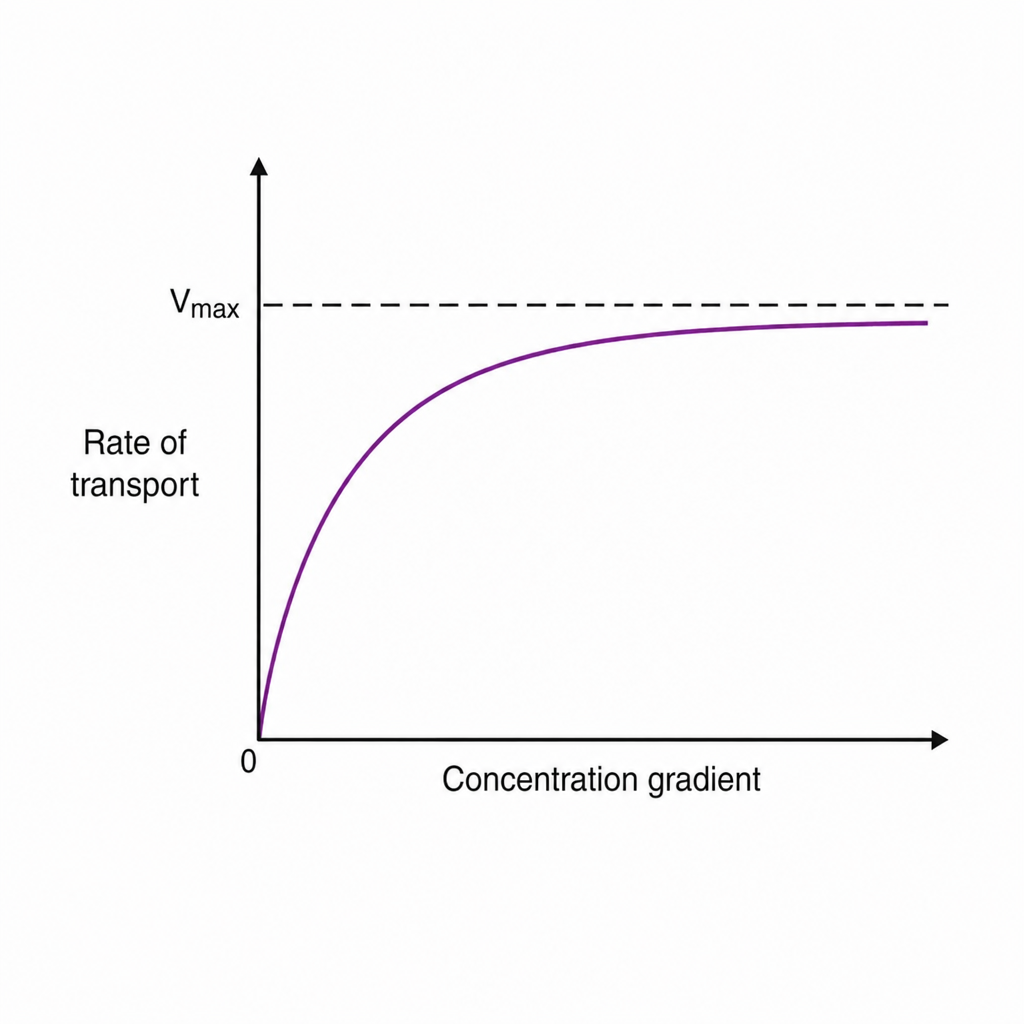
Explanation: **Explanation:** The transport of substances across the cell membrane is determined by their lipid solubility and molecular size. **Correct Answer: D. Glucose** Glucose is a large, polar (hydrophilic) molecule. Because it is not lipid-soluble, it cannot dissolve in the hydrophobic lipid bilayer of the cell membrane. Therefore, it requires specific **carrier proteins** to facilitate its movement. This occurs via **Facilitated Diffusion** (using GLUT transporters) or **Secondary Active Transport** (using SGLT transporters in the kidneys and intestines). **Why the other options are incorrect:** * **A. Carbon dioxide (CO2):** As a small, non-polar gas, CO2 moves freely across the lipid bilayer via **Simple Diffusion** following its partial pressure gradient. * **B. Steroid hormones:** These are derived from cholesterol and are highly lipid-soluble (lipophilic). They easily dissolve through the cell membrane to reach intracellular receptors. * **C. Vitamin E:** This is a fat-soluble vitamin (along with A, D, and K). Like steroid hormones, fat-soluble vitamins cross cell membranes via **Simple Diffusion** without the need for carrier proteins. **High-Yield NEET-PG Pearls:** * **Simple Diffusion:** No carrier, no energy, non-saturable (e.g., O2, CO2, Alcohol, Steroids). * **Facilitated Diffusion:** Requires a carrier, no energy, **saturable** (Vmax), and specific (e.g., GLUT transporters). * **GLUT-4** is the only insulin-dependent glucose transporter, found primarily in skeletal muscle and adipose tissue. * **SGLT-1/2** are examples of Secondary Active Transport (Symport) where glucose moves against its gradient using the energy from the sodium gradient.
Explanation: **Explanation:** **Peroxisomes** (also known as microbodies) are membrane-bound organelles that contain oxidative enzymes. The hallmark enzyme of the peroxisome is **Catalase**. The primary function of peroxisomes is the β-oxidation of very-long-chain fatty acids (VLCFA), which generates hydrogen peroxide ($H_2O_2$) as a byproduct. Since $H_2O_2$ is highly reactive and toxic to the cell, **Catalase** plays a vital role by converting $H_2O_2$ into water and oxygen ($2H_2O_2 \rightarrow 2H_2O + O_2$), thereby protecting the cell from oxidative damage. **Why other options are incorrect:** * **Golgi complex:** Primarily involved in the post-translational modification, sorting, and packaging of proteins. It does not contain oxidative enzymes like catalase. * **Lysosomes:** Known as the "suicide bags" of the cell, they contain **acid hydrolases** (e.g., cathepsins, glycosidases) that function at an acidic pH to digest cellular debris. * **Mitochondria:** The "powerhouse" of the cell, containing enzymes for the TCA cycle, electron transport chain, and β-oxidation of short/medium-chain fatty acids, but they lack catalase. **High-Yield Facts for NEET-PG:** * **Zellweger Syndrome:** A rare congenital disorder caused by the absence of functional peroxisomes, leading to the accumulation of VLCFAs, especially in the liver and brain. * **Adrenoleukodystrophy (X-linked):** A defect in transporting VLCFAs into peroxisomes for oxidation. * **Marker Enzyme:** Catalase is the biochemical marker used to identify peroxisomes in subcellular fractionation.
Cell Membrane Structure and Function
Practice Questions
Membrane Transport Proteins
Practice Questions
Cellular Energetics and Metabolism
Practice Questions
Mitochondrial Function
Practice Questions
Cell Volume Regulation
Practice Questions
Cellular Responses to Stress
Practice Questions
Calcium Signaling
Practice Questions
Cell Cycle and Regulation
Practice Questions
Cellular Aging
Practice Questions
Apoptosis and Cell Death
Practice Questions
Get full access to all questions, explanations, and performance tracking.
Start For Free