Which of the following glucose transporters is insulin-dependent for its action?
What acid-base and electrolyte imbalance characteristically results from acute renal failure?
High anion gap metabolic acidosis is/are present in which of the following conditions?
All of the following are true about neurotrophins except?
A 64-year-old woman presents with metabolic alkalosis and a bicarbonate level of 34 mEq/L. Which of the following is the most likely cause?
Which of the following are considered blood buffers?
A patient's Arterial Blood Gas (ABG) analysis reveals the following findings: pH 7.0, PCO2 -80 mmHg, HCO3- 24 mEq/L. What is your inference?
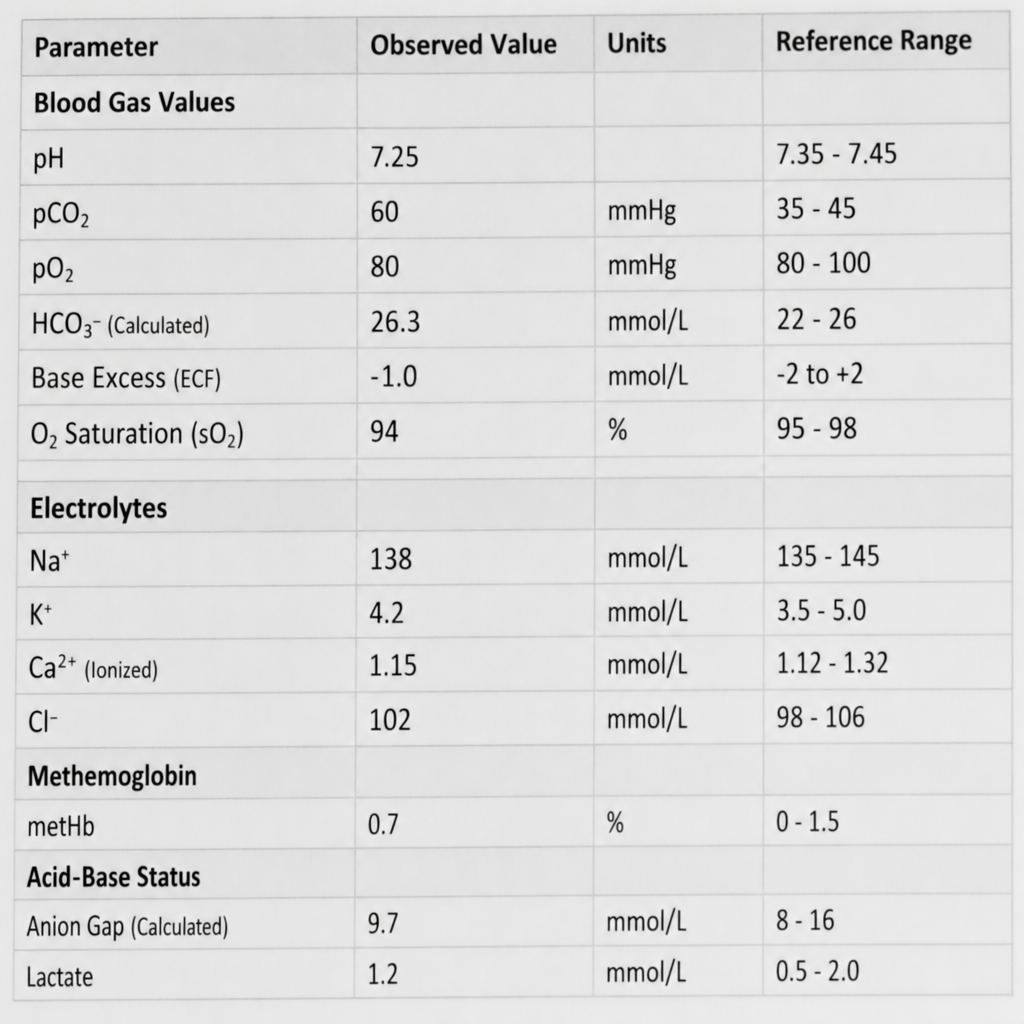
Interpret the following ABG values: PaCO2 - 65 mmHg, HCO3 - 15 mEq/L, and pH - 7.21.
Which of the following is NOT an action of Substance P?
Chronic renal failure is most commonly associated with which acid-base imbalance?
Explanation: **Explanation:** The correct answer is **GLUT 4**. Glucose transporters (GLUTs) are membrane proteins that facilitate the transport of glucose across cell membranes via facilitated diffusion. **GLUT 4** is the only major glucose transporter that is **insulin-dependent**. In the resting state, GLUT 4 is sequestered in intracellular vesicles. When insulin binds to its receptor, it triggers a signaling cascade that causes these vesicles to translocation and fuse with the plasma membrane, allowing glucose entry into the cell. **Analysis of Options:** * **GLUT 1:** Found in RBCs, the blood-brain barrier, and the heart. It provides basal glucose uptake and is insulin-independent. * **GLUT 2:** A high-capacity, low-affinity transporter found in the Liver, Pancreatic beta cells, and the Basolateral membrane of the kidney/intestine. It acts as a "glucose sensor" and is insulin-independent. * **GLUT 3:** Found primarily in Neurons and the placenta. It has a high affinity for glucose, ensuring brain uptake even during hypoglycemia; it is insulin-independent. **High-Yield Clinical Pearls for NEET-PG:** * **Location of GLUT 4:** Primarily found in **Skeletal muscle** and **Adipose tissue**. * **Exercise:** Muscle contraction can also trigger GLUT 4 translocation to the membrane independent of insulin, which is why exercise helps manage blood sugar in Type 2 Diabetes. * **SGLT vs. GLUT:** Remember that SGLT (Sodium-Glucose Linked Transporters) use **secondary active transport** (found in the kidney and gut), whereas GLUTs use **facilitated diffusion**. * **GLUT 5:** Specifically transports **Fructose** (found in the small intestine and spermatozoa).
Explanation: **Explanation:** In acute renal failure (ARF), now commonly referred to as Acute Kidney Injury (AKI), the kidneys experience a sudden decline in the Glomerular Filtration Rate (GFR). This leads to the retention of metabolic waste products and significant electrolyte disturbances. **Why Hyperkalemic Acidosis is Correct:** 1. **Metabolic Acidosis:** The kidneys are responsible for excreting fixed acids (like phosphates and sulfates) and regenerating bicarbonate. In ARF, the failure to excrete these hydrogen ions ($H^+$) and the inability to reabsorb $HCO_3^-$ leads to **High Anion Gap Metabolic Acidosis (HAGMA)**. 2. **Hyperkalemia:** Potassium excretion is primarily a renal process. Decreased GFR and reduced tubular secretion (due to aldosterone resistance or tubular damage) lead to potassium retention. Furthermore, the accompanying acidosis causes an intracellular-to-extracellular shift, where $H^+$ enters cells and $K^+$ moves out to maintain electroneutrality, further elevating serum potassium levels. **Analysis of Incorrect Options:** * **Options A & B (Alkalosis):** Renal failure typically causes an accumulation of acids, not a loss. Alkalosis is more characteristic of vomiting (metabolic) or hyperventilation (respiratory). * **Option D (Hypokalemic Acidosis):** While acidosis is present, potassium levels rise in ARF. Hypokalemic acidosis is typically seen in conditions like Renal Tubular Acidosis (RTA) Type 1 and 2 or chronic diarrhea. **NEET-PG High-Yield Pearls:** * **ECG in Hyperkalemia:** Look for tall "tented" T-waves, widened QRS complexes, and loss of P-waves. * **Management:** Immediate treatment for hyperkalemia includes Calcium Gluconate (to stabilize the myocardium), followed by insulin/glucose or salbutamol to shift $K^+$ intracellularly. * **Anion Gap:** AKI is a classic cause of High Anion Gap Metabolic Acidosis (MUDPILES mnemonic; 'U' for Uremia).
Explanation: **Explanation:** **1. Why the correct answer is right:** **Poorly controlled diabetes** (specifically Diabetic Ketoacidosis or DKA) leads to **High Anion Gap Metabolic Acidosis (HAGMA)**. In the absence of insulin, the body undergoes excessive fatty acid oxidation, resulting in the production of ketoacids (β-hydroxybutyrate and acetoacetate). These are unmeasured anions that accumulate in the blood, increasing the gap between measured cations ($Na^+$) and measured anions ($Cl^-$ and $HCO_3^-$). **2. Why the incorrect options are wrong:** * **Asthma & COPD (Options A & B):** These are obstructive lung diseases that lead to **Respiratory Acidosis** due to $CO_2$ retention (hypoventilation). Anion gap changes are characteristic of metabolic, not primary respiratory, disturbances. * **Renal Tubular Acidosis (Option D):** RTA is a classic cause of **Normal Anion Gap Metabolic Acidosis (NAGMA)** or hyperchloremic acidosis. In RTA, there is either a failure to excrete $H^+$ or a failure to reabsorb $HCO_3^-$, which is compensated for by an increase in Chloride ($Cl^-$) levels to maintain electroneutrality, keeping the anion gap within the normal range (8–12 mEq/L). **3. High-Yield Clinical Pearls for NEET-PG:** * **Mnemonic for HAGMA:** **MUDPILES** (Methanol, Uremia, DKA, Propylene glycol, Iron/INH, Lactic acidosis, Ethylene glycol, Salicylates). * **Mnemonic for NAGMA:** **USED CARP** (Ureterosigmoidostomy, Small bowel fistula, Extra-alimentation, Diarrhea, Carbonic anhydrase inhibitors, Renal Tubular Acidosis, Pancreatic fistula). * **Formula:** Anion Gap = $Na^+ - (Cl^- + HCO_3^-)$. Normal range is 8–12 mEq/L. * **Key Distinction:** If the question mentions "Diarrhea" or "RTA," always think NAGMA. If it mentions "Shock," "Renal Failure," or "Ketoacidosis," think HAGMA.
Explanation: **Explanation** Neurotrophins are a family of proteins essential for the survival, development, and function of neurons. **Why Option D is the Correct Answer (The False Statement):** Neurotrophins are primarily characterized by **retrograde axonal transport**. They are typically secreted by target tissues, bind to receptors on the nerve terminals, and are internalized and transported "backward" (retrograde) along the axon to the cell body (soma) to influence gene expression and promote survival. While some antegrade transport occurs, saying they are "always" transported antegrade is physiologically incorrect. **Analysis of Other Options:** * **Option A:** Neurotrophins play a vital role in maintaining the structural and functional integrity of both presynaptic and postsynaptic neurons, preventing apoptosis. * **Option B:** There is high specificity between neurotrophins and **Trk (Tropomyosin receptor kinase)** receptors. **BDNF** (Brain-Derived Neurotrophic Factor) and Neurotrophin-4/5 bind to **TrkB**. (Note: NGF binds to TrkA; NT-3 binds to TrkC). * **Option C:** Nerve Growth Factor (NGF) is specifically known to support the growth and maintenance of cholinergic neurons in the basal forebrain, which are often affected in Alzheimer’s disease. **High-Yield NEET-PG Pearls:** * **Pro-neurotrophins:** All neurotrophins are synthesized as precursors (pro-forms) which promote apoptosis via the **p75 receptor**, while mature forms promote survival via **Trk receptors**. * **Retrograde Transport Motor:** Mediated by **Dynein**. * **Antegrade Transport Motor:** Mediated by **Kinesin**. * **BDNF Clinical Link:** Reduced levels of BDNF are associated with depression and neurodegenerative diseases; exercise is known to increase BDNF levels.
Explanation: **Explanation:** **Metabolic alkalosis** is characterized by an increase in plasma bicarbonate ($HCO_3^-$) and an increase in pH. The correct answer is **Diuretic use** (specifically loop and thiazide diuretics), which is a classic cause of "contraction alkalosis." 1. **Why Diuretic Use is Correct:** * **Volume Contraction:** Diuretics cause loss of $NaCl$ and water, leading to extracellular fluid (ECF) volume depletion. This activates the Renin-Angiotensin-Aldosterone System (RAAS). * **Aldosterone Effect:** Increased aldosterone promotes $Na^+$ reabsorption in exchange for $H^+$ and $K^+$ secretion in the distal tubule. The loss of $H^+$ leads to "new" $HCO_3^-$ generation. * **Chloride Depletion:** Diuretics cause chloride loss; low chloride levels impair the $HCO_3^-/Cl^-$ exchanger in the collecting duct, preventing the excretion of excess bicarbonate. 2. **Why Other Options are Incorrect:** * **Hyperkalemia:** Acidosis causes hyperkalemia (as $H^+$ moves intracellularly and $K^+$ moves out). Conversely, **hypokalemia** causes alkalosis. * **Mineralocorticoid Deficiency (e.g., Addison’s):** A lack of aldosterone leads to $H^+$ retention, resulting in **Normal Anion Gap Metabolic Acidosis (RTA Type 4)**, not alkalosis. * **Diarrhea:** Lower GI secretions are rich in $HCO_3^-$. Loss of these fluids leads to **Metabolic Acidosis**. **High-Yield Clinical Pearls for NEET-PG:** * **Saline Responsiveness:** Metabolic alkalosis due to diuretics or vomiting is "Saline Responsive" (Urinary $Cl^- < 10$ mEq/L). Alkalosis due to mineralocorticoid excess (e.g., Conn’s Syndrome) is "Saline Resistant" (Urinary $Cl^- > 20$ mEq/L). * **The "H" Rule:** In alkalosis, look for the "Low's": Hypovolemia, Hypochloremia, and Hypokalemia.
Explanation: **Explanation:** The body maintains a narrow physiological pH range (7.35–7.45) through three primary lines of defense: chemical buffers, the respiratory system, and the renal system. Chemical buffers in the blood act immediately to neutralize excess acids or bases. **Why "All of the above" is correct:** Blood buffers are categorized into bicarbonate and non-bicarbonate systems. * **Bicarbonate ($HCO_3^-$):** This is the most important **extracellular fluid (ECF)** buffer. It is highly effective because it is an "open system"—the lungs can regulate $CO_2$ levels and the kidneys can regulate $HCO_3^-$ levels. * **Plasma Proteins:** Proteins (like albumin) act as buffers because their constituent amino acids contain carboxyl (acidic) and amino (basic) groups that can donate or accept protons ($H^+$). * **Hemoglobin (Hb):** This is the most important **intracellular** buffer in the blood (within RBCs). Deoxyhemoglobin is a better buffer than oxyhemoglobin (the **Haldane effect**), allowing it to bind $H^+$ ions generated during $CO_2$ transport. **Analysis of Options:** Since Bicarbonate, Plasma proteins, and Hemoglobin all function as physiological buffers within the blood compartment, option D is the only accurate choice. **High-Yield Clinical Pearls for NEET-PG:** * **First line of defense:** Chemical buffers (seconds). * **Second line of defense:** Respiratory system (minutes). * **Third line of defense:** Renal system (hours to days; most powerful). * **Phosphate Buffer:** Most important buffer in the **renal tubules** and **intracellular fluid (ICF)**, but plays a minor role in blood due to low concentration. * **Isohydric Principle:** All buffer systems in a common solution are in equilibrium; a change in one affects all others.
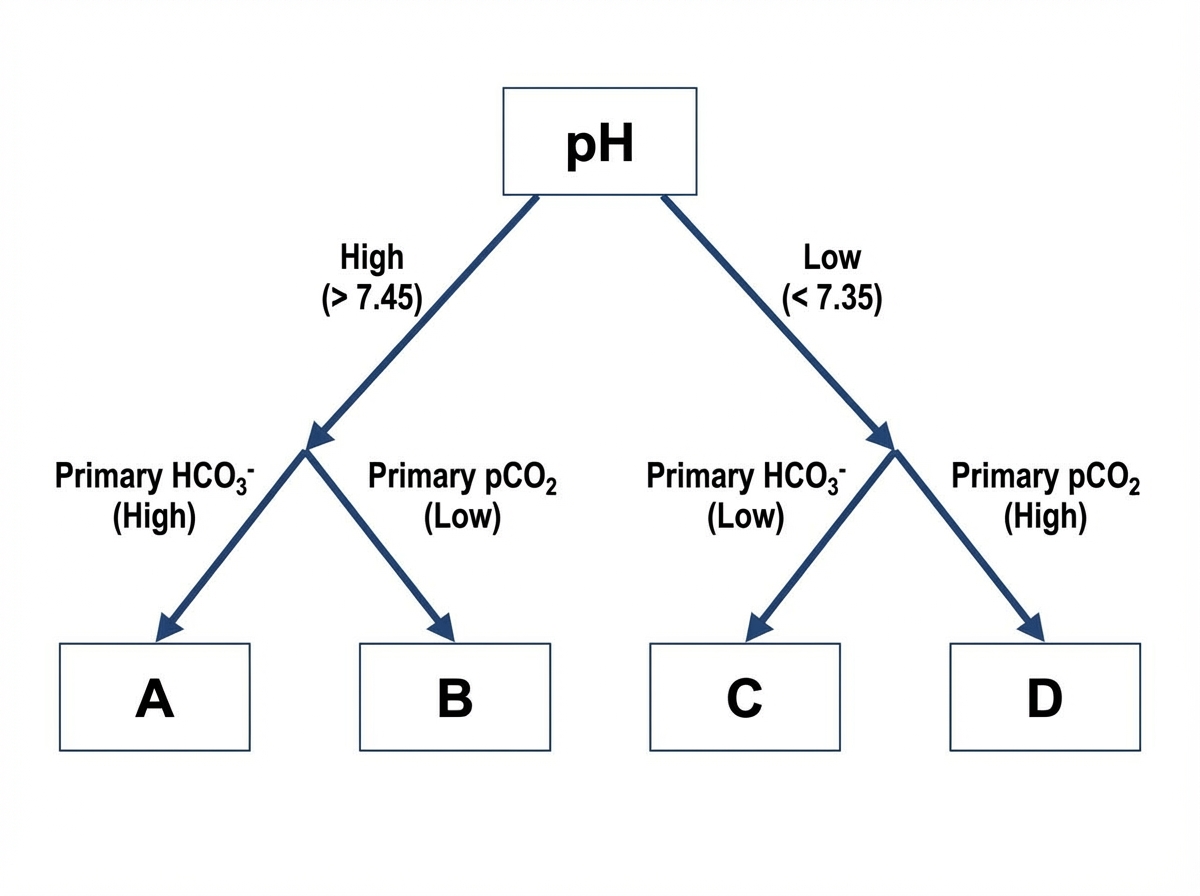
Explanation: ### Explanation To solve any ABG question, follow a systematic three-step approach: **1. Analyze the pH:** The normal pH range is 7.35–7.45. A pH of **7.0** is significantly low, indicating **Acidosis**. **2. Determine the Primary Cause (Respiratory vs. Metabolic):** * **Respiratory:** Look at $PCO_2$ (Normal: 35–45 mmHg). Here, $PCO_2$ is **80 mmHg** (elevated). High $CO_2$ acts as an acid; thus, this matches the acidic pH. * **Metabolic:** Look at $HCO_3^-$ (Normal: 22–26 mEq/L). Here, $HCO_3^-$ is **24 mEq/L**, which is perfectly normal. **Conclusion:** Since the acidosis is driven by high $PCO_2$ while the bicarbonate remains normal, the diagnosis is **Uncompensated Respiratory Acidosis**. --- ### Why the other options are incorrect: * **Metabolic Acidosis:** This would present with a low pH but a **low $HCO_3^-$** (primary deficit) and usually a compensatory decrease in $PCO_2$. * **Metabolic Alkalosis:** This would feature a **high pH** (>7.45) and an elevated $HCO_3^-$. * **Respiratory Alkalosis:** This would feature a **high pH** (>7.45) and a low $PCO_2$ (<35 mmHg), often seen in hyperventilation. --- ### High-Yield Clinical Pearls for NEET-PG: * **ROME Mnemonic:** **R**espiratory **O**pposite (pH low, $PCO_2$ high or vice versa), **M**etabolic **E**qual (pH and $HCO_3^-$ move in the same direction). * **Acute vs. Chronic:** In **Acute** Respiratory Acidosis (like opioid overdose), the $HCO_3^-$ rises only slightly (1 mEq/L for every 10 mmHg rise in $PCO_2$). In **Chronic** cases (like COPD), the kidneys compensate more significantly (3.5–4 mEq/L rise in $HCO_3^-$). * **Golden Rule:** If the $PCO_2$ and pH move in opposite directions, the primary problem is always respiratory.
Explanation: To interpret this ABG, follow a systematic three-step approach: **1. Analyze the pH:** The pH is **7.21** (Normal: 7.35–7.45). Since it is < 7.35, the primary state is **Acidosis**. **2. Analyze the Respiratory Component (PaCO2):** The PaCO2 is **65 mmHg** (Normal: 35–45 mmHg). An elevated PaCO2 indicates CO2 retention, which causes **Respiratory Acidosis**. **3. Analyze the Metabolic Component (HCO3):** The HCO3 is **15 mEq/L** (Normal: 22–26 mEq/L). A low bicarbonate level indicates **Metabolic Acidosis**. **Conclusion:** Since both the respiratory system (high CO2) and the metabolic system (low HCO3) are contributing to the low pH, this is a **Mixed Respiratory and Metabolic Acidosis**. ### Why the other options are incorrect: * **Option A:** Alkalosis requires a pH > 7.45. Here, the pH is acidic. * **Option C:** "Full compensation" means the pH has returned to the normal range (7.35–7.45). Here, the pH is significantly abnormal. * **Option D:** In compensated respiratory acidosis, the kidneys would increase HCO3 (not decrease it) to buffer the high CO2 and normalize the pH. ### NEET-PG High-Yield Pearls: * **The "Direction" Rule:** In simple acid-base disorders, PaCO2 and HCO3 move in the **same direction**. If they move in **opposite directions** (as seen here: PaCO2 ↑ and HCO3 ↓), it signifies a **mixed disorder**. * **Mixed Acidosis** is a medical emergency often seen in **cardiopulmonary arrest** or combined respiratory failure and septic shock. * **Normal pH with abnormal PaCO2/HCO3** always indicates either full compensation or a mixed disorder.
Explanation: **Explanation:** Substance P is an 11-amino acid neuropeptide belonging to the **Tachykinin** family. It acts primarily through the **NK1 (Neurokinin-1) receptors**. **1. Why Vasoconstriction is the Correct Answer:** Substance P is a potent **vasodilator**, not a vasoconstrictor. It induces vasodilation by stimulating the release of nitric oxide (NO) from the vascular endothelium. This leads to increased capillary permeability and plasma extravasation, contributing to "neurogenic inflammation." **2. Analysis of Incorrect Options:** * **Pain Transmission:** Substance P is a key neurotransmitter in the spinal cord (specifically the dorsal horn). It is released by primary afferent nociceptors (C-fibers) to transmit slow, chronic pain signals. * **Axon Reflex:** When peripheral nerve endings are stimulated, Substance P is released locally. This causes the "flare" response (vasodilation) in the triple response of Lewis, a classic example of the axon reflex. * **Peristalsis:** In the gastrointestinal tract, Substance P acts as an excitatory neurotransmitter. It is found in the myenteric plexus and stimulates the contraction of intestinal smooth muscle, thereby promoting peristalsis. **High-Yield Clinical Pearls for NEET-PG:** * **Triple Response of Lewis:** Consists of Flush (capillary dilation), Flare (arteriolar dilation via axon reflex/Substance P), and Wheal (exudation/edema). * **Aprepitant:** A clinical antagonist of the NK1 receptor used as an antiemetic to prevent chemotherapy-induced nausea and vomiting. * **Capsaicin:** Depletes Substance P from sensory nerve endings, which is why it is used topically for pain relief in conditions like post-herpetic neuralgia.
Explanation: **Explanation:** **Metabolic Acidosis** is the hallmark acid-base disturbance in Chronic Renal Failure (CRF). As kidney function declines, the organs lose their ability to maintain pH balance through three primary mechanisms: 1. **Reduced Excretion of Fixed Acids:** The failing kidney cannot effectively excrete "titratable acids" (like phosphates) and organic anions (sulfates, urates) produced by daily metabolism. 2. **Impaired Ammoniagenesis:** There is a significant decrease in the production of ammonia ($NH_3$) in the distal tubule, which is essential for buffering and excreting hydrogen ions ($H^+$). 3. **Bicarbonate Loss:** There is a reduced capacity to reabsorb filtered bicarbonate ($HCO_3^-$) and generate new bicarbonate. Initially, CRF often presents as a **Normal Anion Gap Metabolic Acidosis (NAGMA)** due to tubular dysfunction. However, as the GFR drops below 20-25 mL/min, it typically converts to a **High Anion Gap Metabolic Acidosis (HAGMA)** due to the retention of unmeasured anions (sulfates, phosphates). **Why other options are incorrect:** * **Respiratory Alkalosis/Acidosis:** These are primary disturbances of the lungs ($CO_2$ regulation). While a patient with CRF will show compensatory respiratory alkalosis (hyperventilation to blow off $CO_2$), the *primary* pathology is metabolic. * **Hypoxia:** This refers to low oxygen levels in tissues. While CRF can cause anemia (due to low Erythropoietin), hypoxia is a clinical state, not an acid-base imbalance. **High-Yield Clinical Pearls for NEET-PG:** * **Kussmaul’s Respiration:** The deep, sighing breathing pattern seen in CRF patients as a compensatory mechanism for metabolic acidosis. * **Anion Gap:** Remember that advanced CRF is a classic cause of HAGMA (Mnemonic: **MUDPILES** – 'U' stands for Uremia). * **Hyperkalemia:** Acidosis leads to a shift of $K^+$ out of cells in exchange for $H^+$, often worsening the hyperkalemia already present in renal failure.
Acid-Base Chemistry
Practice Questions
Respiratory Regulation of Acid-Base Balance
Practice Questions
Renal Regulation of Acid-Base Balance
Practice Questions
Bicarbonate Buffer System
Practice Questions
Non-Bicarbonate Buffer Systems
Practice Questions
Respiratory Acidosis and Alkalosis
Practice Questions
Metabolic Acidosis and Alkalosis
Practice Questions
Mixed Acid-Base Disorders
Practice Questions
Compensatory Mechanisms
Practice Questions
Clinical Assessment of Acid-Base Status
Practice Questions
Get full access to all questions, explanations, and performance tracking.
Start For Free