Which of the following is NOT an example of chronic adverse drug reactions?
The study of how variations in the human genome affect the response to medications is known as?
What is the approximate dose of a drug for a 3-year-old child compared to an adult dose?
In sub-acute toxicity studies, for what duration is the drug given to animals?
Administration of which of the following drugs requires therapeutic drug monitoring?
What are orphan drugs?
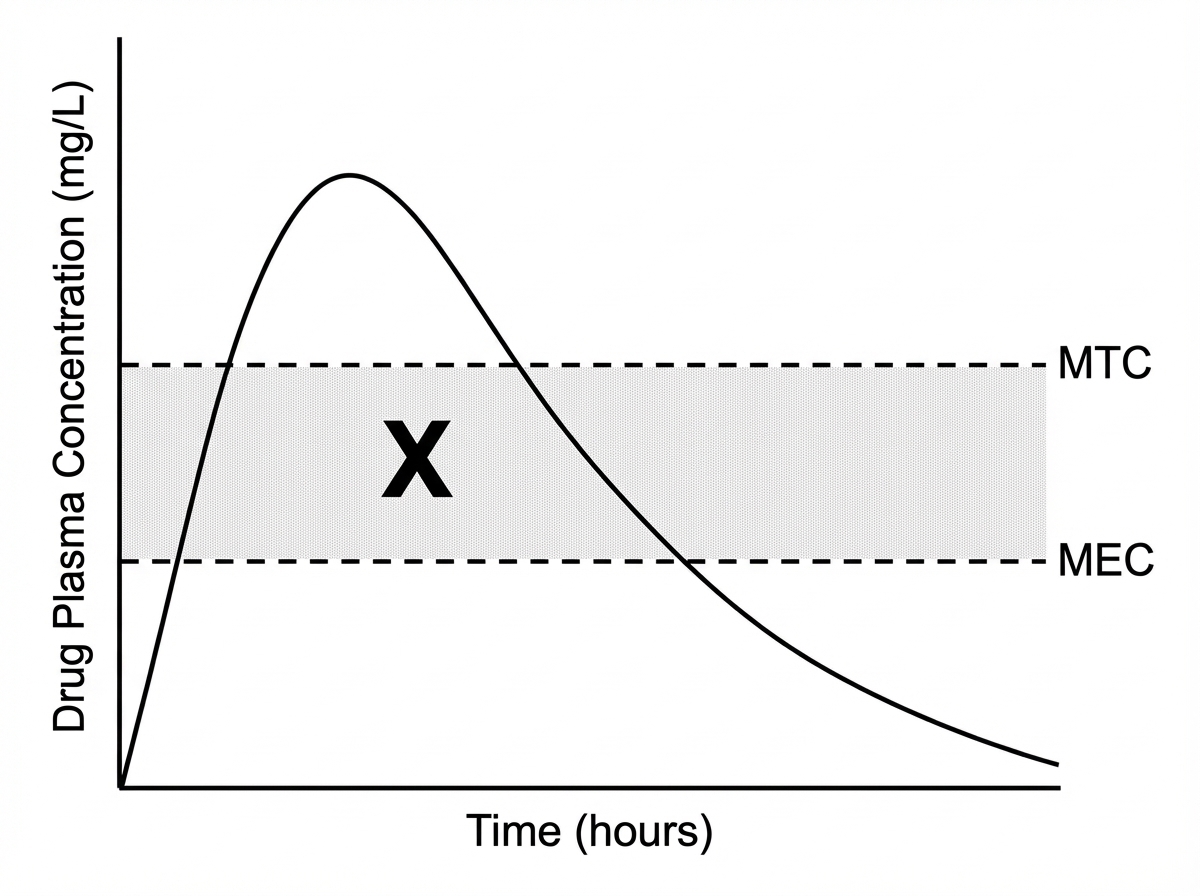
What does X represent in the given graph?
Which of the following drugs requires therapeutic drug monitoring?
A patient with history of ischemic stroke was started on clopidogrel. However, she had another attack of stroke after 6 months. Which of the following is likely to be responsible for the failure of clopidogrel in this patient?
Prolonged apnea may occur in patients with a genetically determined abnormal variant of cholinesterase following intravenous administration of
Explanation: ### Explanation Adverse Drug Reactions (ADRs) are classified using the **Rawlins and Thompson classification**. To answer this question, one must distinguish between **Type A (Augmented)** and **Type C (Chronic)** reactions. **1. Why "Nitrate induced headache" is the correct answer:** Nitrate-induced headache is a **Type A (Augmented)** reaction. It is a predictable, dose-dependent extension of the drug’s primary pharmacological action (vasodilation). It occurs acutely shortly after administration. Because it is an immediate effect rather than a result of long-term cumulative exposure, it is NOT classified as a chronic ADR. **2. Analysis of Incorrect Options (Chronic ADRs):** Type C reactions are associated with **long-term drug use** and involve cumulative dose effects. * **Glucocorticoid-induced osteoporosis:** This occurs due to the cumulative suppression of osteoblast activity and calcium resorption over months or years of therapy. * **Chloroquine-induced retinopathy:** This is a classic example of cumulative toxicity where the drug deposits in the retinal pigment epithelium over a long duration (typically seen with high cumulative doses >1000g). * **Amiodarone deposition in cornea:** Also known as *cornea verticillata*, this occurs due to the long-term accumulation of the drug in lysosomal compartments (phospholipidosis). **3. High-Yield Clinical Pearls for NEET-PG:** * **Type A (Augmented):** Common, predictable, low mortality (e.g., Gastritis by NSAIDs, Hypoglycemia by Insulin). * **Type B (Bizarre):** Unpredictable, idiosyncratic, high mortality (e.g., Anaphylaxis, SJS/TEN). * **Type C (Chronic):** Related to cumulative dose (e.g., Analgesic nephropathy). * **Type D (Delayed):** Occurs years after treatment (e.g., Teratogenicity, Carcinogenicity). * **Type E (End of use):** Withdrawal symptoms (e.g., Opioid withdrawal, Rebound hypertension with Clonidine).
Explanation: **Explanation:** **Pharmacogenomics** is the study of how an individual’s entire genetic makeup (genome) influences their response to drugs. It combines pharmacology and genomics to analyze how genetic variations (like Single Nucleotide Polymorphisms or SNPs) affect drug metabolism, efficacy, and toxicity. This field is the cornerstone of **personalized medicine**, allowing clinicians to prescribe the "right drug at the right dose" based on a patient's genotype. **Analysis of Incorrect Options:** * **Pharmacokinetics (B):** Refers to what the body does to the drug. it involves the processes of Absorption, Distribution, Metabolism, and Excretion (ADME). * **Pharmacotherapeutics (C):** The clinical application of drugs to prevent, treat, or diagnose diseases. It focuses on the use of pharmacological information for patient care. * **Pharmacovigilance (D):** The science relating to the detection, assessment, understanding, and prevention of adverse effects or any other drug-related problems (post-marketing surveillance). **High-Yield Clinical Pearls for NEET-PG:** * **HLA-B*1502:** Screening is mandatory before starting **Carbamazepine** in patients of Asian ancestry to prevent Stevens-Johnson Syndrome (SJS). * **TPMT (Thiopurine Methyltransferase):** Deficiency leads to life-threatening bone marrow suppression when treated with **6-Mercaptopurine** or Azathioprine. * **CYP2C19:** Polymorphisms affect the activation of **Clopidogrel** (a prodrug); "poor metabolizers" have a higher risk of cardiovascular events. * **VKORC1 & CYP2C9:** Variations in these genes significantly influence the required maintenance dose of **Warfarin**.
Explanation: ### Explanation The correct answer is **C. One-third of an adult dose.** Pediatric drug dosing is not merely a reduction of adult doses; it is based on physiological differences in body surface area (BSA), weight, and metabolic maturity. To estimate pediatric doses when specific guidelines are unavailable, several mathematical formulas are used. **The Underlying Concept: Young’s Rule** For children aged 1–12 years, **Young’s Rule** is a classic high-yield formula used to calculate the dose [1]: * **Formula:** $\text{Child Dose} = \frac{\text{Age}}{\text{Age} + 12} \times \text{Adult Dose}$ * **Calculation for a 3-year-old:** $\frac{3}{3 + 12} = \frac{3}{15} = \frac{1}{5}$ of an adult dose. However, clinical practice and more accurate indices like **Clark’s Rule** (based on weight) [1] or **BSA-based calculations** (the most accurate method) generally place the requirement for a 3-year-old (average weight 14–15 kg) at approximately **one-third (30-33%)** of the adult dose to account for their higher metabolic rate and larger BSA relative to weight compared to adults. **Analysis of Incorrect Options:** * **A. Same as an adult dose:** Incorrect. Children have immature hepatic enzymes and renal clearance [2]; an adult dose would lead to severe toxicity. * **B. Half of an adult dose:** Incorrect. This typically applies to older children/adolescents (around 12 years or 40 kg). * **D. One-fourth of an adult dose:** Incorrect. This is more characteristic of an infant (approx. 1 year old). **High-Yield Clinical Pearls for NEET-PG:** 1. **Most Accurate Method:** Body Surface Area (BSA) is the most reliable method for pediatric dosing ($ \frac{\text{Child's BSA}}{\text{Adult BSA (1.73 } m^2)} \times \text{Adult Dose}$). 2. **Dilling’s Rule:** $\frac{\text{Age}}{20} \times \text{Adult Dose}$ (Easier for quick estimation). 3. **Fried’s Rule:** Used for infants (<1 year): $\frac{\text{Age in months}}{150} \times \text{Adult Dose}$. 4. **Physiological Note:** Neonates have higher total body water and lower plasma protein binding, significantly altering the Volume of Distribution ($V_d$) of drugs.
Explanation: **Explanation:** Toxicity studies are a fundamental part of preclinical drug development, categorized based on the duration of drug administration to determine the safety profile of a new chemical entity. **1. Why Option B is Correct:** **Sub-acute toxicity studies** (also known as repeated-dose or short-term toxicity studies) involve the daily administration of a drug for a period typically ranging from **2 to 12 weeks** (commonly 4 weeks/28 days). The primary objective is to identify target organ toxicity and establish the "No Observed Adverse Effect Level" (NOAEL) before proceeding to human clinical trials. **2. Analysis of Incorrect Options:** * **Option A (Single dose):** This refers to **Acute Toxicity studies**. The drug is administered in a single dose (or multiple doses within 24 hours) to determine the Median Lethal Dose ($LD_{50}$) and immediate toxic effects. * **Option C (6-12 months):** This refers to **Chronic Toxicity studies**. These are conducted to evaluate the effects of long-term exposure, including cumulative toxicity and potential carcinogenic effects. In most species, this lasts 6 months, though it can extend to 12. * **Option D (1-3 years):** This duration is typically reserved for **Carcinogenicity studies** in rodents (usually 2 years) or long-term observation in specific longitudinal safety models. **High-Yield Clinical Pearls for NEET-PG:** * **Acute Toxicity:** Single dose; determines $LD_{50}$. * **Sub-acute Toxicity:** 2–12 weeks; identifies target organs of toxicity. * **Chronic Toxicity:** >6 months; evaluates cumulative effects. * **Therapeutic Index (TI):** Calculated as $LD_{50} / ED_{50}$. A higher TI indicates a safer drug. * **Pre-clinical requirement:** Toxicity must be tested in at least two mammalian species (one rodent and one non-rodent) before Phase I trials.
Explanation: ### Explanation **Therapeutic Drug Monitoring (TDM)** is indicated for drugs with a **narrow therapeutic index**, where the difference between the therapeutic and toxic dose is minimal, and there is a direct correlation between plasma concentration and clinical effect. **1. Why Lithium is the Correct Answer:** Lithium is the classic example of a drug requiring TDM. It has a very narrow therapeutic range (typically **0.6–1.2 mEq/L**). Concentrations slightly above this range can lead to severe toxicity (tremors, ataxia, seizures), while levels below it are ineffective for treating bipolar disorder. Furthermore, its pharmacokinetics are highly variable based on renal function and salt intake, making regular monitoring of serum levels mandatory for safety and efficacy. **2. Why the Other Options are Incorrect:** * **Haloperidol (Antipsychotic):** While it has side effects (EPS), its therapeutic window is relatively wide. Clinical response (reduction in psychosis) is used to titrate the dose rather than plasma levels. * **Diazepam (Benzodiazepine):** It has a high therapeutic index. Monitoring is unnecessary because the dose required to cause fatal toxicity is extremely high compared to the sedative dose. * **Acetazolamide (Carbonic Anhydrase Inhibitor):** Used for glaucoma or altitude sickness, its effect is monitored clinically (intraocular pressure) or via biochemical markers (acid-base balance), not plasma drug levels. **Clinical Pearls for NEET-PG:** * **Mnemonic for TDM drugs:** "**L**earn **T**he **P**harmacology **D**ose **V**ery **C**arefully" (**L**ithium, **T**ricyclic Antidepressants/Theophylline, **P**henytoin, **D**igoxin, **V**alproate, **C**yclosporine). * **Lithium Sampling Time:** Blood for TDM should be drawn **12 hours after the last dose** (trough level). * **Excretion:** Lithium is handled by the kidneys like sodium; thus, **thiazide diuretics** and **NSAIDs** can increase lithium levels and cause toxicity.
Explanation: **Explanation:** **Orphan drugs** are medicinal products intended for the diagnosis, prevention, or treatment of **rare diseases** (orphan diseases). These conditions affect a small percentage of the population (e.g., in the US, fewer than 200,000 people; in India, diseases with a prevalence of less than 1 in 5,000). Because the patient base is so small, pharmaceutical companies are often reluctant to develop them under normal market conditions, as the cost of research and development would not be recovered through sales. **Analysis of Options:** * **Option B (Correct):** This aligns with the definition. To encourage the development of these drugs, governments provide incentives like tax credits, clinical research subsidies, and extended patent exclusivity (e.g., 7 years in the US). * **Option A (Incorrect):** Orphan drugs are often difficult to obtain and extremely expensive due to limited production and specialized distribution. * **Option C (Incorrect):** These drugs are developed despite a lack of primary monetary gain. They are "orphaned" because they lack commercial viability without government intervention. **High-Yield Clinical Pearls for NEET-PG:** * **Examples of Orphan Drugs:** Digoxin Immune Fab (for digitalis toxicity), Fomepizole (for methanol poisoning), Thalidomide (for leprosy/multiple myeloma), and various enzyme replacements for storage disorders (e.g., Alglucerase for Gaucher’s disease). * **Orphan Status:** A drug can be "orphan" in one country but not another, depending on the local prevalence of the disease. * **The Orphan Drug Act (1983):** The landmark legislation in the US that pioneered the concept of providing regulatory and financial incentives for rare disease research.
Explanation: ***Therapeutic window*** - The **therapeutic window** represents the drug concentration range between the **minimum effective concentration (MEC)** and **minimum toxic concentration (MTC)**. - This region (X) indicates the safe and effective dosing range where the drug provides **therapeutic benefit** without causing **toxicity**. *Therapeutic index* - The **therapeutic index** is a numerical ratio calculated as **TD50/ED50** (toxic dose/effective dose), not a region on a graph. - It represents the **safety margin** of a drug as a single value, not a concentration range. *Therapeutic dose* - **Therapeutic dose** refers to a specific **amount of drug administered** to achieve desired effects. - It is not represented as a region between two concentration thresholds but as a **discrete dosing amount**. *Therapeutic efficacy* - **Therapeutic efficacy** describes the **maximum response** a drug can produce regardless of dose. - It relates to drug **effectiveness** and **intrinsic activity**, not to concentration ranges between safety thresholds.
Explanation: ### Explanation **Correct Option: D (Phenytoin)** Phenytoin is a classic candidate for **Therapeutic Drug Monitoring (TDM)** due to its unique pharmacokinetic profile. It follows **zero-order (non-linear) kinetics** at therapeutic concentrations. This means that as the metabolic enzymes (CYP2C9) become saturated, even a small increase in dose can lead to a disproportionately large increase in plasma concentration, resulting in toxicity. Additionally, Phenytoin has a **narrow therapeutic index** (10–20 µg/mL), where the margin between the effective dose and the toxic dose is very slim. **Analysis of Incorrect Options:** * **A. Metformin:** Its efficacy is monitored by clinical parameters like blood glucose levels and HbA1c. It has a wide safety margin and predictable kinetics. * **B. Propranolol:** The clinical response (reduction in heart rate or blood pressure) is easily measurable at the bedside, making plasma level monitoring unnecessary. * **C. Warfarin:** While Warfarin has a narrow therapeutic index, it is monitored using **PT/INR** (a pharmacodynamic marker) rather than measuring the drug concentration in the blood. **High-Yield Clinical Pearls for NEET-PG:** * **Criteria for TDM:** Narrow therapeutic index, high inter-individual variability, non-linear kinetics, and lack of easily measurable clinical markers. * **Mnemonic for TDM Drugs:** "**L**earn **T**he **V**ery **P**oisonous **D**rugs **C**arefully" (**L**ithium, **T**heophylline/Tricyclic antidepressants, **V**alproate, **P**henytoin, **D**igoxin, **C**yclosporine). * **Phenytoin Toxicity:** Characterized by nystagmus (earliest sign), ataxia, and gum hypertrophy. * **Exception:** If a drug has a measurable physiological effect (e.g., BP for antihypertensives, INR for Warfarin), TDM is generally not required.
Explanation: ***Reduced function/Loss of function of CYP2C19*** - **Clopidogrel** is a **prodrug** that requires activation by **hepatic cytochrome P450 (CYP) enzymes**, primarily **CYP2C19**, to its active metabolite. - **Genetic polymorphisms** causing **reduced function or loss of function of CYP2C19** (e.g., CYP2C19*2, *3 alleles) result in insufficient conversion of clopidogrel to its active form, leading to **clopidogrel resistance** and increased risk of thrombotic events like recurrent stroke. - These **poor metabolizers** have significantly reduced antiplatelet response to standard clopidogrel doses. *Upregulation of CYP1A1* - **CYP1A1** is involved in the metabolism of various xenobiotics but plays a **minimal role** in clopidogrel activation. - Upregulation of CYP1A1 would not be a primary factor in clopidogrel failure as it is not the main enzyme responsible for its bioactivation. *Downregulation of CYP2E1* - **CYP2E1** is primarily involved in the metabolism of small organic molecules, some drugs, and toxins, and has **no significant role** in the bioactivation of clopidogrel. - Therefore, changes in its expression would not impact clopidogrel's efficacy. *Downregulation of CYP2D6* - **CYP2D6** is a major enzyme involved in the metabolism of many psychoactive drugs, beta-blockers, and opioids, but plays only a **minor role** in clopidogrel activation compared to CYP2C19. - Downregulation of CYP2D6 would not be the primary cause of clopidogrel failure.
Explanation: ***Succinylcholine or mivacurium*** - **Both succinylcholine and mivacurium** are metabolized by **plasma cholinesterase (pseudocholinesterase)**. - Patients with **atypical (abnormal) plasma cholinesterase** have reduced or absent enzyme activity, leading to **prolonged duration of action** and extended paralysis/apnea with both drugs. - **Succinylcholine** is a depolarizing neuromuscular blocker whose duration increases from 5-10 minutes to several hours in affected patients. - **Mivacurium** is the only non-depolarizing neuromuscular blocker metabolized by plasma cholinesterase; its duration increases from 15-20 minutes to several hours in these patients. - This is a classic **pharmacogenetic** condition requiring prolonged ventilatory support until the drug effect dissipates. *Succinylcholine (alone)* - While succinylcholine is affected by atypical cholinesterase, this option is incomplete as it excludes mivacurium, which is equally affected by the genetic variant. *Mivacurium (alone)* - While mivacurium is affected by atypical cholinesterase, this option is incomplete as it excludes succinylcholine, the more commonly used drug that is also affected. *Tubocurarine* - **Tubocurarine** is a non-depolarizing neuromuscular blocker that undergoes **renal excretion** and hepatic metabolism, not plasma cholinesterase degradation. - Its duration of action is **not affected** by variations in cholinesterase activity.
Genetic Basis of Drug Response
Practice Questions
Pharmacogenomic Testing
Practice Questions
Cytochrome P450 Polymorphisms
Practice Questions
Pharmacogenomics of Drug Transporters
Practice Questions
Pharmacogenomics in Oncology
Practice Questions
Pharmacogenomics in Cardiovascular Therapeutics
Practice Questions
Pharmacogenomics in Psychiatry
Practice Questions
Personalized Medicine Approaches
Practice Questions
Ethical Considerations in Pharmacogenomics
Practice Questions
Implementation of Pharmacogenomics in Clinical Practice
Practice Questions
Get full access to all questions, explanations, and performance tracking.
Start For Free