DNA fingerprinting can be done with all, except:
Which of the following is not considered a pharmacogenetic condition?
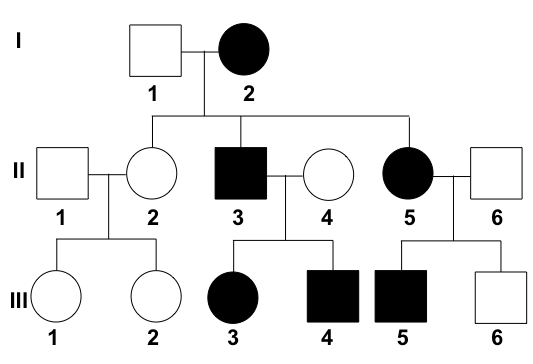
What is the interpretation of the given pedigree chart?
In the context of Indian regulations, what is the minimum number of Medical Termination of Pregnancy (MTP) cases a doctor must have performed to be eligible to perform an MTP?
Molecular genetic testing is used to detect all of the following except?
In case of professional misconduct, patient records on demand should be provided within?
India is a country with different cultures and diverse languages. Which steps should a physician take to address the patient for better outcomes? 1. Insist on good communication 2. Insist on communication only via an interpreter 3. Treat them regardless of their cultural perceptions 4. The physician should consider the patient's religion and cultural perception Select the correct combination:
What is the primary health concern addressed by the Rashtriya Bal Swasthya Karyakram (RBSK)?
Testing of HLA-B' 5701 is recommended prior to initiation of which antiretroviral agent?
Which HLA gene is associated with abacavir hypersensitivity?
Explanation: ***RBC*** - **Mature red blood cells** lack a nucleus and therefore do not contain **DNA**. - DNA fingerprinting relies on analyzing an individual's unique DNA sequence, which is not present in RBCs. *Saliva* - Saliva contains **epithelial cells** from the mouth, which have intact nuclei and thus sufficient DNA for analysis [2]. - It is a common and non-invasive source of DNA for forensic and genetic testing [2]. *WBC* - **White blood cells** (leukocytes) are nucleated cells that contain a full complement of DNA [2]. - They are an excellent source of DNA for genetic analysis, including DNA fingerprinting. *Spermatozoa* - **Sperm cells** are haploid and contain a nucleus with DNA, making them suitable for DNA fingerprinting [1]. - They are frequently used in forensic cases, particularly in sexual assault investigations [1].
Explanation: ***Adenosine deaminase deficiency*** - **Adenosine deaminase deficiency** (ADA deficiency) is an **autosomal recessive** metabolic disorder causing severe immunodeficiency, primarily affecting gene function rather than drug response. - While it can be treated with enzyme replacement therapies or gene therapy, it is not primarily characterized by an altered response to standard therapeutic drugs. *Coumarin insensitivity* - **Coumarin insensitivity** refers to an individual's reduced response to **warfarin (a coumarin derivative)**, requiring higher doses to achieve effective anticoagulation. - This is a well-documented **pharmacogenetic condition**, often linked to variations in genes like *CYP2C9* and *VKORC1*. *G6PD deficiency* - **Glucose-6-phosphate dehydrogenase (G6PD) deficiency** is an X-linked genetic disorder that can lead to **hemolytic anemia** upon exposure to certain drugs (e.g., antimalarials, sulfonamides, aspirin) and fava beans [1]. - It is a classic example of a **pharmacogenetic condition** where genetic variations dictate drug-induced adverse reactions [1]. *Malignant hyperthermia* - **Malignant hyperthermia** is a life-threatening, inherited disorder triggered by certain **inhalation anesthetics** (e.g., halothane, isoflurane) and the **depolarizing muscle relaxant succinylcholine**. - This condition is caused by mutations in genes involved in calcium regulation in muscle cells (e.g., *RYR1*) and is a critical **pharmacogenetic response**.
Explanation: ***Autosomal dominant*** - The trait appears in **every generation**, indicated by affected individuals in the first, second, and third generations [1]. - Both males and females are affected relatively equally, and affected individuals transmit the trait to approximately half of their offspring, consistent with **vertical transmission** [1]. - **Male-to-male transmission** is present, which definitively rules out X-linked inheritance patterns [1]. *Incomplete penetrance* - This pattern would typically show some individuals who carry the disease-causing genotype but **do not express the phenotype** (unaffected). - In this pedigree, all individuals who are expected to express the trait based on the clear dominant pattern are indeed affected. *Autosomal recessive* - This mode of inheritance would typically show **skipped generations**, meaning affected individuals would often have unaffected parents who are carriers [1]. - In this chart, every affected individual has at least one affected parent, ruling out an autosomal recessive pattern [1]. X-linked dominant - In X-linked dominant inheritance, **no male-to-male transmission** would be observed, as fathers pass their X chromosome only to daughters. - The presence of affected males transmitting the trait to male offspring rules out this inheritance pattern. **References:** [1] Kumar V, Abbas AK, et al.. Robbins and Cotran Pathologic Basis of Disease. 9th ed. Genetic Disorders, pp. 148-151.
Explanation: ***25*** - As per the **MTP Act of India (1971)**, a registered medical practitioner needs to have assisted in or performed a minimum of **25 medical termination of pregnancies** in an approved training center to be certified to perform MTPs independently. - This regulation ensures a certain level of practical experience and competence before a doctor can perform this procedure. *10* - This number is **insufficient** according to Indian MTP regulations for a doctor to be eligible to perform MTPs independently. - The required practical experience is set higher to ensure adequate skill and safety for the procedure. *15* - This number also **falls short** of the minimum requirement stipulated by the Indian MTP Act. - The legislative framework emphasizes a more extensive practical exposure for practitioners. *35* - While performing 35 MTPs would certainly meet the experience requirement, it is **not the minimum specified** by the Indian MTP regulations. - The law requires a lower threshold of practical experience, which is 25 cases.
Explanation: ***Translocation*** - **Translocations** are chromosomal rearrangements that were historically detected primarily by **cytogenetic methods** (karyotyping, conventional FISH), rather than by traditional molecular genetic testing methods focused on DNA sequencing [3]. - While modern molecular techniques like **RT-PCR for fusion transcripts** (e.g., BCR-ABL), **NGS-based fusion detection**, and **targeted breakpoint sequencing** can now detect translocations, the classic distinction is that translocations involve large-scale structural chromosomal changes better visualized by cytogenetics [2], [3]. - In the traditional classification, molecular genetic testing referred primarily to **sequence-based methods** (PCR, Sanger sequencing) that detect smaller-scale DNA changes rather than gross chromosomal rearrangements. *Deletion* - **Deletions** are readily detected by molecular genetic testing using PCR, Sanger sequencing, MLPA (Multiplex Ligation-dependent Probe Amplification), and NGS [5]. - These techniques identify missing DNA sequences by analyzing changes in fragment size, read depth, or absence of expected amplification products [2], [5]. *Amplification* - **Amplification** (increased gene copy number) is detected by molecular methods including **quantitative PCR (qPCR)**, **digital PCR**, and **NGS-based copy number analysis** [4]. - These techniques quantify gene copy numbers to identify amplifications like HER2 amplification in breast cancer. *Point mutation* - **Point mutations** are the primary target of classic molecular genetic testing [1]. - Detected by **Sanger sequencing**, **allele-specific PCR**, **NGS panels**, and other sequence-based methods that identify single nucleotide changes in DNA [1], [2]. **References:** [1] Kumar V, Abbas AK, et al.. Robbins and Cotran Pathologic Basis of Disease. 9th ed. Genetic Disorders, p. 185. [2] Kumar V, Abbas AK, et al.. Robbins and Cotran Pathologic Basis of Disease. 9th ed. Genetic Disorders, pp. 185-186. [3] Kumar V, Abbas AK, et al.. Robbins and Cotran Pathologic Basis of Disease. 9th ed. Neoplasia, pp. 342-343. [4] Kumar V, Abbas AK, et al.. Robbins and Cotran Pathologic Basis of Disease. 9th ed. Neoplasia, p. 344. [5] Kumar V, Abbas AK, et al.. Robbins and Cotran Pathologic Basis of Disease. 9th ed. Genetic Disorders, pp. 183-184.
Explanation: ***72 hours*** - In cases of professional misconduct investigations, medical records are generally required to be produced within **72 hours** of formal demand. - This timeframe allows for prompt review by regulatory bodies while providing adequate time for the practitioner to gather the necessary documentation. *36 hours* - This timeframe is typically too short for the comprehensive retrieval and organization of patient records, especially in cases where the records might be extensive or stored off-site. - There are no standard professional guidelines that mandate such a short period for record production in misconduct cases. *24 hours* - Producing patient records within **24 hours** is usually only feasible in emergency situations or for very limited, specific documents. - This is an impractically short period for compliance during investigations of professional misconduct, which often involve a thorough review of extensive records. *7 days* - While seemingly reasonable, a period of **7 days** might be considered too long when an investigation into professional misconduct requires urgent access to records. - Prompt access to patient records is crucial for swift and effective resolution of such sensitive cases, making 72 hours a more appropriate balance.
Explanation: ***1,4*** - **Good communication** is paramount in healthcare, especially in a diverse country like India, to ensure **patient understanding**, **adherence** to treatment plans, and overall patient satisfaction. - Considering a patient's **religion and cultural perceptions** allows the physician to tailor treatment and communication in a sensitive and **respectful manner**, fostering trust and better **health outcomes**. *1,2* - While good communication (1) is vital, **insisting solely on an interpreter** (2) may not always be feasible or necessary, particularly if the physician and patient share a common language or if the patient prefers direct communication. This can also disrupt the flow of rapport building. - **Over-reliance on interpreters** can sometimes lead to misinterpretations or loss of non-verbal cues if the interpreter is not trained in medical interpretation. *2,3* - **Insisting only on an interpreter** (2) can be restrictive and may compromise direct patient-physician rapport, as discussed above. - **Treating patients regardless of their cultural perceptions** (3) is an ethnocentric approach that can lead to mistrust, non-adherence, and ultimately **poor health outcomes** as it disregards the patient's beliefs and values regarding health and illness. *3,4* - **Treating patients regardless of their cultural perceptions** (3) can result in a lack of understanding and non-adherence if the treatment conflicts with the patient's deeply held beliefs. - While considering religion and cultural perception (4) is crucial, this option includes an incorrect approach (3) that can undermine patient care.
Explanation: **Comprehensive healthcare for children from birth to 18 years** - The **Rashtriya Bal Swasthya Karyakram (RBSK)** is a national program explicitly designed to provide comprehensive health screening and early intervention for 0-18 year-olds - Its focus is on detecting and managing the **4 D's**: Defects at birth, Deficiencies, Diseases, and Developmental delays - The program provides regular health check-ups, early detection of health conditions, referral for treatment, and promotes healthy development across this critical age group *Adult chronic diseases* - While public health initiatives address adult chronic diseases, they are not the primary focus of the **RBSK** program, which targets a younger demographic - Programs like the **National Programme for Prevention and Control of Cancer, Diabetes, Cardiovascular Diseases & Stroke (NPCDCS)** are more aligned with adult chronic disease management *Elderly health* - **RBSK** is specifically focused on the health of children and adolescents, not the elderly population - **National Programme for Healthcare of the Elderly (NPHCE)** is a dedicated initiative for elderly health *Non-communicable diseases in the youth* - While **RBSK** does address some non-communicable diseases (NCDs) through early detection and management, its scope is much broader, encompassing all 4 D's - RBSK aims for **holistic child health** rather than exclusively targeting NCDs in youth, which is a subset of its overall mandate
Explanation: The correct answer is **Abacavir (Option D)**. **1. Why Abacavir is Correct:** Abacavir is a Nucleoside Reverse Transcriptase Inhibitor (NRTI) associated with a severe, potentially life-threatening **Hypersensitivity Reaction (HSR)** [1]. This reaction is strongly linked to the presence of the **HLA-B*57:01** allele. In individuals carrying this allele, abacavir binds to the HLA-B*57:01 protein, altering the shape of the antigen-binding cleft [1]. This causes the immune system to recognize self-peptides as foreign, triggering a massive T-cell response. Screening for this allele is now a standard of care; if a patient tests positive, abacavir is strictly contraindicated [1]. **2. Why Other Options are Incorrect:** * **Atazanavir (A):** A Protease Inhibitor (PI) known for causing unconjugated hyperbilirubinemia (jaundice) by inhibiting the UGT1A1 enzyme, but it is not linked to HLA-B*57:01 [1]. * **Nelfinavir (B):** An older PI primarily associated with gastrointestinal side effects (diarrhea). No specific HLA screening is required. * **Raltegravir (C):** An Integrase Strand Transfer Inhibitor (INSTI). While it can rarely cause Stevens-Johnson Syndrome (SJS), there is no routine pharmacogenetic screening recommended prior to its use. **3. High-Yield Clinical Pearls for NEET-PG:** * **Abacavir HSR Symptoms:** Fever, rash, GI distress, and respiratory symptoms. **Re-challenge** after a suspected reaction is **fatal**. * **Other High-Yield HLA Associations:** * **HLA-B*15:02:** Carbamazepine-induced SJS/TEN (specifically in Asian populations). * **HLA-B*58:01:** Allopurinol-induced severe cutaneous adverse reactions (SCAR). * **Mnemonic:** "A-B-C" — **A**bacavir **B**inds **C**left of HLA-B*57:01.
Explanation: **Explanation:** **Correct Option: D (HLA-B*57:01)** Abacavir is a Nucleoside Reverse Transcriptase Inhibitor (NRTI) used in HIV treatment. Approximately 5–8% of patients develop a potentially fatal **Abacavir Hypersensitivity Syndrome (AHS)**, characterized by fever, rash, and gastrointestinal symptoms. This reaction is strongly associated with the **HLA-B*57:01** allele. The drug binds to the antigen-binding cleft of this specific HLA molecule, altering the repertoire of self-peptides presented to T-cells, which triggers an autoimmune-like systemic inflammatory response. Screening for this allele is mandatory before initiating abacavir to prevent AHS. **Incorrect Options:** * **A (B5):** This is a broad serotype that includes B51 and B52 but is not specifically linked to abacavir. * **B (B51):** This allele is the classic genetic marker associated with **Behçet’s Disease** (characterized by oral/genital ulcers and uveitis). * **C (DQ2):** This is an HLA Class II allele strongly associated with **Celiac Disease** (along with HLA-DQ8). **High-Yield Clinical Pearls for NEET-PG:** 1. **Mandatory Screening:** If a patient tests positive for HLA-B*57:01, Abacavir is strictly **contraindicated** and should be listed as an allergy in their records. 2. **Re-challenge Warning:** Never re-challenge a patient with abacavir if AHS is suspected; it can lead to rapid, fatal hypotension and multi-organ failure. 3. **Other HLA-Drug Associations:** * **HLA-B*15:02:** Carbamazepine-induced Stevens-Johnson Syndrome (SJS) (especially in Asians). * **HLA-B*58:01:** Allopurinol-induced severe cutaneous adverse reactions (SCAR).
Get full access to all questions, explanations, and performance tracking.
Start For Free