Which of the following is a G protein coupled receptor?
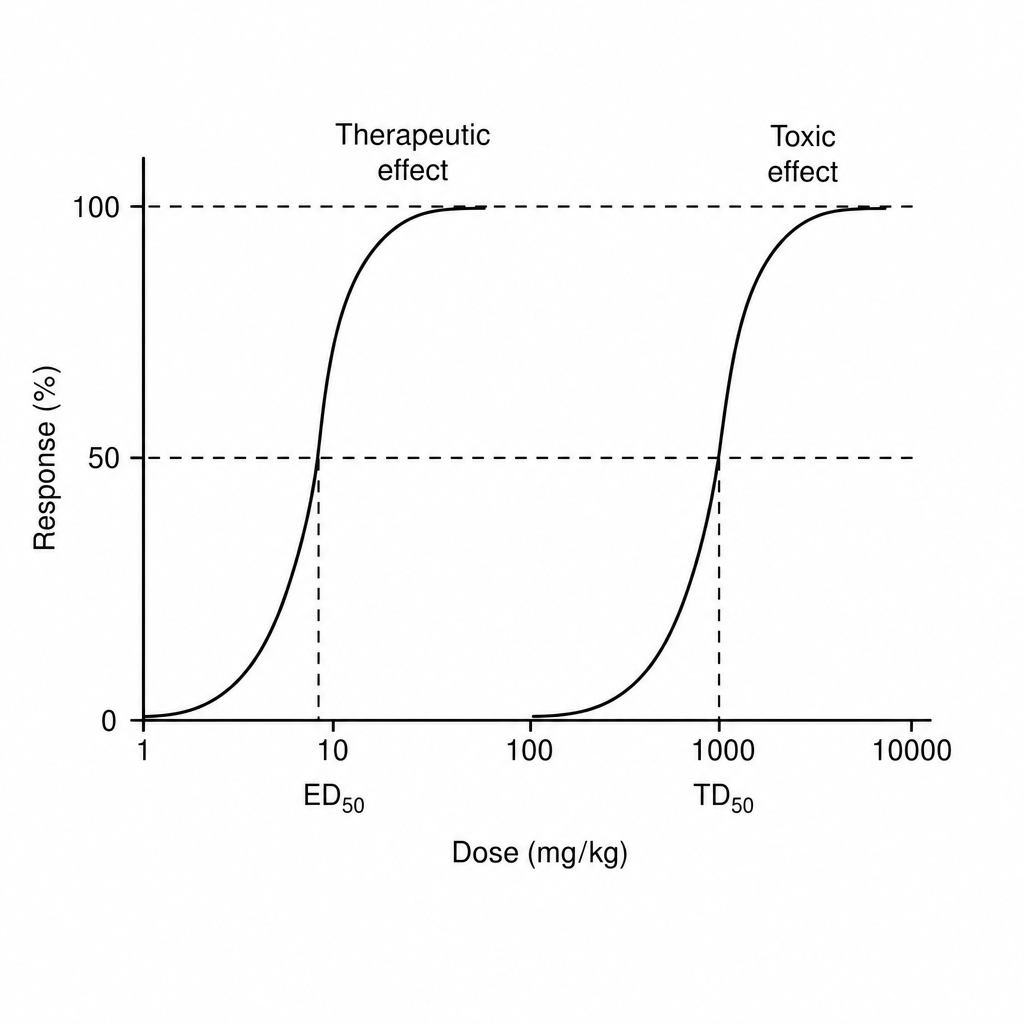
The therapeutic index of a drug is defined as the ratio between the toxic dose and the effective dose.
Variation in sensitivity of response to different doses of a drug in different individuals is obtained from?
Which of the following best demonstrates the variability in drug responsiveness among individuals?
With which of the following receptors does theophylline have an antagonistic interaction?
Which one of the following is true for competitive antagonism?
Which of the following is false about drugs given in urinary incontinence
When two different chemicals act on two different receptors and their responses are opposite to each other on the same cell, this phenomenon is called?
The graph below shows dose-response curves for three drugs A, B, and C. Which of the following drugs has the highest potency?
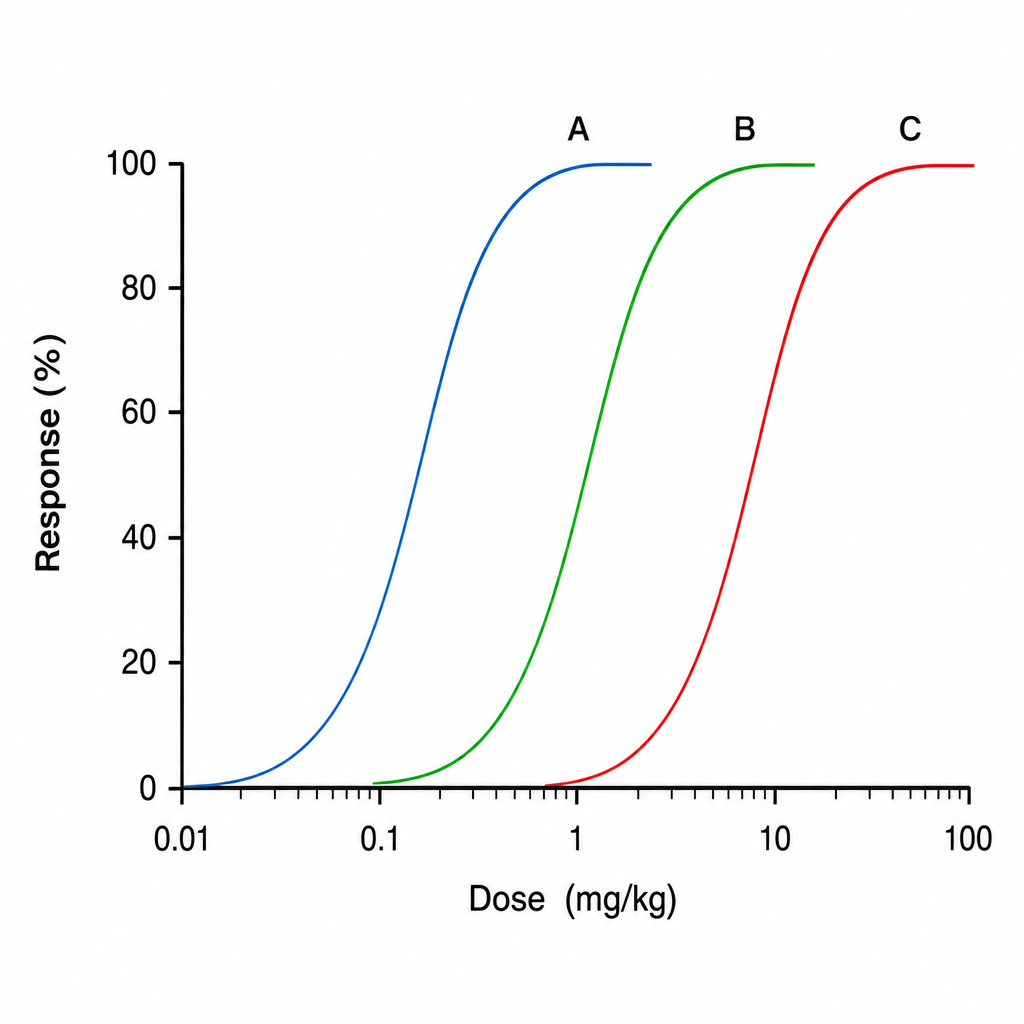
Which of the following statement is correct regarding the given DRC? (AllMS Nov 2016)

Explanation: ***M2 muscarinic receptor***- The **M2 muscarinic receptor** is a classic example of a **G protein-coupled receptor (GPCR)** [1]. When a ligand binds to a G-protein-coupled receptor, it triggers a mechanism where GDP is exchanged for GTP, causing the G-protein's alpha subunit to separate and initiate signaling pathways [1]. These heterotrimeric G-proteins couple cell surface receptors to catalytic units that form second messengers or directly to ion channels [1]. GPCRs are important regulators of nerve activity in the CNS and are receptors for neurotransmitters of the peripheral autonomic nervous system, with acetylcholine (ACh) being a ligand that regulates functions of glands and smooth muscle [2]. The **M2 muscarinic receptor** specifically activates an **inhibitory G protein (G_i)**, leading to a decrease in **cAMP** and opening of **potassium channels**. The effects of metabotropic receptors, like GPCRs, can last tens of seconds to minutes, contrasting with the brief effects of ionotropic receptors [4].*NMDA receptor*- The **NMDA receptor** is a **ligand-gated ion channel** that allows the influx of calcium and sodium ions [3]. It does not couple to G proteins, but directly mediates ion flow upon activation by **glutamate** and **glycine**. Ligand-gated ion channels open a central transmembrane ion channel when a neurotransmitter binds to sites on its extracellular domain [3].*Steroid*- **Steroid hormones** primarily act on **intracellular receptors** that, once activated, translocate to the nucleus to regulate gene expression. They are not cell surface receptors and do not utilize G protein signaling.*Insulin receptors*- **Insulin receptors** are **receptor tyrosine kinases** that, upon binding insulin, undergo autophosphorylation and activate intracellular signaling pathways. They signal through a cascade of protein phosphorylations, not through G proteins.
Explanation: ***Ratio of toxic dose to effective dose***- The **therapeutic index (TI)** is quantitatively defined as the ratio of the toxic dose (TD50 or LD50) to the effective dose (ED50) [1, 2].- This ratio provides a measure of **drug safety**, indicating the range between the therapeutic and toxic concentrations [1, 3].*Margin of safety*- While related to safety, the **margin of safety** is a different concept, often calculated as (TD1 - ED99) / ED99, focusing on the overlap between very few people experiencing toxicity and almost everyone receiving benefit [2].- The therapeutic index is a broader, simpler ratio that doesn't explicitly guarantee overlap safety but indicates overall drug risk.*Efficacy of the drug*- **Efficacy** refers to the maximal effect a drug can produce regardless of the dose, and it is independent of the therapeutic index [2].- A drug can have high efficacy but a narrow therapeutic index, meaning it is very effective but also very toxic at doses slightly above the therapeutic range.*Drug potency*- **Potency** is the amount of drug needed to produce a given effect (e.g., ED50), reflecting its affinity for receptors and efficiency of action [2].- It is distinct from the therapeutic index, which assesses the separation between desired and undesired effects, not the concentration required to achieve a therapeutic effect.
Explanation: ***Dose-response relationship*** - The **dose-response relationship** (particularly the **graded dose-response curve**) describes how the magnitude of a drug's effect changes with different doses. - When plotted for different individuals or populations, these curves reveal **variation in sensitivity** through differences in potency (horizontal shift) and efficacy (maximum response). - This relationship helps characterize inter-individual variability in drug response and is the fundamental concept for understanding differential sensitivity. *Therapeutic index* - The **therapeutic index** is a measure of drug safety, representing the ratio between the toxic dose and the effective dose (TD50/ED50 or LD50/ED50). - It does not directly explain the variation in sensitivity to different doses among individuals, but rather provides information about the drug's overall safety margin. *Bioavailability* - **Bioavailability** refers to the fraction of an administered drug that reaches the systemic circulation unchanged. - While it influences the drug concentration at the site of action, it doesn't directly measure the variability in physiological response to that concentration among individuals. *Phase 1 clinical trials* - **Phase 1 clinical trials** are the first stage of testing a new drug in humans, primarily focusing on safety, dosage range, and pharmacokinetics in a small group of healthy volunteers. - While variability in response may be observed during these trials, they are not the *pharmacological concept* that describes this variation; rather, dose-response relationships are used to interpret findings from these trials.
Explanation: ***Quantal Dose Response Curve*** - A **quantal dose-response curve** plots the percentage of individuals exhibiting a discrete, all-or-none effect against the log dose of a drug. - This curve directly illustrates the **variability in drug responsiveness** within a population by showing the range of doses required to produce a specific effect in different individuals. *Efficacy* - **Efficacy** refers to the maximum effect a drug can produce, regardless of the dose. - While efficacy is an important pharmacological parameter, it describes the drug's overall therapeutic potential, not the **individual variability** in response. *Potency* - **Potency** is a measure of the amount of drug needed to produce an effect of given intensity. - It relates to the absolute dose required for a particular effect but does not directly demonstrate the **inter-individual differences** in biological response. *Graded Dose Response Curve* - A **graded dose-response curve** depicts the relationship between the dose of a drug and the **magnitude of the effect** in a **single biological unit** (e.g., an individual, a tissue, or a cell). - This curve reflects the relationship between drug concentration and effect intensity, but not the **variability in response among different individuals** in a population.
Explanation: ***Adenosine receptors*** - **Theophylline** acts as a **non-selective competitive antagonist** at **adenosine receptors** (A1, A2A, and A2B). - This antagonism contributes to its **bronchodilator effects** by blocking adenosine-induced bronchoconstriction and to its **stimulant effects** by enhancing neurotransmitter release. *Histamine receptors* - Theophylline does not primarily interact with **histamine receptors**. Its effects are mediated through different mechanisms. - While histamine plays a role in allergic reactions and airway smooth muscle contraction, theophylline's direct action is not on these receptors. *Imidazoline receptors* - Theophylline does not have a significant antagonistic interaction with **imidazoline receptors**. - These receptors are primarily involved in blood pressure regulation and sympathetic outflow, and are not a key target for theophylline's therapeutic effects. *Bradykinin receptors* - Theophylline does not directly antagonize **bradykinin receptors**. - Bradykinin is a potent vasodilator and inflammatory mediator, but its receptors are not the primary site of action for theophylline.
Explanation: ***Agonist and competitive antagonist bind to the same receptor*** - In **competitive antagonism**, both the **agonist** and the **antagonist** compete for the **same binding site** on the receptor. - This competition means that the effect of the antagonist can be **overcome by increasing the concentration of the agonist** (reversible antagonism). - The binding is **reversible** and depends on the **relative concentrations** and affinities of both molecules. *Agonist cannot displace an antagonist from the receptor* - This is **incorrect** for competitive antagonism; a high concentration of the **agonist** can indeed displace the antagonist from the receptor binding site. - This **reversibility** is a defining characteristic of competitive antagonism. *Antagonism cannot be completely reversed by an increased dose of an agonist* - This is **false** for competitive antagonism; a sufficiently high dose of **agonist** can completely overcome the effect of a competitive antagonist. - This describes **non-competitive** or **irreversible antagonism**, not competitive antagonism. *Maximum response (Emax) is reduced in the presence of a competitive antagonist* - This is **incorrect** for competitive antagonism; the **Emax remains unchanged**. - In competitive antagonism, only the **EC50 increases** (curve shifts right), but the maximum response is still achievable with sufficient agonist. - **Reduced Emax** is characteristic of **non-competitive antagonism**.
Explanation: ***Tolterodine can be given as transdermal patch*** - This statement is **false**. While tolterodine is available in oral forms, such as extended-release capsules, it is **not available as a transdermal patch**. - **Oxybutynin** is the muscarinic antagonist commonly available and administered as a transdermal patch for urinary incontinence. *Oxybutynin, Tolterodine, and Solifenacin are muscarinic receptor blockers used to decrease detrusor muscle contraction* - This statement is **true**; these drugs are indeed anticholinergics that block muscarinic receptors (primarily M3) on the detrusor muscle. - By blocking these receptors, they reduce the involuntary contractions of the detrusor, thereby alleviating symptoms of **overactive bladder** and urgency incontinence. *Darifenacin is a selective M3 antagonist* - This statement is **true**; **darifenacin** is known for its high selectivity for the **M3 muscarinic receptor**. - This selectivity makes it effective in treating **overactive bladder** with potentially fewer side effects in other organ systems compared to less selective anticholinergics. *Trospium is a quaternary amine with no CNS side effects* - This statement is **true**; **trospium** is a **quaternary amine**, which means it has a permanent positive charge. - Due to its charge, it has **poor lipid solubility** and does not readily cross the **blood-brain barrier**, resulting in a significantly lower incidence of central nervous system (CNS) side effects compared to tertiary amines.
Explanation: ***Physiological antagonism*** - This occurs when two drugs act on **different receptors** to produce **opposite physiological effects** within the same system or cell, effectively canceling each other out [1]. - A classic example is the opposing actions of **histamine** (causing bronchoconstriction) and **adrenaline** (causing bronchodilation) on the bronchi [1]. *Chemical antagonism* - This involves a direct **chemical interaction** between two drugs that results in the **inactivation of one or both** of them. - An example is the binding of **chelating agents** to heavy metals, forming an inert complex. *Reversible antagonism* - This describes antagonism where the antagonist binds to the receptor and can be **displaced by a higher concentration of the agonist**. - It does not specifically describe antagonists acting on different receptors or producing opposing physiological effects. *Competitive antagonism* - This occurs when an antagonist directly **competes with an agonist for the same binding site** on a receptor [1]. - The antagonist, while not producing a response itself, prevents the agonist from binding and activating the receptor.
Explanation: ***Drug A*** - Potency is inversely related to the **concentration required to produce an effect (EC50)**. A lower EC50 indicates higher potency. - Drug A achieves its half-maximal effect (indicated by the dashed line) at approximately **0.01 concentration**, which is the lowest among all three drugs. *Drug B* - Drug B reaches its half-maximal effect at a concentration of approximately **1**, which is significantly higher than Drug A. - This indicates that a larger dose of Drug B is needed to achieve the same effect as Drug A, making it less potent than A. *Drug C* - Drug C requires the highest concentration, approximately **100**, to achieve its half-maximal effect. - This signifies that Drug C is the least potent among the three drugs, as it demands a much larger dose for an equivalent effect compared to A and B. *Both Drug A & B* - While Drug A is highly potent, Drug B is less potent as it requires a higher concentration to elicit its effect. - Therefore, it is incorrect to state that both drugs A and B have the highest potency.
Explanation: ***A and B are full agonists*** - Both Drug A and Drug B reach the **maximum biological effect**, indicated as 100 on the y-axis, meaning they are capable of producing the full response. - A full agonist is a substance that binds to a receptor and produces the **maximum possible biological response**. *C is non-competitive antagonist* - Drug C *does* produce a biological effect, albeit a lower one, making it a **partial agonist**, not an antagonist. - A non-competitive antagonist would **reduce the maximum effect** of the agonist and shift the curve downwards, which is not what is observed here for C. *B is more potent than A* - Drug A achieves 50% of its maximal effect at a **lower concentration** than Drug B (i.e., further to the left on the x-axis). - Therefore, Drug A is **more potent** than Drug B, as potency is inversely related to the concentration required for a given effect. *A is more efficacious than B* - Both Drug A and Drug B reach the **same maximum biological effect** (100 on the y-axis), indicating they have equal efficacy. - Efficacy refers to the **maximum effect** a drug can produce, regardless of the dose.
Get full access to all questions, explanations, and performance tracking.
Start For Free