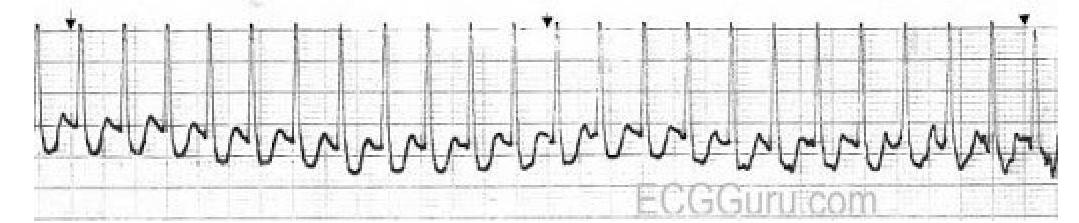
Which one of the following was traditionally considered the drug of choice for ventricular tachycardia in myocardial infarction?
Patient with pulmonary fibrosis. Which antiarrhythmic drug is contraindicated?
Which of these is least effective as first-line treatment for dangerous hyperkalemia?
Which of the following rhythms associated with cardiac arrest is considered shockable?
Which drug is used as an adjunct to epinephrine in refractory ventricular fibrillation/ventricular tachycardia during cardiac arrest?
A patient is pulseless with the following rhythm shown in the ECG. What is the next best step in management?
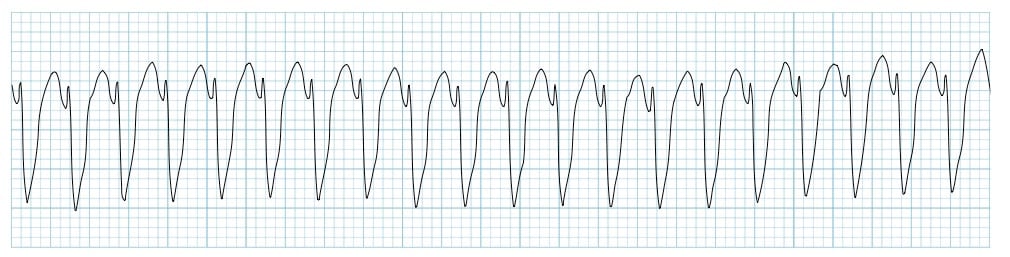
As per the recent guidelines of resuscitation, what should be done if asystole is not responding to two consecutive doses of epinephrine?
Which local anesthetic is considered the most cardiotoxic?
In ACLS, which antiarrhythmic drug can be given following ventricular fibrillation after cardiac arrest other than epinephrine?
Identify the diagnosis based on the provided ECG image.

Explanation: ***Xylocaine/Lidocaine*** - **Lidocaine (Xylocaine)** is a **Class IB antiarrhythmic drug** [2] that was historically the drug of choice for suppressing ventricular arrhythmias, including ventricular tachycardia, in the setting of **myocardial ischemia and infarction** [1]. - It works by **blocking sodium channels** and shortening the action potential duration, thereby reducing excitability and automaticity in ischemic myocardial tissue [1]. - **Current guidelines**: Lidocaine is now considered a **second-line agent**, with **amiodarone** being the preferred first-line antiarrhythmic for hemodynamically stable VT in acute MI, and electrical cardioversion for unstable VT. *Digitalis* - **Digitalis** (e.g., digoxin) is primarily used for **supraventricular arrhythmias** like atrial fibrillation or flutter, and for heart failure due to its positive inotropic effect. - It can **aggravate ventricular arrhythmias** in the setting of acute myocardial infarction and is generally contraindicated for ventricular tachycardia. *Quinidine* - **Quinidine** is a **Class IA antiarrhythmic drug** that prolongs the action potential and is effective against a variety of arrhythmias. - However, it can cause **hypotension** and has a **proarrhythmic effect**, increasing the risk of Torsades de Pointes, making it less favorable as a first-line agent, especially in acute MI. *Disopyramide* - **Disopyramide** is also a **Class IA antiarrhythmic drug** with similar mechanisms to quinidine. - It has significant **negative inotropic effects** and can worsen heart failure [3], which is a common complication in acute myocardial infarction, making it less suitable.
Explanation: Amiodarone - **Amiodarone** is contraindicated in patients with pulmonary fibrosis due to its well-known and potentially severe pulmonary toxicity, which can exacerbate existing lung conditions or induce new ones like **interstitial lung disease**. Dose-related pulmonary toxicity is the most important adverse effect, and potentially fatal pulmonary fibrosis can be observed even at low doses [1]. - Its long half-life means that its toxic effects, including **pulmonary toxicity**, can persist for an extended period even after discontinuation [1], [2]. *Flecainide* - **Flecainide** is a Class IC antiarrhythmic drug primarily associated with cardiac side effects and is generally not contraindicated in patients with pulmonary fibrosis. - Its main risks include **proarrhythmia**, especially in patients with structural heart disease, but not pulmonary issues [3]. *IV ibutilide* - **IV ibutilide** is a Class III antiarrhythmic agent used for rapid conversion of atrial fibrillation/flutter and is not specifically contraindicated in pulmonary fibrosis. - Its primary concern is the risk of **QT prolongation** and **Torsades de Pointes**, rather than pulmonary complications. *Lidocaine* - **Lidocaine** is a Class IB antiarrhythmic typically used for ventricular arrhythmias, especially in the setting of acute myocardial infarction. It is not contraindicated in pulmonary fibrosis. - Its main side effects are **neurological (e.g., seizures, paresthesias)** at higher doses, not pulmonary complications.
Explanation: ***Intravenous sodium bicarbonate*** - While it can drive potassium into cells, its effect is often **delayed and unreliable** in acute, dangerous hyperkalemia, especially without concurrent acidosis. - Its efficacy is most pronounced when hyperkalemia is associated with **metabolic acidosis**, which is not always the primary driving factor of dangerous hyperkalemia. *Calcium chloride injection* - This is a **first-line treatment** for dangerous hyperkalemia, as it **stabilizes the cardiac membrane** by antagonizing the direct effects of potassium on myocardial excitability [1]. - It does not lower serum potassium levels but **protects the heart** from life-threatening arrhythmias, buying time for other therapies to reduce potassium [1]. *Beta-2 agonist (Salbutamol)* - **Beta-2 agonists** like salbutamol are effective in shifting potassium **intracellularly**, thereby lowering serum potassium levels. - This effect is mediated by stimulating the **Na+/K+-ATPase pump** on cell membranes. *Dialysis (Hemodialysis)* - **Hemodialysis** is the **most effective and rapid** method for removing excess potassium from the body, especially in cases of severe or refractory hyperkalemia. - It provides definitive treatment by directly **filtering potassium** from the blood, and is often considered when other measures fail or in patients with kidney failure.
Explanation: ***Ventricular fibrillation*** - **Ventricular fibrillation (VF)** is a chaotic, disorganized electrical activity in the ventricles, leading to ineffective myocardial contraction and cardiac arrest [1]. - Due to the presence of electrical activity that can be reset, **defibrillation** (an electrical shock) is the definitive treatment to restore a perfusing rhythm [1]. *Asystole* - **Asystole** is characterized by the complete absence of electrical and mechanical activity in the heart, appearing as a "flat line" on the ECG. - Since there is no electrical activity to reorganize, defibrillation is ineffective, and management focuses on **cardiopulmonary resuscitation (CPR)** and medications like epinephrine [2]. *Pulseless electrical activity* - **Pulseless electrical activity (PEA)** involves an organized electrical rhythm on the ECG but no palpable pulse, indicating inadequate cardiac mechanical activity. - Defibrillation is not indicated as there is a rhythmic electrical activity, and treatment focuses on identifying and correcting the underlying causes of **cardiac mechanical failure**. *Pulseless ventricular tachycardia* - While **pulseless ventricular tachycardia (VT)** is a malignant rhythm, the question asks for a rhythm that is *considered shockable* in the context of cardiac arrest. - In actual cardiac arrest algorithms, **pulseless VT** is treated similarly to **ventricular fibrillation** and is indeed shockable [1]. However, if multiple options are given and only one can be chosen, **VF** and **pulseless VT** are both shockable. Given the options, VF is explicitly and commonly cited as a primary shockable rhythm. * Correction: **Pulseless ventricular tachycardia** *is* a shockable rhythm and is treated with immediate defibrillation in cardiac arrest. The initial explanation incorrectly implies it's not. This response should be revised to state that both VF and pulseless VT are shockable. - Both **ventricular fibrillation (VF)** and **pulseless ventricular tachycardia (VT)** are considered shockable rhythms in cardiac arrest algorithms [1]. - Defibrillation is performed to depolarize the cardiac muscle cells simultaneously, allowing the natural pacemaker of the heart to resume control [1].
Explanation: ***Amiodarone infusion*** - **Amiodarone** is a **Class III antiarrhythmic** drug commonly used in advanced cardiac life support (ACLS) protocols for refractory **ventricular fibrillation (VF)** or **pulseless ventricular tachycardia (VT)** that persists despite defibrillation and epinephrine [1]. - It works by blocking potassium channels, prolonging repolarization and the refractory period, which helps to stabilize the electrical activity of the heart. *Atropine* - **Atropine** is an anticholinergic drug primarily used to treat **symptomatic bradycardia** by increasing heart rate. - It is not indicated for the treatment of **ventricular fibrillation** or **ventricular tachycardia** during cardiac arrest. *High dose vasopressin* - **Vasopressin** was previously included in some ACLS algorithms as an alternative to epinephrine for **vasoconstrictive effects**, but recent guidelines do not support its routine use in cardiac arrest. - While it can cause **vasoconstriction**, there is no evidence that high-dose vasopressin improves outcomes in refractory VF/VT over epinephrine. *Adenosine* - **Adenosine** is an antiarrhythmic drug used to treat **supraventricular tachycardias (SVTs)** by transiently blocking the AV node. - It is not effective for **ventricular fibrillation** or **ventricular tachycardia** and can even be harmful in these rhythms.
Explanation: ***Defibrillate and continue chest compression*** - This scenario describes a **pulseless ventricular tachycardia (pVT)**, which is a **shockable rhythm**. - Immediate defibrillation is crucial, followed by resuming **chest compressions** without delay, as per advanced cardiac life support (ACLS) guidelines. - The correct sequence is: shock → immediate CPR for 2 minutes → rhythm/pulse check. *Defibrillate and check pulse* - While defibrillation is the correct initial intervention for a shockable rhythm, checking the pulse immediately after is incorrect. - Chest compressions should be resumed immediately after a shock for 2 minutes before stopping to check a pulse. - Minimizing interruptions in chest compressions is critical for survival. *Check pulse and give synchronized DC* - Checking a pulse before any intervention wastes critical time in a pulseless patient with a shockable rhythm; immediate defibrillation is indicated. - Synchronized direct current (DC) cardioversion is used for unstable patients **with a pulse** (e.g., unstable ventricular tachycardia with a pulse), not for pulseless rhythms. *Give synchronized DC and continue chest compressions* - Synchronized DC cardioversion is inappropriate for a **pulseless rhythm**; unsynchronized defibrillation is required. - Synchronization requires an R wave to time the shock, which is not feasible in pulseless VT management. *Start chest compressions and give epinephrine* - While chest compressions are essential, the **immediate priority** for a shockable rhythm (pVT/VF) is **defibrillation**. - Epinephrine is given during CPR cycles (after the first shock), but defibrillation must come first for shockable rhythms. - This would be the approach for **non-shockable rhythms** (PEA/asystole), not pulseless VT.
Explanation: ***Continue high-quality CPR and consider advanced airway management.*** - For **asystole** that is unresponsive to initial epinephrine doses, maintaining **high-quality CPR** is the cornerstone of resuscitation efforts, ensuring vital organ perfusion. - **Advanced airway management** (e.g., endotracheal intubation) should be considered early to secure the airway and facilitate ventilation, optimizing oxygen delivery during CPR. *Administer another dose of epinephrine.* - While epinephrine is the primary drug for asystole, repeating doses beyond the initial recommended schedule without other interventions is not indicated if there is no response, as it may not improve outcomes. - The focus shifts to identifying and treating reversible causes while maintaining high-quality CPR, rather than escalating epinephrine frequency. *Administer vasopressin as a second-line drug.* - **Vasopressin** is no longer recommended in adult cardiac arrest resuscitation algorithms, including for asystole, according to current guidelines from organizations like the American Heart Association. - Its use has not been shown to improve survival to hospital discharge or neurological outcomes compared to epinephrine. *Defibrillation with 200J.* - **Defibrillation** is only indicated for shockable rhythms such as **ventricular fibrillation (VF)** or **pulseless ventricular tachycardia (pVT)**. - Asystole is a **non-shockable rhythm**, meaning there is no electrical activity to defibrillate, and administering a shock is ineffective and can be harmful.
Explanation: ***Bupivacaine*** - **Bupivacaine** is an amide-type local anesthetic associated with significant **cardiotoxicity** due to its high lipid solubility and slow dissociation from cardiac sodium channels. - This can lead to severe **arrhythmias** and myocardial depression, making it particularly dangerous in systemic overdose. *Procaine* - **Procaine** is an ester-type local anesthetic with a relatively low potential for cardiotoxicity. - Its rapid metabolism by **plasma pseudocholinesterase** limits systemic exposure and reduces the risk of cardiac effects. *Prilocaine* - **Prilocaine** is an amide-type local anesthetic that is generally less cardiotoxic than bupivacaine. - Its primary concern is the potential to cause **methemoglobinemia** at higher doses, a side effect not directly related to cardiotoxicity. *Ropivacaine* - **Ropivacaine** is an amide-type local anesthetic developed as an alternative to bupivacaine with a reduced cardiotoxicity profile. - It exhibits a more favorable **therapeutic index** for cardiac effects due to its chemical structure and faster dissociation from cardiac sodium channels.
Explanation: ***Amiodarone*** - **Amiodarone** is a Class III antiarrhythmic agent recommended in ACLS for **refractory ventricular fibrillation (VF)** or pulseless ventricular tachycardia (pVT) after initial defibrillation and epinephrine. - It works by blocking potassium channels, prolonging repolarization, and increasing the **refractory period** in the heart. *Dopamine* - **Dopamine** is a **vasopressor** used to improve **hemodynamics** in patients with symptomatic hypotension, not primarily as an antiarrhythmic for VF. - Its effects include increasing heart rate, myocardial contractility, and blood pressure. *Adenosine* - **Adenosine** is a drug of choice for **supraventricular tachycardia (SVT)** to interrupt reentry pathways in the AV node. - It is not indicated for ventricular fibrillation, as it would be ineffective in this rhythm. *Atropine* - **Atropine** is an **anticholinergic agent** used to treat **symptomatic bradycardia** by increasing heart rate. - It has no role in the management of ventricular fibrillation.
Explanation: ***PSVT*** - The ECG shows a **narrow complex tachycardia** with a regular rhythm and a high heart rate, characteristic of **paroxysmal supraventricular tachycardia (PSVT)**. - P waves are often **buried within the QRS complex** or T waves, or may be retrograde, which can be seen as small deflections or changes in the baseline in some leads. *VT* - **Ventricular tachycardia** is characterized by a **wide QRS complex** (>0.12 seconds), which is not observed in this ECG. - While VT can be regular, the primary distinguishing feature is the QRS duration. *AT* - **Atrial tachycardia (AT)** is another form of supraventricular tachycardia, but it typically shows **distinct P waves** with an abnormal morphology, often separate from the T wave, which are not clearly visible or consistently distinct in this tracing. - While it can present with narrow complex tachycardia, the mechanism differs from re-entrant PSVT. *Ventricular fibrillation* - **Ventricular fibrillation** is characterized by **chaotic, irregular electrical activity** with no distinguishable P waves, QRS complexes, or T waves, representing disorganized ventricular depolarization. - The ECG in the image shows a consistent, regular rhythm with identifiable, albeit narrow, QRS complexes.
Get full access to all questions, explanations, and performance tracking.
Start For Free