Antidote for benzodiazepine poisoning: FMGE 10, 13; NEET 14
Which anxiolytic acts through 5-HT1A receptor partial agonism without exhibiting significant anticonvulsant or muscle relaxant properties?
A patient on SSRI sertraline was also prescribed amitriptyline and subsequently developed serotonin toxicity. What is the likely treatment for serotonin toxicity?
What is the primary therapeutic use of 5-HT1B/1D agonists?
What is the drug of choice for rapid relief of an acute panic attack?
Match the following: Column A: a. Beta 1 b. Beta 2 c. Beta 3 Column B: 1. Mirabegron 2. Betaxolol 3. Salbutamol
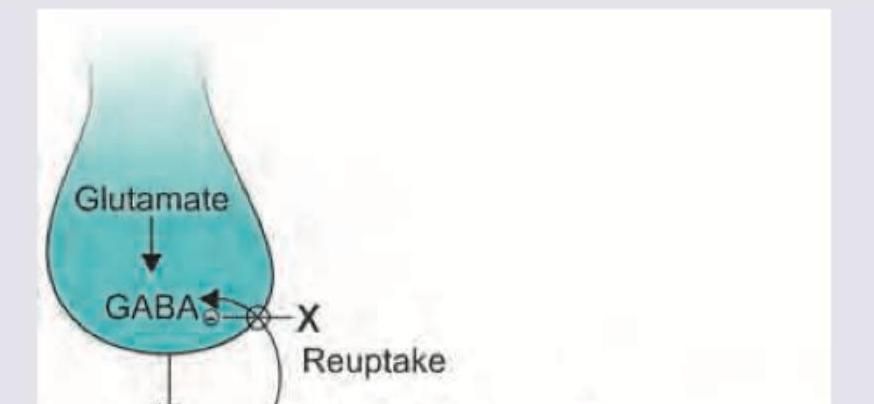
Which anti-epileptic drug marked X will act at the site shown?
Atropine is not an antidote in:
Which of the following is the most characteristic sexual side effect of SSRIs?
Which of the following antidepressants is least likely to have sexual side effects?
Explanation: ***Flumazenil*** - **Flumazenil** is a competitive **benzodiazepine receptor antagonist** that can reverse the sedative and other central nervous system effects of benzodiazepines. - It works by blocking benzodiazepines from binding to their receptor sites on the **GABA-A receptor complex**. *Naloxone* - **Naloxone** is a competitive **opioid receptor antagonist** used to reverse opioid overdose. - It has no effect on **benzodiazepine toxicity** as it targets different receptor systems. *Atropine* - **Atropine** is an **anticholinergic drug** used to reverse the effects of **cholinergic poisoning** (e.g., from organophosphates, carbamates) or symptomatic bradycardia. - It works on muscarinic acetylcholine receptors and is not involved in benzodiazepine metabolism or action. *N-acetyl-cysteine* - **N-acetyl-cysteine (NAC)** is primarily used as an antidote for **acetaminophen (paracetamol) poisoning**, where it replenishes glutathione. - It is also used in some cases of mucolysis but has no role in reversing benzodiazepine toxicity.
Explanation: ***Buspirone*** - **Buspirone** is a unique anxiolytic that primarily acts as a **partial agonist at 5-HT1A receptors**. - Unlike benzodiazepines, it lacks significant **anticonvulsant**, **muscle relaxant**, or **sedative-hypnotic properties** and does not lead to physical dependence or withdrawal. *Diazepam* - **Diazepam** is a **benzodiazepine** that acts by enhancing the effect of **GABA** at GABA-A receptors, leading to significant anxiolytic, sedative, muscle relaxant, and anticonvulsant effects. - It does not primarily act via **5-HT1A receptor partial agonism**. *Zolpidem* - **Zolpidem** is a **non-benzodiazepine hypnotic** that selectively binds to the **GABA-A receptor** subunit, primarily mediating sedative effects. - While it's used for insomnia, it doesn't primarily act as a **5-HT1A partial agonist** and is not typically used for its anxiolytic properties in the same way as buspirone. *Phenobarbitone* - **Phenobarbitone** is a **barbiturate** that acts by prolonging the opening of **chloride channels** associated with GABA-A receptors, leading to strong sedative, hypnotic, and anticonvulsant effects. - Its mechanism of action is distinct from **5-HT1A receptor partial agonism**, and it carries a high risk of dependence and overdose.
Explanation: ***Cyproheptadine*** - **Cyproheptadine** is a serotonin antagonist that can help reverse the effects of excessive serotonin in the central nervous system. - It works by blocking **serotonin 5-HT2A receptors**, which are implicated in the pathophysiology of serotonin toxicity. *Flumazenil* - **Flumazenil** is a benzodiazepine receptor antagonist used to reverse the effects of benzodiazepine overdose. - It has no role in the treatment of **serotonin toxicity**, as it does not affect serotonin pathways. *L-Carnitine* - **L-Carnitine** is a mitochondrial co-factor used in fatty acid metabolism, sometimes supplemented for certain metabolic disorders or muscle pain. - It does not have any direct action on **serotonin receptors** or the serotonin system, making it ineffective for serotonin toxicity. *Leucovorin* - **Leucovorin** (folinic acid) is used to counteract the effects of methotrexate toxicity or to enhance the effects of fluorouracil in chemotherapy. - It is not involved in modulating **neurotransmitter levels** or reversing the symptoms of serotonin toxicity. *Naloxone* - **Naloxone** is an opioid receptor antagonist used to reverse opioid overdose. - It has no effect on **serotonin receptors** or serotonergic pathways, making it ineffective for treating serotonin toxicity.
Explanation: ***Acute migraine treatment*** - 5-HT1B/1D agonists, such as **triptans**, primarily work by causing **vasoconstriction of intracranial blood vessels** and inhibiting the release of pro-inflammatory neuropeptides. - This action directly alleviates the pain and associated symptoms of **acute migraine attacks**. *Anti-anxiety medications* - Anti-anxiety medications typically target neurotransmitter systems like **GABA** (e.g., benzodiazepines) or **serotonin reuptake** (e.g., SSRIs), not the 5-HT1B/1D receptors in this context. - While serotonin plays a role in anxiety, specific 5-HT1B/1D agonism does not lead to anxiolytic effects. *Anti-nausea medications for chemotherapy* - Anti-nausea medications used for chemotherapy-induced nausea and vomiting often target **5-HT3 receptors** (e.g., ondansetron) to block their pro-emetic effects. - 5-HT1B/1D agonists do not have primary anti-emetic properties useful in this setting. *Drugs for gastroesophageal reflux disease (GERD)* - GERD medications primarily focus on reducing stomach acid production (e.g., **proton pump inhibitors**, H2 blockers) or neutralizing it (antacids). - 5-HT1B/1D agonists do not directly influence gastric acid secretion or esophageal motility in a way beneficial for GERD.
Explanation: ***Benzodiazepines (rapid anxiolytic action)*** - **Benzodiazepines** are used for **rapid symptomatic relief** of acute panic attacks due to their **fast onset of action** (within 30-60 minutes) and potent anxiolytic effects. - They work by enhancing the effect of **GABA**, an inhibitory neurotransmitter, leading to CNS depression and reduced anxiety. - **Important note:** While effective for acute relief, benzodiazepines are recommended only for **short-term use** (2-4 weeks) due to risks of dependence, tolerance, and withdrawal. - **First-line long-term treatment** for panic disorder is **SSRIs** (not benzodiazepines). *Beta-blockers (manage physical symptoms)* - **Beta-blockers** can help manage **physical symptoms** of anxiety such as palpitations and tremors, but they do not address the core psychological component of a panic attack. - They are often used as an adjunct or in performance anxiety situations, but not for acute panic attack relief. *Neuroleptics (antipsychotic agents)* - **Neuroleptics** (antipsychotic agents) are primarily used for treating **psychotic disorders** like schizophrenia, not panic attacks. - Their side effect profile and mechanism of action make them unsuitable for acute anxiety or panic. *Tricyclic Antidepressants (long-term management)* - **Tricyclic Antidepressants (TCAs)** like imipramine and clomipramine can be used for **long-term management** of panic disorder. - However, their onset of action is slow (2-4 weeks), making them unsuitable for acute panic attack relief. - **SSRIs are preferred over TCAs** for long-term management due to better tolerability.
Explanation: ***a-2, b-3, c-1*** - This pairing correctly matches **Betaxolol** with **Beta 1 selective** antagonism, **Salbutamol** with **Beta 2 selective** agonism, and **Mirabegron** with **Beta 3 selective** agonism. - **Betaxolol** is a beta-1 selective adrenergic receptor antagonist, primarily used in ophthalmology to reduce intraocular pressure and as an antihypertensive. **Salbutamol** is a selective beta-2 adrenergic agonist used as a bronchodilator in asthma and COPD, causing relaxation of bronchial smooth muscle. **Mirabegron** is a selective beta-3 adrenergic agonist used to treat overactive bladder by relaxing the detrusor muscle. *a-2, b-1, c-3* - This option incorrectly assigns **Mirabegron** to Beta 2. Mirabegron is a **Beta 3 selective agonist**. - It also incorrectly assigns **Salbutamol** to Beta 3. Salbutamol is a **Beta 2 selective agonist**. *a-3, b-2, c-1* - This option incorrectly assigns **Salbutamol** to Beta 1. Salbutamol is a **Beta 2 selective agonist**. - It also incorrectly assigns **Betaxolol** to Beta 2. Betaxolol is a **Beta 1 selective antagonist**. *a-3, b-1, c-2* - This option incorrectly assigns **Salbutamol** to Beta 1 and **Betaxolol** to Beta 3. - **Salbutamol** is a Beta 2 selective agonist, and **Betaxolol** is a Beta 1 selective antagonist.
Explanation: ***Tiagabine*** - The image shows site 'X' as a **GABA reuptake transporter** that actively removes GABA from the synaptic cleft back into the presynaptic neuron or glial cells - **Tiagabine** specifically inhibits **GABA reuptake transporters (GAT-1)**, thereby increasing GABA concentration in the synaptic cleft and enhancing its inhibitory effect - This is the mechanism directly targeting the site shown in the diagram *Vigabatrin* - Irreversible inhibitor of **GABA transaminase (GABA-T)**, the enzyme responsible for catabolizing GABA - Acts intracellularly to prevent GABA breakdown, not at the synaptic reuptake transporter shown - Different mechanism from the site depicted *Gabapentin* - GABA analog but does not bind to GABA receptors or interfere with GABA reuptake - Primary mechanism involves modulating **voltage-gated calcium channels (α2δ subunit)**, reducing excitatory neurotransmitter release - Does not act at GABA transporters *Rufinamide* - Prolongs the inactive state of **voltage-dependent sodium channels**, reducing neuronal excitability - Mechanism is distinct from GABA reuptake or metabolism - Does not act at the site shown in the diagram
Explanation: ***Endrin*** - Endrin is an **organochlorine insecticide**, and its toxicity is primarily mediated through the central nervous system, causing seizures and neurological symptoms. - Atropine is an **anticholinergic drug** and is ineffective because organochlorines do not act on cholinergic receptors; therefore, it is not an antidote for endrin poisoning. *Baygon* - Baygon is a **carbamate insecticide**, which inhibits acetylcholinesterase, leading to cholinergic crisis. - Atropine is an appropriate antidote for Baygon poisoning, as it blocks the effects of excess acetylcholine at muscarinic receptors. *Parathion* - Parathion is an **organophosphate insecticide**, known for irreversible inhibition of acetylcholinesterase, resulting in severe cholinergic toxicity. - Atropine is a crucial antidote for parathion poisoning, used to counteract the muscarinic effects of acetylcholine accumulation. *Tik 20* - Tik 20 typically contains **organophosphate compounds** such as malathion or parathion, which are acetylcholinesterase inhibitors. - As an effective anticholinergic, atropine is indicated in the treatment of poisoning by organophosphates found in products like Tik 20.
Explanation: ***Delayed ejaculation*** - **Delayed ejaculation** is a common and characteristic sexual side effect of SSRIs due to their impact on serotonin pathways involved in sexual response. - This effect can lead to significant distress and non-adherence to treatment, and often requires dose adjustment or switching to an alternative antidepressant. *Erectile dysfunction* - While **erectile dysfunction** can occur with SSRIs, it is a less specific and less consistently reported sexual side effect compared to ejaculatory dysfunction. - Many factors, including underlying mood disorder and comorbidities, can contribute to erectile dysfunction, making it less characteristic of SSRI use alone. *Retrograde ejaculation* - **Retrograde ejaculation** is a condition where semen enters the bladder during orgasm, and while it can be a side effect of some medications (e.g., alpha-blockers), it is not a hallmark sexual side effect of SSRIs. - SSRIs primarily affect the process of emission and expulsion, leading more commonly to delayed or absent ejaculation rather than retrograde flow. *Anxiety* - **Anxiety** is generally a *primary symptom* of the conditions SSRIs are prescribed to treat, such as depression or anxiety disorders, not a sexual side effect of the medication itself. - Although SSRIs can initially cause or worsen anxiety in some patients before therapeutic effects are seen, this is a systemic side effect, not a sexual one.
Explanation: ***Mirtazapine*** - **Mirtazapine** is an atypical antidepressant (NaSSA - Noradrenergic and Specific Serotonergic Antidepressant) that works by blocking alpha-2 adrenergic receptors, enhancing serotonin and norepinephrine release [1]. - It has the **lowest incidence of sexual side effects** among antidepressants because it blocks 5-HT2 and 5-HT3 receptors while avoiding significant 5-HT1A stimulation, which is responsible for sexual dysfunction with SSRIs [1]. - It may even **improve libido** in some cases due to its unique receptor profile and histamine antagonism that can enhance sleep quality. *Amitriptyline* - **Amitriptyline** is a tricyclic antidepressant (TCA) with broad receptor actions, including anticholinergic and antihistaminic effects. - TCAs like amitriptyline can cause **sexual dysfunction** (including erectile dysfunction and decreased libido) due to their anticholinergic properties and effects on multiple neurotransmitter systems, though typically less severe than SSRIs. *Fluoxetine* - **Fluoxetine** is a selective serotonin reuptake inhibitor (SSRI), and while effective for depression, it is associated with a **high incidence of sexual side effects** (30-70% of patients) [2]. - These side effects include **decreased libido**, **anorgasmia**, and **erectile dysfunction**, caused by increased serotonergic activity at 5-HT2 receptors in areas regulating sexual function [2]. *Venlafaxine* - **Venlafaxine** is a serotonin-norepinephrine reuptake inhibitor (SNRI), increasing both serotonin and norepinephrine levels in the brain [1]. - Like SSRIs, SNRIs such as venlafaxine frequently cause **sexual dysfunction**, with common complaints including reduced libido and difficulty achieving orgasm due to enhanced serotonergic neurotransmission [1].
Get full access to all questions, explanations, and performance tracking.
Start For Free