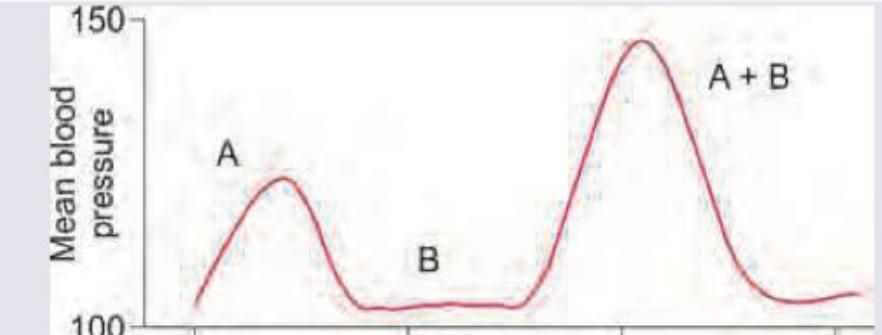
Which of the following combinations does not show synergistic action?
Which of the following are CYP3A inhibitors?
Which of the following reduces the efficacy of oral contraceptives?
Which of the following medications does not interact with warfarin?
A postoperative patient developed septicemia and was empirically started on combination chemotherapy by a new resident doctor. However, when the patient did not respond even after 10 days of antibiotic treatment, the review of the charts was done. It was found that the resident doctor had started the combination of antibiotics that was mutually antagonistic in action. Which of the following is the most likely combination that was given?
Which of the following combinations can result in severe toxicity due to inhibition of cytochrome P450 enzymes?
Which antiretroviral drug should be avoided in a known sputum-positive pulmonary tuberculosis patient who is currently on INH, rifampicin, pyrazinamide, and ethambutol, and has a CD4 count of 100 cells/dL and a viral load of more than 50,000 copies/mL, given that the patient is HIV-positive?
The antiepileptic drug that does not produce enzyme induction is:
Which of the following drugs should not be given with tyramine, as it may result in a dangerous reaction?
Which of the following statements is true regarding the use of combination therapy with anakinra and infliximab in patients with rheumatoid arthritis?
Explanation: ***Penicillin plus tetracycline*** - This combination is generally **antagonistic** or **indifferent**, not synergistic. Penicillin is a cell wall synthesis inhibitor that works best on actively growing bacteria, while tetracycline is a bacteriostatic protein synthesis inhibitor that can reduce bacterial growth, thereby diminishing penicillin's effect. - The combination is usually avoided as the **bacteriostatic action of tetracycline** can counteract the **bactericidal action of penicillin**, leading to reduced efficacy, especially in infections requiring rapid bacterial clearance. *Penicillin plus sulfonamide* - This combination can show synergism in some contexts, particularly as sulfonamides inhibit **folate synthesis**, while penicillin inhibits **cell wall synthesis**. - While not a classic synergistic pair for all infections, their mechanisms of action are distinct, and they can sometimes be used together, although specific synergistic effects are more limited compared to other pairs. *Streptomycin plus penicillin* - This is a classic example of **synergistic action**, particularly in conditions like **enterococcal endocarditis**. - Penicillin damages the bacterial cell wall, allowing **streptomycin** (an aminoglycoside) to more easily penetrate the cell and act on ribosomal targets, leading to enhanced bactericidal effect. *Rifampicin plus dapsone* - This combination is a cornerstone of **multi-drug therapy for leprosy**, demonstrating clear synergy against *Mycobacterium leprae*. - **Rifampicin** inhibits bacterial RNA synthesis, and **dapsone** inhibits folate synthesis, attacking different essential bacterial pathways which, when combined, are more effective and reduce the development of resistance.
Explanation: ***Both a and c (Ritonavir and Verapamil)*** - **Ritonavir** is a **potent CYP3A4 inhibitor**, one of the strongest known, commonly used as a pharmacokinetic booster for other protease inhibitors to increase their bioavailability - **Verapamil** is a **calcium channel blocker** that acts as a **moderate CYP3A4 inhibitor**, leading to clinically significant drug interactions requiring dose adjustments - Both drugs have **clinically relevant and well-established** CYP3A4 inhibitory effects *Ritonavir alone* - While correct that Ritonavir is a potent CYP3A4 inhibitor, this option is incomplete as it excludes Verapamil - Ritonavir's inhibitory effect is so strong that it can increase plasma concentrations of co-administered CYP3A4 substrates by several-fold *Amiodarone* - Amiodarone is primarily a **potent inhibitor of CYP2C9, CYP2D6, and P-glycoprotein** - While it does have **weak to moderate CYP3A4 inhibitory activity**, this effect is **less clinically significant** compared to its effects on other CYP enzymes - In the context of clinically important CYP3A4 inhibitors, Ritonavir and Verapamil are more relevant examples *Verapamil alone* - While correct that Verapamil is a CYP3A4 inhibitor, this option is incomplete as it excludes Ritonavir - Verapamil can increase plasma concentrations of drugs like simvastatin, cyclosporine, and other CYP3A4 substrates
Explanation: ***Griseofulvin*** - **Griseofulvin** is an antifungal agent known to induce liver enzymes, specifically the **cytochrome P450 system**. - Enzyme induction accelerates the metabolism and clearance of **oral contraceptives**, leading to lower plasma concentrations and reduced efficacy. *Erythromycin* - **Erythromycin** is a macrolide antibiotic that typically inhibits liver enzymes rather than inducing them. - While it can interfere with the metabolism of some drugs, it usually **increases** rather than decreases the plasma levels of co-administered medications, and is not known to reduce oral contraceptive efficacy. *Disulfiram* - **Disulfiram** is used to treat chronic alcoholism and inhibits aldehyde dehydrogenase. - It does not significantly interact with the metabolism of **oral contraceptives** via the cytochrome P450 system or other mechanisms that would reduce their efficacy. *Cimetidine* - **Cimetidine** is an H2 receptor antagonist that is known to inhibit cytochrome P450 enzymes. - This inhibition would likely **increase** the plasma concentration of drugs metabolized by these enzymes, such as oral contraceptives, rather than reducing their efficacy.
Explanation: ***Benzodiazepines*** - **Benzodiazepines** are generally considered safe to use with warfarin as they are extensively metabolized in the liver, but they do not typically alter the **cytochrome P450 enzymes** responsible for warfarin metabolism. - They also do not interfere with **vitamin K recycling** or **platelet function**, which are key mechanisms through which other drugs interact with warfarin. *Barbiturate* - **Barbiturates** are **potent inducers of hepatic enzymes**, particularly CYP2C9, which is responsible for metabolizing warfarin. - This enzyme induction leads to **increased warfarin metabolism**, reducing its anticoagulant effect and necessitating higher warfarin doses. *Oral contraceptive* - **Oral contraceptives** can **reduce the anticoagulant effect of warfarin** by inducing clotting factors or inhibiting warfarin metabolism. - This interaction can increase the risk of **thromboembolic events** in patients on warfarin. *Cephalosporins* - Certain **cephalosporins**, especially those with a **methylthiotetrazole (MTT) side chain** (e.g., Cefamandole, Cefoperazone, Moxalactam), can **inhibit vitamin K epoxide reductase**. - This inhibition leads to a **decrease in vitamin K-dependent clotting factors**, thus potentiating the anticoagulant effect of warfarin and increasing bleeding risk.
Explanation: ***Ampicillin and Chloramphenicol*** - **Ampicillin** is a **bactericidal** antibiotic that inhibits cell wall synthesis, while **chloramphenicol** is **bacteriostatic** and inhibits protein synthesis. - When combined, the bacteriostatic action of chloramphenicol can antagonize the antimicrobial effect of ampicillin, particularly in infections where rapid bacterial killing is crucial. *Vancomycin and Amikacin* - **Vancomycin** is **bactericidal** (cell wall synthesis inhibitor), and **amikacin** is also **bactericidal** (aminoglycoside, protein synthesis inhibitor). - This combination is generally considered synergistic or additive, especially against gram-positive organisms and certain gram-negative bacteria, rather than antagonistic. *Cephalexin and Gentamicin* - Both **cephalexin** (a cephalosporin) and **gentamicin** (an aminoglycoside) are **bactericidal** antibiotics. - This combination can be synergistic, particularly against gram-negative bacteria, by targeting different bacterial processes (cell wall synthesis and protein synthesis, respectively). *Ciprofloxacin and Piperacillin* - **Ciprofloxacin** (a fluoroquinolone) and **piperacillin** (a penicillin) are both **bactericidal** antibiotics. - This combination is often used empirically to broaden coverage against a wide range of bacteria, exhibiting additive or synergistic effects, and is not typically antagonistic.
Explanation: ***Atorvastatin + Itraconazole*** - **Itraconazole** is a potent inhibitor of **CYP3A4**, the primary enzyme responsible for atorvastatin's metabolism. - Co-administration leads to significantly increased **atorvastatin plasma concentrations**, raising the risk of severe side effects like **rhabdomyolysis** and **hepatotoxicity**. *Amiodarone + Atorvastatin* - **Amiodarone** is a moderate **CYP3A4 inhibitor** and can increase atorvastatin levels, but the inhibition is **less potent** than itraconazole. - While this combination does carry a risk and requires dose adjustment, the interaction is **less severe** compared to the potent inhibition seen with itraconazole. - The direct CYP inhibition leading to severe atorvastatin toxicity is less pronounced than with itraconazole. *Carbamazepine + Atorvastatin* - **Carbamazepine** is a potent **CYP3A4 inducer**, meaning it would increase the metabolism of atorvastatin, potentially *decreasing* its efficacy rather than causing toxicity through inhibition. - This interaction would typically lead to subtherapeutic atorvastatin levels, rather than severe toxicity. *Phenytoin + Atorvastatin* - **Phenytoin** is also a potent **CYP3A4 inducer**, similar to carbamazepine. - Concurrent use would likely lead to enhanced metabolism and **reduced efficacy of atorvastatin**, not increased toxicity due to enzyme inhibition.
Explanation: ***Ritonavir (Correct Answer)*** - **Ritonavir** is the most critical drug to avoid due to severe drug-drug interactions with **rifampicin** - **Rifampicin** is a potent CYP3A4 inducer that dramatically reduces ritonavir plasma concentrations by 75-90%, rendering it completely ineffective - Ritonavir is commonly used as a pharmacokinetic booster for other protease inhibitors, making this interaction particularly significant - **Contraindicated** with rifampicin-based TB regimens *Indinavir* - Also a protease inhibitor metabolized via CYP3A4 - Should also be **avoided with rifampicin** as levels are reduced by approximately 90% - However, indinavir is rarely used in modern ART regimens due to high pill burden, need for dietary restrictions, and significant side effects (nephrolithiasis) - Less commonly used than ritonavir, making ritonavir the better answer *Lamivudine* - Nucleoside reverse transcriptase inhibitor (NRTI) with **renal elimination** - Not metabolized by CYP450 enzymes - **No significant interactions** with rifampicin or other anti-TB drugs - Safe and commonly used in TB/HIV co-infection *Efavirenz* - Non-nucleoside reverse transcriptase inhibitor (NNRTI) that **can be safely co-administered** with rifampicin - Standard dose (600 mg daily) is generally adequate, though some guidelines recommend considering 800 mg in patients >60 kg - **Preferred NNRTI** for TB/HIV co-infection according to WHO guidelines - Well-studied and effective combination with rifampicin-based TB therapy
Explanation: **Sodium valproate** - Unlike many other antiepileptic drugs, **sodium valproate is primarily an enzyme inhibitor**, not an enzyme inducer. - It inhibits CYP450 enzymes (particularly CYP2C9) and UGT enzymes, which can **increase levels of co-administered drugs**. - This characteristic makes it important to monitor for potential drug interactions when used with other medications. *Phenobarbitone* - **Phenobarbitone is a potent CYP450 enzyme inducer**, particularly of CYP3A4, CYP2C9, and CYP2C19. - This induction leads to increased metabolism and reduced efficacy of co-administered drugs. *Phenytoin sodium* - **Phenytoin is a well-known CYP450 enzyme inducer**, especially of CYP3A4 and CYP2C9. - Its enzyme-inducing properties necessitate careful monitoring of other medications taken concurrently. *Carbamazepine* - **Carbamazepine is a strong autoinducer** of its own metabolism, as well as an inducer of other CYP450 enzymes. - This enzyme induction leads to a need for dose adjustments over time and significant drug interactions.
Explanation: ***Tranylcypromine*** - As an **irreversible, non-selective monoamine oxidase inhibitor (MAOI)**, tranylcypromine prevents the breakdown of monoamines, including tyramine. - Ingesting **tyramine-rich foods** while on tranylcypromine can lead to a **hypertensive crisis** due to excessive norepinephrine release. - This is the classic drug-food interaction that requires strict dietary restrictions. *Selegiline* - At **therapeutic doses**, selegiline is a **selective MAO-B inhibitor**, which primarily breaks down dopamine in the brain. - At therapeutic doses, it has **minimal interaction with tyramine** since MAO-A (which metabolizes tyramine in the gut) remains functional. - This selectivity is lost only at higher doses, but at standard dosing, dietary tyramine restrictions are not required. *Dextromethorphan* - This is an **antitussive** (cough suppressant) that acts on the **NMDA receptor** and has weak opioid effects. - It does not interact with tyramine directly, though it can interact with **MAOIs** to cause **serotonin syndrome**. *Meperidine* - This is an **opioid analgesic** that acts on opioid receptors. - While it can interact with **MAOIs** to cause potentially fatal reactions (e.g., **serotonin syndrome** or **hyperpyrexic crisis**), it does not directly interact with dietary tyramine.
Explanation: **Combination therapy is not recommended due to the risk of serious infections.** - The concurrent use of **anakinra** (an IL-1 receptor antagonist) and **infliximab** (a TNF-alpha inhibitor) has been shown to significantly increase the risk of serious infections, particularly **opportunistic infections**, without a demonstrable increase in efficacy. - This combination is therefore discouraged in clinical practice due to an unfavorable risk-benefit profile, as validated by clinical trials that observed higher rates of adverse events. *Combination therapy is more effective than methotrexate plus etanercept.* - This statement is incorrect because combination therapy with anakinra and infliximab has not shown superior efficacy to the established and effective combination of **methotrexate and etanercept** (a TNF-alpha inhibitor), especially considering the heightened risk of adverse events. - Studies have demonstrated that combining two biologic agents with different mechanisms of action (IL-1 blockade and TNF-alpha blockade) does not consistently lead to improved outcomes compared to single biologic therapy with methotrexate, and the toxicity often outweighs any potential benefit. *Combination therapy is more effective than methotrexate alone.* - While adding a biologic agent to methotrexate is generally more effective than methotrexate monotherapy for **rheumatoid arthritis**, the specific combination of anakinra and infliximab has fallen out of favor due to the elevated risk of infections. - Other, safer biologic combinations or single biologic agents with methotrexate have proven efficacy over methotrexate alone without the significant safety concerns associated with anakinra and infliximab co-administration. *Combination therapy has similar effectiveness to oral triple therapy.* - Oral triple therapy (typically methotrexate, sulfasalazine, and hydroxychloroquine) is a common and effective initial treatment strategy for rheumatoid arthritis in many patients. - The combination of anakinra and infliximab has not been shown to have similar effectiveness to oral triple therapy, particularly when considering its safety profile; it carries a higher risk of side effects, especially infections, without a clear demonstration of superior efficacy over oral triple therapy or other biologic combinations.
Mechanisms of Drug Interactions
Practice Questions
Pharmacokinetic Interactions
Practice Questions
Pharmacodynamic Interactions
Practice Questions
Drug-Food Interactions
Practice Questions
Drug-Disease Interactions
Practice Questions
Clinically Significant Drug Interactions
Practice Questions
Computer Systems for Detecting Drug Interactions
Practice Questions
Management of Drug Interactions
Practice Questions
Drug Interactions in Special Populations
Practice Questions
Role of P-glycoprotein in Drug Interactions
Practice Questions
Get full access to all questions, explanations, and performance tracking.
Start For Free